
KernelDAO is building a yield-bearing stablecoin backed not by T-bills or crypto collateral, but by the $10 trillion engine of global trade itself.
Most stablecoins are boring by design.
You hold USDT or USDC, and that’s it. Your capital sits still. Tether earns the yield. You don’t. The irony of the stablecoin market, now over $315 billion, is that it represents the largest pool of idle capital in crypto. Hundreds of billions of digital dollars, moving at internet speed, earning nothing.
The first wave of fixes came from two directions. Ethena built a synthetic dollar that captures crypto funding rates. Ondo wrapped T-bills onchain. Both are clever. But both inherit the same problem: their yield lives and dies with the macro cycle. Ethena’s sUSDe paid 19% in the 2024 bull run. Today? Around 3.6%. T-bill yields move with the Fed.
What if stablecoin yield came from something more durable, like the fact that businesses never stop trading?
That’s the KUSD thesis.
What Is KUSD?
KUSD is a yield-bearing stablecoin built by KernelDAO, the restaking protocol behind Kelp (Ethereum LRT) and Kernel (BNB Chain restaking). Its yield doesn’t come from crypto speculation or government debt. It comes from short-term commercial receivables, the invoices, merchant payouts, remittance flows, and trade settlements that move through the global economy every single day.
The staking derivative, sKUSD, targets approximately 10% APR, sourced from real borrower repayments, not from funding rate arbitrage or interest rate sensitivity.
KernelDAO calls this model commerce-backed. And the infrastructure layer powering it is called Kred, positioned as the “Internet of Credit.”
The Problem It’s Solving
Here’s a number worth sitting with: $5 trillion.
That’s the estimated volume of idle capital locked inside pre-funded payment accounts across global financial institutions. Payment service providers, remittance operators, and trade finance desks are required to park liquidity in correspondent accounts across dozens of corridors, just to guarantee settlement timing when transactions arrive. That capital earns near-zero return.
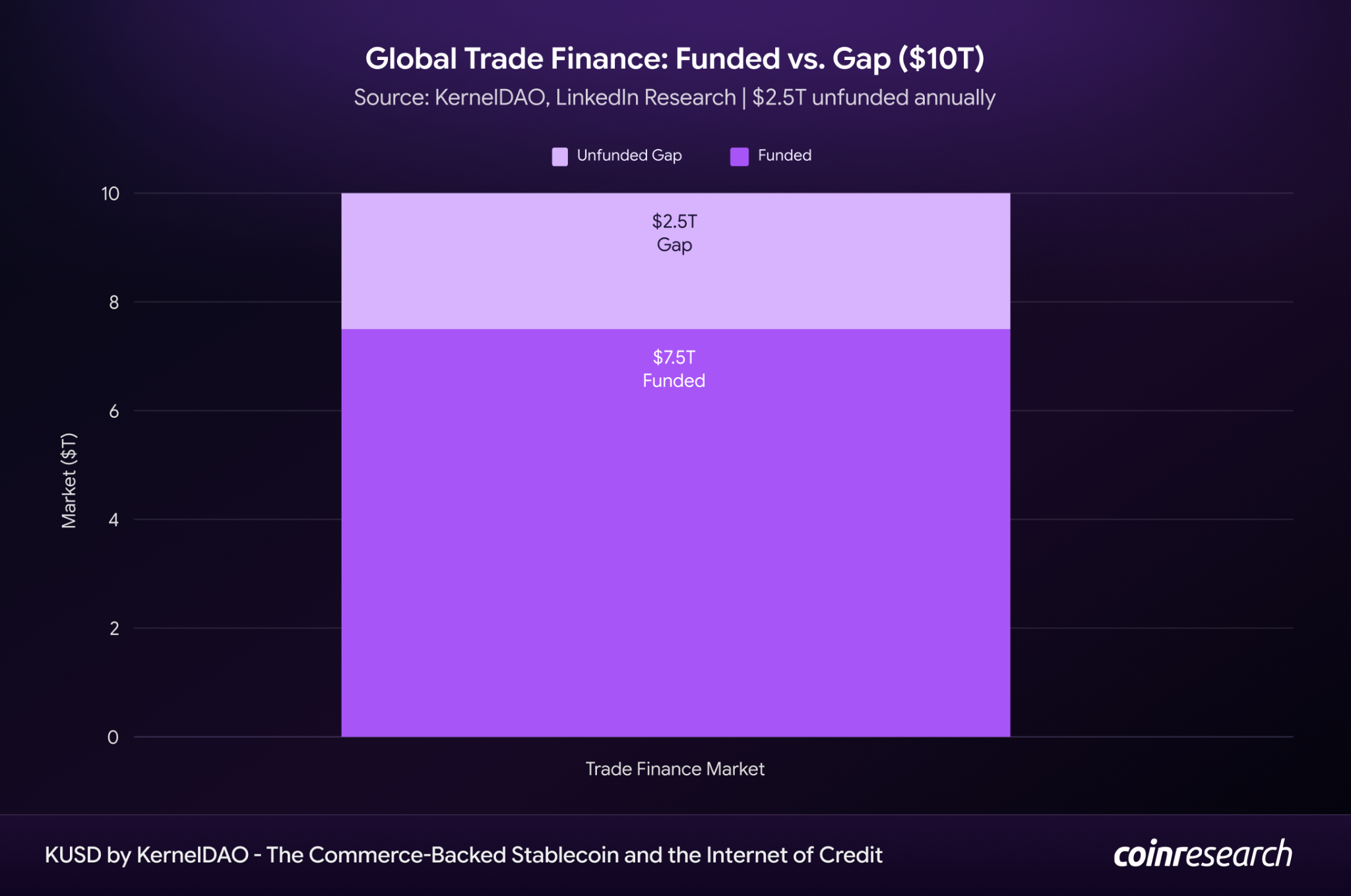
Meanwhile, there’s a $2.5 trillion annual gap in global trade finance, legitimate, creditworthy businesses that can’t access short-term credit from traditional banks because the ticket sizes are too small, the corridors too niche, or the compliance overhead too high.
Two massive pools of capital inefficiency. One protocol trying to bridge them.
How It Works
The KUSD mechanism is clean:
-
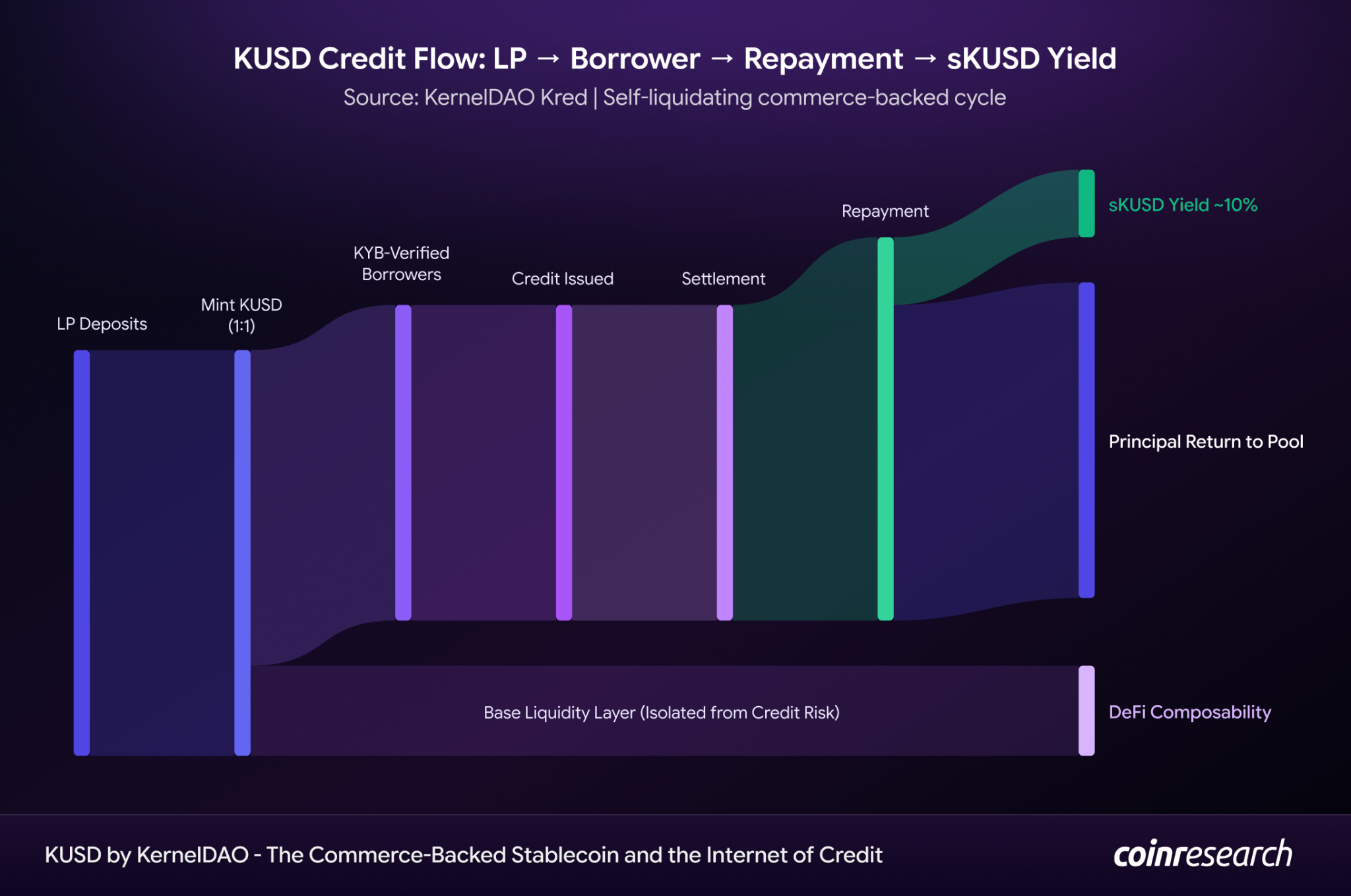
LPs deposit stablecoins → receive KUSD (1:1 USD peg)
-
KYB-verified institutional borrowers, PSPs, remittance operators, trade finance companies, draw credit against verified commercial receivables
-
Repayment is embedded in the settlement cycle, when the invoice clears, the card network settles, or the payout rail finalizes, repayment happens automatically
-
sKUSD holders receive the interest from those repayments as continuous yield
The critical insight: repayment isn’t discretionary. It’s structurally embedded in the underlying commerce event. When the business transaction resolves, so does the credit. That’s what makes this “self-liquidating”, and what makes it different from every other on-chain lending model.
The KernelDAO Stack
KUSD doesn’t exist in isolation. It sits atop a $1.9 billion TVL ecosystem that KernelDAO has built across four products:
-
Kernel, BNB Chain restaking, securing 26+ DVNs
-
Kelp, Ethereum liquid restaking, 2nd largest LRT on ETH
-
Gain, 1-click yield vaults targeting 12–20% APR
-
Kred, The Internet of Credit, launching Q2 2026 with KUSD as its flagship
This isn’t a one-product protocol attempting to enter a crowded market cold. KUSD launches with 350,000+ existing users and over 150 DeFi integrations already in the ecosystem. That’s a meaningful distribution advantage.
How Does It Compare?
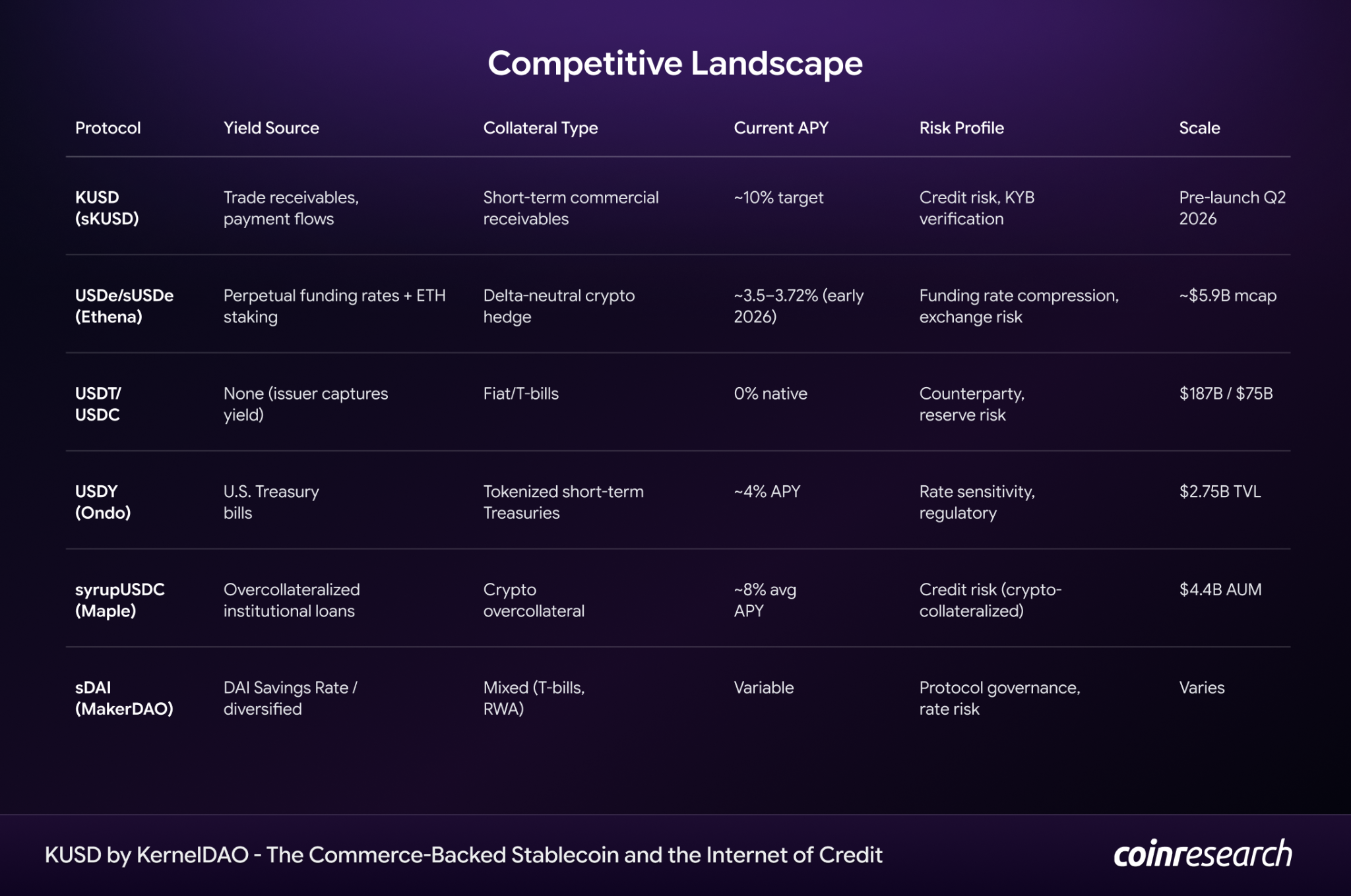
The yield-bearing stablecoin market is getting competitive. Here’s where KUSD sits:
-
vs. Ethena (sUSDe): Ethena is pro-cyclical, yields compress hard in bear markets. KUSD’s commerce yield exists in all market conditions.
-
vs. Ondo (USDY): T-bill yield is Fed-dependent and capped around 4%. KUSD targets 10% from credit spreads.
-
vs. Maple (syrupUSDC): Maple lends to crypto-native institutions against crypto overcollateral. KUSD lends to traditional businesses against real receivables, different risk profile, different borrower universe.
-
vs. USDT/USDC: Zero base yield. The issuer keeps everything.
The Risks Are Real
This model doesn’t work without institutional trust infrastructure. Three risks stand out:
-
Credit risk. Receivables-backed lending depends on borrowers actually repaying. Short duration (1–90 days) and KYB verification help, but there’s no live track record yet, KUSD is pre-launch.
-
The GENIUS Act. US stablecoin legislation signed in 2025 prohibits yield-paying stablecoins. Whether sKUSD’s staking mechanism falls inside or outside that definition is an unresolved legal question. This is the biggest near-term regulatory wildcard.
-
Execution. KernelDAO raised $9 million. Building institutional credit rails at scale, underwriting, KYB, corridor management, requires more than a DeFi-native team typically deploys. The Q2 2026 launch is the first real test.
The KERNEL Token Disconnect
One number that stands out: KernelDAO generates an estimated $38.6 million in annualized protocol fees across its four products. Its market cap is ~$25 million.
KERNEL token holders currently receive $0 in distributed revenue. No buybacks, no staking yield, pending governance activation.
That gap is either the most obvious asymmetric bet in DeFi right now, or a governance failure waiting to continue. Probably worth watching closely as KUSD approaches launch.
The Bottom Line
KUSD is making a bet that the most durable yield in crypto isn’t synthetic, isn’t sovereign, and isn’t overcollateralized, it’s the yield that exists because global commerce never stops.
If that thesis holds at scale, it doesn’t just create a new stablecoin. It creates a new primitive: one that makes DeFi yield resilient across market cycles for the first time.
The Q2 2026 launch will tell us a lot.
This article is a preview of our full flagship Intelligence Report on KUSD by KernelDAO.
Read the complete deep-dive, including full mechanism breakdown, competitive matrix, risk analysis, scenario modeling, and investment view, on
Coinresearch delivers institutional-grade crypto research for investors who want signal, not noise.
Disclaimer: This article is for informational purposes only and does not constitute financial or investment advice. CoinResearch analysts may hold positions in assets discussed. Cryptocurrency investments are highly volatile and speculative. Always conduct your own due diligence before making any investment decisions.