
A Bitcoin fork hit a $1.65 all-time high in 32 days by turning AI matrix math into mining. We break down whether “useful work” is a breakthrough or a subsidy in disguise.
Bitcoin’s biggest criticism is also its whole security model.
It burns a mid-sized country’s worth of electricity to compute hashes that are, by design, useful for nothing. The energy isn’t wasted in the security sense — it is the security. But it produces no second output. A terawatt-hour of SHA-256 leaves behind exactly zero tokens of AI inference.
Now sit that next to the defining anxiety of 2026: AI is on track to dominate global electricity consumption, and power — not chips, not data — has become the binding constraint on how far models can scale.
Pearl Network’s founding question is the collision of those two facts. If proof-of-work needs to burn energy to be secure, and AI is going to burn the world’s energy anyway, why run them as two separate bills? Why not make the computation that secures a blockchain be the same computation that trains and serves a model?
On April 27, 2026, Pearl Research Labs shipped an answer to mainnet. The pitch fits on one line: the Bitcoin of the AI compute era.
What Pearl actually is
Strip the framing and Pearl is a Bitcoin fork — UTXO accounting, fixed supply, proof-of-work — with the hash function swapped for something that does real work.
The supply is 2.1 billion PRL, exactly 100x Bitcoin’s 21 million. Blocks come every 194 seconds instead of ten minutes. And instead of discrete halvings every four years, emission follows a smooth polynomial curve that releases roughly half of all supply in the first four years and then tapers without cliffs.
The launch narrative leans hard on one claim: a fair launch. No pre-mine, no founder allocation, no insider block. Every PRL mined from block zero on the open network. For a proof-of-work asset, that’s the most valuable thing you can say. Hold that thought.
How you mine with matrix math
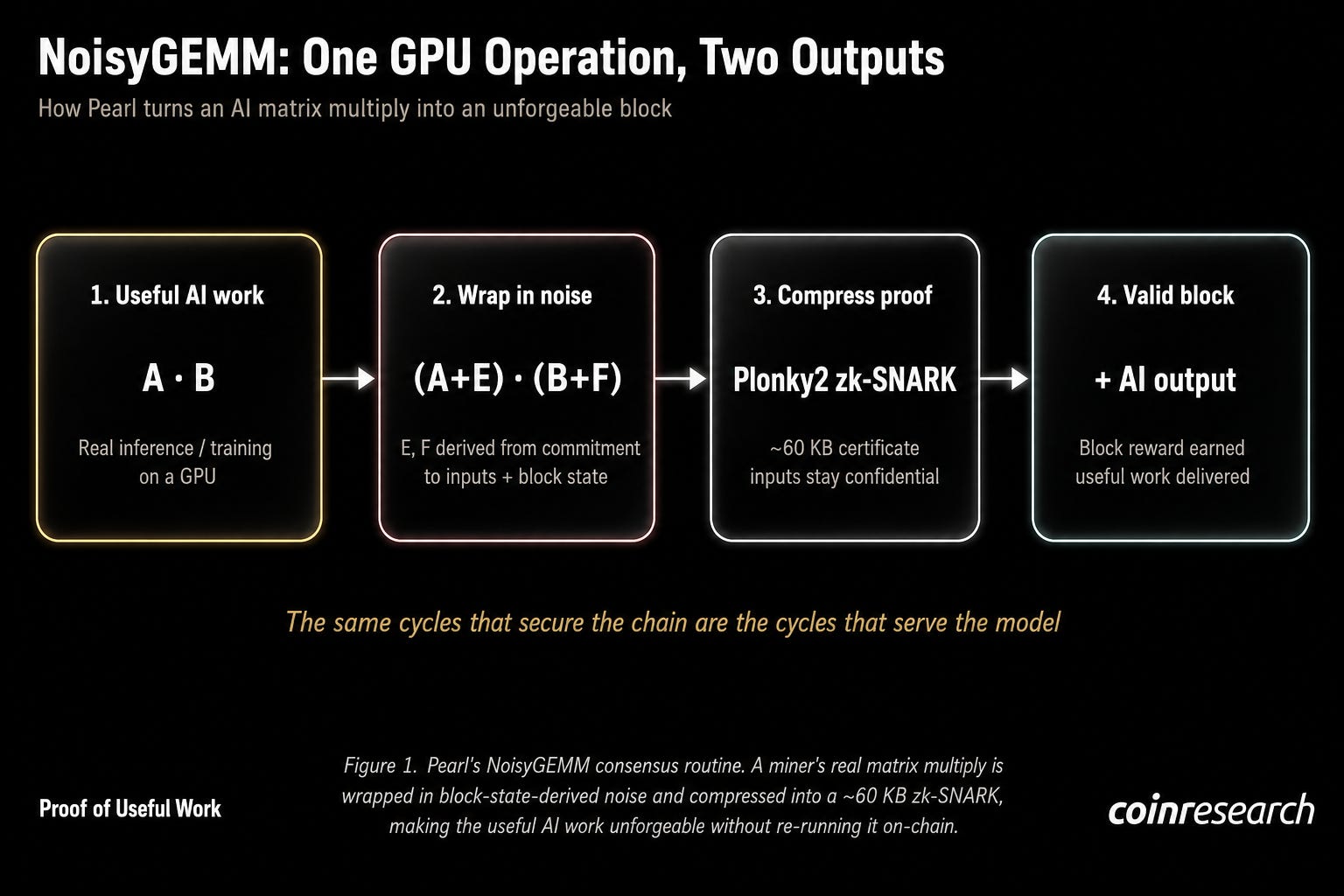
The engine is a routine called NoisyGEMM, and it answers the obvious objection: if mining is just matrix multiplication, what stops a miner from faking the result?
Here’s the mechanism in three steps:
1. Do the useful work. A miner runs a legitimate matrix multiply, A · B — real AI inference or training on a GPU.
2. Wrap it in noise. Pearl computes (A+E)·(B+F), where the noise matrices E and F are derived from a commitment to the inputs and the current block state. The miner can’t know them in advance, so the work can’t be pre-computed.
3. Compress the proof. A Plonky2 zero-knowledge SNARK shrinks the proof that the noised multiply was done correctly into a ~60 KB certificate. Nodes verify the certificate, not the computation — and the inputs stay confidential.
The elegant part falls out for free: ASIC-resistance by design. A chip built to compute NoisyGEMM faster than a GPU is, by definition, just a better AI accelerator. There is no “Pearl ASIC” that isn’t also useful for the exact workload the network exists to serve.
Pearl’s benchmarks claim the certified path is nearly free: a Pearl-certified Llama 3.3 70B hit 18,291 tokens/second against a 15,270 baseline, holding accuracy flat. Stated overhead for the whole wrapper: about 10%.
The token is a leveraged bet on compute
Everything reduces to one equilibrium: in steady state, the cost of mining must roughly equal the reward, or miners enter and exit until it does. Pearl writes it as τ · G(t) · D(t) = p(t) · e(t) — overhead times compute cost times difficulty equals price times emission.
Plug in the reference numbers (GPU cost ~$1.70/H100-hour, 10% overhead) and you get a token whose value tracks the growth of global compute, with a slight kicker from the shrinking emission schedule. In one sentence: PRL is a leveraged long on the total addressable market of AI compute.
The whitepaper is honest about the catch. PRL is a store-of-value token whose worth “depends on future adoption expectations… Without this assumption, the value of the token and the amount of mining should clearly be zero.” The equilibrium explains how price moves given demand. It says nothing about why the demand exists.
The first real proof: Together AI
Eighteen days after mainnet, Pearl got the thing every infrastructure project needs and few get this early — a customer who isn’t a believer, just a buyer.
On May 15, Together AI launched a production endpoint for Gemma-4-31B-it-pearl, priced more than 25% below its standard rate. The mechanism is the entire point: Together can charge less because PRL emissions earned during inference offset part of the compute cost. The miner reward subsidizes the customer’s bill.
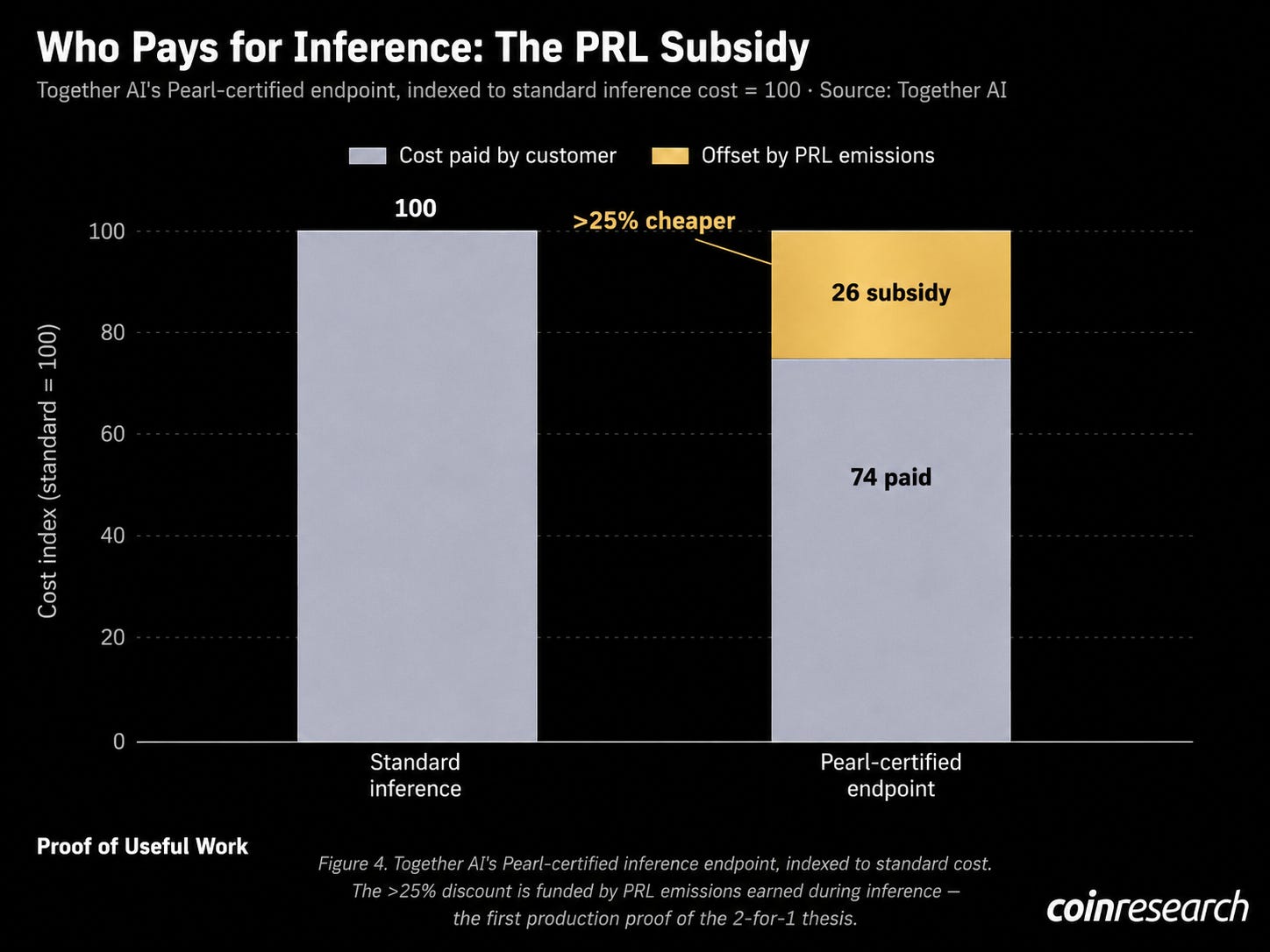
That’s the “2-for-1” thesis leaving the whitepaper and showing up on a pricing page. The caveat keeps it honest: it’s one partnership, and the discount is itself Together’s bet on the future value of the PRL it accumulates. The second and third partners are the difference between a category and a curiosity.
The mining rush already turned into a squeeze
The market noticed in late May the way crypto always notices a new way to print money: with GPUs. PRL ran to an all-time high near $1.65 on May 29, and “mine a hot new coin with your gaming GPU” pulled a wave of retail miners onto the network.
Then the math did exactly what it was built to do.
Network difficulty adjusts up fast as compute floods in. Estimated daily revenue for an RTX 5090 roughly halved to $17.19 within weeks. Every new miner made every existing miner’s PRL worth less. This isn’t a bug — it’s the equilibrium working. Pearl’s design guarantees early mining profits are transient, because the system is built to arbitrage them away. What’s left when the rush ends — steady-state operators running real AI workloads who treat PRL as a bonus on compute they were buying anyway — is the network Pearl actually wants. Whether enough of them exist is unproven.
The fair-launch question that doesn’t quite reconcile
Remember the fair-launch claim? Here’s the wrinkle. Pearl is widely reported as backed by a16z crypto, Dragonfly, VanEck, USV, and Delphi — some of the biggest crypto VCs alive.
Both can be true. A fair token launch (no pre-mined coins handed to investors) is fully compatible with VCs funding the lab — salaries, equity, R&D — without receiving a PRL allocation. That’s a legitimate structure.
But the distinction does a lot of quiet work, and most readers won’t parse it. “No VC” and “backed by a16z and VanEck” land as a contradiction even when they aren’t one — and that ambiguity erodes the exact asset the fair-launch claim was meant to build: credible neutrality. Until Pearl states the cap-table structure plainly, “fair launch” belongs in the plausible but unverified column.
The Bottom Line
Pearl is the most intellectually serious attempt yet to make proof-of-work do something useful — launched with real validation, a credible technical team, and an economic flaw it states out loud. The technology works. The first customer is real. But the token’s value rests on a reflexive belief loop, mining margins are already compressing by design, and adoption beyond a single partner is still hypothetical. Pearl is a bet on whether useful and valuable turn out to be the same word.
This article is a preview of our full flagship Intelligence Report on Pearl Network.
Read the complete deep-dive — including the full emission-curve and tokenomics breakdown, the three probability-weighted 12-month scenarios with specific triggers, the complete competitive map against the DePIN compute sector, and our split actionable guidance for new vs. existing investors — on
Coinresearch delivers institutional-grade crypto research for investors who want signal, not noise.
*Disclaimer: This article is for informational purposes only and does not constitute financial or investment advice. CoinResearch analysts may hold positions in assets discussed. Cryptocurrency investments are highly volatile and speculative. Always conduct your own due diligence before making any investment decisions.*