
The Shift from Emerging Asset Class to Core Portfolio Consideration

Everyone in crypto has the same question right now:
“Are digital assets still just speculative chips, or have they actually become financial infrastructure for institutions?”
In 2021, the honest answer was: speculation with a side of hopium.
In 2026, the data is very different.
-
Bitcoin spot ETFs have pulled in $21.8B+ net inflows in 2025 alone.
-
Stablecoins have hit $310B market cap and processed $60.9T in transaction volume in 2025 — 2.2x Visa+Mastercard combined.
-
Tokenized real‑world assets (RWAs) have gone from niche experiment to $30–33B in value locked, led by treasuries and private credit.
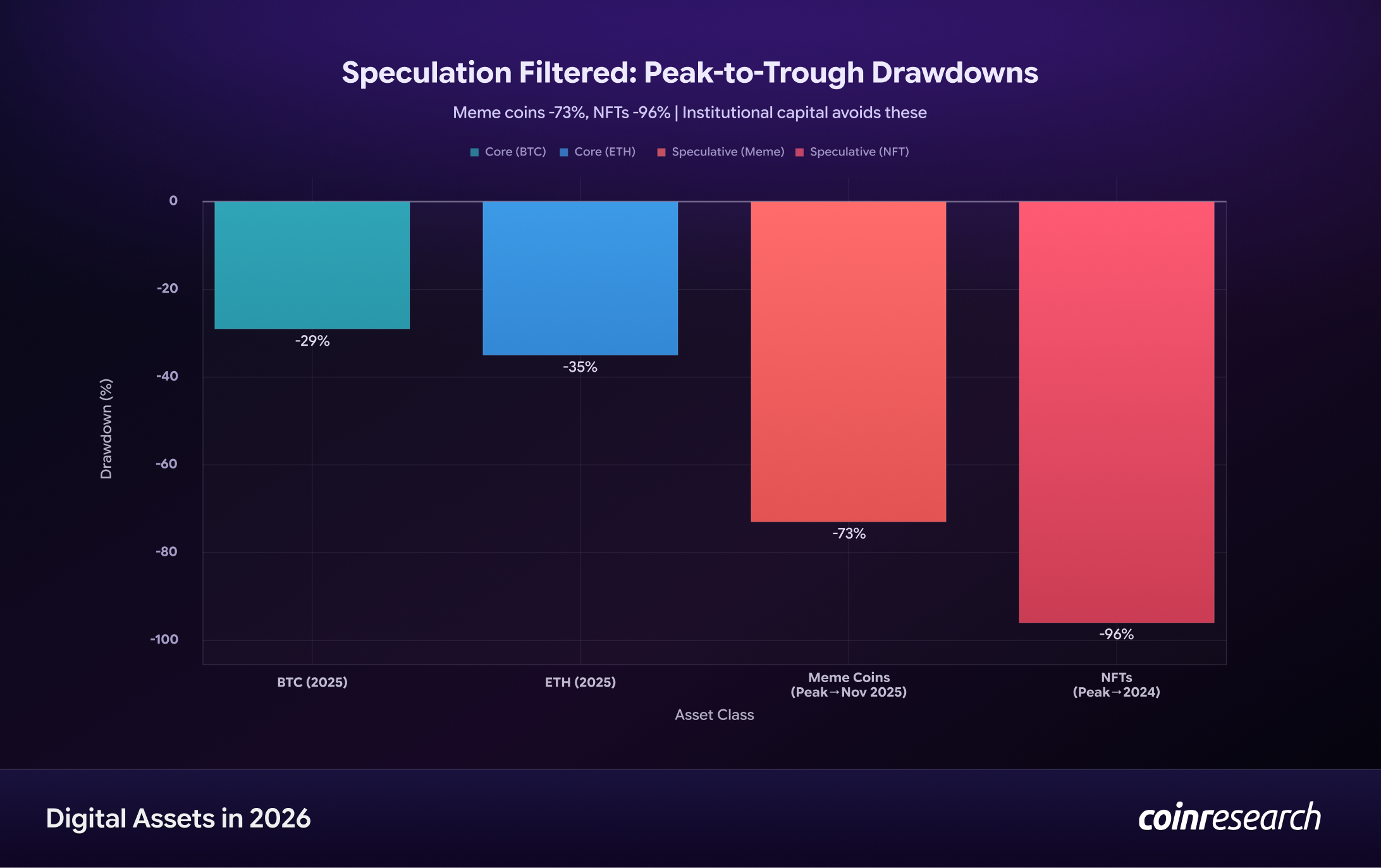
But derivatives still account for ~74% of all trading volume, memecoins nuked –73% from peak, and 96% of NFT collections are effectively dead.
So where does that leave us?
This is the “lite” version of our latest CoinResearch deep dive:
Digital Assets in 2026: A Reality Check — From Speculation to Settlement Layer.
You can read the full 50‑page institutional report (with all charts and data) at the end.
The One‑Sentence Answer
Digital assets in 2026 are no longer just a casino — but only a small core of the market has truly crossed into “institutional financial instrument” territory. Bitcoin, USD stablecoins (USDT, USDC), and tokenized treasuries + private credit now behave like infrastructure that institutions can hold, use, and settle with. The rest of the market is still a speculative frontier that rises and falls with the liquidity cycle.
What Actually Changed Since 2020–2022
If you zoom out, four things really matter.
1. ETFs turned Bitcoin into an allocatable product
Spot Bitcoin ETFs launched in early 2024 and did what ETFs always do: they made access boring, compliant, and scalable.
-
Crypto spot ETFs saw $31.8B in net inflows in 2025.
-
Bitcoin ETFs alone: $21.4B. Ethereum ETFs: $9.6B. Solana ETFs: $765M.
-
BlackRock’s IBIT has already taken in $24.7B by itself.
That’s not “crypto‑native degen flow.” That’s RIA, wealth, and institutional capital moving through wrappers they already understand.
2. Stablecoins quietly became a global settlement layer
If you want one chart that explains why crypto is still here, it’s this:
-
Stablecoins opened 2026 at $310B market cap.
-
They processed $60.9T in payment volume in 2025 — more than 2x Visa+Mastercard combined.
-
USDT + USDC control 83% of the market (58% + 25% respectively).
These aren’t just “trading chips” anymore. They are dollars with an API — moving value across exchanges, DeFi, OTC desks, fintech apps, and cross‑border rails that never touch SWIFT.
3. Tokenized RWAs gave DeFi a real yield anchor
The last cycle tried to manufacture yield out of thin air. This one is different.
-
Tokenized RWA value locked grew from $8.6B → $30–33B over 2025.
-
Treasuries: $8.2B, led by BlackRock’s BUIDL at $2.88B.
-
Private credit: $17B, with originators like Figure tokenizing multi‑billion HELOC books.
Instead of paying 20% APY in freshly minted governance tokens, protocols can now plug into US treasuries and real loan books.
4. Regulation and accounting finally got “good enough”
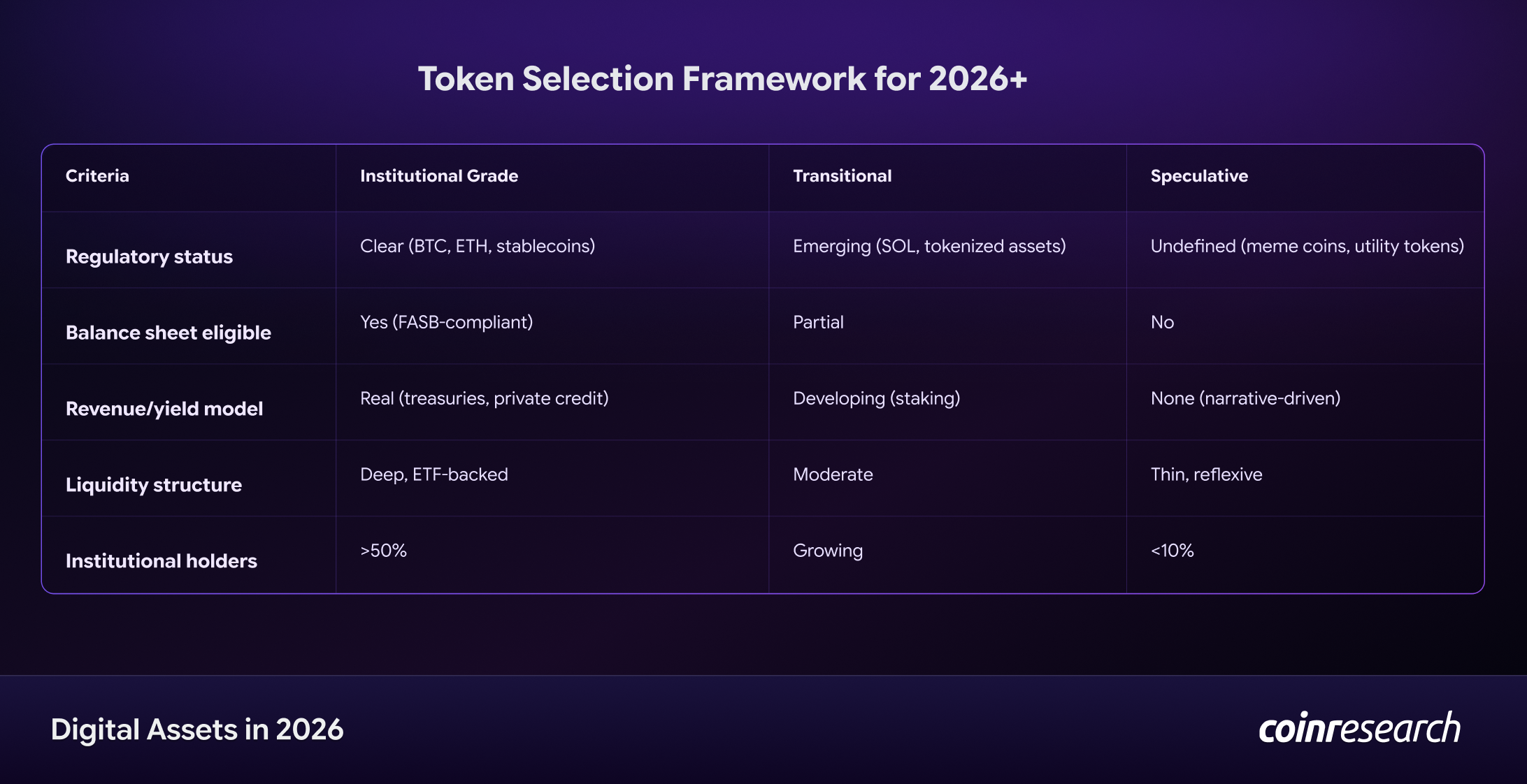
Institutions don’t move because of narratives. They move because:
-
There’s clear law, and
-
They know how to book it.
Two things unlocked that:
-
FASB ASU 2023‑08: crypto on US corporate balance sheets now gets fair value accounting instead of impairment‑only treatment. That’s huge for CFOs.
-
Stablecoin laws & MiCA: the US GENIUS Act and the EU’s MiCA regime provide formal treatment for payment stablecoins and crypto‑asset service providers.
This is not “we’ll see what the SEC thinks later.” It’s: here is the rulebook, here is how you comply, and here is the audit trail.
What Still Hasn’t Changed (And Probably Won’t Soon)
For all of the progress above, three structural problems remain.
1. Crypto is still a liquidity‑cycle asset
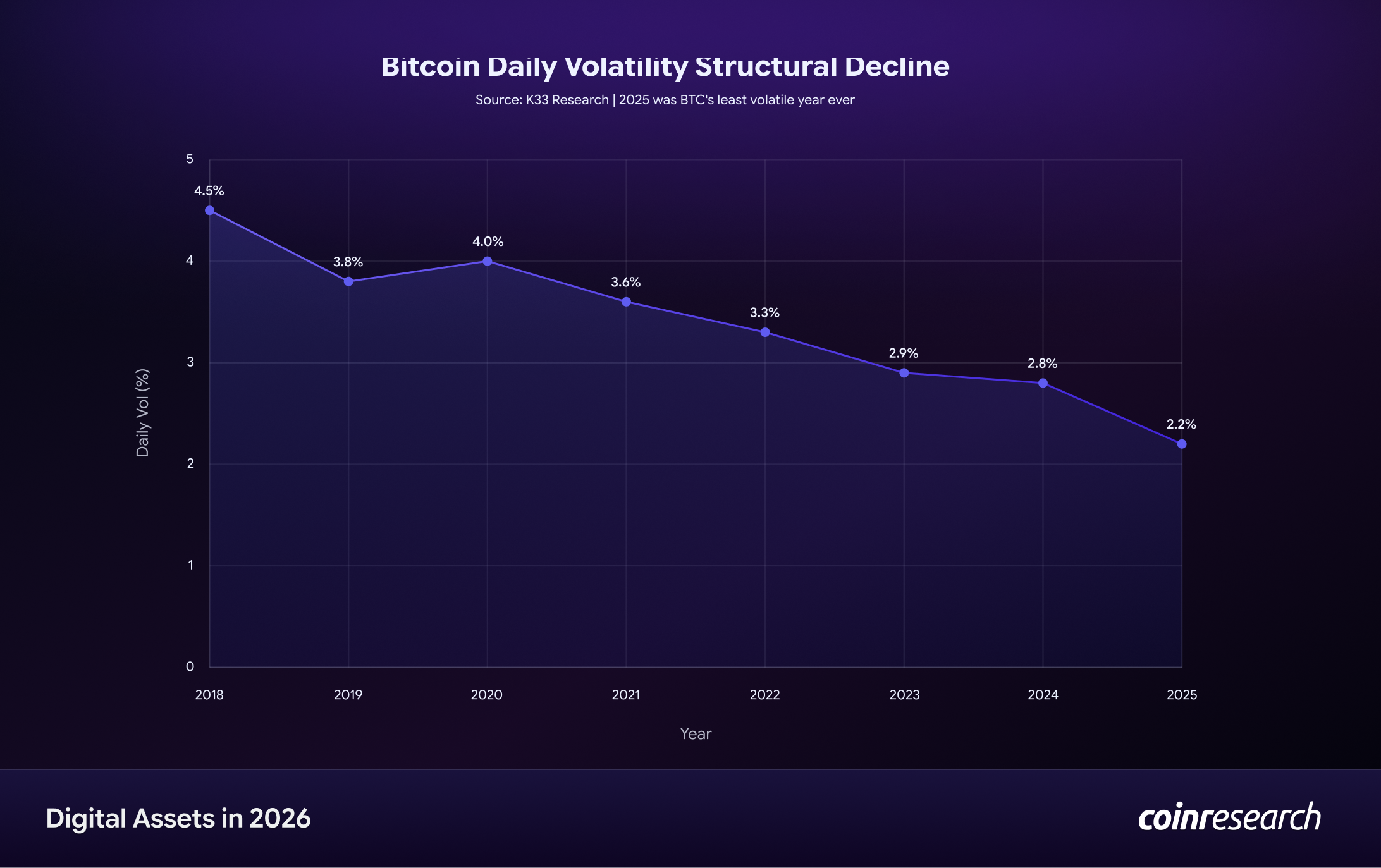
Bitcoin is less wild than it was — 2025 was actually its least volatile year on record, with daily volatility falling to ~2.24%. But structurally:
-
BTC’s correlation to the S&P 500 has jumped to ~0.75 in early 2026.
-
Its volatility is still 3–5x that of major equity indices.
Translation: Bitcoin behaves like a high‑beta macro trade, not a safe‑haven hedge.
2. Leverage still drives the market
The casino never disappeared. It just moved further out on the curve.
-
Derivatives make up ~74% of all crypto trading volume; spot is only ~26%.
-
Perpetual swaps alone are 78% of derivative volume.
This is a structurally levered market. When funding flips and liquidations start, price still moves first, narrative second.
3. The speculative junk got filtered out — by force
Institutions didn’t “reject” most of crypto. The market did.
-
Algorithmic stablecoins (like UST) wiped out $40–60B and are effectively dead as an institutional category.
-
NFTs: ~96% of collections are functionally dead — no volume, no floor, no community.
-
Memecoins: market cap collapsed –73% from ~$150.6B at peak to ~$38–47B by late 2025.
Big allocators just watched what survived:
-
BTC survived.
-
Stablecoins thrived.
-
RWAs emerged.
-
Most experiments did not.
So Where Are We? The Institutionalization Scorecard
In the full report, we score digital assets across five dimensions (0–10 each):
-
Regulatory Legitimacy
-
Balance Sheet Integration
-
Settlement Usage
-
Collateral Recognition
-
Market Structure Maturity
The 2026 score comes out to 32 / 50 — firmly in the “transitional phase”.
-
Settlement usage (stablecoins): 8/10. This is crypto’s first true institutional product.
-
Regulatory legitimacy: 7/10. US + EU are now investable; Asia is patchwork; rest is uneven.
-
Balance sheet integration: 6/10. BTC/ETH, maybe some stablecoins/RWAs. The rest is off‑limits.
-
Collateral recognition: 5/10. JPMorgan now takes BTC/ETH as collateral, but with conservative LTVs and narrow scope.
-
Market structure maturity: 6/10. Prime brokers, proper custody, better clearing — but still derivatives‑heavy and reflexive.
Verdict:
We’ve crossed the line for a small set of assets, not for “crypto” as a whole.
What This Means for Three Audiences
1. Retail Investors
-
Treat BTC as a macro‑sensitive digital commodity, not a magical hedge or savings account.
-
Ignore verticals with zero real revenue: most memecoins, most NFTs, narrative tokens with no cash flow.
-
Focus on infrastructure and rails: base layers, core infra, stablecoin and RWA ecosystems.
2. Institutional Allocators
-
Think 1–5% BTC as a high‑beta risk allocation, sized like a satellite sleeve — not a core defensive holding.
-
Use stablecoins as treasury and settlement rails where regulation allows: cross‑border flows, collateral mobility, intraday liquidity.
-
Access yield via tokenized treasuries and private credit, not via reflexive DeFi emissions.
3. Builders & Founders
-
Assume compliance‑first: MiCA, GENIUS‑style laws, and FATF guidance make “we’ll fix KYC later” a non‑starter.
-
Build with TradFi interoperability in mind: custody, reporting, treasury workflows, not just on‑chain UX.
-
Anchor yield in real‑world cash flows or durable protocol fees — not tokenomics gimmicks.
Want the Full Data, Charts, and Scorecard?
This post is the lite version.
The full CoinResearch report —
“Digital Assets in 2026: A Reality Check — From Speculation to Settlement Layer” — includes:
-
A 32/50 Institutionalization Scorecard with category breakdowns.
-
Full breakdown of Bitcoin ETF flows, long‑term holder behavior, and volatility trends.
-
Detailed analysis of stablecoin settlement vs Visa/Mastercard.
-
RWA deep dive: treasuries, private credit, and on‑chain money markets.
-
Regulatory review: GENIUS Act, MiCA, Asia (Singapore, HK, Japan).
-
Scenario analysis for 2026–2030: institutional consolidation vs regulatory reversal vs dual‑system fragmentation.
Read the full 50‑page research report on CoinResearch Platform