
Why a $10B restaking giant trades like a distressed token
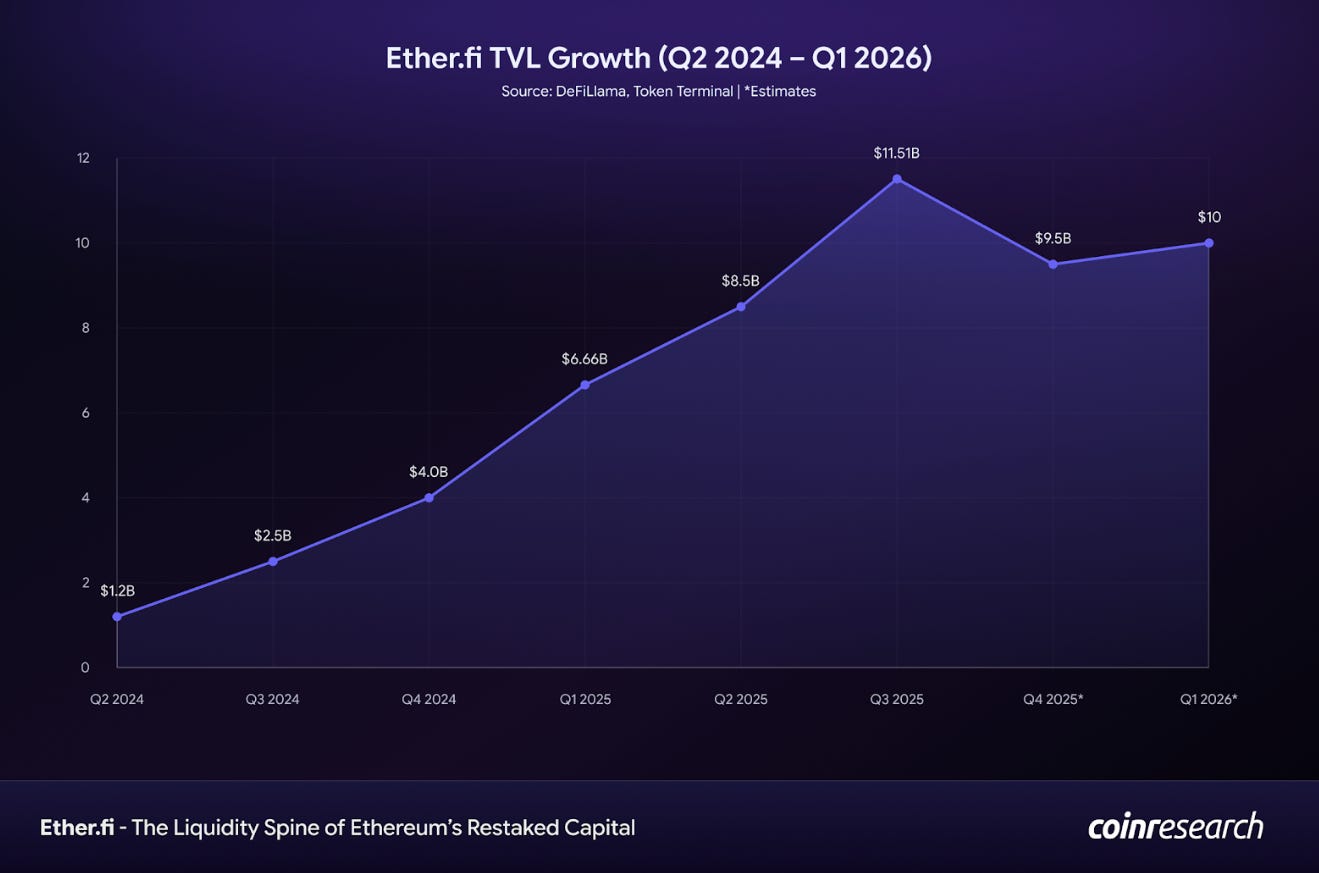
Restaking has gone from niche experiment to one of the most important structural trades in Ethereum. EigenLayer now secures tens of billions of dollars in assets, and liquid restaking tokens are increasingly used as core collateral across DeFi. At the center of this flow sits Ether.fi, currently the largest liquid restaking protocol with roughly $10 billion in TVL and integrations across Aave, Pendle, major L2s, and more.
The investor question is simple:
“Is Ether.fi just a conduit for restaking yield, or is ETHFI exposure to a durable piece of Ethereum’s financial infrastructure?”

What Ether.fi Actually Does
Ether.fi is a decentralized, non-custodial liquid restaking protocol on Ethereum. Users deposit ETH and receive eETH or its wrapped variant weETH, liquid tokens that compound Ethereum staking rewards plus EigenLayer restaking yield. Ether.fi handles the validator lifecycle and EigenLayer integrations, removing the 32 ETH minimum, illiquidity, and operational complexity of staking and restaking manually.
In practice, any amount of ETH can earn base staking yield plus a restaking premium while remaining usable across DeFi as collateral, LP capital, or strategy input. Architecturally, Ether.fi differentiates itself through non-custodial key management, Distributed Validator Technology integration via Obol Labs, and a growing multi-product stack rather than a single-token focus.
More Than an Liquid Restaking Token
Ether.fi now looks less like a token wrapper and more like a restaking-centric ecosystem.
-
Stake: Core eETH/weETH liquid restaking on Ethereum with about $10.2B TVL.
-
Liquid: Automated DeFi strategy vaults with roughly $1.3B.
-
Cash: A DeFi-native credit card and borrowing product on Scroll with around $175M in volume/TVL.
-
eBTC: A Bitcoin liquid restaking token connected to Babylon/Lombard, live across multiple chains.
-
eUSD: Stablecoin restaking built on Ethena’s USDe, launched in 2025.
Few competitors combine staking, automated vaults, consumer credit, and BTC/stablecoin extensions under one brand. That breadth gives Ether.fi multiple revenue levers if pure restaking yields compress.
Explosive Growth
Over the last 18 months, Ether.fi moved from roughly $1.2B in TVL in late 2024 to $11.5B by the end of Q3 2025, peaking near $13.9B before settling around the $10B level. At one point, growth exceeded 70% quarter over quarter.
Economically, the protocol generated approximately $228M in annualized fees and roughly $32M in protocol revenue as of Q3 2025, with Cash contributing nearly $10M annualized. Monthly active users approached 30,000, and Cash spend volume grew sharply quarter over quarter.
Where the Moat Comes From
Three structural advantages stand out.
Scale. At around $10B TVL, Ether.fi is nearly twice the size of the next liquid restaking competitor. That scale drives integrations. weETH is embedded across 50+ DeFi protocols and more than 15 chains.
Non-custodial design and validator diversity. With 250+ node operators and over 142,000 validators, Ether.fi is structurally more decentralized than many competitors, an important consideration for institutional allocators focused on governance and counterparty risk.
Product optionality. Liquid vaults, Cash, eBTC, and eUSD give Ether.fi growth paths beyond simple staking yield extraction.
The ETHFI Token Problem
The core tension is that protocol strength does not automatically translate into token performance.
ETHFI has a fixed 1 billion supply, with roughly 74% already circulating as of early 2026. The remaining supply unlocks through March 2027, creating ongoing dilution pressure. The current MC/FDV ratio around 0.42 reflects that overhang.
Value capture remains limited. Five percent of protocol revenue is used for ETHFI buybacks and distribution to stakers. At the current revenue run-rate, that represents roughly $1–2M annually, modest relative to the scale of fees generated. A $50M buyback authorization provides support below certain price levels, but it is finite.
In effect, ETHFI functions primarily as a governance and coordination token rather than a strong claim on cash flows.
Yet valuation looks inexpensive on headline metrics. MC/TVL sits near 0.05x, and P/Revenue is roughly 10–12x. Compared to peers, the market appears to be discounting uncertainty around token value capture rather than the underlying protocol quality.
Key Risks
Several risks must be underwritten.
-
EigenLayer dependency. Ether.fi’s restaking premium depends on the maturation of the AVS ecosystem. If slashing-backed economic demand fails to materialize, yields could compress toward standard staking levels.
-
Systemic restaking risk. Restaking introduces layered security exposure. A correlated failure across multiple AVSs could have cascading effects.
-
Liquidity and dilution. On-chain ETHFI liquidity remains thin relative to market cap, and roughly a quarter of supply still unlocks over the next year.
-
Incentive normalization. Past TVL growth was partially incentive-driven. With incentives reduced, the durability of the ~$10B base will be tested.
Framing the Opportunity
In the full report, we treat Ether.fi as a high-quality infrastructure bet with an evolving token design. We model bear, base, and bull scenarios through 2027–2028, tie market cap outcomes to TVL and revenue trajectories, and outline portfolio sizing in the 1–3% range for diversified crypto investors. Read the in-depth, institutional level research report in our platform:
The core thesis is conditional:
If liquid restaking becomes a permanent structural layer of Ethereum, and if governance meaningfully improves token value capture, ETHFI could be mispriced infrastructure exposure.
If yields compress and token economics remain static, it remains a strong protocol with a capped token.
Ether.fi deserves serious analytical attention. Whether it deserves capital depends on your conviction in the restaking cycle and your tolerance for token structure risk.
Disclaimer: This report is for informational purposes only and does not constitute financial advice. All data is sourced from publicly available information as of February 2026. Investors should conduct their own due diligence and consider their risk tolerance before making investment decisions. Crypto assets are highly volatile and may result in total loss of capital.