Bringing GPU financing, real-world yield, and on-chain stability into a single system
AI infrastructure is expanding faster than Moore’s Law, driving up costs for compute, data centers, and robotics that traditional finance can’t fully support. At the same time, DeFi sits on billions in idle liquidity, often tied to synthetic or speculative yields.
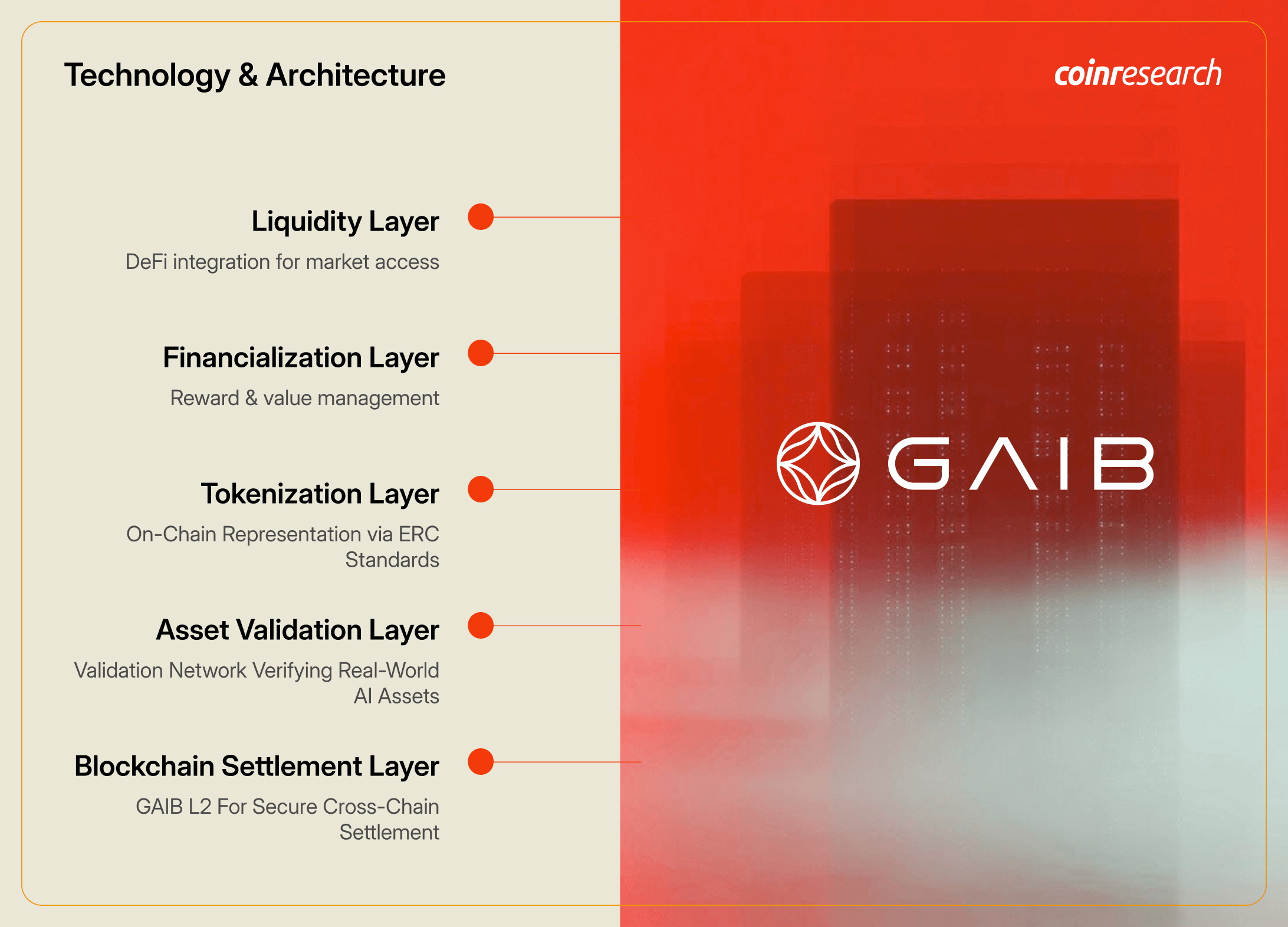
GAIB bridges this divide by tokenizing AI hardware (enterprise-grade GPUs, robotics, and data centers) and financing it through crypto capital. This creates real-world yields for on-chain holders. The project’s core products are the synthetic stablecoin AID (AI Dollar) and the yield-bearing sAID.

Why GAIB Exists
AI infrastructure ranks among the most capital-intensive sectors, requiring billions for GPUs, servers, and robotics. Financing is dominated by a handful of giants like NVIDIA suppliers and hyperscalers, leaving smaller operators underserved. DeFi, conversely, overflows with liquidity but lacks ties to productive, real-world assets.
GAIB’s core thesis:
-
AI demands scalable capital for expansion.
-
DeFi provides abundant, underutilized capital.
-
Tokenizing AI infra creates a bridge, unlocking a novel class of yield-bearing RWAs (Real-World Assets).
Rather than providing compute services directly (like competitors in decentralized GPU networks), GAIB focuses on financing the underlying hardware and tokenizing the cash flows from borrowers’ operations. This includes expansions into robotics and energy systems, powering embodied AI.
How GAIB Works
The system centers on two primary tokens:
-
AID (AI Dollar): A synthetic stablecoin minted 1:1 against USDC, USDT, or other accepted stables. Backed initially by U.S. Treasuries and stable reserves, it evolves to include income from AI infrastructure loans (e.g., GPU financing). Stability relies on protocol reserves, a treasury buffer, and redemption mechanics allowing holders to convert AID back to underlying assets at par. Currently, redemptions are whitelisted with KYC; a permissionless USDC redemption on Ethereum is planned for late November 2025.
-
sAID: A staked version of AID, functioning as an ERC-4626 vault token. It appreciates as AI borrowers (e.g., GPU operators, robotics firms) repay loans, delivering real-world yield estimated at 15-16% APY from tokenized assets. sAID remains liquid and transferable across chains. Unstaking involves a cooldown period before redeeming principal plus yield.
GAIB deploys capital into verified deals, such as a $30M GPU tokenization with Siam.AI and $50M in AI/robotics financing, with a $725M pipeline. Integrations include LayerZero for cross-chain functionality, partnerships with Resolv Labs, Plume Network, Aethir, and Primech Holdings, and planned restaking via EigenLayer or Symbiotic for enhanced security models.
Market Outlook and Risks
Short-term: AID’s peg (currently holding near $1) and sAID’s yield performance (~15% from real GPU revenue) will signal viability. Transparent redemptions, liquidity on Curve and Pendle, and on-chain reporting are key.
Medium-term: Scaling financing deals is crucial. GAIB has executed pilots (e.g., Aethir on BNB Chain) and major tokenizations, but consistent underwriting, verifiable repayments, and robotics expansion will solidify its role in AI+RWA.
Long-term: Tokenized AI infra could become a regulated asset class, but GAIB must navigate competition, borrower defaults, and evolving regs. The upcoming TGE for the native $GAIB token (teased via the GAIB Foundation launch) could align incentives further, but details remain pending.
Risks include:
-
Peg breaks under volatility or low liquidity.
-
Yield shortfalls if borrowers underperform.
-
Regulatory hurdles in tokenizing RWAs.
-
Execution gaps in complex integrations.
Bottom Line & What to Watch Next
GAIB represents a bold fusion of AI financing and DeFi, with proven traction, real yields from tangible assets, and a strong narrative in the exploding AI infra market (projected >$200B by 2028). It’s not just hype—deals are deploying capital, and TVL growth shows demand.
As an early investment opportunity: Bullish for those betting on AI’s capital needs, offering exposure via AID/sAID deposits or the impending $GAIB TGE. Real yields beat many DeFi farms, and backers add credibility. However, it’s high-risk—complex mechanics, unproven at scale, and sensitive to market stress. Enter with caution; diversify and monitor milestones.
Key watches:
-
AID Permissionless Redemption (Critical) Set for late November 2025—essential for peg trust and stablecoin credibility.
-
First Yield Reports Proof of GPU/robotics deal performance, targeting 15%+ APY.
-
Peg Stability Under Stress AID must maintain ~$1 cross-chain amid volatility.
-
EigenLayer/Symbiotic Restaking Integration Boosts security; watch for rollout impacting validator models.
-
Real Deployments & TGE Beyond announcements—track financed clusters, robotics deals, and $GAIB launch for ecosystem alignment.
If GAIB executes, it could pioneer RWAiFi for AI. If not, it’s a reminder of the challenges in blending cutting-edge tech with finance. Early positioning justifies interest, but due diligence is non-negotiable.
Hit the subscribe button below for more crisp crypto breakdowns delivered straight to your inbox. For those wanting deeper dives, like advanced investing and trading insights, detailed research reports, market sentiment assessments, and AI-powered predictive analytics, you’ll find all that and more in our Coinresearch AI platform starting at just $9/month (and yes, prices are going up soon!).