How a permissionless L1 is printing $100M+ in revenue and why HYPE is the institutional proxy bet for 2025.
Decentralized exchanges usually force a compromise: you either get the speed of a centralized exchange (with opaque custody) or the security of on-chain settlements (with slow, expensive transactions).
Meet Hyperliquid, a purpose-built Layer 1 blockchain that refuses to compromise. It delivers 200,000 orders per second with fully on-chain order books, all while directing 97% of its fees to buy back its own token.
This “lite” research report explores the Hyperliquid flywheel, the recent “institutional” pivot, and why $HYPE is becoming the highest-beta play.
Hyperliquid, TLDR;
Hyperliquid isn’t just an app; it’s a sovereign blockchain.
-
HyperCore: A high-speed consensus engine written in Rust. It handles order matching on-chain with sub-second latency.
-
HyperEVM: Allows standard DeFi apps (lending, stablecoins) to co-exist with the exchange.
The “Assistance Fund”: This is the secret sauce. 97% of all protocol fees go into this fund, which is used to buy back HYPE. It currently holds over $1 Billion in assets, acting as a massive, relentless bid under the token price.
Why Hyperliquid Exists
The “Performance vs. Trust” trilemma has plagued crypto trading for years.
-
Centralized Exchanges (Binance/Coinbase): Fast and cheap, but you don’t own your assets (FTX risk).
-
DeFi V1 (dYdX/GMX): Secure, but often rely on off-chain order books or have slower settlement times and high gas fees on general-purpose chains (Ethereum/Arbitrum).
Hyperliquid was built to solve this by creating a custom Layer 1 blockchain solely optimized for trading. No cat-themed NFTs clogging the network—just pure, high-frequency financial throughput.
Team and Capital
The project is led by Jeff Yan and a lean team of ~15 engineers at Hyperliquid Labs in Singapore. Their philosophy is “product over marketing”—they spent $0 on influencers and relied purely on referral loops.
The VC Alpha:
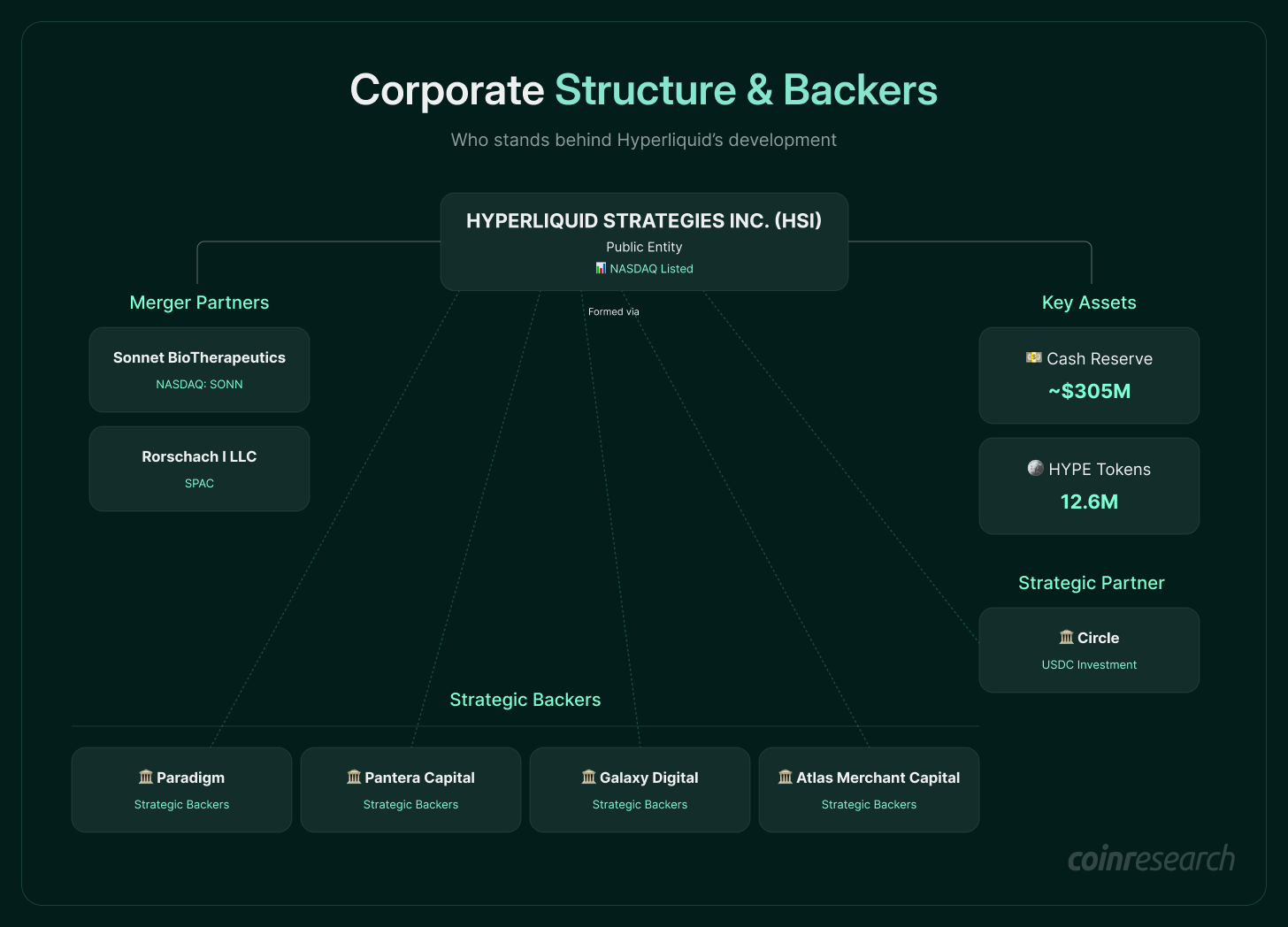
Heavyweights like Paradigm and Pantera Capital are backers, but here is the critical nuance: They own equity in the development lab, not HYPE tokens.
-
Why this matters: Unlike most “VC coins” where investors unlock millions of tokens to dump on retail, HYPE has no private seed round overhang.
The Institutional Pivot:
In late 2025, “Hyperliquid Strategies Inc.” filed for a $1 Billion capital raise (via a SPAC structure) specifically to accumulate HYPE. This signals a shift from a “DeFi app” to an institutional-grade asset manager.
$HYPE Tokenomics
-
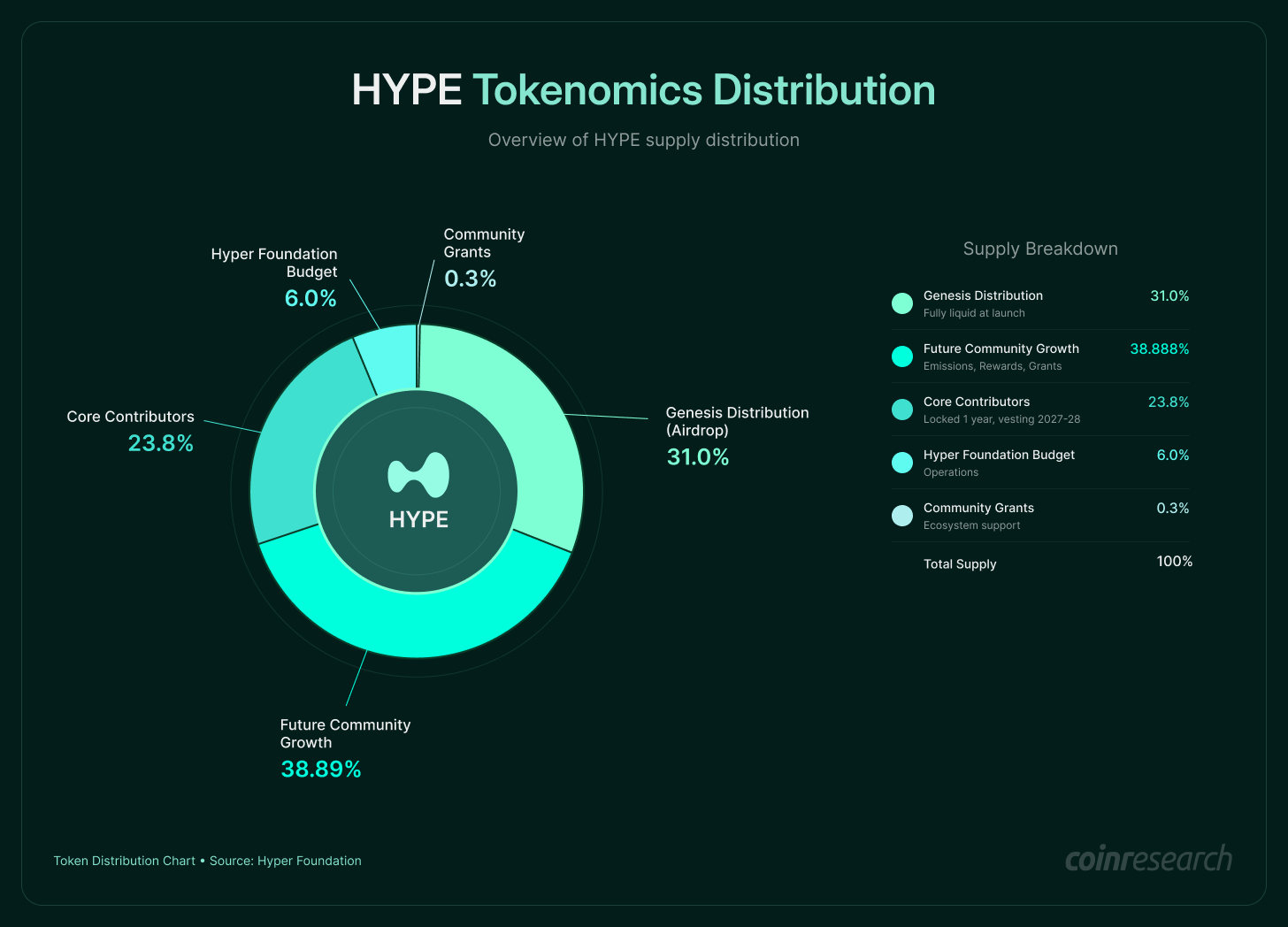
Total Supply: 1 Billion (Capped).
-
Distribution: ~31% was airdropped to the community (Genesis), creating a loyal user base rather than mercenary VC liquidity.
-
Utility: Gas for the L1, Staking (for fee discounts), and Governance.
The “Flywheel” effect is real:
-
Traders pay fees.
-
97% of fees buy HYPE.
-
HYPE is removed from circulation (into the Assistance Fund).
-
Price appreciates -> More attention -> More traders -> More fees.
The economic engine of HYPE is its buyback model. Hyperliquid generates revenue primarily through trading fees (taker fees) on its perpetual and spot markets. Approximately 97% of this revenue is programmatically used to buy back HYPE tokens from the open market. These tokens are then either burned or allocated to the community treasury. With annualized revenues reaching hundreds of millions of dollars in 2025, this mechanism creates a constant, price-agnostic bid for the token, making it highly deflationary during periods of high volume.
Roadmap and Traction
The platform is currently generating $100M+ in annualized revenue, placing it in the top tier of all crypto protocols.
Key Catalysts (Nov 2025):
-
HIP-3 (Permissionless Perps): Just went live. Anyone can now list a perp market for any asset (meme coins, RWAs) by staking HYPE. This effectively makes Hyperliquid the “Uniswap of Perps.”
-
Base Liquidity Pool (BLP): Currently on testnet, this will allow yield farming on tokenized tech stocks (Nvidia, Tesla), bridging TradFi and DeFi.

Competitive Landscape
vs. dYdX
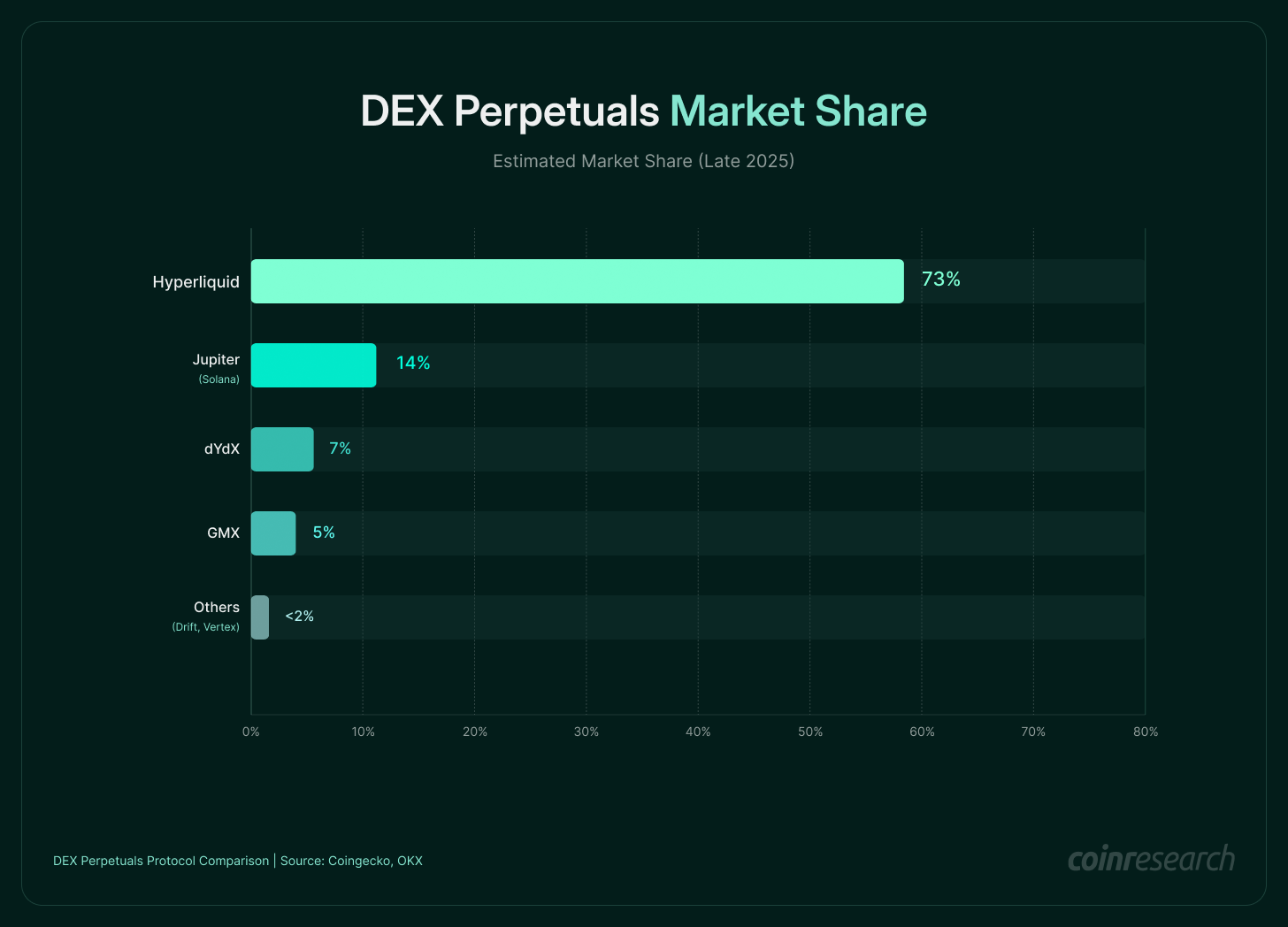
dYdX moved to its own Cosmos chain but struggled with validator centralization and user retention. Hyperliquid’s community-first tokenomics gave it the edge in 2024-2025.
vs. Jupiter (Solana)
Jupiter dominates the retail/aggregator space on Solana. However, Hyperliquid dominates the “Pro Trader” and “Institutional” niche because its order book architecture mimics the experience of Binance better than Jupiter’s AMM-centric model.
vs. GMX
GMX (Arbitrum) relies on liquidity providers who take the other side of trades. Hyperliquid uses a true order book (buyers match sellers), which scales better for institutional size.
Market Outlook and Risks
The Bull Case ($60 – $80):
Hyperliquid becomes the “MicroStrategy of DeFi.” The $1B institutional raise executes, creating a massive buy wall. HIP-3 unleashes a wave of “meme coin perp” speculation that drives fees (and buybacks) to record highs.
The Bear Case (<$30):
Regulatory crackdown on the “Hyperliquid Strategies” entity scares off institutions. Technical bugs in the new HIP-3 permissionless listing logic cause a chain halt.
Bottom Line
Hyperliquid has successfully transitioned from a niche DEX to a financial super-app.
It is currently the only major protocol that combines CEX-level performance, fully on-chain transparency, and a token value accrual mechanism (97% buyback) that puts nearly every other “governance token” to shame.
For investors, HYPE acts as a leveraged bet on crypto volatility. If the market moves (up or down), traders trade, fees are generated, and HYPE is bought back.
Hit the subscribe button below for more crisp crypto breakdowns delivered straight to your inbox. For those wanting deeper dives, like advanced investing and trading insights, detailed research reports, market sentiment assessments, and AI-powered predictive analytics, you’ll find all that and more in our Coinresearch AI platform starting at just $9/month (and yes, prices are going up soon!).