
Jupiter has already built Solana’s financial front door. The unresolved question is whether that distribution can become diversified, durable value capture for JUP holders.

Jupiter and JUP are living in different markets.
The product is everywhere. A Solana user opens Jupiter to route a swap, but the same surface now offers Ultra execution, perps, lending and borrowing, liquid staking, limit orders, DCA, launch tools, JupUSD utility, portfolio features, mobile access, and payment-style sends. That is no longer the profile of a single-purpose DEX aggregator. It is the architecture of a consumer-finance platform.
The token is still priced like a conditional claim on that platform.
Jupiter routed $22.754B of aggregator volume over the latest 30 days and $1.253T cumulatively. JUP trades near $0.2133, with a $708.1M market cap and a $1.463B FDV. It remains 89.3% below its all-time high, even after a 40.4% 30-day recovery. The market is not saying Jupiter lacks product-market fit. It is saying product-market fit does not automatically belong to token holders.
That distinction is the whole report.
The Machine Works
Jupiter’s routing scale is the part of the thesis that requires the least imagination. In the latest DeFiLlama snapshot, Jupiter routed roughly 2.7x the 30-day volume of the second-ranked aggregator, OKX Swap, and more than 5x the volume of 0x. The lead matters because aggregation is not simply a volume business. It is a habit and an intent-capture business.
Users arrive at Jupiter before they decide which venue should fill their trade. Underneath the interface, Raydium, Orca, Meteora, PumpSwap and the rest of Solana’s liquidity layer can compete with each other. Above that fragmentation sits the router. The user may not care which pool ultimately fills the order; they care about the price, the execution, and whether the transaction lands. Jupiter owns that decision point.
That position creates three advantages. First, the router sees order flow and captures the default front-end relationship. Second, venue fragmentation can become a feature: a user needs aggregation most when liquidity is scattered. Third, the front door creates a cheaper path into perps, lending, staking, stablecoin utility, and portfolio products. The platform does not need to buy a new customer for every new product line.
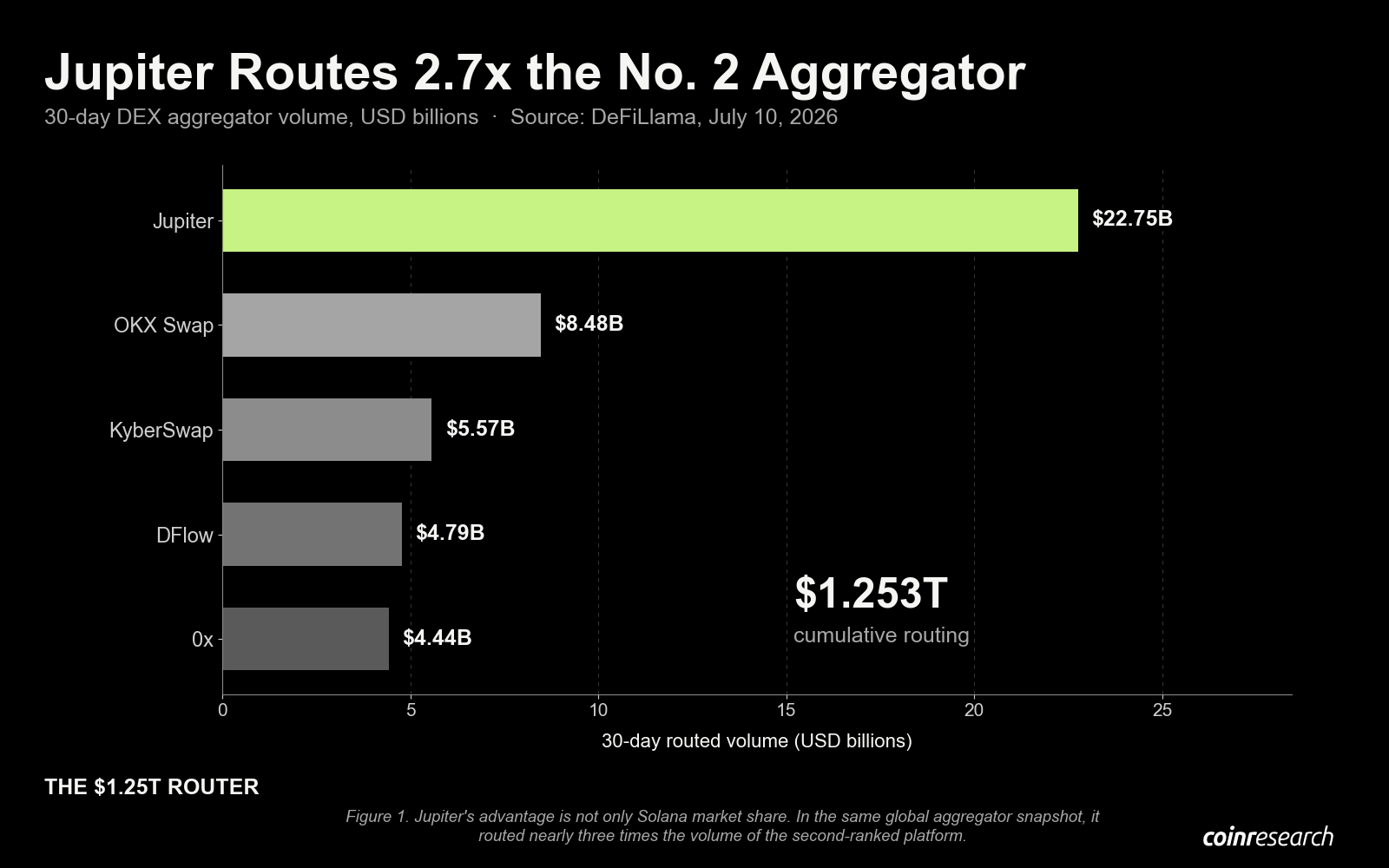
There is one analytical line we should not cross. Public datasets do not provide a scope-matched Ultra take-rate. Ultra fees cover one product mode, while aggregator volume covers all routed spot activity. Dividing one by the other creates a precise-looking number built on mismatched scopes. The old 1.05 bps comparison has therefore been removed. The correct signal is absolute revenue, holders revenue, and whether routing share can feed more than one revenue engine.
The Superapp Has a Revenue Bottleneck
Jupiter’s product surface is broad. Its current economics are not.
Over the latest 30 days, the full Jupiter suite produced $16.528M of fees, $5.017M of protocol revenue, and $2.508M of holders revenue. That is a meaningful correction from the aggregator-only view: the token-value bridge is broader than Ultra. But when the labeled daily product series is summed, aggregation and perps still supply approximately 93.5% of the revenue mix.
That concentration changes the way the word “superapp” should be read. It accurately describes the user surface. It does not yet describe a diversified cash-flow base. Aggregation contributes roughly 47.9% of the latest labeled 30-day revenue; the perpetual exchange contributes another 45.6%. Everything else is strategically interesting but economically small today.
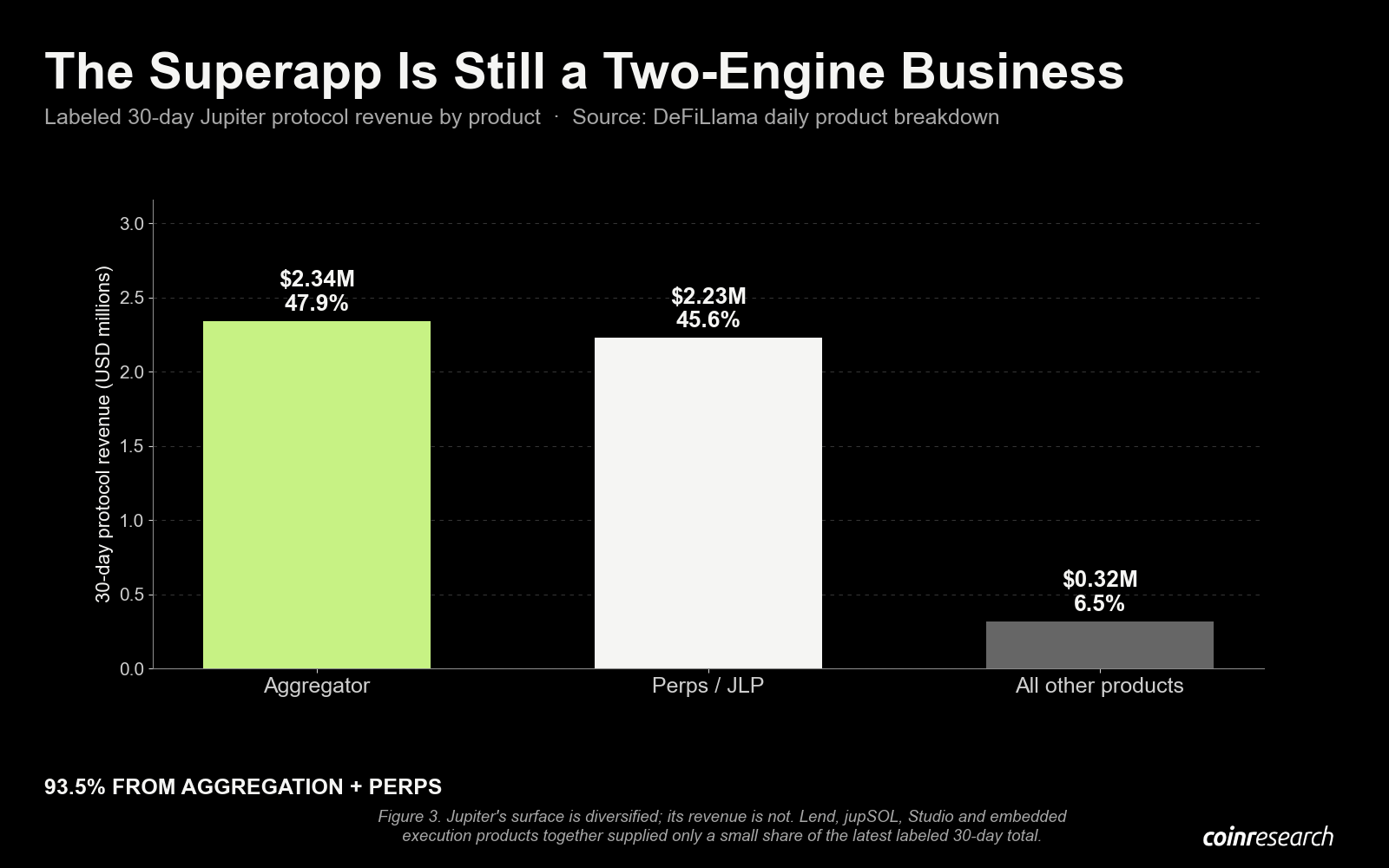
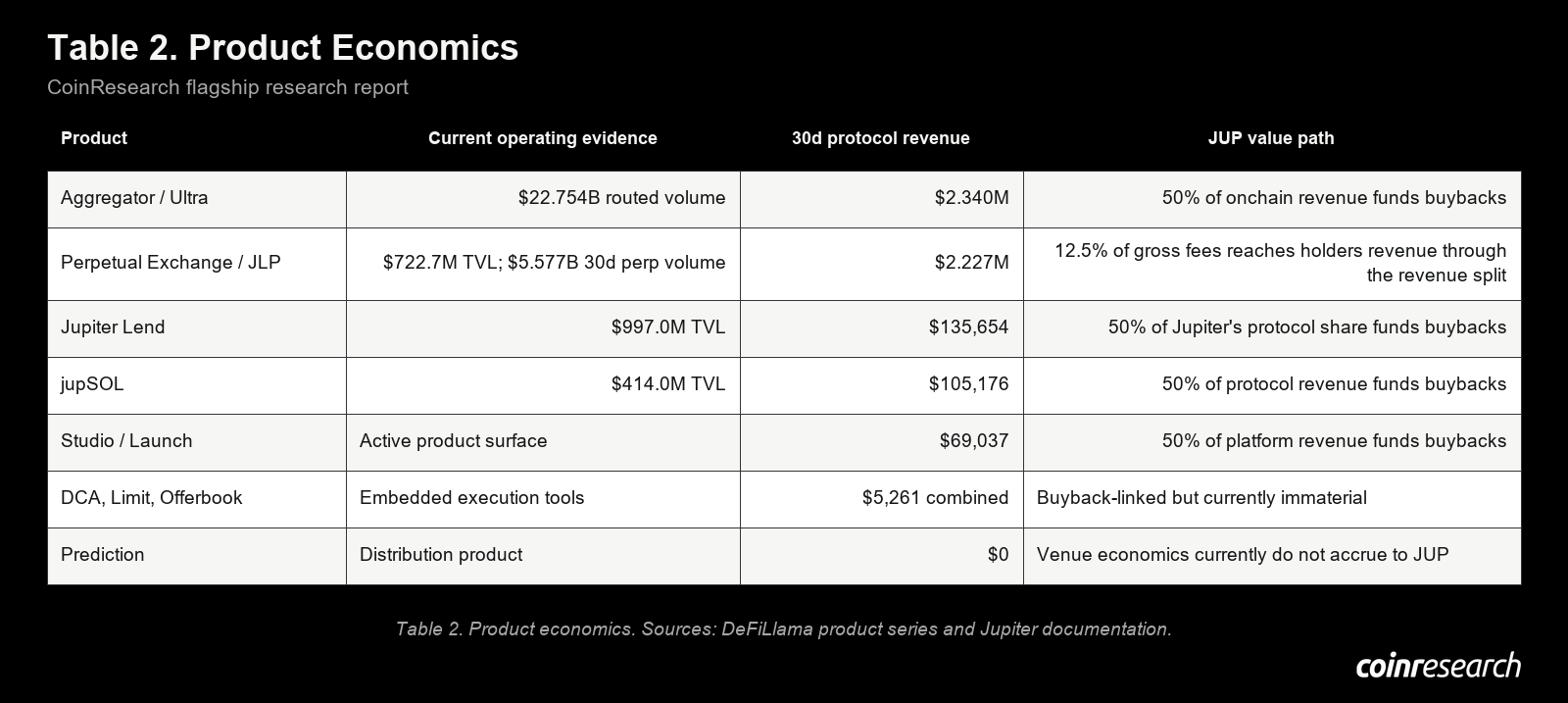
The bull case is that the smaller products already have real capital behind them. Jupiter Lend is near $997M TVL. Perps holds more than $722M, while jupSOL adds roughly $414M of staked value. These are not empty menu items. They show that Jupiter can move users from episodic swaps into persistent balances, collateral, leverage, and recurring product relationships.
The bear case is more straightforward: if routing monetization or JLP/perps activity weakens, the long product list will not yet protect holders revenue. The next phase of the thesis is not that Lend, JupUSD, jupSOL, Studio, and embedded execution tools must replace the two main engines. They only need to become large enough that the platform’s cash flow stops depending on two lines.
The Token Has an Economics Problem, Not a Product Problem
Jupiter documentation states that 50% of onchain revenue is sent to the Litterbox Trust for programmatic open-market JUP purchases. The full-suite holders-revenue series now gives that mechanism a current scale: annualizing the last 30 days produces a $30.51M buyback run-rate, a 4.3% yield on JUP’s current market cap, and a 23.2x market-cap-to-holders-revenue multiple.
Those are investable numbers. They are also not the same thing as a direct cash distribution.
JUP holders receive value indirectly through purchases, reserve accumulation, and governance alignment. That can be powerful if it is sustained: a repeat buyer can reduce liquid supply, make the treasury more strategic, and create a visible link between usage and token demand. But the market will discount an indirect mechanism relative to a legally enforceable claim on cash flow. It should. The run-rate annualizes one month, not a contract, and revenue still depends on trading activity, leverage, SOL prices, interest demand, and product mix.
That is why JUP can be both interesting and not obviously cheap. At the current run-rate, the market is already capitalizing the buyback stream. A major rerating needs one of two things: a much larger holders-revenue base, a higher valuation multiple, or both. The cleaner route is operating leverage. If product distribution turns into $45M-$60M of annualized holders revenue without a new supply problem, a mid-pack multiple can support a materially different outcome.
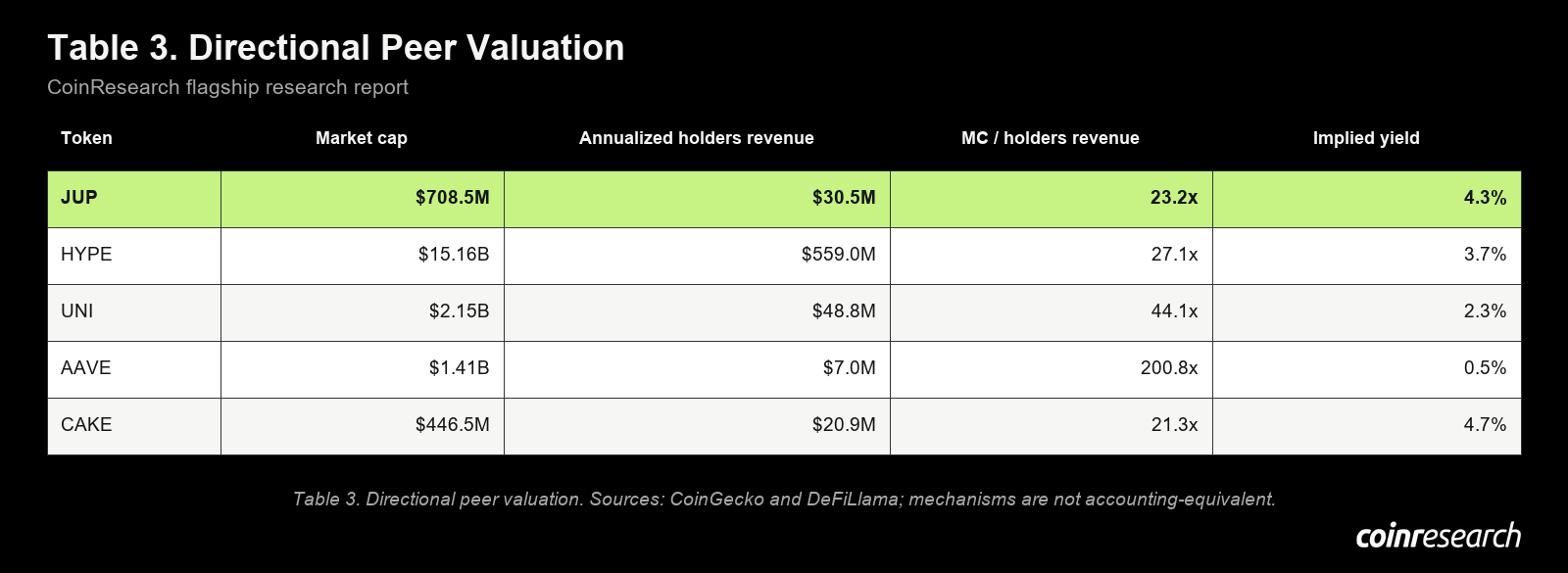
The comparison is directional, not an accounting exercise. Hyperliquid, Uniswap, Aave, PancakeSwap, and Jupiter use different combinations of fees, burns, buybacks, staking, auctions, governance, and distributions. Still, the table answers the honest question. JUP is cheaper than UNI and AAVE on the selected holders-revenue multiple, near CAKE, and slightly below HYPE. That is a discount, but not an absurdity. The market is pricing a real platform with an unresolved value-capture mix.
Supply Repair Is Real, but Still a Policy Variable
Jupiter has taken unusually direct action on the denominator problem. The original design was 10B JUP. A community-approved proposal reduced it by 30%, from 10B to 7B, with 1.5B removed from the team-managed side and 1.5B from the community side. Current total supply is approximately 6.862B after subsequent burns, while circulating supply is 3.320B, or about 48.4% of the current total.
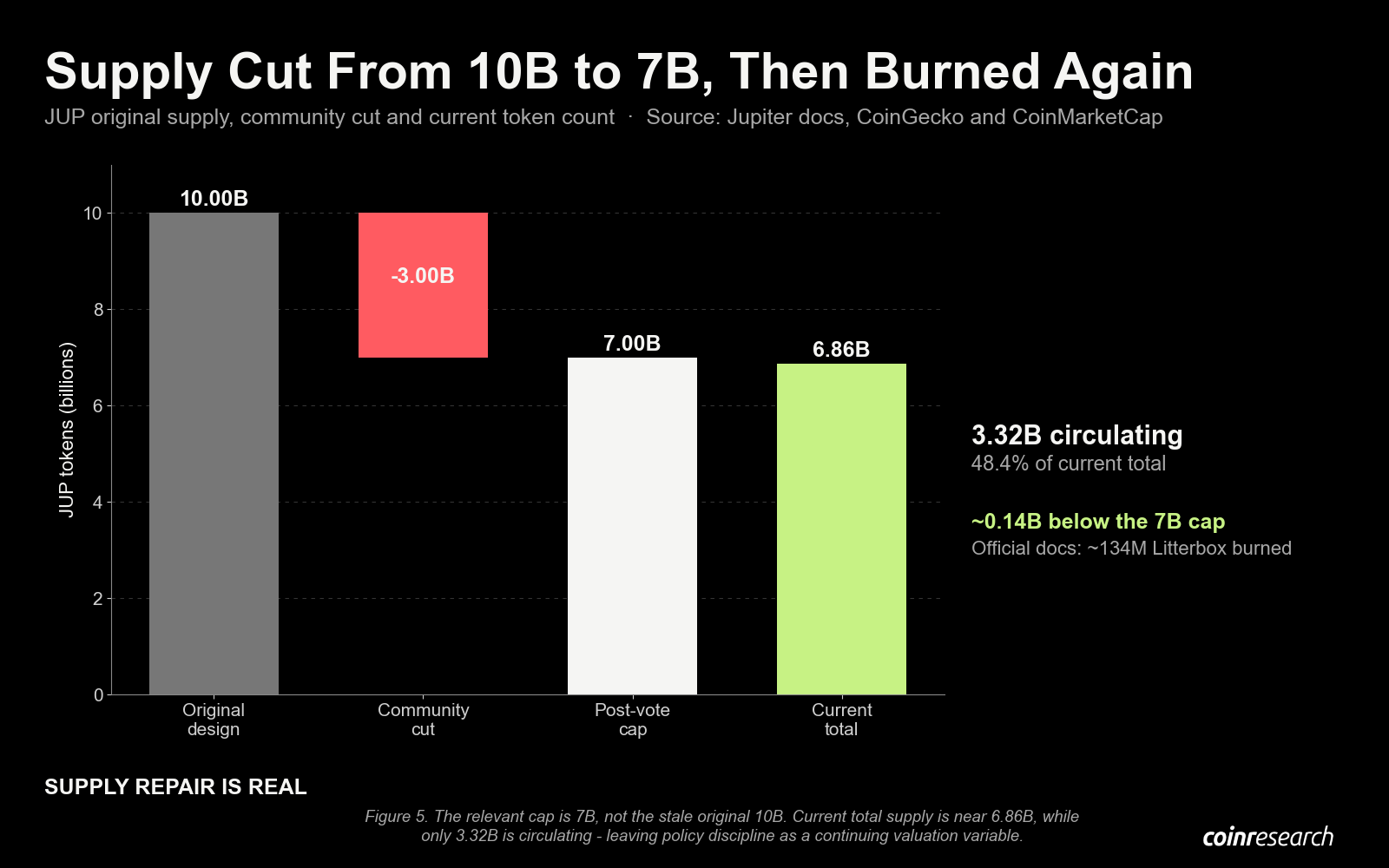
That is a meaningful improvement from the old token overhang narrative. The market can now work with a 7B policy cap rather than a stale 10B headline, and the Litterbox Trust has burned roughly 134M JUP. The February 2026 Net-Zero Emissions proposal also addressed the near-term flow concerns that mattered most: postponing the 700M Jupuary allocation, stopping team emissions for the foreseeable future, and offsetting Mercurial stakeholder sales through balance-sheet purchases.
But postponement is not cancellation. Supply repair reduces the denominator; it does not create demand. The remaining question is behavioral: actual circulating growth, wallet movements, future DAO decisions, and whether buybacks can absorb any renewed flow. The market will trust a policy only after it has seen it survive a period when issuing more tokens would be convenient.
What Would Change the Market’s Mind
The cleanest catalyst is not simply higher routed volume. Jupiter already has the volume. The real monitoring metric is holders revenue per month, separated by product.
First, Ultra and execution quality have to protect the front door. Better routing, landing, slippage control, and MEV-aware execution preserve the habit that makes the rest of the platform possible. The token impact comes only when that habit shows up in sustained revenue without a loss of routing share.
Second, perps and JLP need to remain deep enough to be a durable second engine rather than a cyclical surge. Perps already contributes roughly $2.23M of labeled 30-day protocol revenue. More durable open interest, better liquidity, and a broader collateral ecosystem would make that number more defensible, though the same growth raises leverage, oracle, and liquidity risks.
Third, Lend and JupUSD need to turn persistent balances into a meaningful third line. Lending is strategically different from swap volume because it keeps capital in the ecosystem. JupUSD can become a unit of account and collateral layer across the product suite. Neither has to dominate tomorrow. They have to prove that Jupiter’s distribution can monetize outside the two incumbent engines.
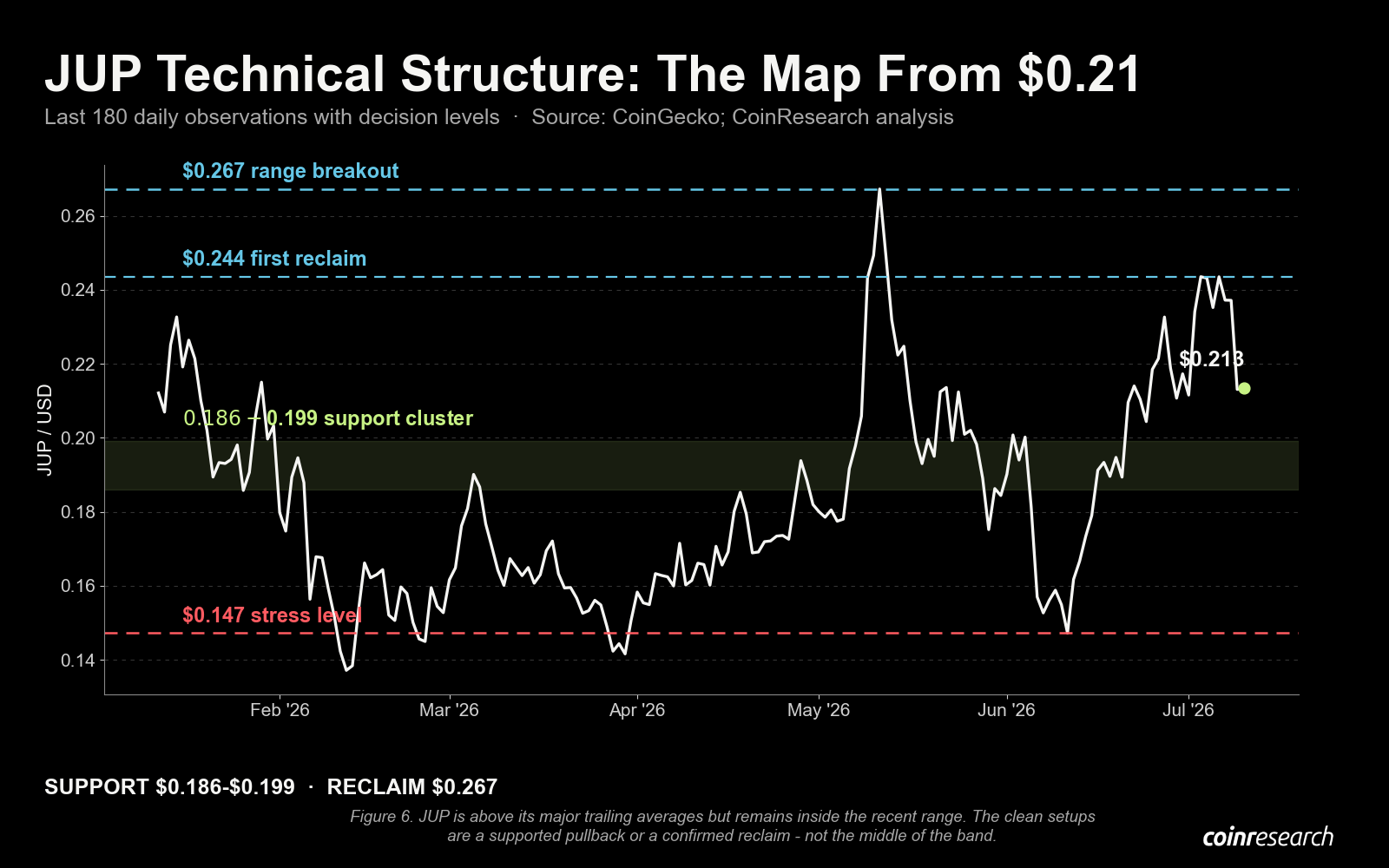
Technically, JUP sits between clear decision levels: the $0.186-$0.199 support cluster, the $0.147 stress level, and $0.267 as the first meaningful range breakout. A supported pullback or a confirmed reclaim matters more than buying the middle of the band, but the chart is only useful if revenue confirms it.
The Bottom Line
Jupiter has already done the hard part: it has become a default financial front door for a large part of Solana activity. The distribution is real. The revenue is real. The supply repair is real. What remains incomplete is the bridge from a great product surface to a diversified, durable token-holder economy.
That makes the current setup more nuanced than a simple drawdown trade. JUP is not cheap because it fell 89% from the all-time high. It becomes genuinely compelling only if holders revenue rises, the mix broadens beyond aggregation and perps, and supply discipline survives the next governance cycle. Until then, the market’s discount is not irrational. It is a price on execution risk.
Our full-report conclusion remains Speculative HOLD / conditional accumulation. The platform has earned strategic importance. The token earns a premium only when the superapp becomes a diversified cash-flow machine.
This article is a preview of the full flagship CoinResearch report. Read the complete deep-dive on the CoinResearch platform for the valuation sensitivity, catalyst map, full risk matrix, methodology, and source list.
Disclaimer: This article is for informational purposes only and does not constitute financial or investment advice. Cryptocurrency investments are volatile and speculative. Conduct your own due diligence before making investment decisions.