Parallel execution, ecosystem momentum, and where the $MON token may go next
Ethereum is the center of smart contract innovation, but its core design limits throughput. Rollups help, but fragmentation and cost still create friction. A new Layer 1 is trying to solve this without forcing developers to abandon the EVM.
Meet Monad, a high-performance chain built by high-frequency trading engineers to run Ethereum workloads at speeds that rival Solana and Sui, while keeping the developer experience unchanged. Massive VC support, a wide airdrop, and aggressive testnet adoption have quickly turned Monad into one of the most anticipated mainnet launches of the cycle.
This “lite” research report explores how Monad works, why it matters, and what traders and investors should watch as the $MON token moves toward its official debut.
Why Monad Exists
Blockchains struggle to balance security, decentralization, and scalability. Ethereum preserves security and decentralization, but performance suffers. Sequential execution caps throughput, creating fee spikes and wait times whenever demand rises. Layer 2 rollups help, but they increase architectural complexity and fragment liquidity.
Other Layer 1s have attempted different tradeoffs. Solana delivers high throughput but has faced network instability. Sui and Aptos use new languages and object-centric execution, but adoption takes time because developers must rebuild in Move.
Monad, TLDR;
Monad is a Layer 1 blockchain designed to run thousands of transactions at once through parallel execution. Developers can deploy Solidity contracts without modification, while users benefit from faster execution, near instant block finality, and tiny fees.
The chain uses:
-
Parallel EVM execution (many transactions at the same time)
-
Optimistic conflict resolution (replay only when necessary)
-
A custom database called MonadDB
-
Pipelined consensus for fast finality
-
Familiar EVM tooling
The result: an environment that resembles Ethereum at the smart contract level, but behaves more like a high frequency trading engine under the hood.
Transactions are ordered first, then distributed across multiple threads for simultaneous execution. Most transactions do not touch overlapping state, so throughput increases dramatically. If conflicts occur, the system re-executes to ensure correctness. This is conceptually similar to speculative execution in CPUs.
MonadDB stores most blockchain state on disk while caching common data in memory. This reduces memory pressure and lowers hardware requirements for validators. With pipelined consensus, block processing stages overlap, further improving performance.
Team and Capital
Monad was created by former engineers from high frequency trading firms. Their backgrounds in low latency distributed systems fit the technical challenge of parallelized blockchain execution.
The project has raised more than 240 million dollars in venture capital from top-tier crypto investors. This funding provides long runway for engineering, ecosystem development, and validator incentives.
A dedicated foundation manages ecosystem growth, grants, and community participation, while core engineering continues under the original development organization.
Tokenomics and Airdrop
The MON token has a total supply of 100 billion. Most distribution will occur through a large airdrop spanning community members, on-chain users, builders, and general crypto participants. More than 200 thousand wallets are eligible.
Claiming does not unlock liquidity. Tokens remain non-transferable until the mainnet token generation event (TGE). That means current price discovery is taking place in futures markets.
The token is expected to be used for network fees, staking, and governance. Final vesting and allocation details are still forthcoming, and will be a major factor for long-term valuation.
Roadmap and Early Traction
Monad’s public testnet has drawn significant builder interest. Hundreds of projects across DeFi, NFTs, wallets, and infrastructure are preparing to deploy at launch. Hackathons, grants, and accelerator-style programs are expanding the ecosystem before mainnet.
The airdrop claim window has attracted strong community participation. A reveal event will let users see their allocation ahead of TGE. Mainnet is expected shortly thereafter.
Success depends on shipping a stable high-performance network and onboarding enough developers to seed activity. Early signals are positive, but mainnet outcomes will matter far more.
Competitive Landscape
Ethereum and L2s
Ethereum remains dominant. Its tooling, security, and liquidity are unmatched. Rollups help scale, but increase architectural complexity and fragment users.
Monad’s value proposition is to scale the EVM directly at Layer 1, without requiring rollup infrastructure.
Solana
Solana is fast and low cost with strong developer activity. It has experienced network outages and requires development in Rust. Monad’s advantage is familiar Solidity tooling.
Sui and Aptos
These chains use the Move language with parallelism built into the object model. While performance is strong, developers must learn new patterns. Monad aims to deliver similar throughput without changing developer habits.
Differentiator
Monad provides a familiar EVM environment while targeting performance levels associated with alternative L1s. If this combination works at scale, Monad could become a preferred home for high-frequency DeFi, advanced derivatives, and low-latency consumer apps.
Market Outlook and Risks
The addressable market includes DeFi, trading, NFT marketplaces, and gaming. These categories benefit from high throughput and low costs. A performant EVM base layer could also help consolidate liquidity that is currently spread across rollups.
However, Monad faces meaningful risks:
-
Execution risk. Parallel EVM is technically complex and unproven at scale.
-
Security risk. Custom databases and consensus pipelines introduce new attack surfaces.
-
Adoption risk. Ethereum has massive incumbency. Developers may stay with L2s.
-
Tokenomics risk. A 100 billion supply with large airdrops may create future sell pressure.
-
Timeline risk. Competitor chains are shipping fast. Momentum matters.
Investors should monitor real-world performance metrics after mainnet launch, including block stability, throughput under load, and application adoption.
Bottom Line
Monad is one of the most ambitious blockchain engineering efforts in recent years. The core idea is simple: keep EVM, remove bottlenecks. The execution is not. Delivering parallel EVM at scale is a hard problem, but the upside is significant.
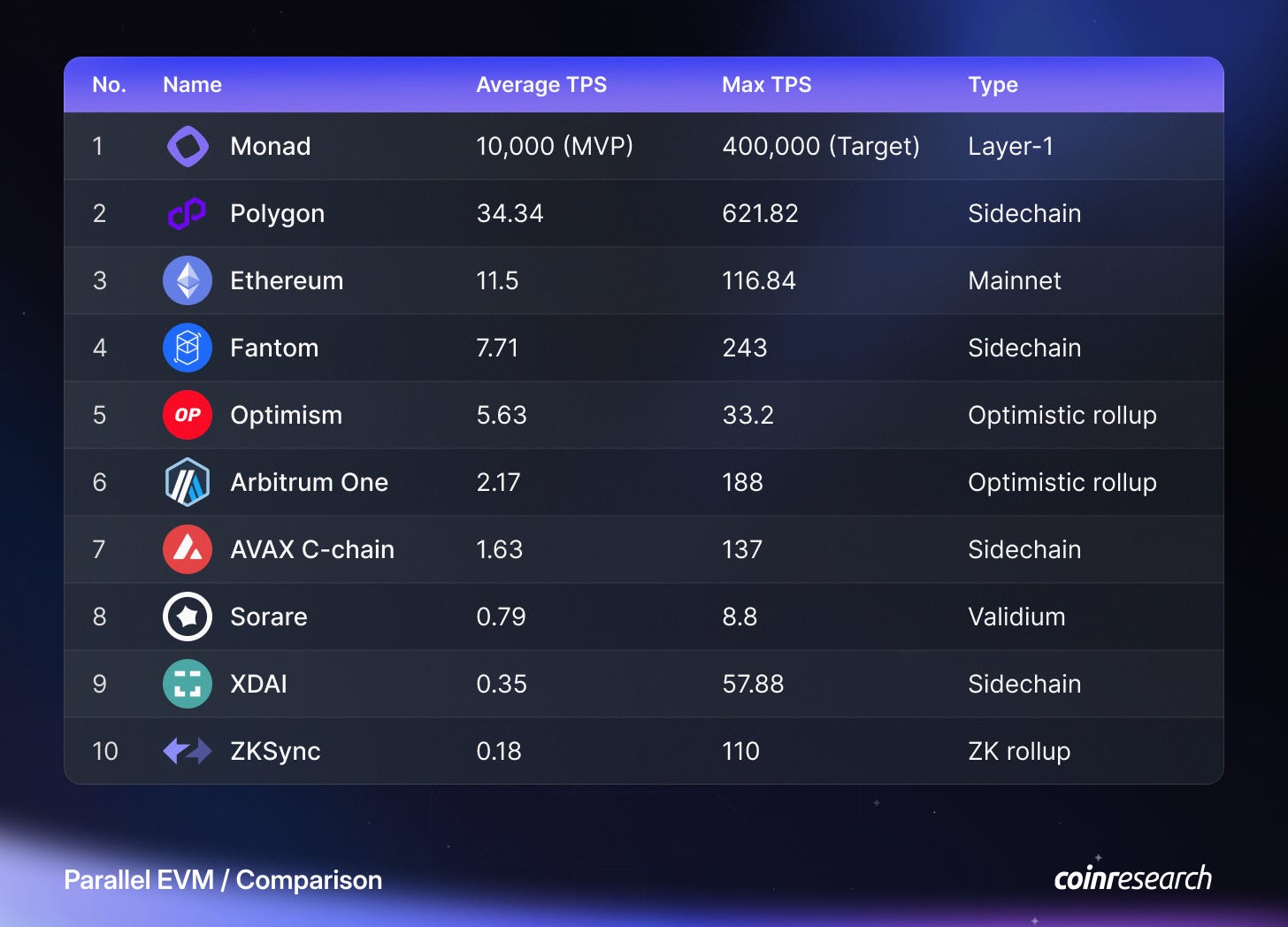
If Monad proves that Ethereum-style execution can scale to tens of thousands of transactions per second, it could become the preferred environment for high-frequency DeFi, derivatives trading, real-time marketplaces, and games.
The strong technical team, large budget, and aggressive ecosystem programs create favorable conditions. Real validation will come at mainnet.
For traders and investors, the key events lie ahead:
-
Airdrop finalization
-
Mainnet launch
-
Exchange support
-
Early dApp adoption
-
Token unlock schedules
Hit the subscribe button below for more crisp crypto breakdowns delivered straight to your inbox. For those wanting deeper dives, like advanced investing and trading insights, detailed research reports, market sentiment assessments, and AI-powered predictive analytics, you’ll find all that and more in our Coinresearch AI platform starting at just $9/month (and yes, prices are going up soon!).