
Plume built one of crypto’s widest real-world asset distribution networks. Then most of the reported capital disappeared.

Plume has already solved the part of tokenization that many projects are still pitching in slide decks.
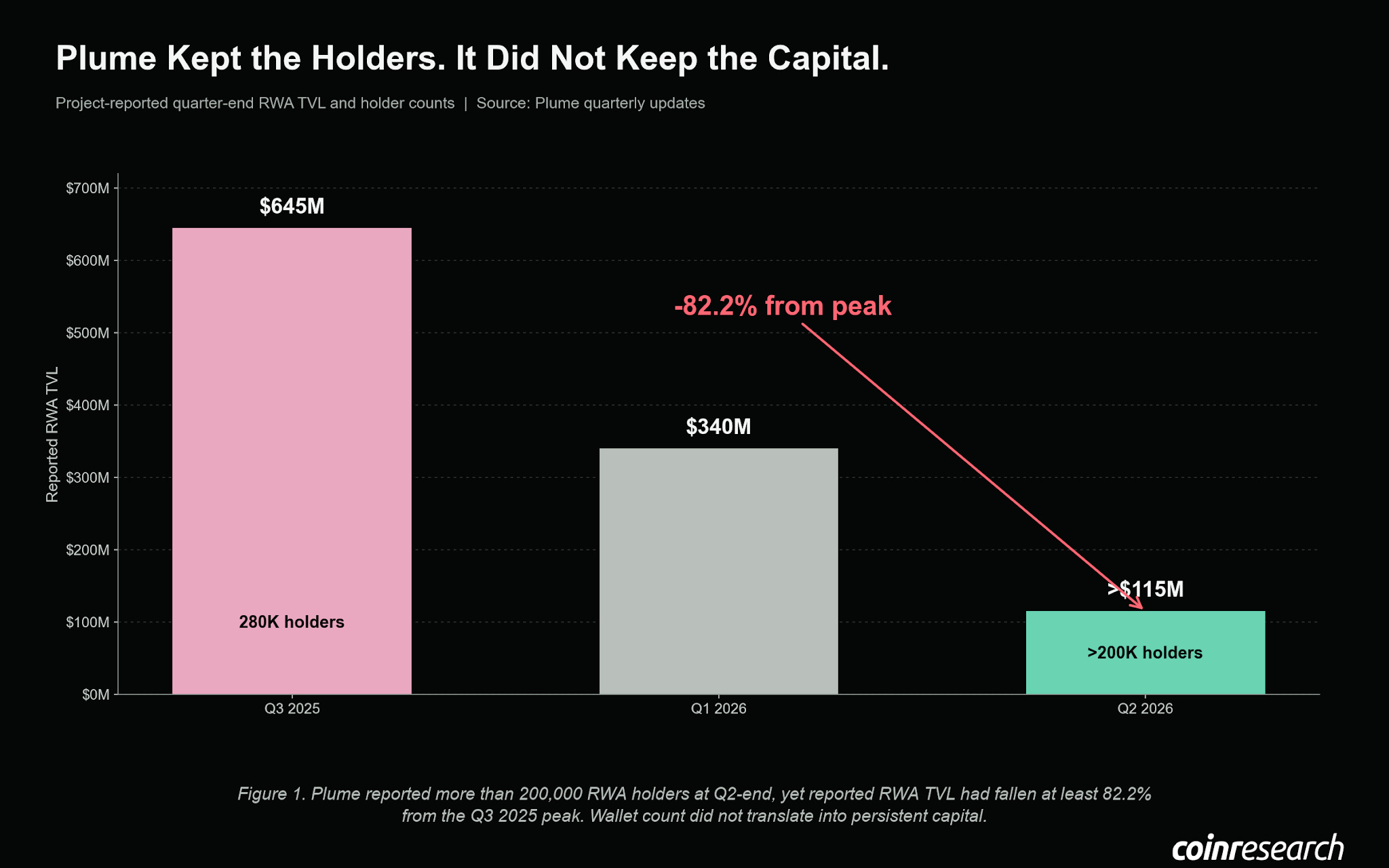
It can bring assets onchain. It can package them into vaults. It has compliance infrastructure, a dedicated EVM network, regulated entities, and integrations with exchanges, wallets, DeFi protocols, and other chains. At the end of Q3 2025, Plume reported $645 million of real-world asset TVL and 280,000 RWA holders.
That looked like product-market fit.
By the end of Q2 2026, reported RWA TVL had fallen to more than $115 million. The holder count remained above 200,000.
Plume kept much of the footprint and lost roughly 82% of the capital attached to it.
That contradiction is the investment case. The question is no longer whether Plume can attract attention, sign partners, or distribute products. It is whether the money stays – and whether the economics of that distribution ever become necessary to the PLUME token.
The Distribution Story Worked
Tokenizing an asset is no longer the scarce capability.
The hard part is everything that comes after issuance: custody, identity, transfer restrictions, pricing data, subscriptions, redemptions, usable interfaces, and access to investors who are both interested and eligible.
Plume built for that bottleneck.
Arc helps originators bring assets onchain. Nexus connects applications to real-world data. Passport handles identity and access. Nest packages tokenized products into vaults that can move through crypto-native distribution channels. Underneath the stack sits an Arbitrum-based network that settles to Ethereum and offers the low-cost execution expected from an L2-style environment.
The distribution layer is the real product. A user may encounter a Nest vault through Bybit, Binance Wallet, Solana, Pendle, or another interface without first deciding to become a Plume user. That is a sensible strategy. Capital already lives inside those venues.
Plume has also done the slow work that institutional tokenization requires. It secured a Bermuda Class M digital-asset licence, established a registered-transfer-agent footprint in the United States, and announced relationships with ether.fi, FalconX, Securitize, and other firms that would be difficult for a new RWA network to reproduce quickly.
This is why Plume remains strategically credible despite PLUME’s weak market performance. The project is not missing products or partners. It is missing proof that announced distribution converts into retained capital.
Then the Money Left
The decline happened in two steps.
Reported RWA TVL fell from $645 million at Q3 2025-end to $340 million at Q1 2026-end. By Q2-end, Plume reported more than $115 million. The final number is a floor rather than an exact total, but it still implies an approximately 82% contraction from the peak and at least a 66% decline during Q2 alone.
The timing deserves attention. Plume’s first Nest Points season ended in March after rewarding selected deposits and activities with substantial multipliers. The sharpest capital decline followed in Q2.
That does not prove the rewards caused the outflow. Products mature. Investors redeem. Asset prices change. Partners reallocate. Reporting scopes move. Plume has not published a complete bridge explaining the decline, so ordinary turnover cannot be separated cleanly from incentive-sensitive capital.
But the burden of proof has changed.
Plume has already shown that rewards and distribution can bring deposits in. It now has to show that users remain after the rewards normalize.
200,000 Holders Is Not the Same as 200,000 Investors
More than 200,000 RWA holders is meaningful reach for a network whose public mainnet launched in 2025.
It is not the same thing as 200,000 active investors.
One person can control several wallets. A wallet can receive a reward, interact once, retain a dust balance, or hold an asset that has fallen sharply in value. Holder count becomes useful when it is paired with balances, subscriptions, redemptions, retention cohorts, transfer value, and fees.
A crude calculation shows how far the headline can drift from the economics. At the Q3 peak, $645 million across 280,000 reported holders implied roughly $2,300 of RWA TVL per holder. At Q2-end, more than $115 million across more than 200,000 holders implied less than $575 per holder.
Those averages do not describe the distribution of individual accounts. They do show the direction clearly: the network retained much of its wallet footprint while the economic weight behind each reported holder collapsed.
The strongest defense is that Plume’s value increasingly sits outside visible mainnet balances. Users may access Nest through an exchange, wallet, or another chain. Institutional allocations may be economically meaningful but operationally quiet.
That is plausible. It also raises the disclosure standard. A multichannel distribution network needs consolidated reporting of deployed assets, subscriptions, redemptions, average balances, and fees. Without it, investors are left comparing partnership announcements with a shrinking reported capital base.
The Chain Looks Busier Than Its Economics
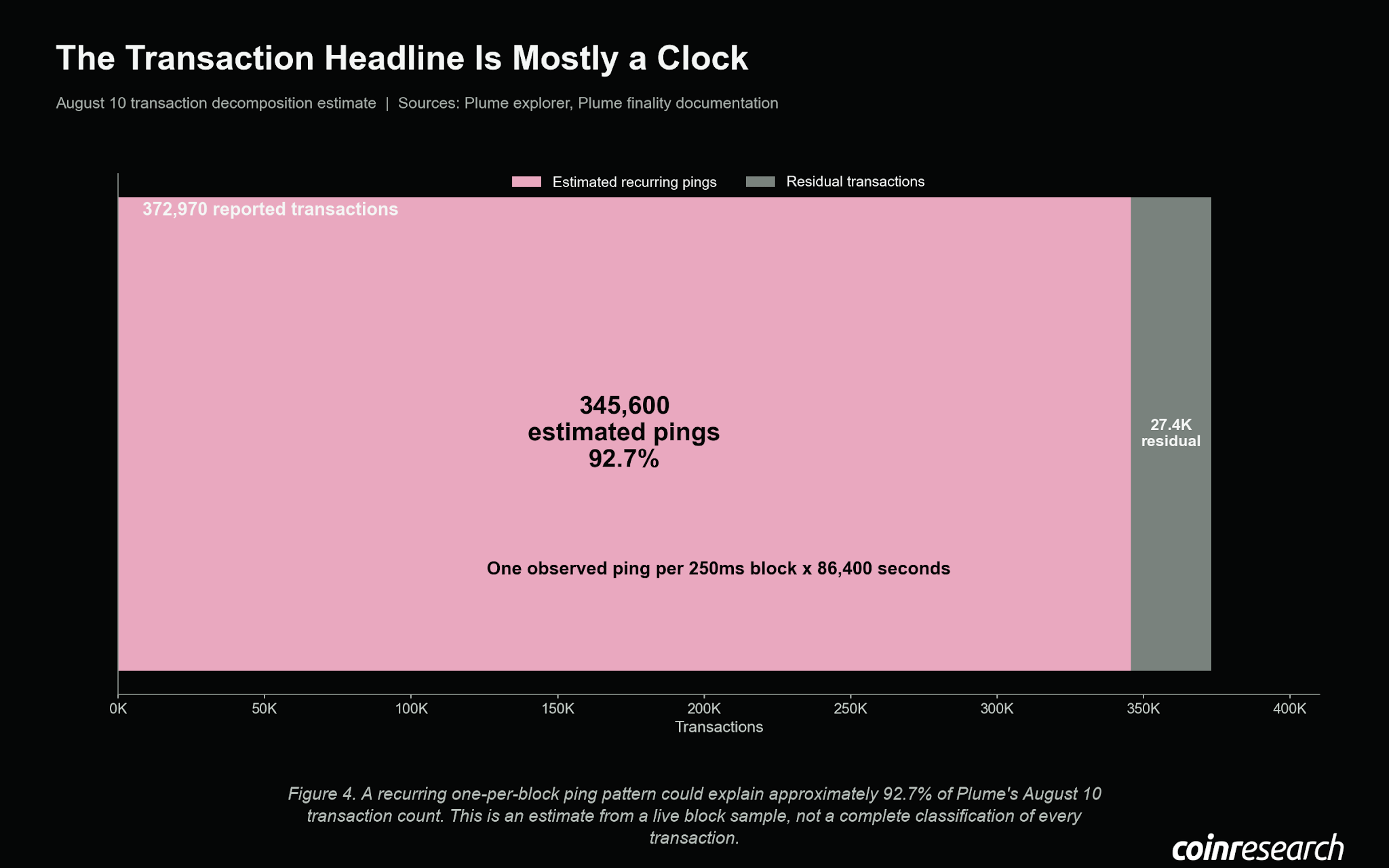
Plume’s explorer recorded 372,970 transactions on August 10. Read alone, that number suggests a busy young network.
A live CoinResearch review found a recurring ping() call from the same address in each sampled block, alongside the normal Arbitrum system transaction. Plume documents an approximately 250 millisecond block interval, or roughly four blocks per second. One ping per block would generate about 345,600 transactions per day – roughly 93% of the August 10 headline.
This is a sample-based extrapolation, not a classification of every transaction. It is not proof that 93% of Plume activity is artificial or valueless.
It is enough to show that raw transaction count is the wrong adoption metric.
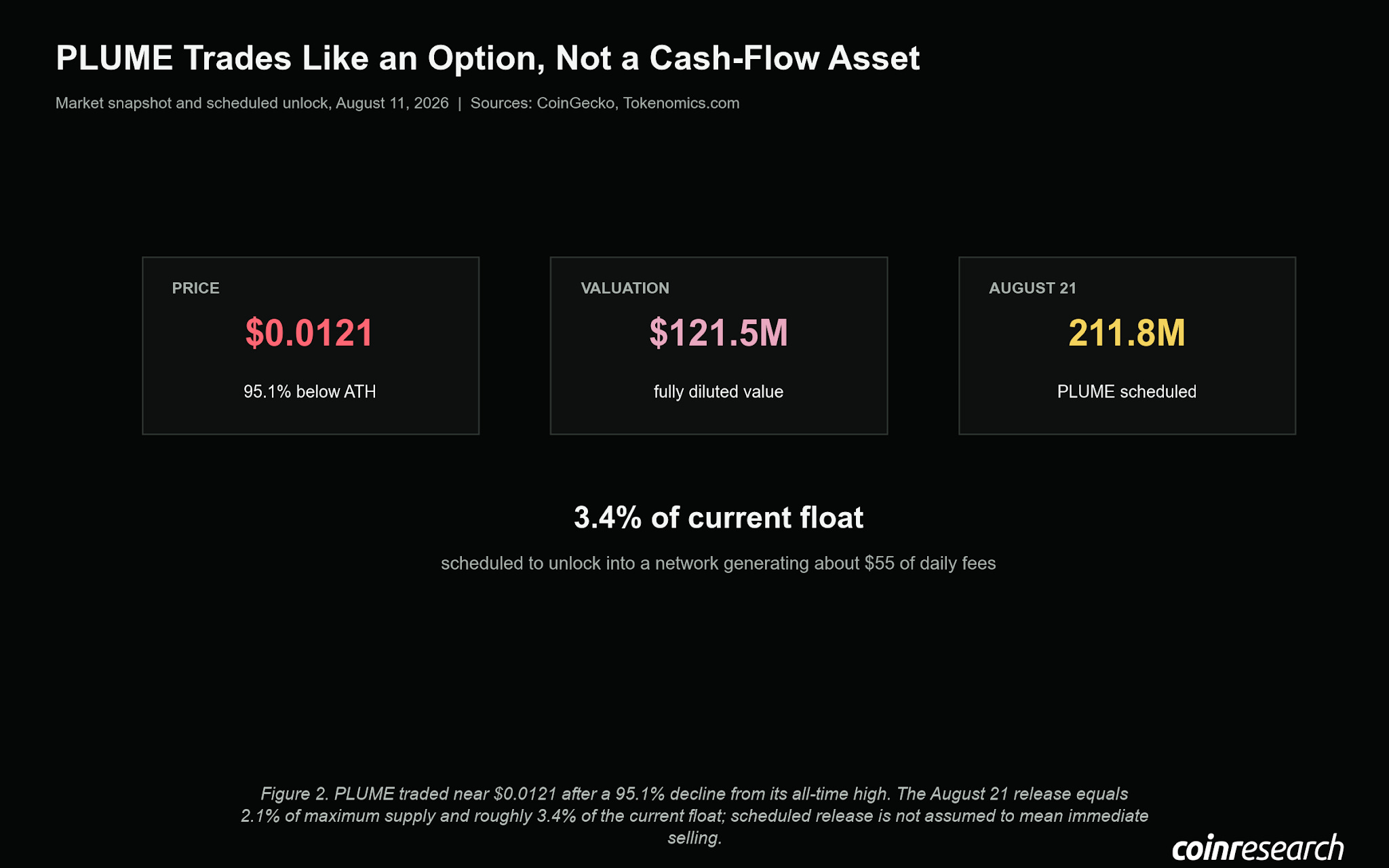
Fee generation points in the same direction. At the report cutoff, DeFiLlama recorded approximately $55 of Plume chain fees over 24 hours and $1,652 over 30 days. The latest daily figure annualized to roughly $20,000.
Low fees can be a feature. A financial network should be cheap to use. But hundreds of thousands of economically distinct daily interactions would normally leave more evidence in fee revenue, funded wallets, transfer value, or application income.
The network does not appear constrained by throughput. It appears constrained by economic demand.
Plume Can Win Without PLUME Winning
This is the distinction most token theses avoid.
Plume can become a useful company, product suite, and RWA distribution layer while PLUME captures only a small part of the value created.
Asset managers can earn product fees. Vault operators can earn management or performance fees. Depositors can receive real-world yield. Validators can earn staking rewards. Exchanges and wallets can capture distribution economics.
None of those outcomes automatically pays an unstaked PLUME holder.
The token has two clearly verified roles today: gas and staking. Plume also describes governance, collateral use, liquidity, and potential future benefits. CoinResearch could not verify a live, enforceable right for PLUME holders to receive Nest revenue or company cash flow.
The multichain strategy makes that gap more important. If a user can access a Nest product through Bybit, Binance Wallet, Solana, or another external interface, the product can grow without creating much native gas demand. Distribution can strengthen Plume while bypassing PLUME.
Supply is moving in the opposite direction. Approximately 6.18 billion of the 10 billion maximum supply was circulating at the cutoff. DeFiLlama’s estimated schedule showed roughly $136,000 of tokens entering circulation per day at the cutoff price, while a separate tracker scheduled a 211.8 million-token release for August 21.
Unlocks are not automatic sales, and PLUME already traded roughly 95% below its all-time high. The imbalance is still difficult to ignore: transferable supply is expanding much faster than verified value is being removed through network use.
What Would Change the View
The bear case is not that real-world asset tokenization fails. It is that Plume’s products create value for issuers, managers, distributors, and users without making PLUME economically necessary.
The bull case is equally clear. Announced partner capital becomes visible and persistent. RWA TVL recovers without another comparable reward campaign. Nest develops into a transparent recurring revenue engine. Some enforceable part of that growth creates PLUME demand, burn, distributions, collateral use, or governance power.
Four developments would materially strengthen the evidence:
-
RWA TVL recovers above $300 million without an equivalent new incentive campaign.
-
Plume discloses recurring chain and Nest revenue with a clear stakeholder allocation.
-
Cross-chain product growth creates measurable PLUME demand or an enforceable holder right.
-
Scheduled releases are absorbed without weakening liquidity or accelerating staking exits.
The view would deteriorate if RWA TVL remains below $150 million, announced commitments fail to appear as deployed capital, or holder and transaction counts remain disconnected from balances, fees, and transfer value.
The Bottom Line
Plume has built something strategically credible. Its regulatory work, product stack, and distribution network address a real bottleneck in tokenized finance.
The evidence does not yet show that the capital stays. It also does not show that PLUME participates proportionately when the platform grows.
That makes PLUME an early-stage option on RWA distribution rather than a cash-flow-backed tokenization asset. Investors are underwriting three conversions that have not yet been completed: from partnerships to deployed capital, from deployed capital to recurring economics, and from those economics to token-holder value.
Plume has already won the right to be watched. The next phase determines whether it earns the right to be owned.
This article is a preview of our full flagship Research Report on Plume.
The complete report includes the architecture and value-flow analysis, full supply model, competitive map, probability-weighted scenarios, risk matrix, and separate guidance for new and existing investors on the CoinResearch Platform.
Disclaimer: This article is for informational and educational purposes only and does not constitute investment, legal, tax, or accounting advice. Digital assets are volatile and may lose all value. Always conduct independent due diligence.