
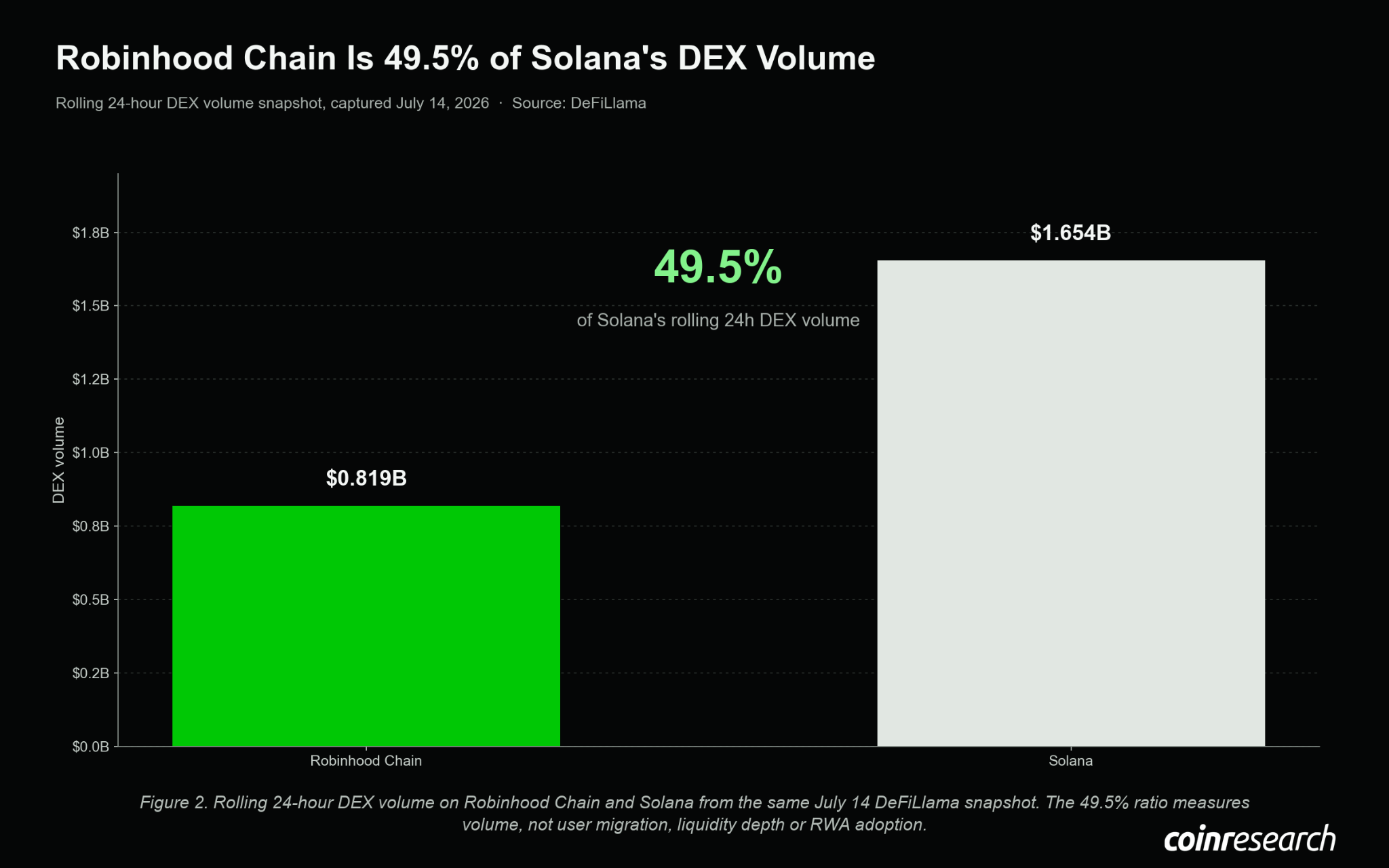
Robinhood Chain reached $819.2M in rolling 24-hour DEX volume in our July 14 snapshot, or 49.5% of Solana’s volume from the same source.

Robinhood Chain did not tiptoe into the market.
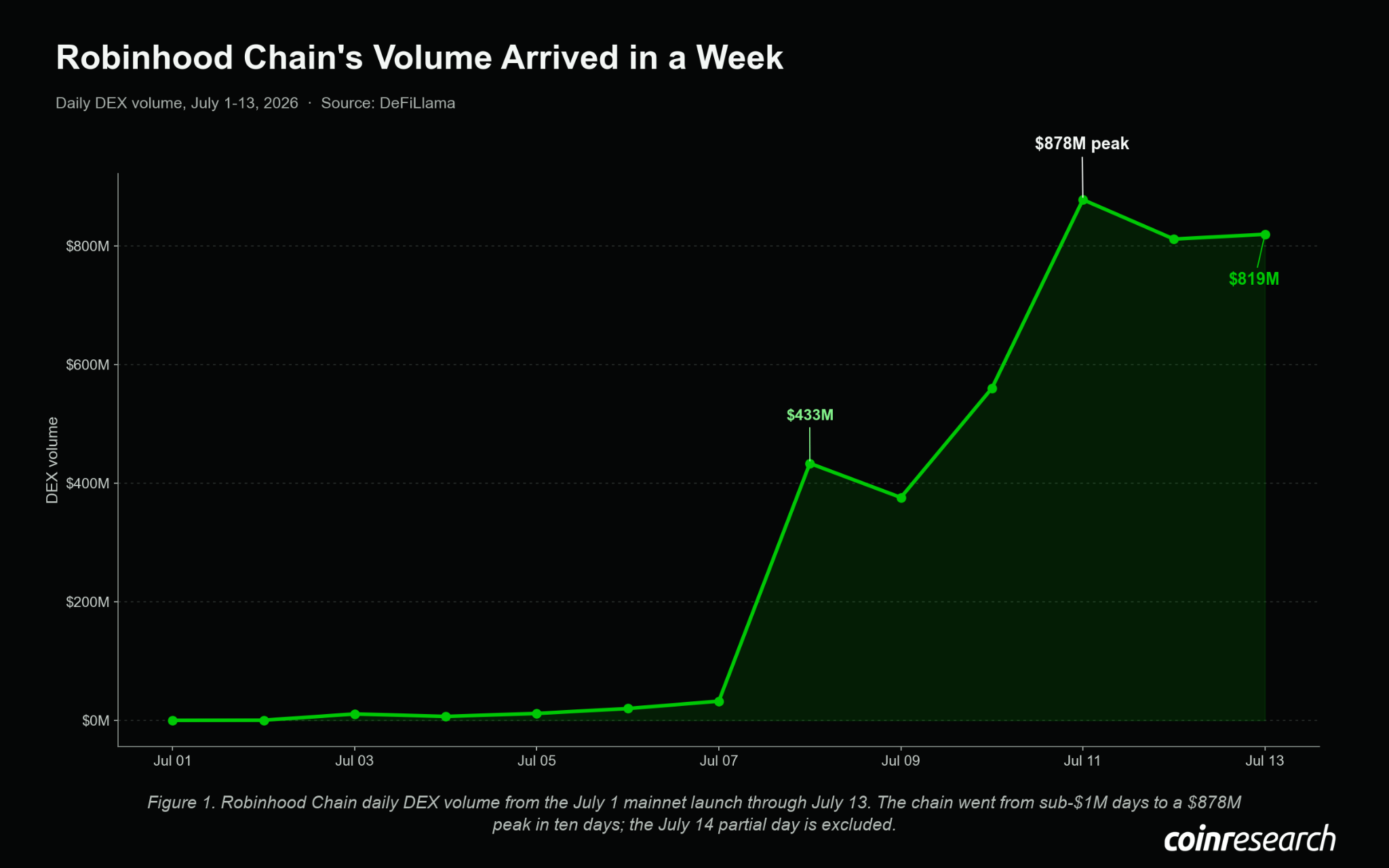
The public mainnet launched on July 1. Less than two weeks later, its completed-day DEX volume had climbed from roughly $250,000 to $819.2M, after peaking near $877.6M on July 11. In the same snapshot, Solana recorded $1.654B. The comparison produces the headline: Robinhood Chain was trading at 49.5% of Solana’s rolling 24-hour DEX volume.
That number is worth taking seriously. It is also very easy to misunderstand.
It does not mean Robinhood Chain took half of Solana’s users, liquidity, or economic activity. Solana still processed its own $1.65B day. It means a new venue attached to one of the best-known retail trading brands generated a huge burst of onchain turnover very quickly. That is a distribution event and a market-structure event. It is not yet proof that tokenized stocks have found mass-market product-market fit.
The first thing the new chain proved is that Robinhood can summon attention in crypto. The harder question is whether that attention can become a durable financial stack: stock-token liquidity, retained stablecoin balances, lending use, and repeat activity after the fastest memecoin trade has cooled.
The $819M Headline Is Real, but It Is a Launch-Week Headline
Our July 14 research pull recorded $819.2M of 24-hour DEX volume on Robinhood Chain, $3.91B over seven days, and roughly $3.96B over 30 days. The chain had only just opened, so the 30-day figure is almost entirely a launch-period figure rather than a mature trailing measure. The same provider showed $12.14B of seven-day Solana DEX volume, making Robinhood Chain’s weekly print about 32.2% of Solana’s.
The trajectory matters more than any single snapshot. On July 1 and July 2, activity was measured in hundreds of thousands of dollars. By July 8, it was $433.2M. By July 10, it was $559.7M. By July 11, it was $877.6M. This was not a slow institutional pilot gradually discovering liquidity. It was a very fast attention loop.
Robinhood did launch with a serious infrastructure package. The chain is an Arbitrum-based L2 using ETH for gas, with a public, EVM-compatible environment, account abstraction support, first-come first-served sequencing, canonical bridging, Chainlink infrastructure, custody partners, Uniswap as a primary public liquidity partner, and Pleiades as a proprietary AMM venue. The stated destination is much bigger than speculative swapping: tokenized equities, ETFs, private assets and programmable financial instruments.
But it is important to separate infrastructure from outcome. A credible stack can make an outcome possible; it cannot make users prefer a regulated asset over a reflexive trade on day one. The early data is a proof of distribution and composability. It is not a scorecard for stock-token adoption.
The other important caveat is concentration. In the snapshot, Uniswap V2, V3 and V4 together processed about $773.5M, or 94.4%, of the chain’s recorded 24-hour DEX volume. That does not invalidate the volume. It does tell us that this was primarily a concentrated AMM-market event, not a broad financial-services economy running at scale.
The Chain Was Built for Stocks. Memecoins Got There First.
This is not an embarrassing side note. It is the mechanism behind the headline.
Memecoins won the launch because permissionless blockspace turns the path from narrative to trade into a few simple actions: deploy a token, seed a pool, get a ticker into a wallet or a screener, and attract attention. No issuer needs to be approved. No user needs to read a securities disclosure, demonstrate eligibility, navigate custody language, source a canonical asset, or wait for a deep two-sided market to form. A token is easy to create. A liquid market is hard, but it can be stimulated quickly when the narrative is strong enough.
Robinhood is a particularly powerful narrative catalyst. It is already shorthand for retail trading, risk-taking, market culture, and the idea that a small trader might find the next big winner. Put that brand next to a newly opened chain, a community of launchpad users, familiar EVM tooling, and a visible leaderboard of rapid winners, and the reflexivity is obvious. The first perceived winner advertises the second wave of traders. Volume itself becomes marketing.
Stock tokens face the opposite starting point. They need canonical contracts, underlying-asset arrangements, price feeds, professional market makers, liquidity that can survive exits, and a regulatory wrapper that works jurisdiction by jurisdiction. They also need the user to understand what they own.
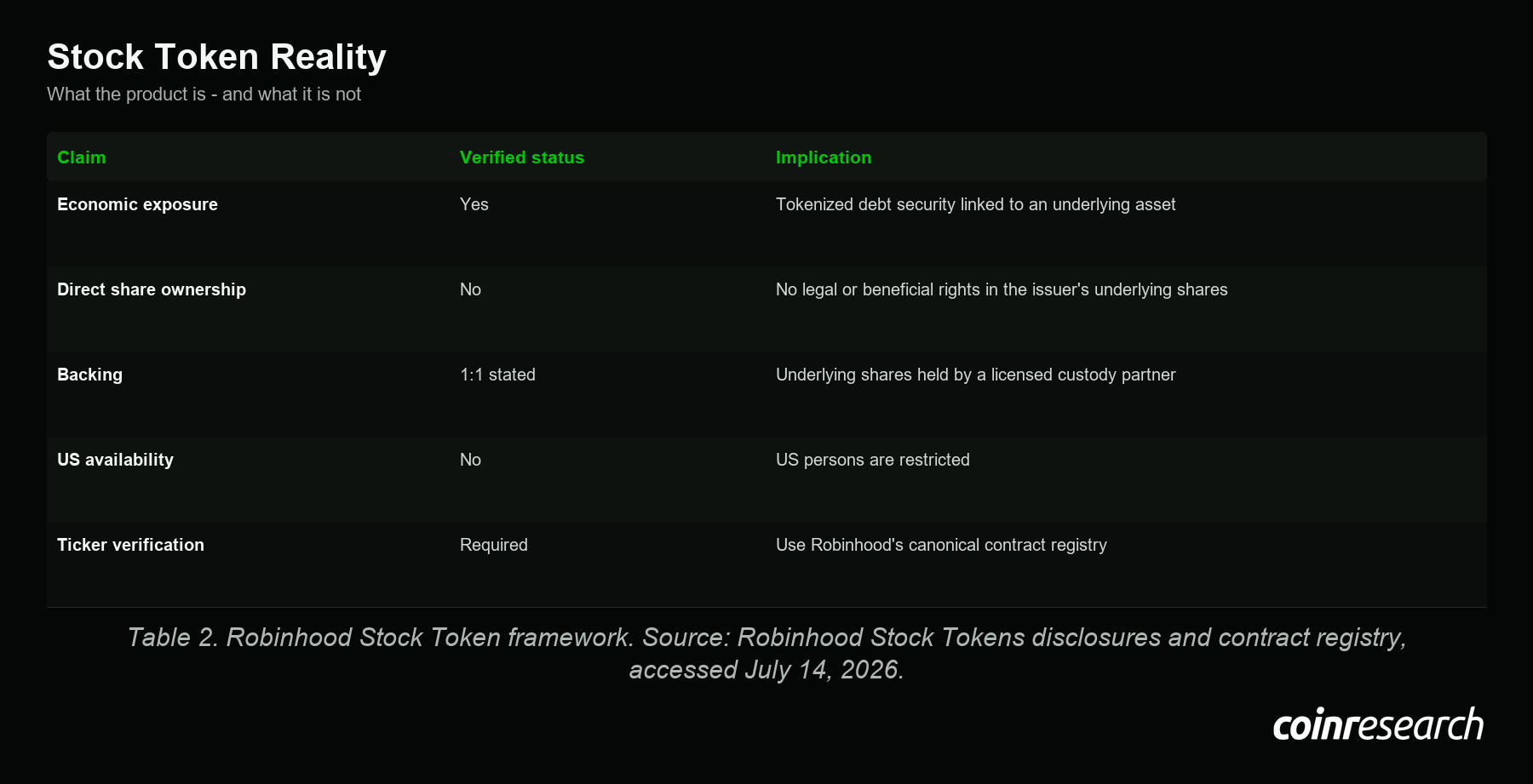
Robinhood’s disclosure is clear on this last point: its Stock Tokens are tokenized debt securities that provide economic exposure to an underlying asset. Robinhood says they are 1:1 backed, but holders do not receive legal or beneficial rights in the issuer’s underlying shares. Availability is also restricted, including for US persons and users in several other jurisdictions. That does not make the product less real. It makes it a financial product with more friction than a meme pool.
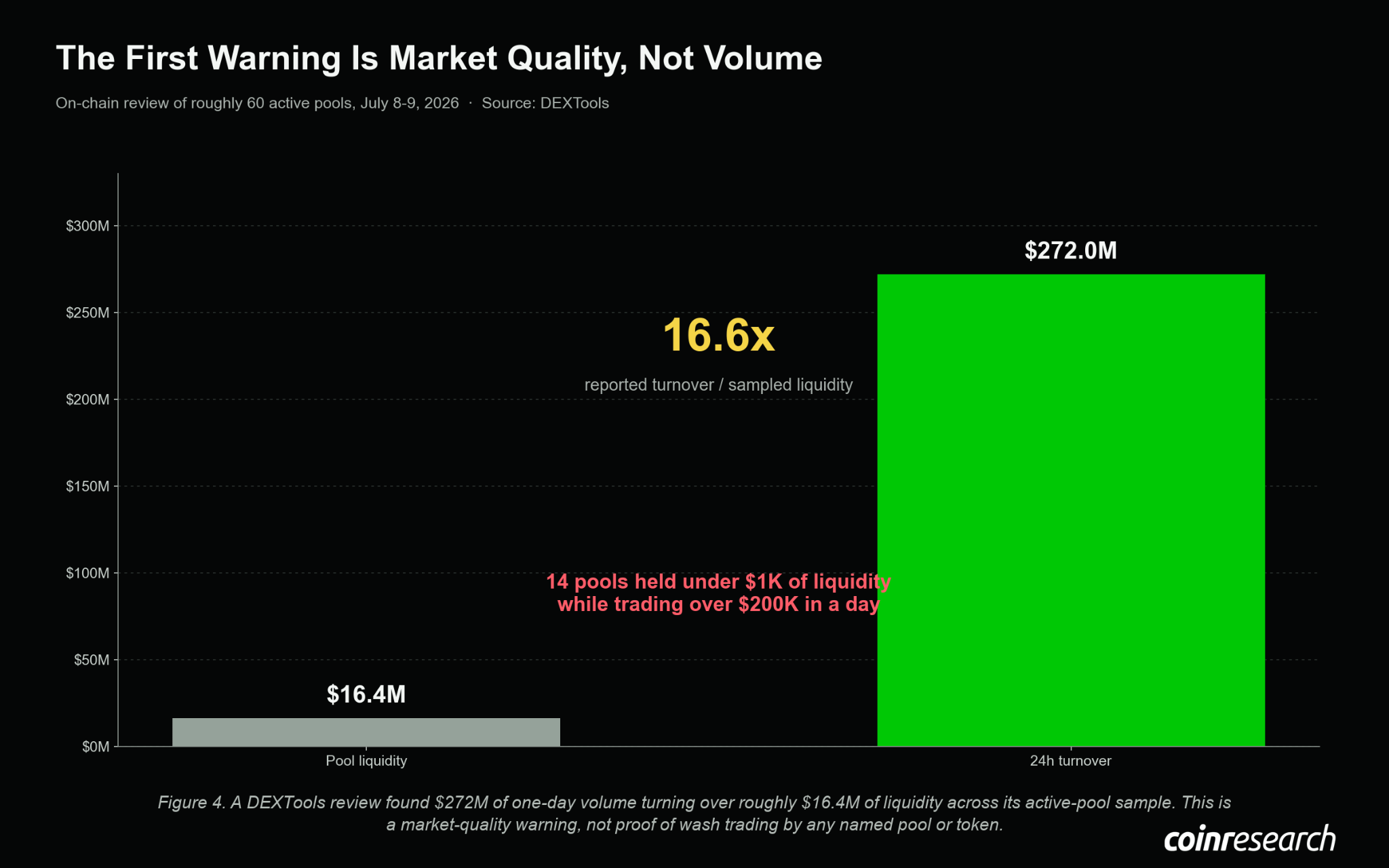
The early onchain evidence reflects that difference. A DEXTools review of active pools found approximately $16.4M of liquidity turning over about $272M in one day across its sample, with many pools identified as memecoin pools. It also estimated that Stock Tokens represented only 0.27% of early onchain transfers. These are third-party early observations, not an allegation that a named pool is wash trading, but the directional conclusion is hard to escape: early volume was overwhelmingly speculative rather than equity-market activity.
What We Are Watching Next
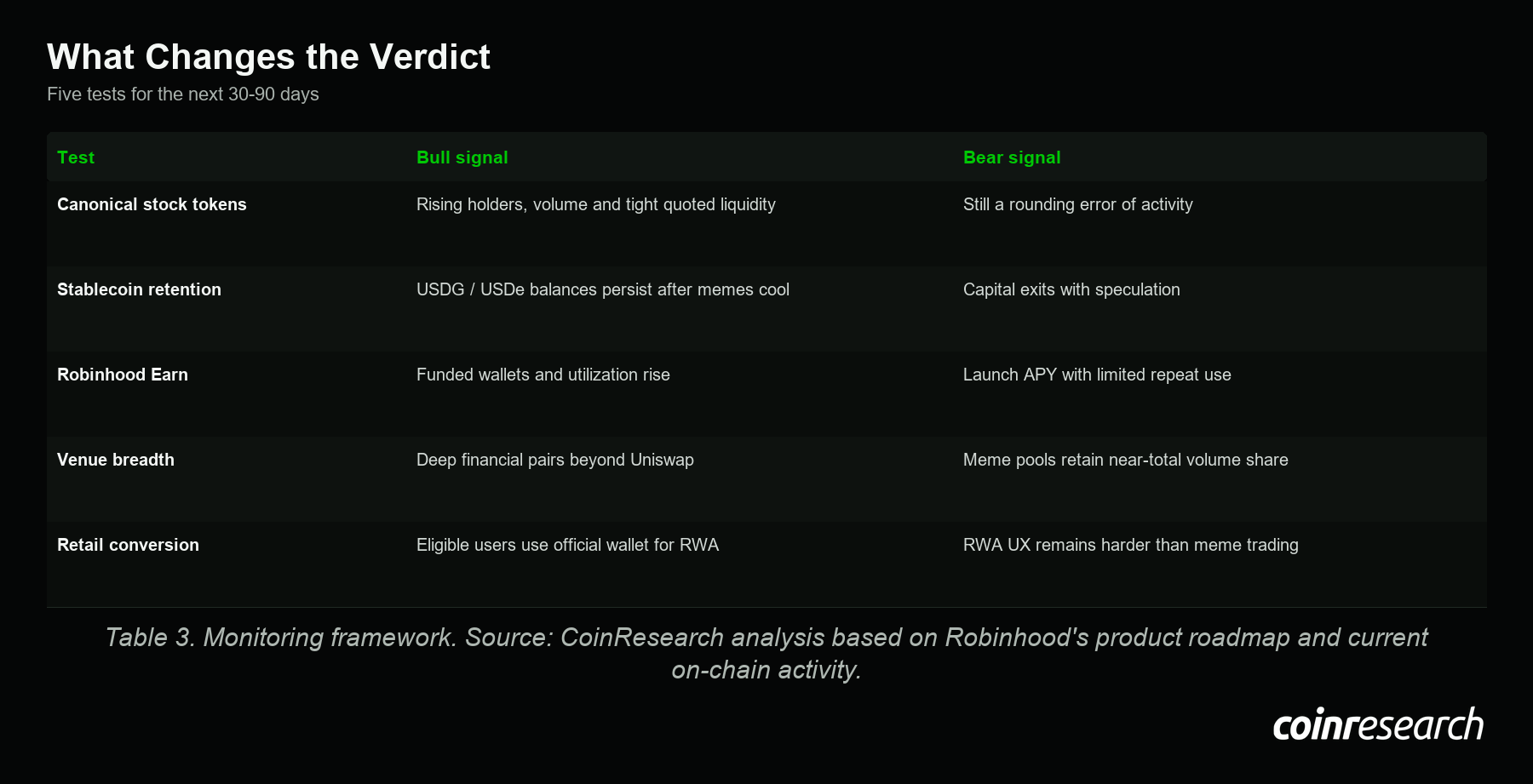
The next report should not be triggered by another large volume number. It should be triggered by proof that the quality of activity has changed.
First, watch canonical stock-token activity. The key metric is not a ticker with a familiar name. It is the volume, holder count, liquidity, and trading frequency of assets in Robinhood’s contract registry. A rising share after the meme cycle cools would validate the chain’s stated purpose.
Second, watch stablecoin retention. The $323M snapshot is a promising starting point, not a conclusion. If USDG and USDe balances remain elevated after speculative volume falls, they can support lending, collateral, and market making. If they leave with the memes, the financial base was only temporary inventory.
Third, watch Robinhood Earn usage. A headline APY is not a user habit. Funded wallets, loan utilization, borrower quality, liquidation performance, and repeat deposits will say far more about whether Robinhood can convert app users into onchain financial users.
Fourth, watch venue breadth and pool depth. Uniswap accounting for 94.4% of DEX volume is a useful launch partner signal, but it is not a healthy end state on its own. A stronger market would show deeper USDG pairs, more stock-token market makers, lending collateral turnover, and meaningful activity across integrated venues such as Rialto, Lighter, Arcus, and 1inch.
Finally, watch whether Robinhood makes the compliant path easier than the speculative one. The decisive competition is not Robinhood Chain versus Solana. It is the friction of buying a verified tokenized security versus the friction of buying a meme. If the official wallet, eligibility flow, custody disclosure, and canonical-asset verification become simple enough for ordinary retail users, the adoption curve can change quickly.
There is no native Robinhood Chain token. ETH is the gas asset. That fact keeps the analysis disciplined: chain activity is not a direct investable claim. The clean read-throughs are indirect, including HOOD for distribution and execution, ARB for the ecosystem, and the applications that capture actual fees and retained liquidity. None of them is a pure claim on Robinhood Chain volume.
The Bottom Line
Robinhood Chain has earned its headline. A chain that launched on July 1 reached $819.2M of rolling 24-hour DEX volume by the July 14 snapshot, nearly half of Solana’s $1.654B from the same source. That is not a normal launch.
But it has not yet earned the stronger headline: that tokenized stocks are the source of the activity, or that the chain has built a durable onchain financial market. The market did what permissionless markets usually do first. It traded the easiest, fastest, most reflexive assets available.
Our base case remains a speculative venue with financial optionality. The bull case is that Robinhood converts its retail distribution into retained stablecoin balances, lending, and real stock-token liquidity. The bear case is that the meme cycle fades, capital leaves, and stock tokens do not replace the turnover.
Robinhood Chain has solved attention. It now has to prove financialization.
This article is a preview of the full flagship CoinResearch report. The full report includes the scenario framework, risk matrix, methodology, and full source list.
Disclaimer: This article is for informational and educational purposes only and does not constitute financial, legal, or investment advice. Crypto assets and tokenized securities carry material risk. Conduct independent due diligence before making a decision.