
Real positions show why high Uniswap fees can produce both a 21% winner and a 15% loss, while a Stock Token generated 7.8% in gross fees before the final return was known.
Robinhood Chain has created one of the strangest liquidity environments in decentralized finance. At CoinResearch’s September 3 data pull, the network held approximately $783 million of DeFi TVL while processing about $1.55 billion of DEX volume over the preceding 24 hours. Uniswap v2, v3, and v4 carried roughly 68.5% of that daily flow.
Trading activity had arrived faster than competing liquidity, producing brief windows of unusually high fee capture. Selected positions displayed or accrued fees equivalent to roughly 0.5%-5% of capital over a day. In one Stock Token pool, an anonymized position accrued approximately $96.10 on about $1,229 of capital in roughly seven hours.
CoinResearch reviewed our own records from actual Uniswap positions on Robinhood Chain. The sample includes two positions with reconciled closing proceeds, reconstructed entry conditions, several marked outcomes, and a recent Stock Token position with verified fee accrual.
The Fee Imbalance Is Real
LP income is generated by trading flow but divided among active liquidity. A new network can therefore become attractive when users, routers, arbitrageurs, and speculators arrive faster than market-making capital. The early LP is not simply forecasting token appreciation; the LP is betting that enough two-way activity will cross a limited amount of liquidity before competitors close the gap.
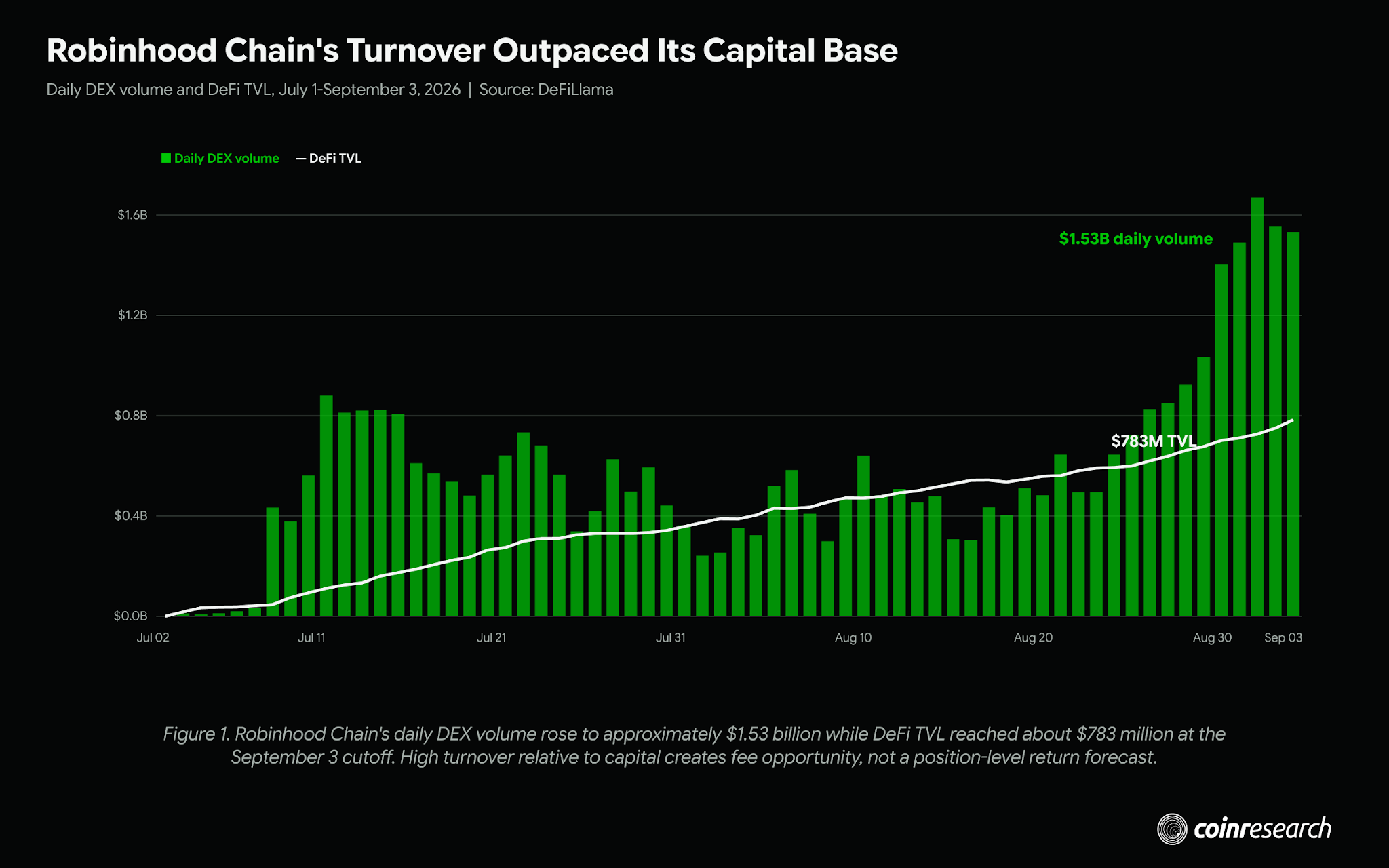
Robinhood Chain fits that setup. Within roughly two months of its July 1 launch, DefiLlama recorded about $1.55 billion of rolling 24-hour DEX volume against approximately $783 million of DeFi TVL. Uniswap carried most of the chain’s activity across daily, weekly, and monthly windows.
The chain-level ratio is still only an invitation to investigate. High volume can come from genuine users, arbitrage, routing, incentives, launch speculation, or manipulative activity. A durable pool should show persistent activity across several windows, diverse counterparties, two-way flow, credible pricing, and enough executable depth to close. The actual opportunity lives at the pool and position level.
APR Is Not What the Investor Keeps
Uniswap v3 and v4 let liquidity providers concentrate capital inside selected price ranges. While price remains in range, each dollar can earn a larger share of fees than full-range liquidity. But as price moves, the position continuously exchanges one asset for the other. At one boundary it can become entirely the volatile asset; at the opposite boundary it can become entirely the quote asset. Outside the range, it generally stops earning until price returns or the position is moved.
That makes the LP a market maker rather than a passive depositor. Four measures must remain separate: the pool fee rate paid by traders; gross pool fees generated by volume; position fees earned by the LP’s active share; and net return after inventory movement, impermanent loss, gas, rebalancing, slippage, and closing execution.
A useful first screen is fee density = trading volume x fee tier / pool TVL. A 1% pool processing $1 million against $100,000 of TVL has simple daily fee density of 10%. The same flow against $5 million has only 0.2%. Yet neither figure is a position return because liquidity is distributed unevenly across ranges and active-liquidity share changes as price and competing capital move.
Impermanent loss completes the picture. The relevant question is not whether the position gained dollars, but whether the closed position plus fees outperformed holding the original assets over the same interval. Until proceeds settle, an annualized APR describes recent flow rather than what the investor kept.
Two Settled Positions, Opposite Results
The strongest evidence is the contrast between two positions whose closing proceeds were actually reconciled. Case A began with 100 normalized units of WETH and closed with 121, a 21.0% realized return. Its pool had processed approximately $1.65 million over the prior 24 hours against about $88,000 of liquidity, equal to 18.7x volume-to-TVL and an estimated 18.68% daily fee density at the 1% tier.
The price path helped. The volatile token had declined modestly before entry, but moved back and forth rather than efficiently in one direction. That choppiness created repeated crossings through the active range without immediately forcing the position into one-sided inventory.
Case B began with the same 100-unit basis and closed with 84.8, a 15.2% loss despite earning fees. The pool reported slightly more prior-day volume, but also held more than four times as much liquidity. Volume-to-TVL was only 4.9x and estimated fee density was 4.86%. More importantly, the volatile asset had already risen 61.7% over the prior 24 hours. When that move reversed, the position converted increasingly into the falling token and the exit came too late.
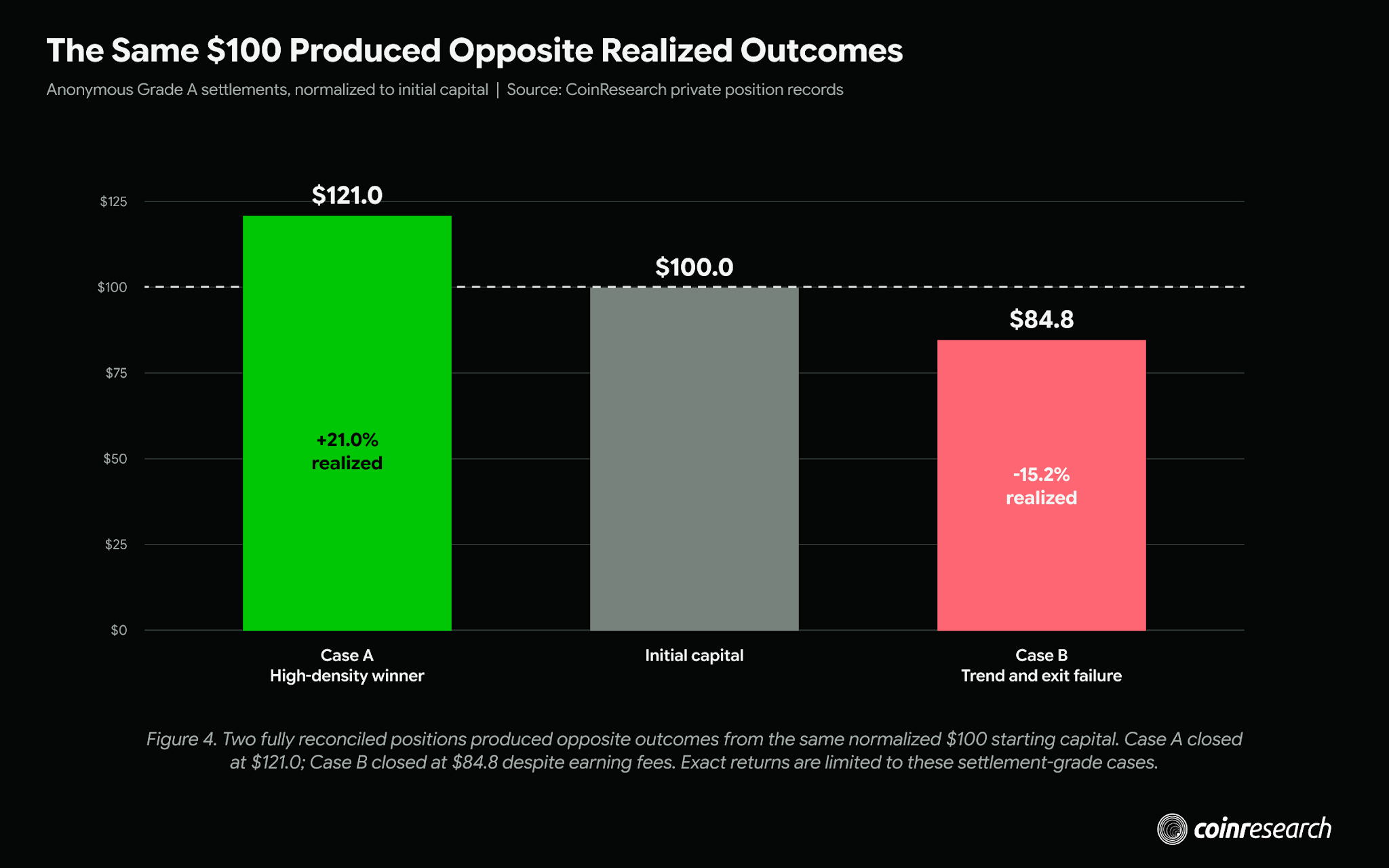
The comparison rejects two attractive shortcuts. High volume did not identify the better trade, and positive fees did not define profitability. Flow relative to liquidity, the directionality of price, range placement, and exit timing mattered more. Two observations are not a backtest, but they expose the mechanism any larger study must measure.
The Stock Token Window Was Exceptional
Robinhood Stock Tokens may offer a more durable source of turnover than memecoins because they reference assets with external markets, visible prices, and recurring investor interest. They are still not shares. Robinhood describes them as tokenised debt securities that provide economic exposure to underlying stocks and ETFs without granting legal or beneficial ownership of those securities.
For an LP, the opportunity comes from the gap between a 24/7 onchain market and a listed reference market with trading sessions, earnings, overnight news, and corporate actions. When the onchain token moves away from the reference price, arbitrage can create repeated DEX flow. Thin liquidity and a high fee tier can make that activity unusually valuable to a position near spot.
An anonymized large-cap healthcare Stock Token position shows the potential. Approximately $1,229 was deployed and about $96.10 of fees accrued in roughly seven hours, equal to 7.8% of capital before impermanent loss and closing settlement. The pool processed about $589,000 over six hours at a 1% fee tier, implying approximately $5,894 of gross fees for active LPs. Our own calculation estimates that the concentrated position captured about 1.5%-2% of the active-range flow.
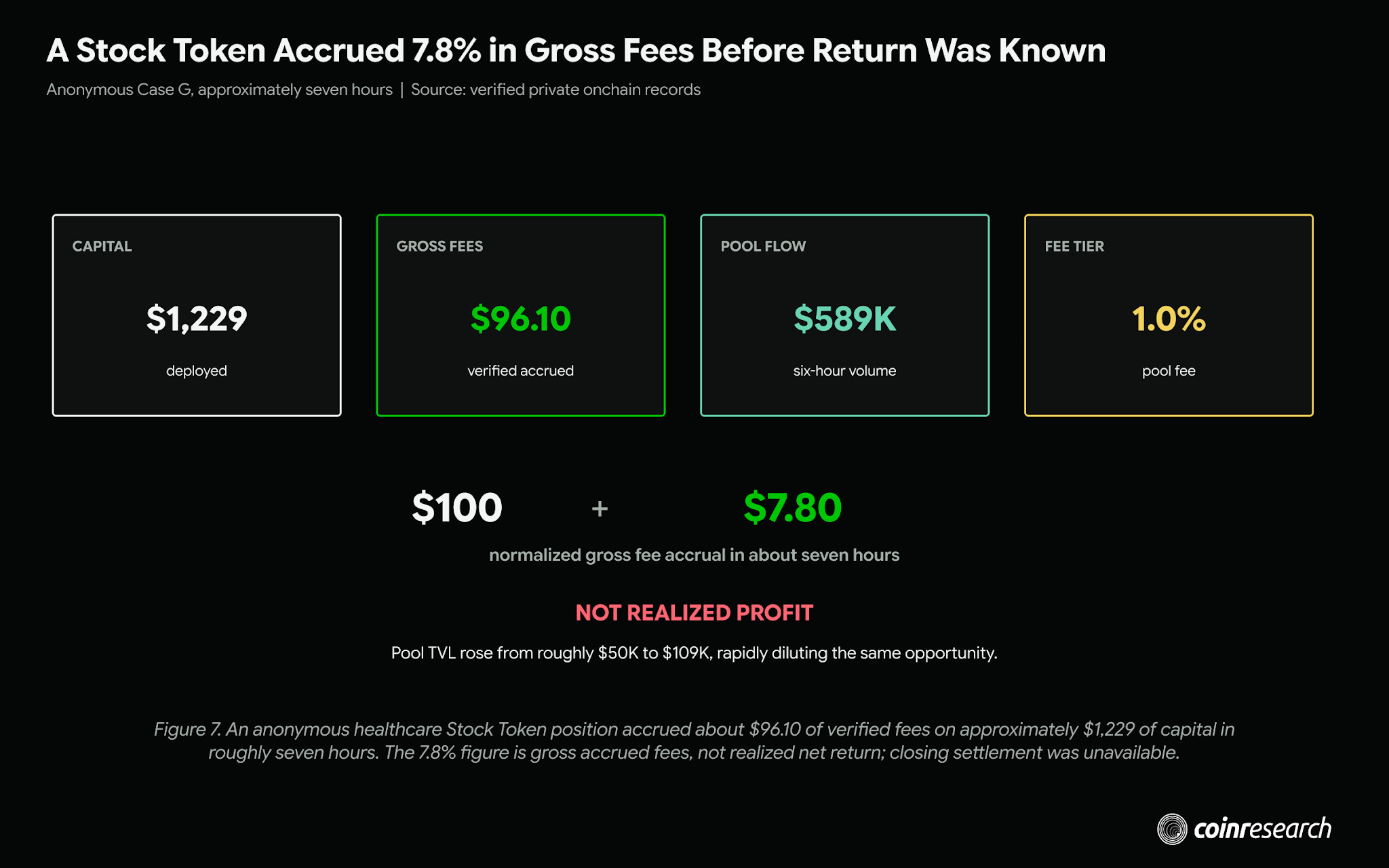
The opportunity was also diluting in real time. Pool TVL rose from roughly $50,000 near entry to approximately $109,000 at the later checkpoint. Other LPs had found the same trade. Even if volume stayed constant, doubling competing liquidity would reduce the original position’s share. Once the listed market closed, short-window volume also fell sharply, showing that a 24/7 token does not produce uniform 24/7 fee flow.
Stock Token LPs additionally underwrite the issuer and legal wrapper, the canonical contract, reference-price feeds, corporate-action handling, the stablecoin leg, Robinhood Chain infrastructure, and Uniswap execution. A familiar ticker does not create shareholder rights, and an external reference price does not guarantee a frictionless onchain exit.
One Interface Hides Three Different Trades
The Uniswap interface can make every position look similar, but Robinhood Chain offers at least three different LP trades. Memecoin/WETH pools pay for launch speculation and extreme volatility, with terminal token decline as the dominant risk. Stock Token/stablecoin pools connect onchain trading to listed references, adding gap, issuer, oracle, corporate-action, and jurisdiction risk. Major-asset/stablecoin pools offer stronger assets and deeper exits, but lower fees and professional competition make range management decisive.
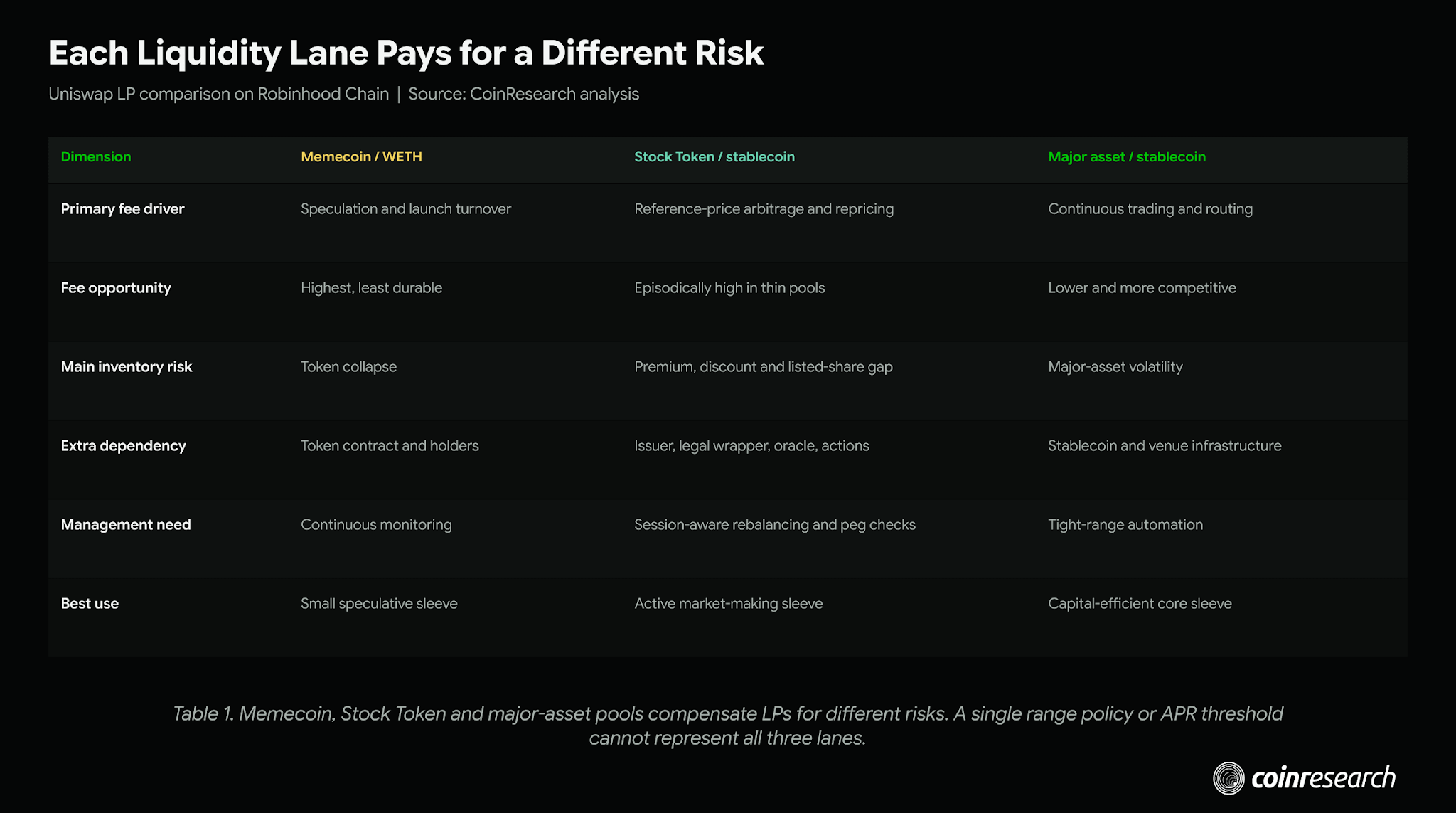
There is no universal best-pool screen. The correct question is which inventory risk the investor understands, can monitor, and is genuinely willing to own at a range boundary. The highest displayed APR may simply be the highest compensation for an asset or operating problem the interface does not show.
What Investors Should Do Before Providing Liquidity
The first test is brutally simple: would you willingly hold either asset if the position became entirely one-sided? If the answer is no, the fee rate is irrelevant. Contract integrity, transferability, sellability, holder concentration, administrative controls, minting authority, and usable exits should be checked before pool economics. Stock Tokens require added review of the legal wrapper, price feed, corporate-action mechanics, jurisdictional restrictions, and stablecoin leg.
Next, measure market quality rather than volume alone. Compare five-minute, hourly, six-hour, and daily activity; look for diverse buyers and sellers, persistent two-way flow, and executable depth. Calculate fee density with consistent windows, estimate liquidity active near spot, and consider whether the proposed deposit materially dilutes the opportunity it is trying to capture.
The range and exit must express a plan. Model what the position will own at each boundary, how long it may remain active, and what an overnight or weekend gap would do. Define the maximum loss, monitoring interval, inventory warning, and closing procedure before entry. Track fees separately from position value, compare the result with holding the original assets, and reconcile final proceeds onchain.
These controls do not make the strategy safe. They make the risk visible before a passive-income interface turns market making into something it is not.
The Bottom Line
Robinhood Chain’s LP opportunity is credible because trading flow has, at times, exceeded the liquidity available to absorb it. CoinResearch’s own evidence captures the tension: one position realized a 21.0% gain, another lost 15.2%, and a Stock Token position accrued 7.8% of capital in gross fees before the final return was known.
The edge, if it exists, is not high APR. It is finding dense, persistent, two-way flow before competing liquidity arrives; placing a range that can survive the price path; and closing before adverse inventory conversion erases the fees.
Our current conviction is Speculative. Robinhood Chain LPing may suit a small, actively managed allocation for investors who understand concentrated liquidity and can tolerate holding either asset. It is unsuitable for predictable income, principal stability, or unattended capital. The thesis strengthens only when prospectively defined rules produce positive median net returns across at least ten fully settled positions.
The full CoinResearch report includes the complete anonymized case audit, entry-condition reconstruction, fees-to-impermanent-loss framework, risk matrix, scenario analysis, monitoring dashboard, and due-diligence process.
This article is for information and education only. It is not investment, legal, tax, or trading advice; it is not an offer or solicitation; and it does not recommend entering a named pool or copying a position. Liquidity provision can result in partial or total loss, and historical fee observations do not indicate future returns.