
Goldman Sachs sold every share of its $108 million SOL position. Three weeks later, SOL printed its 2026 low at $62. Here’s the anatomy of the exit, and where the money actually went.
Solana’s ETF was supposed to be the demand machine. Instead, it top-ticked the cycle.
In October 2025, Solana became only the third cryptocurrency to get a US spot ETF. The story sold itself: regulated access, staking yield inside a ticker, the institutional bid finally arriving. Goldman Sachs showed up in the filings as one of the largest holders of SOL and XRP fund products.
Seven months later, SOL trades at $65, down 77.8% from its $293.31 all-time high. And Goldman owns exactly zero shares of every SOL fund it held.
Here’s the detail nobody puts on the conference slide: SOL has not made a higher high since October 2025. The month the ETFs launched. The institutions didn’t arrive to buy the asset. They arrived to rent the trade.
What Actually Happened
The breakdown came in two acts. Act one: a Form 13F filed on May 15, 2026, revealing Goldman had zeroed its entire SOL ETF position in Q1. SOL was trading near $84. Funding rates flipped from +8% to negative 3% in three days, the fastest bearish swing since February.
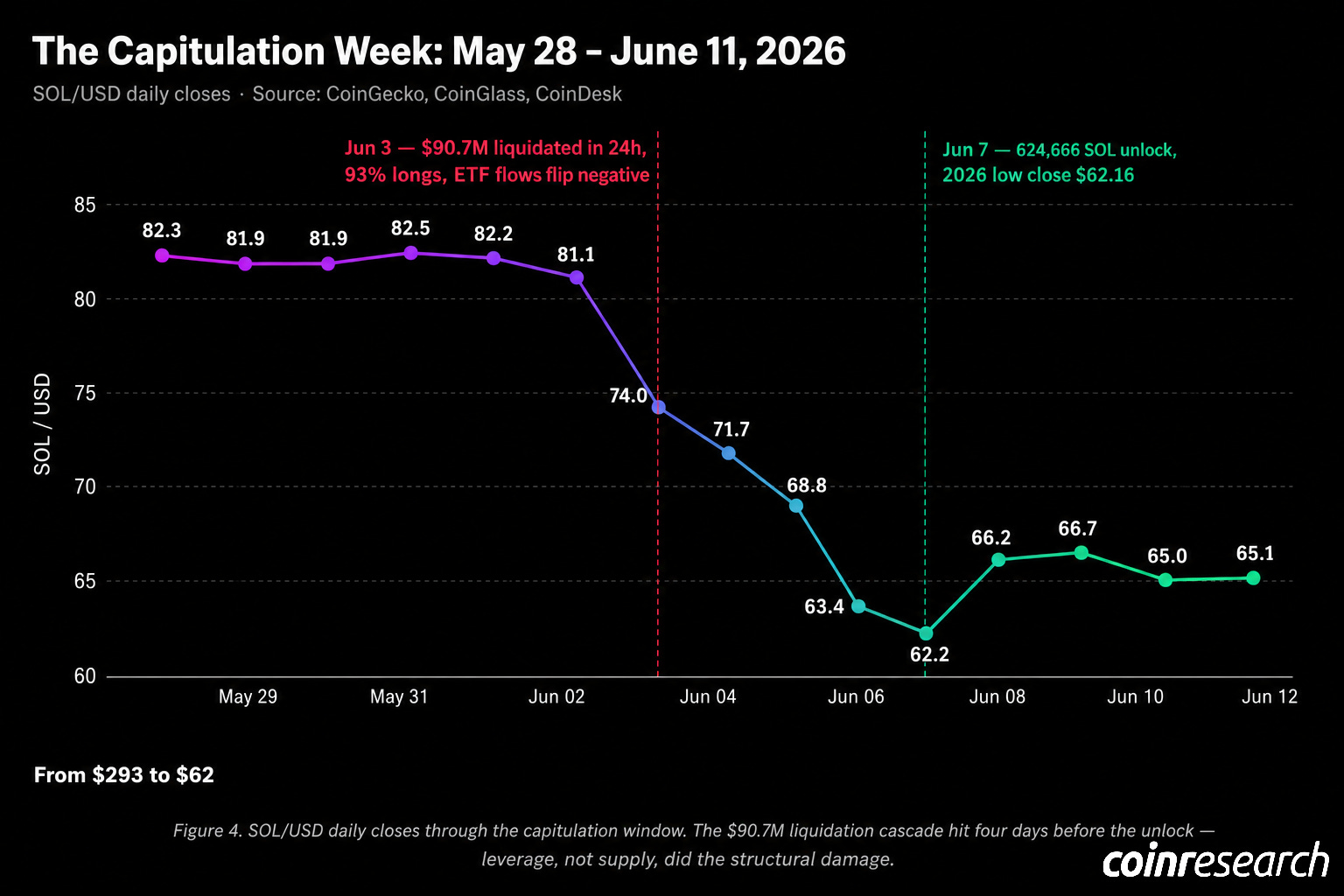
Act two: the first week of June. SOL fell from $81 to a $62.16 low close on June 7, with intraday prints at $61.53. That’s the lowest price since December 2023. The bounce since has stalled at $65, below the broken $70 support.
A 77.8% drawdown is a number. The sequence behind it is the story.
The Filing That Ended the Honeymoon
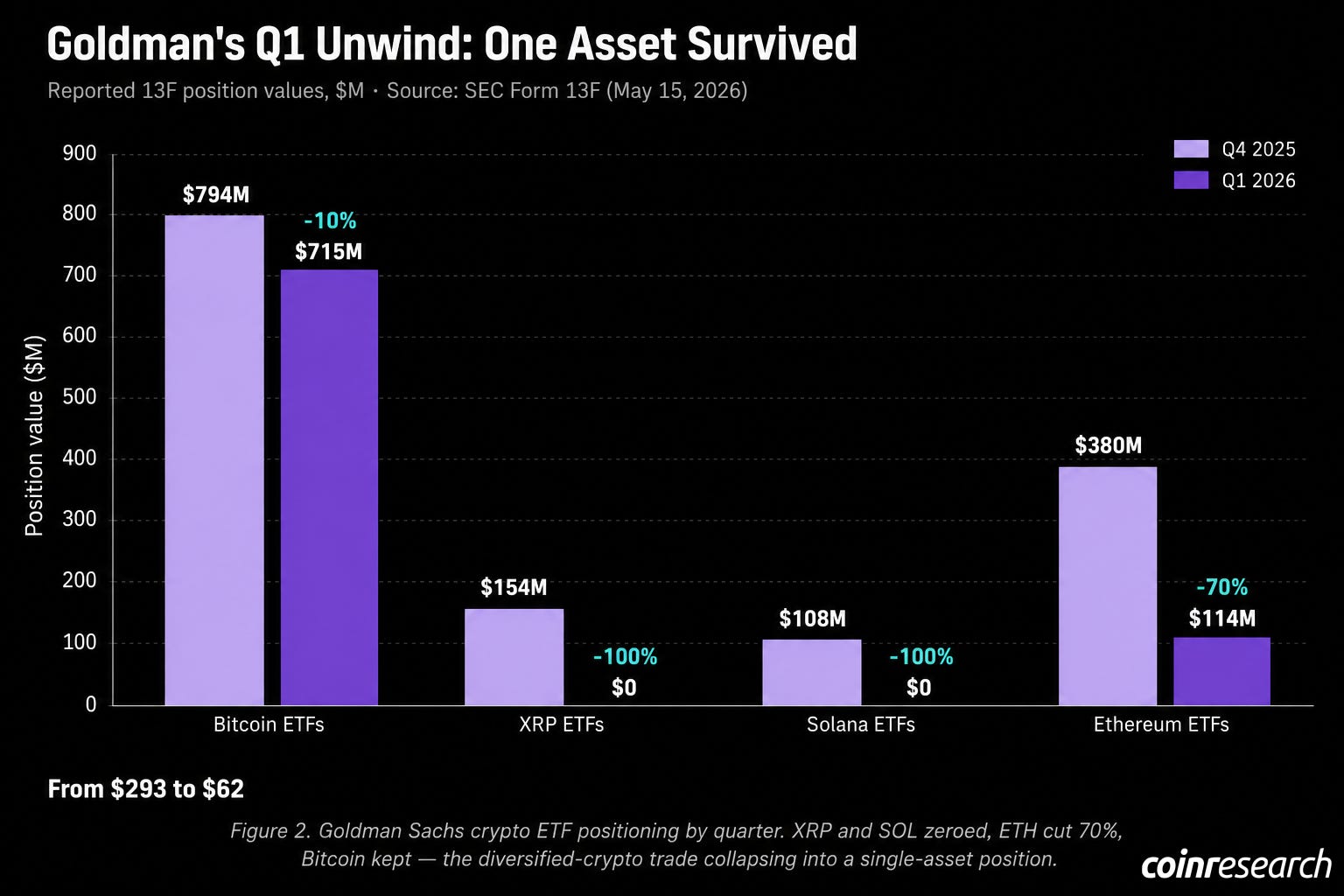
Goldman’s 13F didn’t just exit Solana. Read as one decision, it executed the death of the “diversified crypto” trade:
-
Solana ETFs: $108 million, zeroed. Positions across Grayscale, Bitwise, Fidelity, VanEck, 21Shares, and Franklin Templeton, all gone in one quarter.
-
XRP ETFs: $154 million, zeroed.
-
Ethereum: cut 70%, down to roughly $114 million via BlackRock’s ETHA.
-
Bitcoin: kept. Roughly $715 million, trimmed just 10%.
One asset survived. The bank now treats Bitcoin as the only crypto with durable institutional characteristics. Everything else was a tactical position that ran out of tactics.
One Fund Is the Entire Market
Here’s the structural weakness the bull case never priced: the SOL ETF category isn’t a category. It’s one fund.
Cumulative spot SOL ETF inflows crossed $1.06 billion on May 26. Of that, roughly $861 million sits in a single product, the Bitwise Solana Staking ETF. That’s 81% of every dollar ever allocated to the entire complex.
And the cruel part: SOL ETF investors were the last believers. While Bitcoin funds bled $4.37 billion across 13 straight sessions, Solana ETFs posted their best month since launch, roughly $106 million of May inflows.
Then June 3 happened. SOL funds flipped to a $12.74 million daily outflow, $11.56 million of it from BSOL alone. When 81% of a category is one fund, that fund’s redemption day is the category’s redemption day.
The Unlock Didn’t Break the Market. Leverage Did.
The June 7 unlock of 624,666 SOL got the headlines. It didn’t deserve them. At prevailing prices that’s roughly $40 million of supply, in an asset trading $5 to $10 billion of futures volume daily. Historically most unlocked SOL gets staked, not sold.
The real damage came June 3 and 4: $90.68 million in SOL positions liquidated in 24 hours. $84 million of it was longs. A 93% one-sided wipeout, 2.8x the weekly average liquidation rate, over 12,000 traders flushed. Market-wide, forced selling crossed $1.7 billion in a day, the heaviest since mid-2024.
The leverage flush took SOL from $81 to $69 first. The unlock landed four days later into a market stripped of bid and simply timestamped the bottom.
Where the Money Actually Went
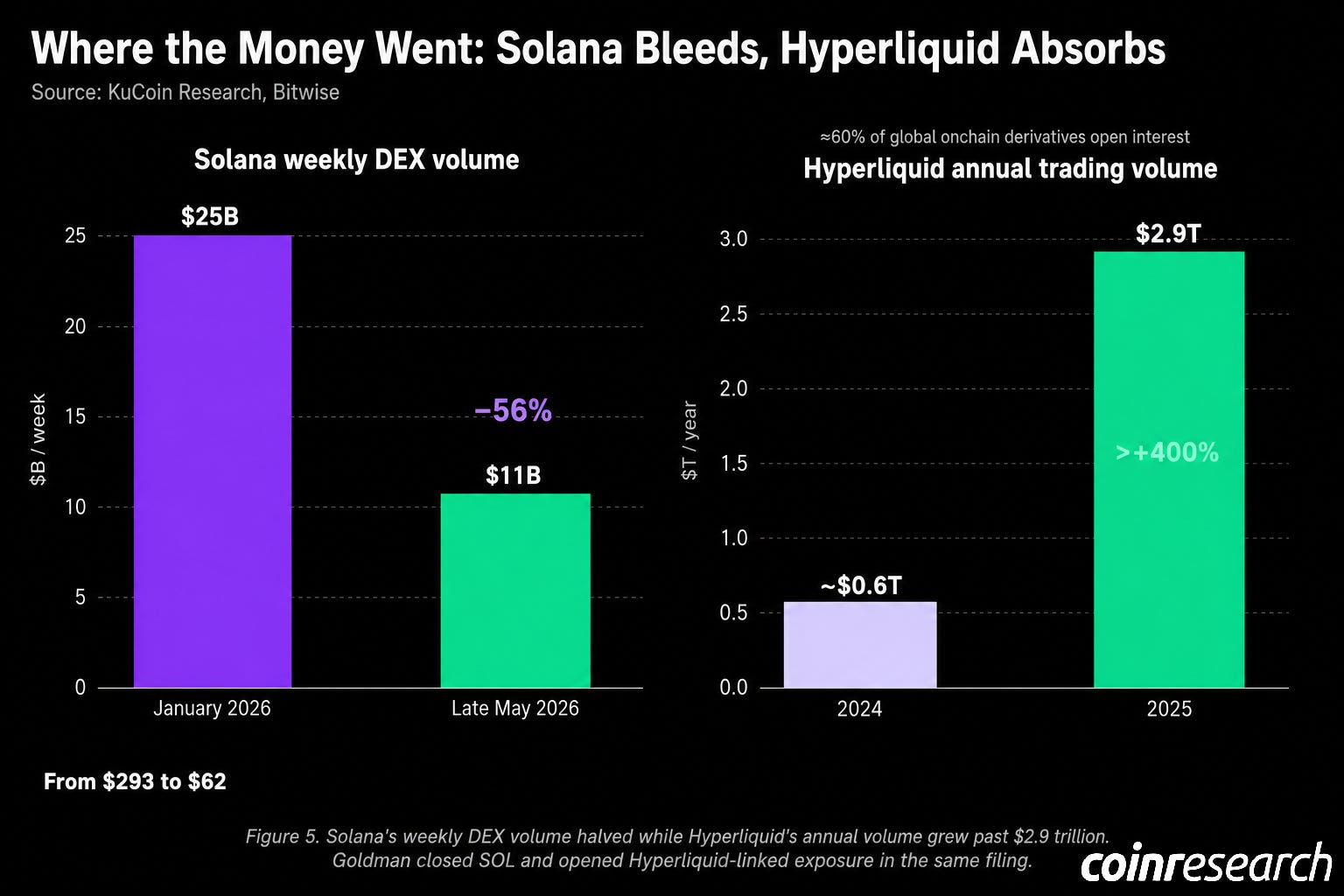
The lazy reading is “institutions are leaving crypto.” Goldman’s own filing refutes it. The same 13F that zeroed SOL opened a new position in Hyperliquid-linked infrastructure.
Hyperliquid processed roughly $2.9 trillion in trading volume in 2025, up more than 400% in a year, and now holds close to 60% of global onchain derivatives open interest. During June’s carnage, Hyperliquid-linked HYPE ETFs were the only crypto fund category drawing net inflows.
The rotation has a fundamental driver. Solana’s own weekly DEX volume has collapsed 56% since January, from $25 billion to roughly $11 billion, with Hyperliquid and Base taking the share. Goldman’s bet, in plain language: the venue where trading happens captures the value, not the chain underneath it.
The Retreat Is Bigger Than One Bank
The Q1 filings tell a consistent story across the street. Harvard’s endowment cut its IBIT stake 43% and fully closed an $86.8 million Ethereum ETF position it had added only the prior quarter. Jane Street slashed IBIT roughly 71%.
The pattern: concentrate into Bitcoin, exit the altcoin wrappers, express altcoin views through equities and infrastructure instead of tokens. The “institutional altcoin era” everyone sold in 2025 lasted about two quarters.
But the institutions are not unanimous. Morgan Stanley filed for its own Solana Trust and built rails letting wealth clients convert held SOL directly into ETF shares. One bank is selling the trade. Another is building the next on-ramp.
What’s Next, and the Risks
The contrarian setup is real: open interest near $4.4 billion is the lowest since April 2025, funding has reset negative, and the marginal seller, Goldman, cannot zero its position twice. SOL also enters this drawdown with regulatory clarity no prior cycle had, after the SEC and CFTC jointly classified it as a digital commodity in March.
The risks are equally real. A weekly close below $60 opens the air pocket toward the $43 demand zone. BSOL flows are the single point of failure: if the one fund that is the category keeps redeeming, there’s no ETF bid left. And the DEX volume bleed to Hyperliquid is a fundamental problem no bounce fixes.
Our base case is repair, not collapse: a grind between $60 and $80 through summer, with the August 13F window revealing who bought what Goldman sold.
The Bottom Line
Solana’s 77.8% drawdown wasn’t caused by its technology. It was caused by the discovery that “institutional adoption” was one bank’s tactical trade and one fund’s inflow streak. The smart money didn’t leave crypto. It left the token and bought the venue. The next leg, up or down, gets decided by whoever shows up in the Q2 filings.
This article is a preview of our full flagship Intelligence Report on Solana’s institutional exit.
Read the complete deep-dive — including the full technical levels map from $60 to $97, three scenario probability breakdowns with specific price targets, the complete Goldman 13F position-by-position data, and separate actionable guidance for new vs. existing SOL investors — on
Coinresearch delivers institutional-grade crypto research for investors who want signal, not noise.
Disclaimer: This article is for informational purposes only and does not constitute financial or investment advice. CoinResearch analysts may hold positions in assets discussed. Cryptocurrency investments are highly volatile and speculative. Always conduct your own due diligence before making any investment decisions.