
Why the chain with the strongest fundamentals still trades like a “speculative L1”
Solana closed 2025 in a strange place.
On one hand, it led the entire industry in on‑chain fee revenue and application earnings, processed more non‑vote transactions than any other general‑purpose chain, and quietly became the home for tokenized treasuries, equities, and high‑velocity stablecoin settlement.
On the other, SOL spent most of Q4 and early 2026 trading 40–50 percent below its cycle highs, even as spot ETFs, RWAs, and Western Union’s stablecoin lined up behind it.
This disconnect between utility and valuation is the core of our Solana 2026 thesis.
TL;DR
-
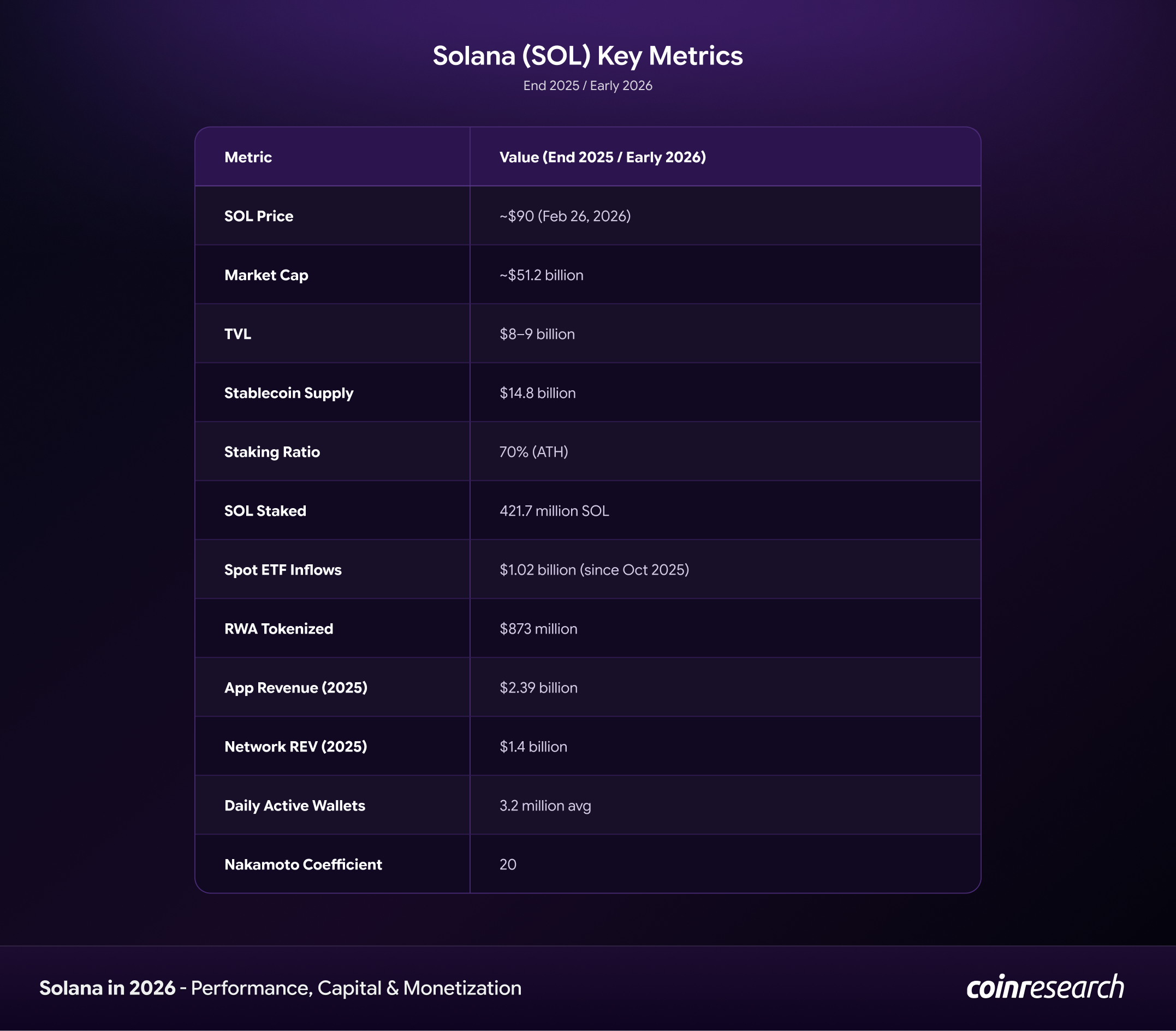
Highest‑revenue L1, still priced like beta. Application revenue reached roughly 2.4 billion dollars in 2025 with about 1.4 billion of “real economic value” (REV) accruing to the chain – yet SOL trades materially below peak multiples.
-
Capital stack is real, not hypothetical. Stablecoin supply sits near the mid‑teens in billions, RWA value is closing in on the 1 billion mark, and spot ETFs added over 1 billion in net inflows within months of launch.
-
Technical roadmap is non‑cosmetic. Alpenglow and Firedancer meaningfully change finality, client diversity, and validator economics rather than adding marginal features.
-
But the risks are non‑trivial. REV collapsed into Q4, validator count is down almost 70 percent from its peak, and a small set of wallets and apps still drive the majority of fees.
The result: Solana is already the most productive general‑purpose chain by several metrics – but investors still treat it as “the fast chain with memecoins”.
1. 2025: A Breakout Year With an Ugly Q4
In the first half of 2025, Solana looked unstoppable: quarterly REV climbed into the mid‑hundreds of millions, DEX volume pushed into the trillions, and seven individual apps crossed 100 million dollars in annual revenue.
Then the memecoin cycle rolled over.
By Q4, chain‑level REV had fallen more than 80 percent from its January peak. The same fee engine that made Solana the revenue leader revealed how dependent the system still is on speculative trading flows.
Two things are true at once:
-
The ceiling for Solana’s monetization is higher than any other L1 today.
-
The floor is still being discovered.
Our full report decomposes 2025 revenue into four buckets – base fees, priority fees, MEV tips, and voting fees – and maps which application verticals actually paid the bills.
2. Capital Formation: From “TVL” to a Real Balance Sheet
The more interesting story sits on the balance sheet side.
Stablecoins. Solana’s stablecoin base grew to nearly 15 billion dollars in 2025, with USDC still dominant but PYUSD and newer programmatic dollars gaining share. Unlike Ethereum L1, this supply actually turns over: settlement velocity is materially higher, which matters if you care about these rails being used as money rather than static collateral.
Real‑World Assets. Tokenized treasuries, yield products, and equities on Solana are no longer slideware. BlackRock’s onchain fund, Ondo’s products, and a growing cluster of tokenized stocks brought the chain’s RWA footprint to the high‑hundreds of millions by year‑end – and Solana captured the overwhelming majority of tokenized equity trading volume.
ETFs. The spot ETF complex is still young, but the early signal is strong. Within weeks of launch, Solana ETFs crossed the billion‑dollar mark in net inflows, with some vehicles staking their holdings to turn SOL exposure into a yield product by default.
When you stack these together, Solana starts to look less like “an L1 with high TPS” and more like a functioning, if early‑stage, onchain balance sheet.
3. Why Alpenglow and Firedancer Actually Matter
A lot of chains have upgrade roadmaps. Few of them meaningfully change the economic profile of the system.
Solana’s 2026 technical agenda is different:
-
Alpenglow compresses finality into the sub‑second range by moving vote aggregation off‑chain and redesigning how blocks are confirmed. It also introduces a new validator admission design aimed at lowering the cost base for operators.
-
Firedancer is a completely independent client stack from Jump. It removes the single‑client risk that has historically contributed to outages and lifts theoretical throughput into the millions of TPS range.
Together, these upgrades move Solana toward behaving like a high‑performance clearing and settlement switch – the kind of infrastructure RWAs, ETFs, and global stablecoins actually want to sit on.
Our full report spends an entire section on how Alpenglow’s VAT system, MEV markets (via Jito), and client diversity interact with validator economics and fee capture.
4. 2026: Three Levers That Matter
We frame Solana’s 2026 path around three macro levers:
-
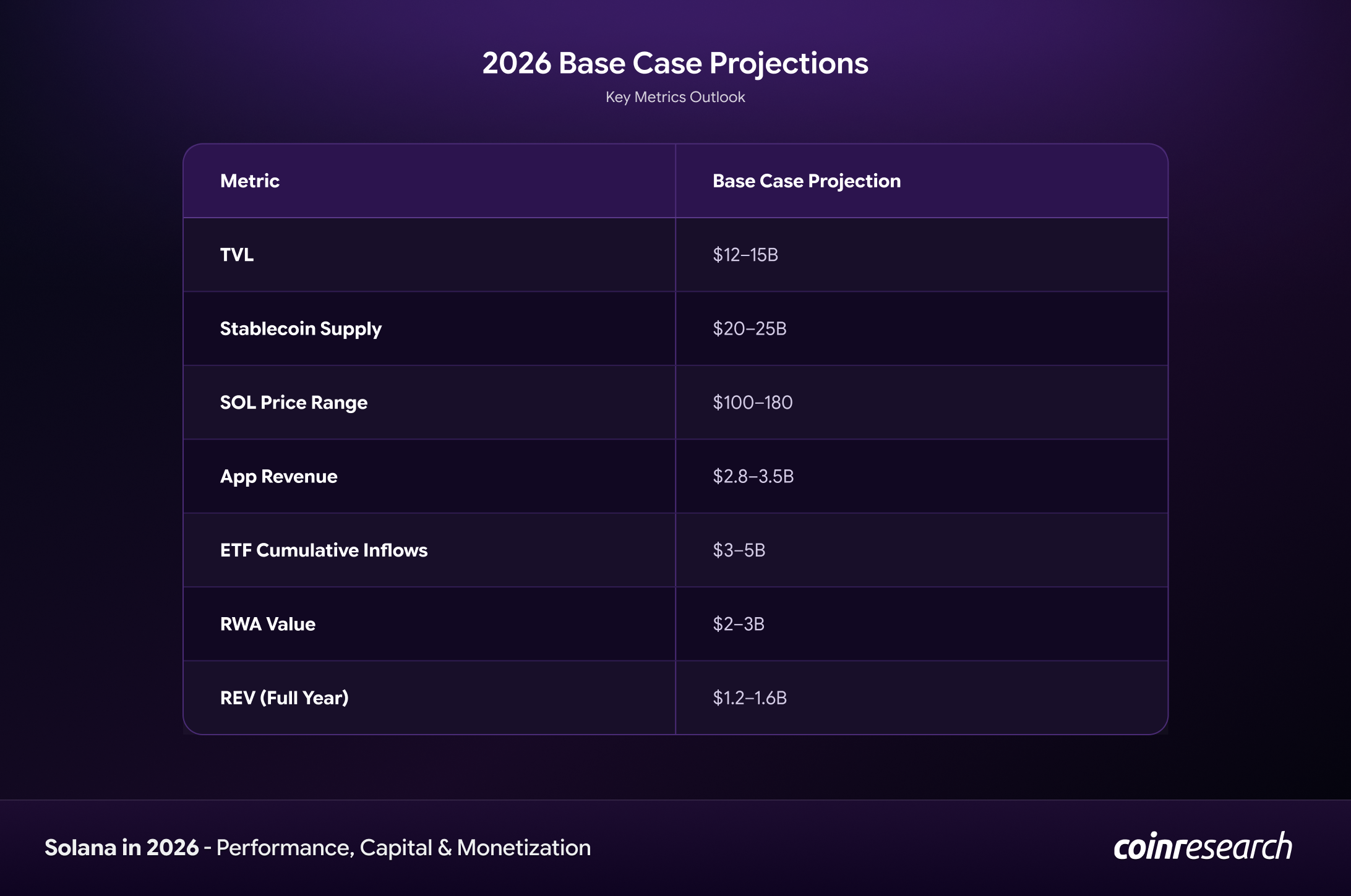
ETF trajectory. Does the current inflow profile continue, flatten, or reverse? The difference between 3–5 billion versus 10+ billion in cumulative ETF assets over the next cycle materially changes the SOL demand curve.
-
RWA scale. Do tokenized treasuries and equities stay a niche, or does Solana become a default pipe for real‑world yield? Regulatory outcomes around stablecoins and market structure will decide how far this can go.
-
Payment and agentic flows. Western Union’s Solana‑based stablecoin, fintech rails, and AI‑agent payment standards like x402 are early tests of whether Solana can capture recurring non‑speculative flows in size.
Our scenario modeling section in the full report spans base, bull, and bear cases for TVL, stablecoin supply, RWA value, app revenue, and ETF inflows – and ties each to specific catalysts and risk events.
5. Where the Thesis Can Break
We also don’t think about this as a one‑way trade.
Key failure modes:
-
ETF and RWA flows never reach escape velocity and Solana remains structurally over‑indexed to speculative trading.
-
Fee markets are optimized so aggressively for UX that, in downcycles, the chain struggles to pay validators from organic revenue.
-
Validator count and Nakamoto metrics continue to drift lower, constraining the types of institutional capital that can hold SOL in size.
-
A small cluster of launchpads and trading venues continues to dominate GDP; any regulatory attention or rotation away from Solana would hit revenues disproportionately.
The core question for institutional allocators is simple: do the structural positives (cash‑flow potential, capital stack, technical roadmap) outweigh these execution and market risks over a 3–5 year horizon?
Our answer today is “yes – at the right entry range and sizing.”
Solana now sits at a rare intersection: the highest‑earning L1, a growing RWA and ETF stack, and a still‑unresolved decentralization and revenue‑quality story. For serious capital, this is exactly when the work matters most – before the narrative catches up to the numbers.
To go deeper, CoinResearch has published a full institutional-style report on Solana’s 2026 outlook – including:
-
Detailed Chain GDP & REV breakdowns by quarter and sector
-
Stablecoin, RWA, and ETF flow charts and projections
-
Deep dive on Alpenglow, Firedancer, and Jito MEV from an economic, not just technical, perspective
-
Base / bull / bear valuation and SOL demand models
-
Segment‑specific sections for long‑only allocators, active traders, validators, and ecosystem builders
Get premium access to the full report on CoinResearch for just $9/month
Unlock the complete Solana 2026 research, plus all future premium coverage across majors, RWAs, and new primitives.
Disclaimer: This report is for informational purposes only and does not constitute financial advice. All data is sourced from publicly available information as of February 2026. Investors should conduct their own due diligence and consider their risk tolerance before making investment decisions. Crypto assets are highly volatile and may result in total loss of capital.