
Native staking pays 6.2%. Active DLMM positions on the same chain are clearing 40–70% on fees alone. Here’s what changed — and why most LPs still can’t capture it.
The “yield” most Solana users earn is the worst trade in the ecosystem.
For two cycles, staking has been the default. Lock SOL, earn 6–7%, repeat. The mental model was savings-account-with-extra-steps. The marketing was built around it.
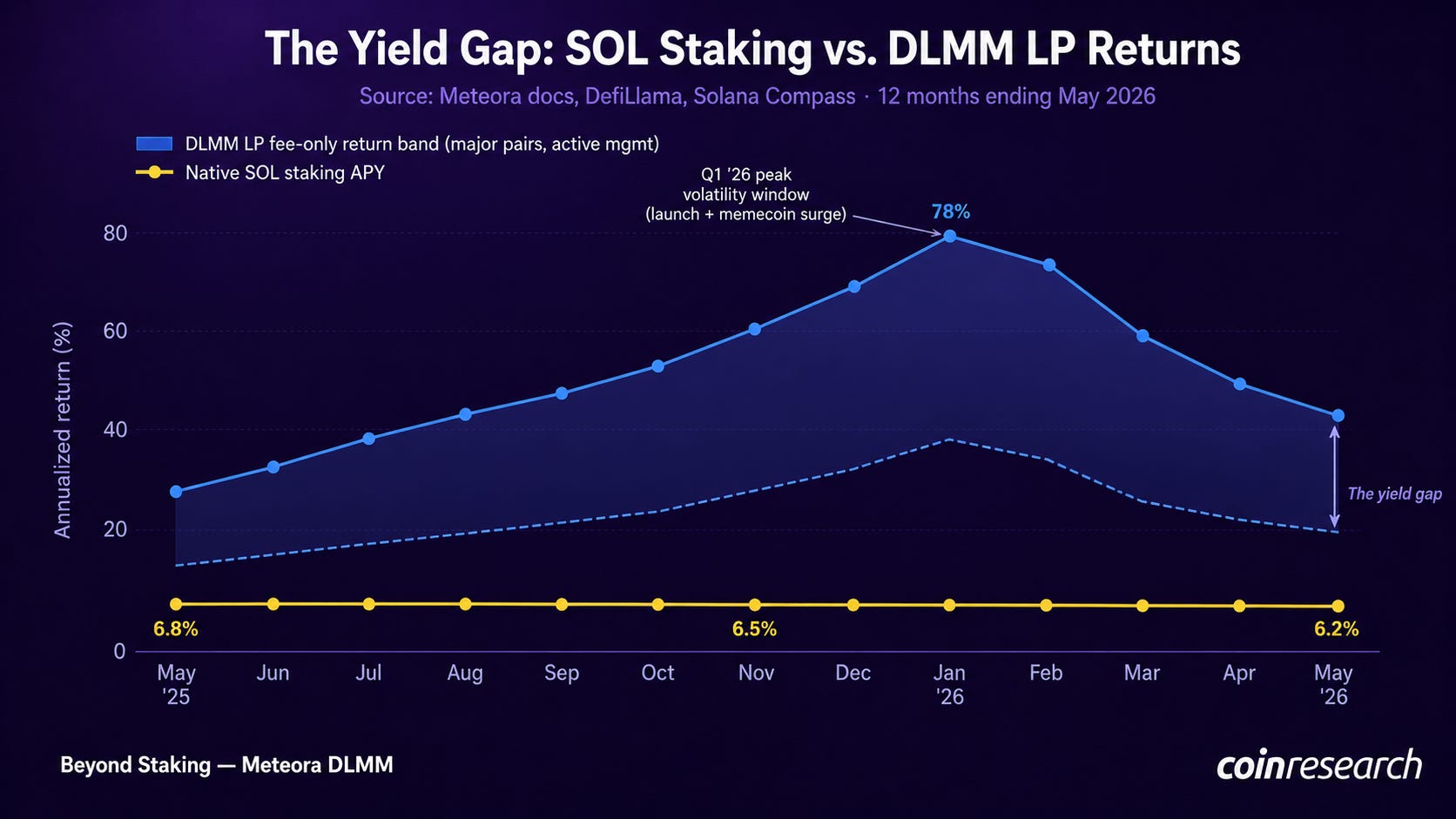
That model is quietly breaking. Solana’s inflation curve is structurally tapering — issuance falls 15% every year toward a 1.5% floor. Native staking yields have compressed from 6.8% to 6.2% over the past 12 months alone. The “set and forget” return has been declining for three years and is forecast to keep declining.
Meanwhile, on the same chain, well-managed DLMM positions on major pairs have returned in a 20–80% annualized fee-only band — excluding impermanent loss, excluding any LM rewards. At the January 2026 volatility peak, top-decile positions cleared above 78% annualized on fees alone.
Same chain. Same denominator currency. Same time period. Two completely different numbers.
What DLMM Actually Is
The Dynamic Liquidity Market Maker (DLMM) is Meteora’s bin-based concentrated liquidity protocol. Technically it descends from Trader Joe’s Liquidity Book; conceptually from Uniswap v3. But it adds something neither predecessor had: real-time dynamic fees that surge with market volatility.
Strip it to first principles. Classical AMMs spread a liquidity provider’s capital across a continuous price curve from zero to infinity. 99% of that capital never gets touched. DLMM divides the price space into discrete bins — narrow price zones where trades execute with zero slippage. LPs choose which bins to deposit into, concentrating capital where trading actually happens.
Three properties matter:
-
Bin step controls granularity. Tight bin steps (1, 5, 10) suit stablecoin pairs. Wide steps (80, 100, 125) suit volatile memecoins.
-
Dynamic fees compensate for volatility. When price moves quickly, the volatility accumulator rises and per-swap fees surge — up to 2% during volatility spikes from a 0.01% base.
-
Single-sided liquidity is supported. Bid-only or ask-only setups, breaking the rigid 50/50 capital requirement that constrained AMM strategies for years.
An LP on DLMM isn’t a passive depositor. They’re choosing a price zone, a bin step, a range width, and a distribution shape. It’s retail-accessible market making.
Where the Yield Actually Comes From
The structural difference isn’t operational. It’s the source of income.
Native staking pays inflation. New SOL is minted on a fixed schedule, validators secure the network, a portion of the issuance flows to stakers. The yield is printed. When emissions taper or the underlying token weakens, the dollar value falls in lockstep.
DLMM pays swap fees from real traders. The yield is earned. It scales with realized volume and volatility. It doesn’t depend on the protocol minting more of itself.
The take rate makes the difference concrete: Meteora returns 95% of every swap fee to LPs on DLMM, retaining only 5% for the treasury. That’s the highest LP share across Meteora’s own product stack. In FY2025, DLMM facilitated $168.3B in trading volume and earned the LP cohort approximately $820M in distributable fees.
Earned yield > printed yield. Especially when the printer is slowing down.
Why Solana, Why Now
DLMM isn’t a Solana-only mechanism in principle — concentrated liquidity has been on Ethereum since 2021. But it’s Solana-only in practice. Why? Unit economics.
Adjusting a DLMM position requires touching the chain, sometimes many times per day. On Ethereum L1, a single rebalance can cost more than a day’s fees on a $500 position. On Solana, it costs fractions of a cent. The mechanism only survives on a chain that lets the operator iterate cheaply.
The volume backdrop reinforces this. Solana monthly DEX volume peaked above $95B in late 2025 and has since contracted to roughly $35B — a 63% drawdown as the launch meta cooled. But Meteora DLMM’s share of Solana DEX volume has risen through the contraction, climbing toward the low-twenties. The active LP cohort is staying engaged while passive capital is leaving.
This is what a regime change looks like in slow motion.
The Pareto Problem
Here’s the part nobody puts in the pitch deck: this is not a yield product in the way staking is a yield product.
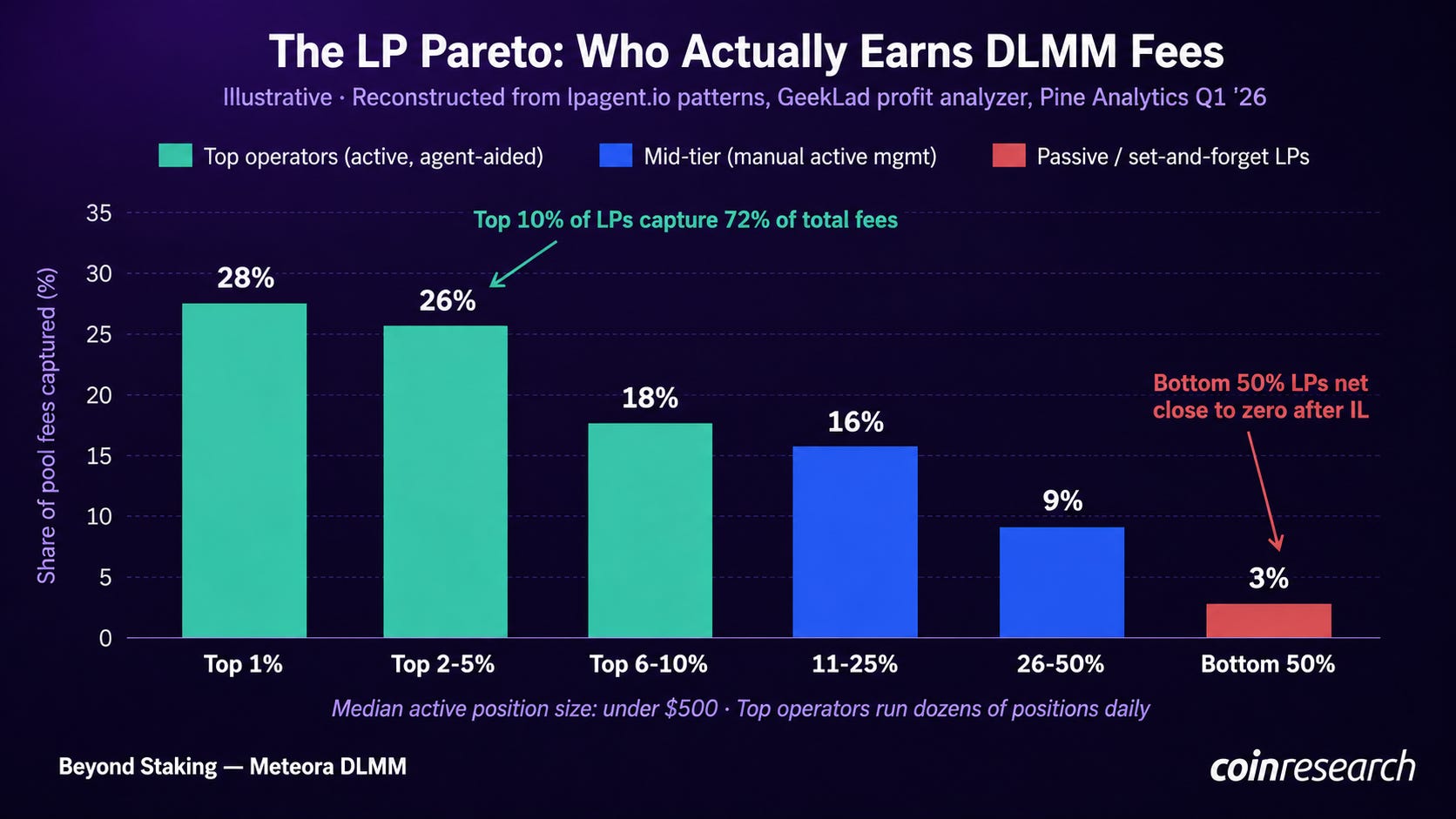
The fee distribution on a typical high-volume DLMM pool follows a sharp Pareto curve:
-
Top 1% of LPs capture roughly 28% of fees
-
Top 10% capture roughly 72%
-
Bottom 50% net close to zero — sometimes meaningfully negative after impermanent loss
What separates the top decile from the median isn’t capital. Median active position size on Meteora sits below $500. Over half of consistently profitable LPs operate with what would be “small” capital by any institutional standard. The separator is monitoring intensity, range-management discipline, and increasingly, automation.
Top operators run dozens of positions a day. They detect out-of-range early. They close cleanly. The bottom-tier LP places a position, walks away, and discovers a week later that the pool drifted and they’ve been holding a falling token for three days.
The Risk Nobody Mentions
Impermanent loss is the most-explained and least-understood risk in DLMM. The classical version is well-trodden — a 2x price move costs a 50/50 AMM position about 5.7% vs HODL. The concentrated version is structurally different.
Two properties define it.
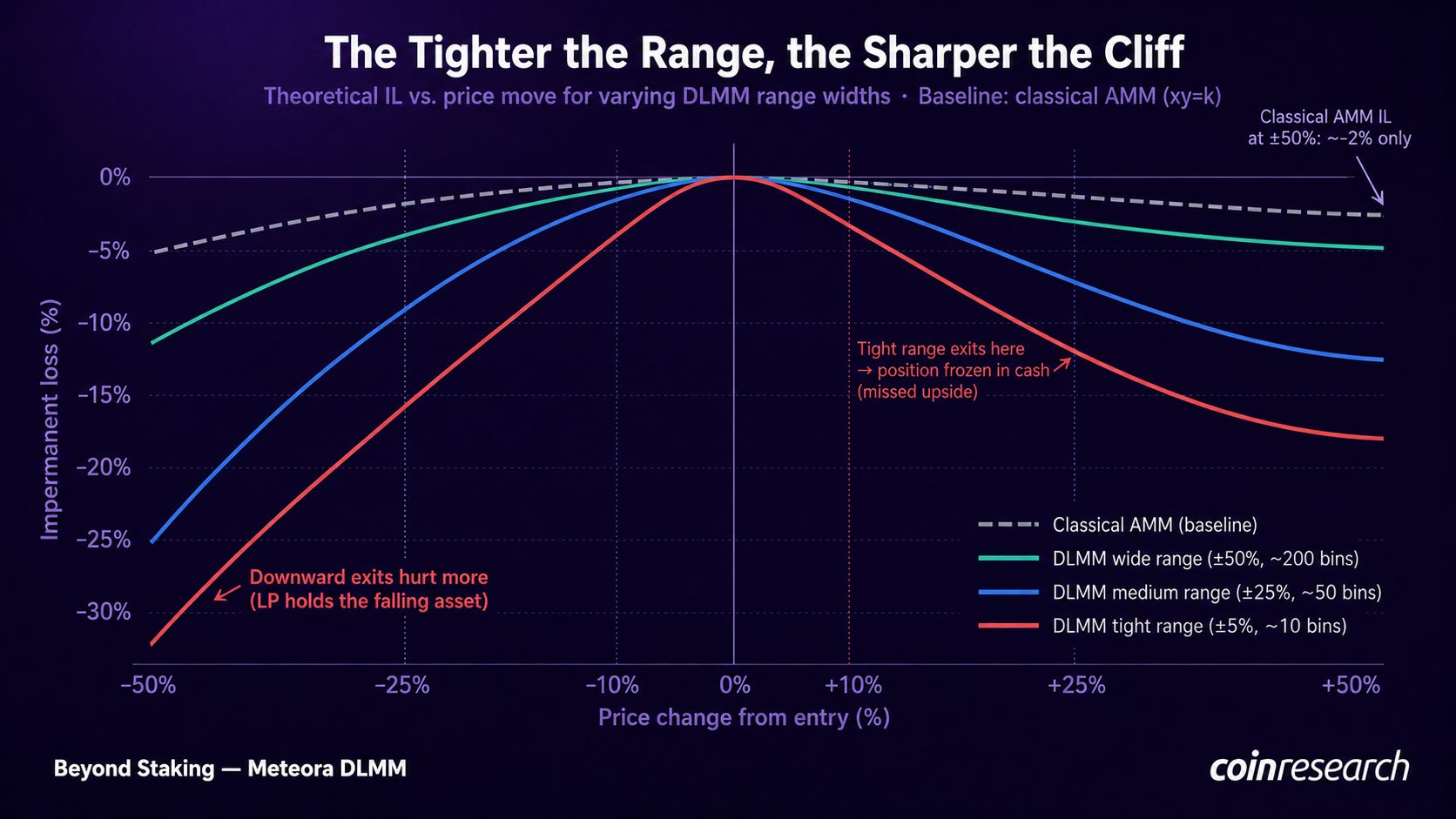
First, IL scales with the leverage implied by your range. A ±5% range produces about 20x the IL leverage of a classical AMM. A ±25% range, about 4x. A ±50% range, about 1.9x. Fee yield moves in the same direction — tight ranges earn more fees per dollar, until they don’t.
Second, out-of-range IL is asymmetric. When price exits the upper bound, your position has been converted to the numeraire token (USDC or SOL). Position value freezes; the HODL benchmark continues to grow. You miss the upside entirely. When price exits the lower bound, your position has been converted to the underlying token — the one that’s currently falling. You ride it down.
In numbers: a ±5% range that experiences a 50% downward move produces approximately 32% impermanent loss vs HODL. This asymmetry is structural. It’s rarely accounted for in “DLMM APY” calculations.
The Automation Layer
The natural endpoint of a mechanism where attention is the cost is the mechanism becoming automated.
Three operational tiers exist today:
-
Manual LP — Meteora UI, hand-managed positions. Capital floor ~$200. Performance highly variable. Best for new LPs developing pattern recognition.
-
HawkFi Precision Curve — managed-rebalancing layer that reshapes liquidity automatically. Hours of setup, low ongoing monitoring. Best for multi-day positions on tokens with established price structure.
-
Self-learning agents (Meridian-class) — agents that close every position with a structured lesson and feed it into the next decision cycle. One documented Meridian build: +$342 over 16 days on $300 starting capital, running cost ~$15/month.
The operator’s attention is the binding constraint. Any system that frees more of it for higher-leverage decisions tends to outperform. Top operators aren’t running spreadsheets anymore. They’re running agents.
If median active positions stay sub-$500 and top-decile capture stays ~70%, the gap between them will increasingly be closed by software, not by capital.
The Bottom Line
Staking-as-default is the worst-performing trade in the Solana ecosystem and getting worse. DLMM converts the LP role from passive depositor into retail market maker, with fee economics that run 3–10x native staking when actively managed. But this is not a yield product. It’s a skill business with a $200 entry point — and the top-decile capture gap is closed by attention and automation, not capital. The shift from emissions-yield to fee-yield is durable. The only real question is whether you’re going to operate it manually, with tooling, or with an agent.
This article is a preview of our full flagship Intelligence Report on Meteora DLMM.
Read the complete deep-dive — including the structured Pareto reconstruction with cohort-level breakdowns, three forward scenarios with probability weighting and signal triggers, the full automation-spectrum comparison across operator profiles, and actionable guidance split for new vs. existing LPs — on
CoinResearch delivers institutional-grade crypto research for investors who want signal, not noise.
Disclaimer: This article is for informational purposes only and does not constitute financial or investment advice. CoinResearch analysts may hold positions in assets discussed. Cryptocurrency investments are highly volatile and speculative. Always conduct your own due diligence before making any investment decisions.