
95% Drawdown, Then a 3.4x Rally in 3 Weeks. The Chart Doesn’t Tell the Story.
The price chart is misleading.
BIO listed on Binance on January 3, 2025 at its all-time high of $0.88. Fourteen months later, in March 2026, it bottomed at $0.018 — a 98% drawdown. The financial media wrote it off as another narrative-token cycle.
While the price was collapsing, every measurable platform metric was improving. Staking participation climbed. Ignition Sales kept oversubscribing. Lab funding crossed $50 million directed to research. Seven BioDAOs went live. Four AI co-scientist agents shipped.
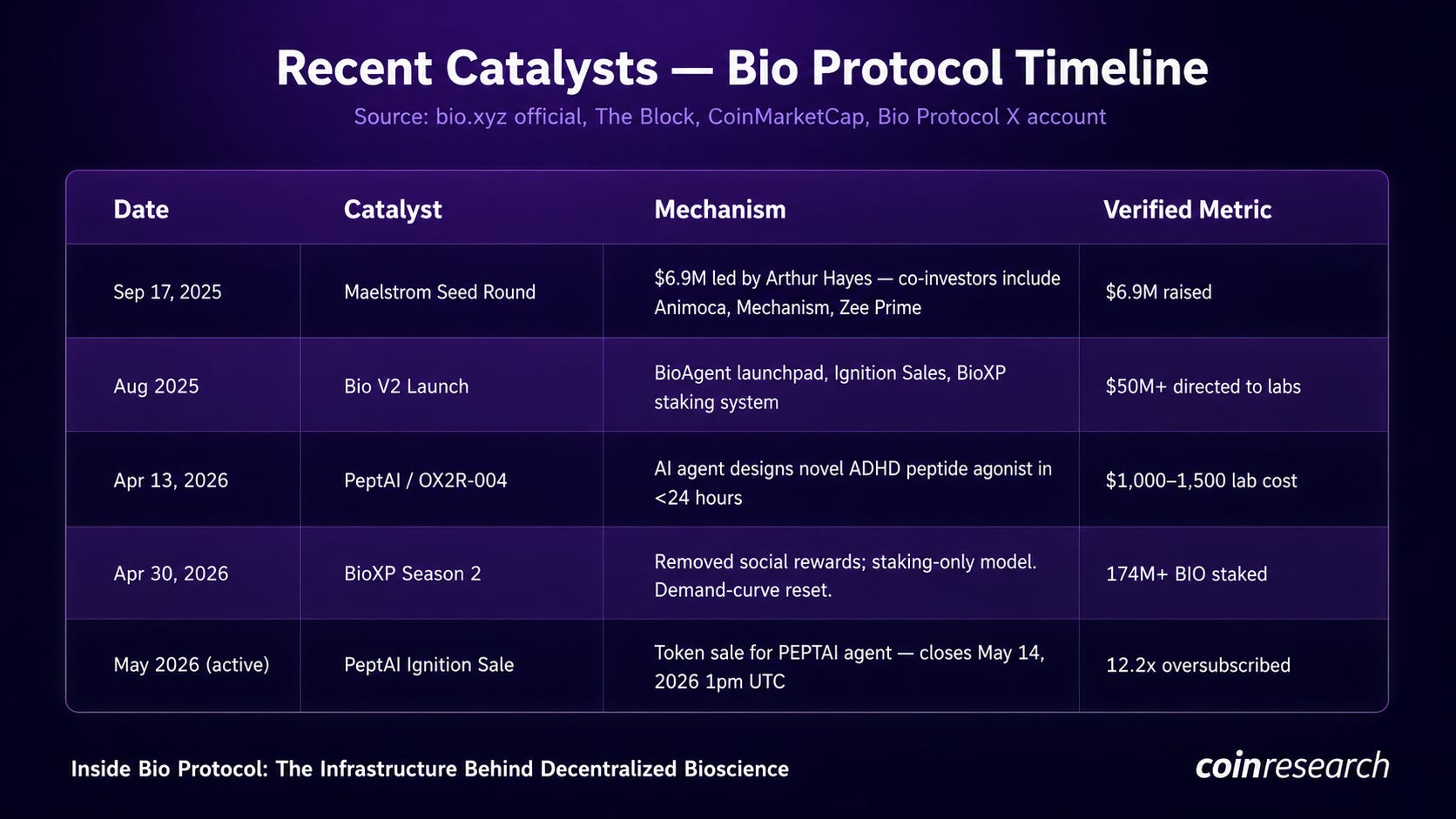
Then on April 13, 2026, an AI agent called PeptAI designed an 18-residue peptide agonist for the OX2R receptor — a novel ADHD drug candidate — in under 24 hours. Wet-lab validation: $1,000–1,500. Traditional pharma reaches the same decision point in two to five years and tens of millions of dollars.
BIO is now $0.062. Market cap $133M. 24-hour volume $349M. The 3.4x rally is real. But the rally isn’t the story. What the platform shipped while the market was looking away is.
What Is Bio Protocol?
Bio Protocol is the financial coordination layer for decentralized science. The protocol funds, governs, and commercializes bioscience research on-chain. Binance Labs — now YZi Labs — described it in November 2024 as “a Y Combinator for on-chain Science” when it made its first DeSci investment.
Mainnet launched Q1 2025. V2 shipped Q3 2025 with Ignition Sales, the BioXP rewards system, and BioAgent infrastructure. As of May 2026, the protocol has directed over $50 million to research labs worldwide, hosts four publicly launched BioAgents, and supports seven active BioDAOs whose pipelines include programs entering Phase 2 clinical trials.
The Problem It’s Solving
Three structural constraints have proven resistant to traditional capital allocation in biomedical research.
Scientists spend roughly 80% of their working hours writing grant applications — cycles measured in months with rejection rates routinely above 80%. Research outputs are locked behind paywalls or institutional patents with commercialization terms favoring the institution over the principal investigator. Traditional drug discovery from target identification to a validated lead candidate takes two to five years and tens of millions of dollars, with failure rates so high that pharma has retreated to acquiring late-stage assets rather than building early.
DeSci protocols address all three through tokenized funding rails, IP-NFTs that fractionalize ownership, on-chain governance that lets domain experts and patients vote on research priorities, and AI agents that compress discovery timelines from years to days.
Global pharmaceutical R&D spending exceeds $250 billion annually. The DeSci sector currently sits at ~$315M in aggregate market cap. That’s a sub-1% capitalization of the addressable problem.
How It Works
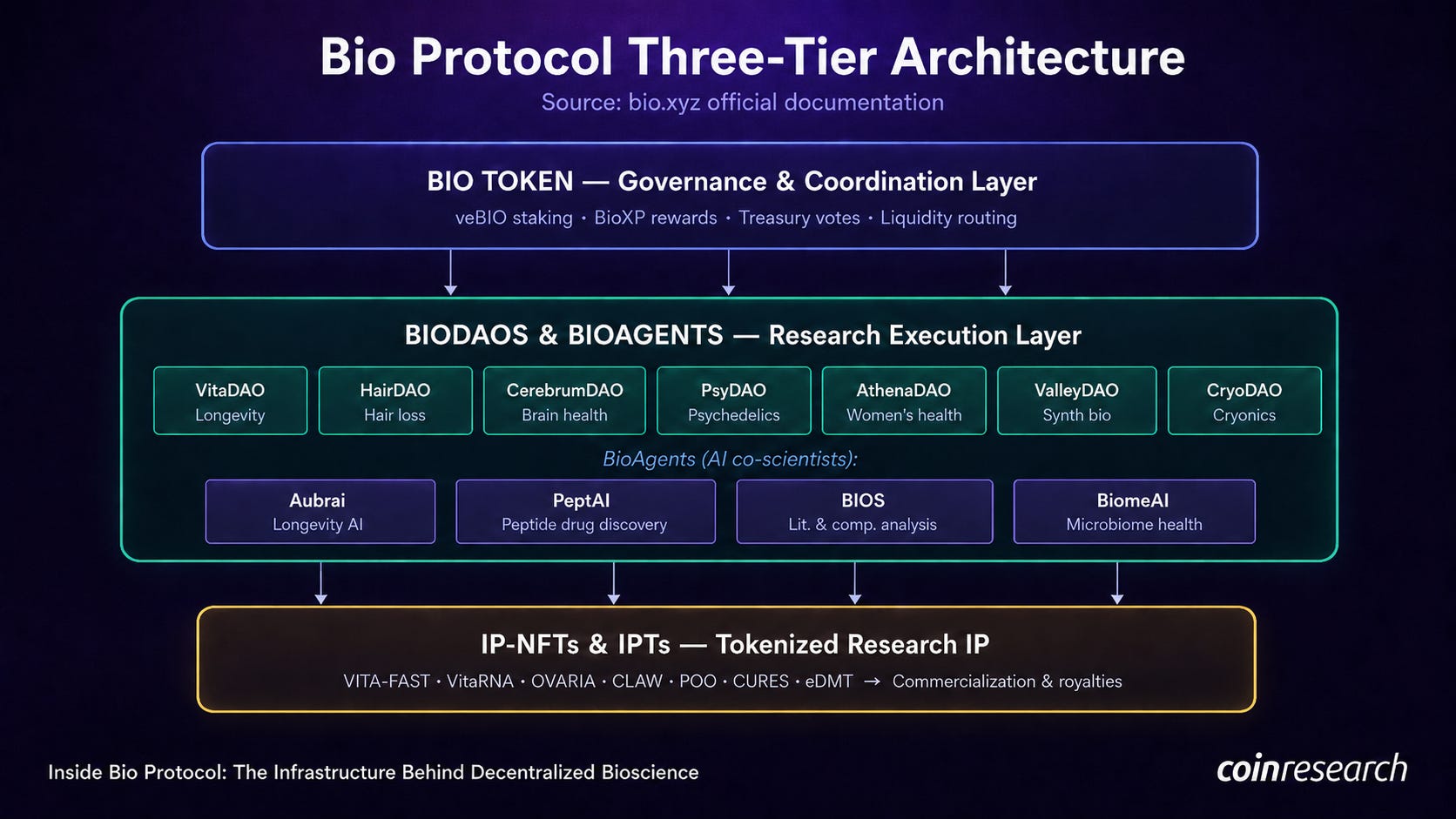
Bio Protocol is structured in three tiers.
-
Tier 1 — BIO Token (governance). Controls protocol parameters, treasury allocation, and admission of new BioDAOs and BioAgents. veBIO staking follows Curve’s vote-escrow model: lock from two weeks to two years to earn vote-escrowed BIO and BioXP rewards.
-
Tier 2 — BioDAOs & BioAgents (research execution). Seven BioDAOs operate as semi-autonomous research communities, each focused on a specific therapeutic area. Four BioAgents operate as on-chain AI co-scientists.
-
Tier 3 — IP-NFTs & IPTs (value capture). Tokenized intellectual property creates legible rights structures for researchers, funders, and downstream pharmaceutical partners.
The mechanic that ties it together is Ignition Sales — low-cap, high-velocity token launches denominated in BIO. Stake BIO, earn BioXP, pledge points pro-rata into the next launch (capped at 0.5% of supply per user). Trading fees from the resulting liquidity pools cycle back into BioDAO treasuries — a closed-loop funding mechanism. Over 174 million BIO are currently staked.
The BioDAO Stack
The BioDAO ecosystem is the substantive product. Each operates as a funded research community in a specific therapeutic vertical:
-
VitaDAO — Longevity. $55M+ treasury. Pfizer Ventures invested. VITA-FAST IPT preparing Phase 2 in UAE.
-
HairDAO — Hair loss. First DAO to file a scientific patent. Owns Anagen telehealth platform.
-
CerebrumDAO — Brain health. CLAW IPT funding Phase 2 of Percepta memory supplement.
-
AthenaDAO — Women’s health. $500K funded. OVARIA IPT with Gero. 14 IP transactions pending.
-
ValleyDAO — Synthetic biology. Active collaboration with Imperial College London.
-
CryoDAO — Cryopreservation. $3M raised. Programs at Oxford Cryotechnology.
-
PsyDAO — Psychedelics. Recently launched OPSY trial-data platform.
-
Curetopia (NEW) — Rare diseases. Consolidating 40 conditions into one coordinated treatment strategy.
The BioAgent layer adds another vector entirely. PeptAI is the agent behind OX2R-004. Aubrai generated $900K+ in research funding and minted 1,000+ hypotheses on-chain in its first weeks live. BIOS coordinates literature search and computational analysis. BiomeAI focuses on microbiome health.
Aggregate ecosystem value — treasuries plus IPT valuations plus active grant pipelines — exceeds $65M in research-deployable capital. That figure exceeded BIO’s standalone market cap during much of the recent drawdown.
The PeptAI Proof Point
OX2R-004 is the cleanest example to date of what AI-native drug discovery looks like in practice.
PeptAI coordinated a fleet of target-scoped agents through an 8-gate computational validation pipeline. Wet-lab synthesis at Adaptyv Bio was paid machine-to-machine via the x402 standard — the first known application of agentic payment rails to biomedical research. Designed-to-validated time: under 24 hours. Total lab cost: $1,000–1,500.
The receptor target is therapeutically novel. Current ADHD treatments suppress orexin signaling. OX2R-004 activates it. The proof-of-concept event triggered a 105% rally in 72 hours and a 10x volume-to-market-cap ratio that day.
The PeptAI Ignition Sale is currently active and 12.2x oversubscribed, with over 610,000 USDC committed by 650+ participants. It closes May 14, 2026 at 1pm UTC. 20% of total PEPTAI supply is allocated as an airdrop to BIO stakers.
How Does It Compare?
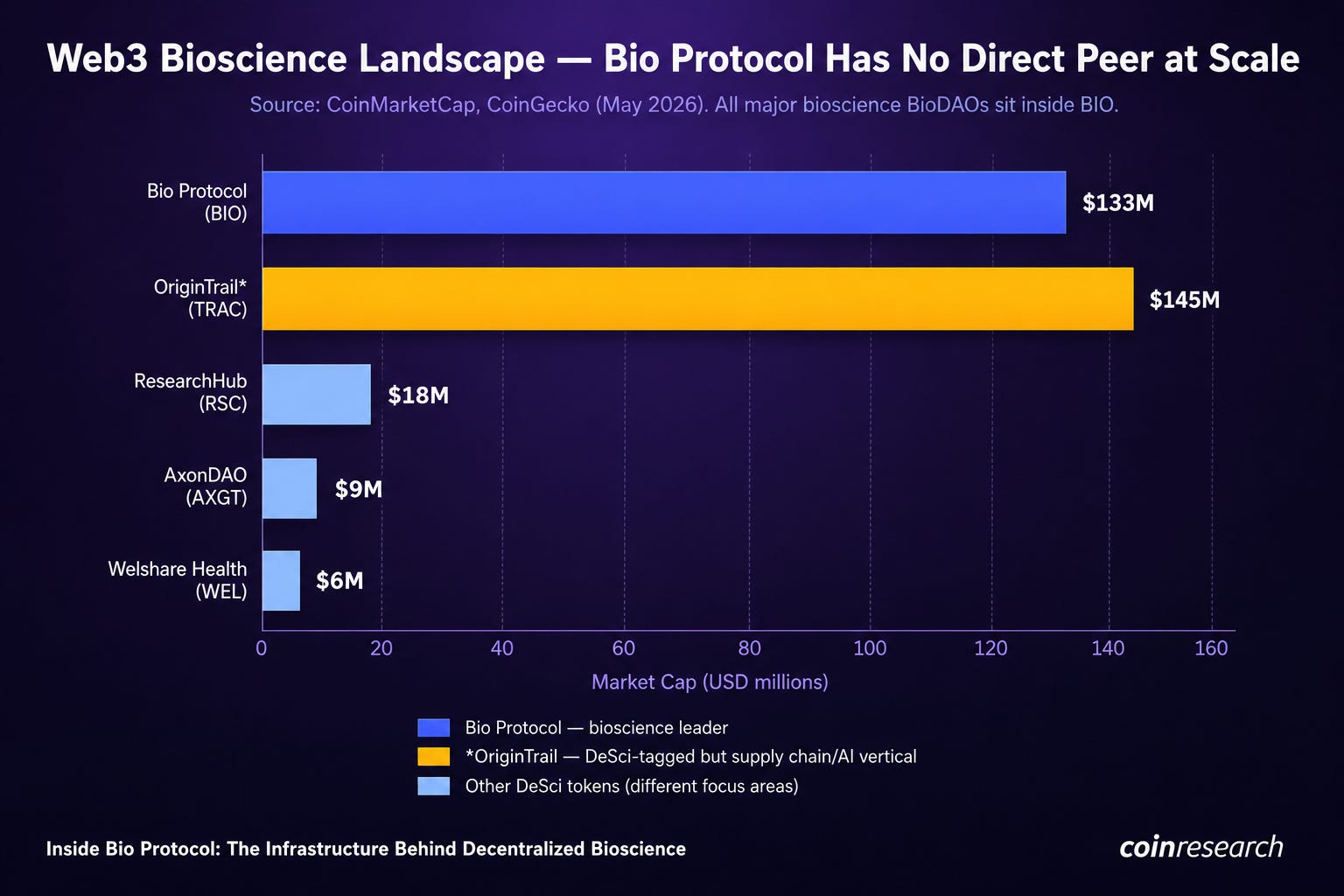
At the broadest level, OriginTrail (TRAC) at $145M is technically larger than BIO at $133M — but OriginTrail is a knowledge graph and supply chain project whose customers include Walmart, BSI, and the European Commission. Categorizing it as a bioscience competitor is a category error.
Within bioscience specifically, Bio Protocol has no direct peer at scale:
-
AxonDAO ($9M) — brain health-tech. An order of magnitude smaller. No aggregator architecture.
-
Welshare Health ($6M) — health data. Sub-scale.
-
ResearchHub ($18M) — peer review and publishing. Adjacent vertical, not bioscience-native.
-
Pump.science — memecoin-based research funding for individual compounds. Different model entirely.
Critically, every bioscience-Web3 project of consequence is inside the BIO ecosystem rather than outside it. VitaDAO, HairDAO, CerebrumDAO, AthenaDAO, ValleyDAO, CryoDAO, PsyDAO — all use BIO for governance meta-rights and Ignition Sale participation. The ecosystem has consolidated rather than fragmented.
The competitive moat isn’t pricing or brand. It’s the BioDAO incubator program, the IP-NFT legal framework inherited from Molecule, the BioAgent infrastructure, and the cap table credentialing — Maelstrom (Arthur Hayes), YZi Labs, Animoca, Mechanism, Pfizer-via-VitaDAO. New entrants face a cold-start problem that BIO has already solved.
The Risks Are Real
Three concrete risks any thesis on BIO has to internalize.
Tokenomics overhang. Roughly 35% of BIO’s 3.32B max supply remains locked, with cliff unlocks extending to 2030. Investors and Core Contributors together hold 34.8% on six-year vests. The unlock calendar is not sympathetic to short-term price action. BIO has historically been volatile in the seven days following past unlock events.
Sector liquidity. DeSci aggregate market cap is only ~$315M. Single major exchange actions can move prices materially — Binance’s January 2026 BIO/BNB pair delisting triggered a 10% same-day drop. The current 3.4x rally leaves the position vulnerable to mean-reversion if the catalyst stack pauses.
Execution dependency. PeptAI’s OX2R-004 was a feasibility proof point, not a clinical outcome — wet-lab validation is just the first gate. Repeating the model across BioAgents in dermatology, men’s health, and microbiome health is the central forward catalyst. One demonstrable case is not yet a pattern.
The Bottom Line
Bio Protocol scores 77.8/100 on the CoinResearch six-dimension institutional framework, supporting a BUY (Speculative) rating. Ecosystem (88) and Team (85) anchor the thesis. Tokenomics (62) is the primary drag. The platform shipped continuously through a 98% drawdown, directed over $50M to labs, designed a novel drug candidate in 24 hours via AI, and consolidated every meaningful bioscience-Web3 project under one umbrella. At $133M market cap, the platform remains arguably under-priced relative to its actual scientific output. The rally isn’t the story. What’s been shipping is.
This article is a preview of our full flagship Intelligence Report on Bio Protocol.
Read the complete deep-dive — including the full six-dimension scoring breakdown, detailed technical levels map (entry/support/resistance), full BioDAO treasury and IPT inventory, complete tokenomics vesting calendar through 2030, and specific actionable guidance for new vs existing investors — on
Coinresearch delivers institutional-grade crypto research for investors who want signal, not noise.
Disclaimer: This article is for informational purposes only and does not constitute financial or investment advice. CoinResearch analysts may hold positions in assets discussed. Cryptocurrency investments are highly volatile and speculative. Always conduct your own due diligence before making any investment decisions.