
Mainnet shipped this week. The token’s down 55% from its high. Here’s why the cap table tells a different story than the chart.
The most-watched institutional crypto launch of 2026 happened on Tuesday. The token barely moved.
On April 29, Kite AI flipped its mainnet live — a sovereign EVM Layer-1 on Avalanche purpose-built so autonomous AI agents can authenticate, transact, and operate on their own. Eighteen months of testnet. 1.9 billion agent interactions logged. PayPal, Coinbase Ventures, and General Catalyst on the cap table.
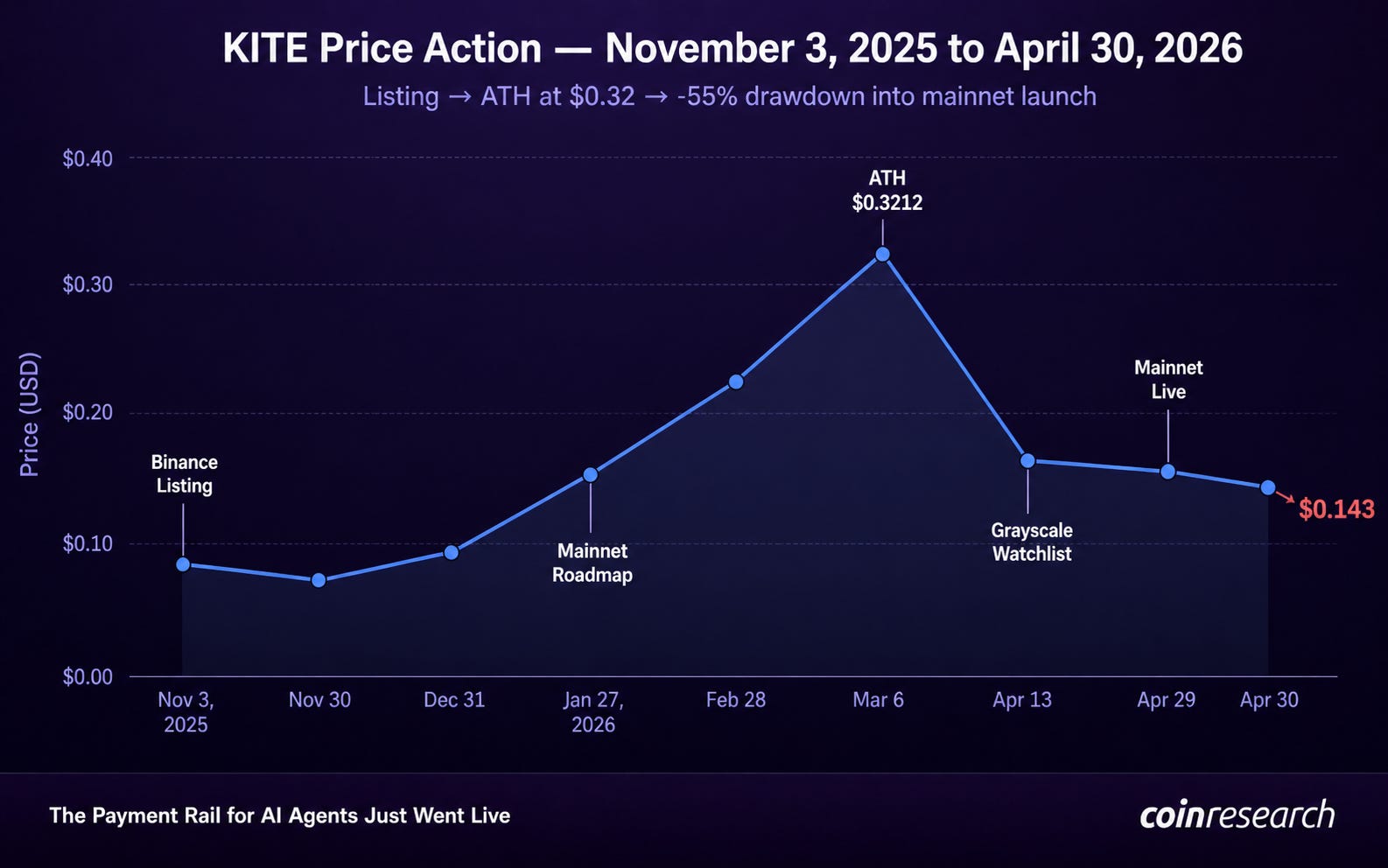
KITE traded at $0.143 the next day. Down 55% from its $0.32 March high.
That gap — between the institutional setup and the price action — is the entire story. Most traders are looking at the chart and concluding the thesis is broken. We think the chart is telling you nothing. The fundamentals here are about to start mattering, and the next 90 days will resolve which read was right.
What Kite Actually Does
Strip away the AI-blockchain marketing and Kite is solving three concrete problems that break when autonomous agents try to use existing payment rails.
Identity: AI agents don’t have passports or KYC documents. Every wallet today assumes a human signer is the ultimate authority. An agent borrowing its operator’s credentials is a security failure waiting to happen.
Cost: A sub-cent micropayment is meaningless if the gas fee exceeds the payment. Even Solana’s $0.00025 average becomes real overhead at the millions-of-calls-per-hour cadence agents operate at. Credit cards (2.9% + $0.30 per transaction) are structurally impossible at machine speed.
Authority: When an agent autonomously buys an API endpoint, who’s liable? Existing smart contracts have no native concept of delegated authority with cryptographic audit trails. You either grant full access or none.
Kite’s argument is that you can’t bolt these primitives onto a general-purpose chain at the application layer. They have to live in the L1.
The Market Kite Is Betting On
McKinsey projects $3–5 trillion in retail spending could be redirected through agentic commerce by 2030. The dedicated agentic AI market grows from ~$10B in 2026 to $57B+ by 2031. Agentic commerce already hit $8B in transaction value this year.
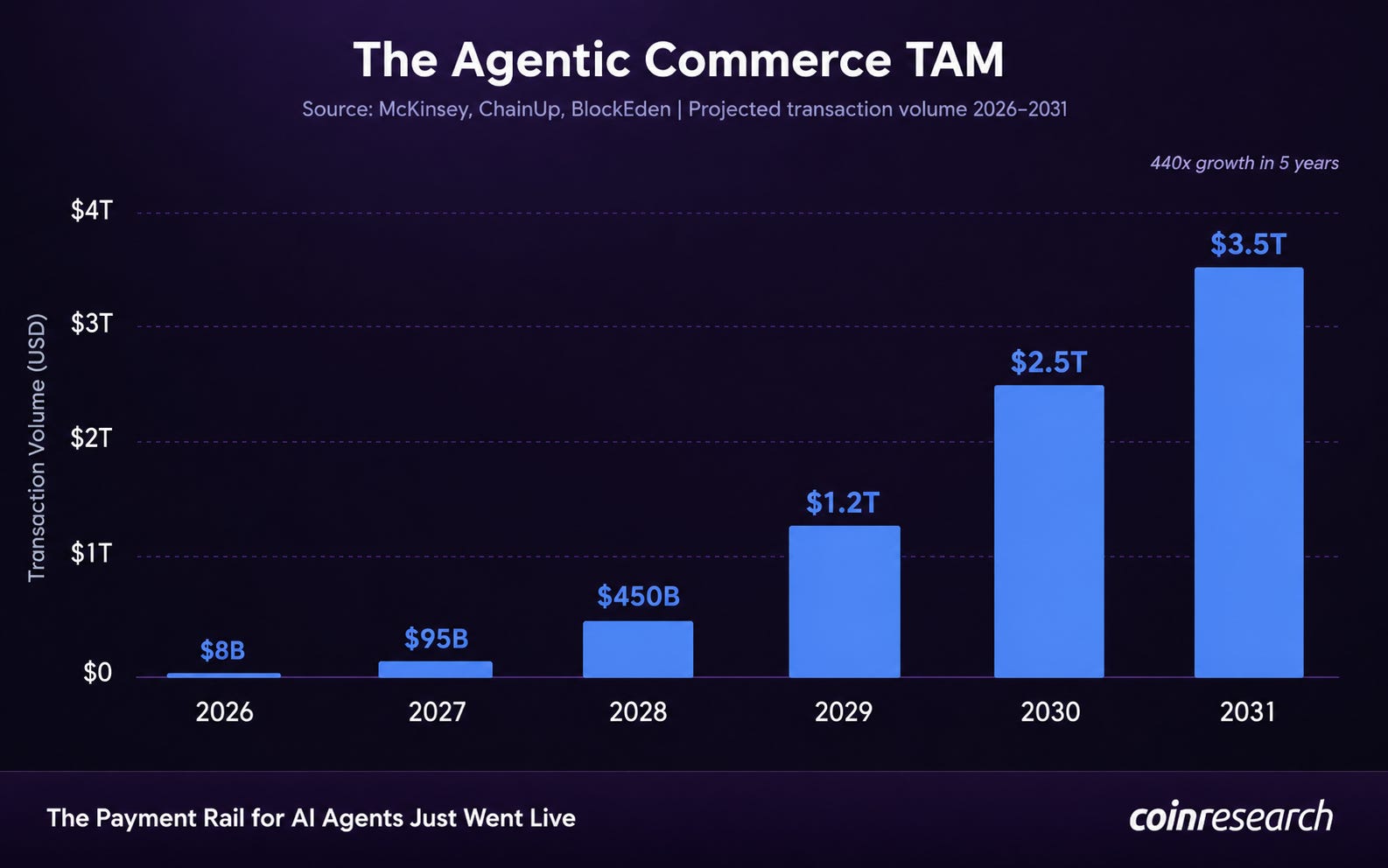
The unresolved question is which infrastructure layer captures the value. Multi-purpose chains can adapt — Solana already does. But Kite’s argument is that purpose-built always beats adapted for high-frequency, identity-sensitive workloads. Whether that argument survives contact with Solana’s network effects is the central question of this report.
The Cap Table Is the Tell
This isn’t a crypto-native team grafting an AI narrative onto a generic L1. The founders spent the last decade shipping production AI infrastructure at scale before moving to the blockchain layer.
Chi Zhang (CEO) — PhD AI from UC Berkeley, ex-Databricks, former Chief AI Expert at dotData. Scott Shi (CTO) — built real-time AI at Uber where he scaled the team to 200+ engineers, founding engineer on Salesforce Einstein, co-founder of RisingWave.
They raised $33M across two rounds. The lead investors are what matter.
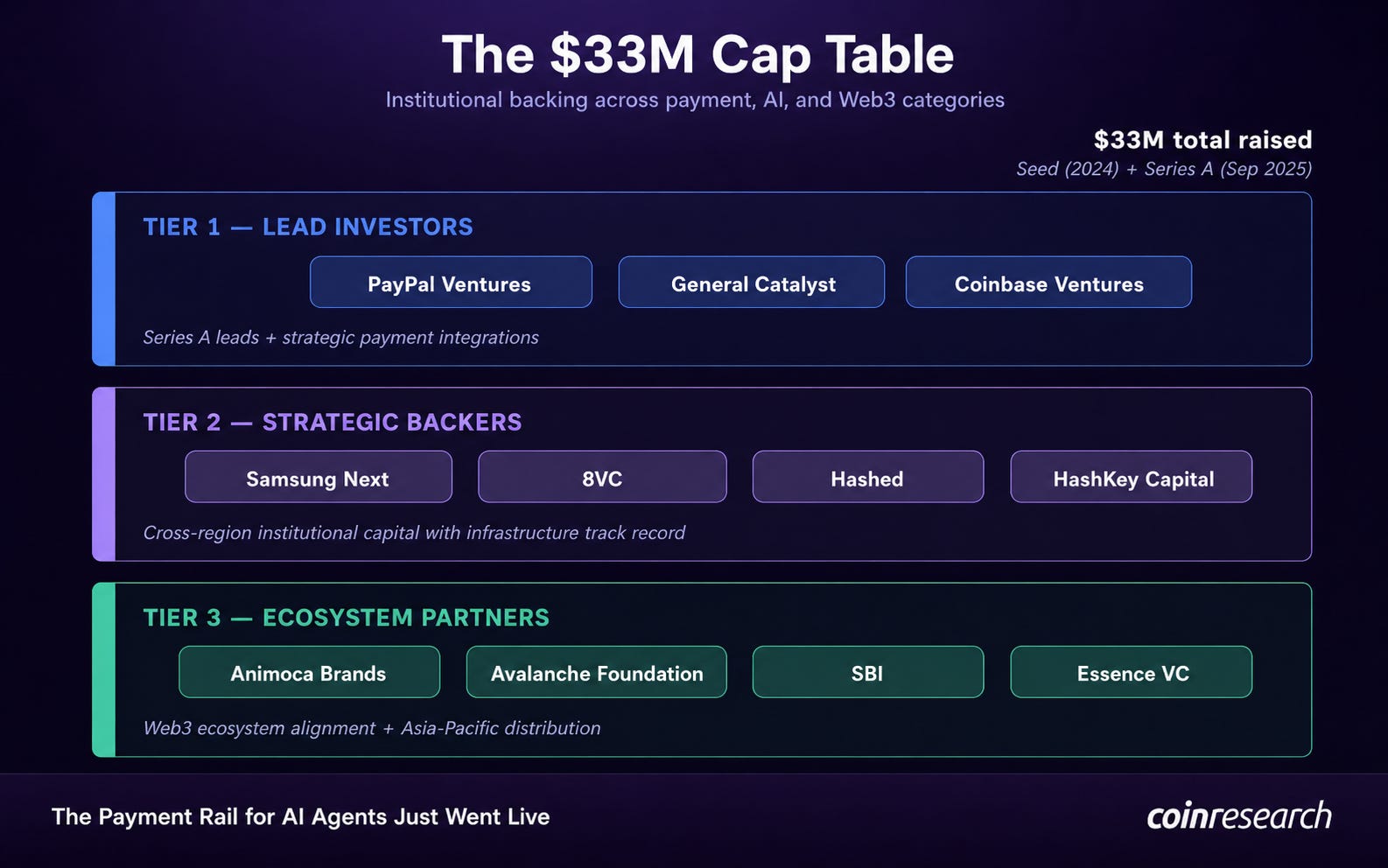
PayPal Ventures and General Catalyst led the Series A. Coinbase Ventures, Samsung Next, 8VC, Hashed, HashKey, Animoca Brands, Avalanche Foundation, and SBI participated. The PayPal + Coinbase combination on a single early-stage Web3 cap table is genuinely rare — these are the two largest payment-adjacent crypto institutions in the world, and they’re rarely on the same line.
PayPal’s PYUSD is integrated as a first-class settlement currency. Coinbase’s x402 standard runs natively on Kite. Any PayPal or Shopify merchant can opt into the Kite Agent App Store and become discoverable to AI shopping agents. This isn’t speculative integration — the rails exist.
The Testnet Receipts Are Real
Most AI-narrative tokens launch with a deck and a Discord. Kite shipped 18 months of testnet activity before mainnet went live.
Yes, these numbers include airdrop farming. That’s true of every major testnet in the post-2023 era — readers should mentally discount accordingly. Even with heavy discounting for sybil activity, the absolute scale of engagement places Kite in a different tier than most AI-narrative L1s. The relevant data point in the next 90 days is whether even 20–30% of testnet daily activity converts to organic mainnet activity. If yes, the bull case strengthens materially. If no, the thesis weakens.
How Kite Compares to the Field
Kite is not alone in chasing the agent economy. Four credible competitors, each with structural advantages of their own:
-
Solana — already hosts 9,000+ registered AI agents, dominates x402 payment activity, sub-second finality, $0.00025 transactions. The most pressing competitive threat.
-
Base + Ethereum L2s — ERC-8004 for identity and reputation, native x402 support, direct Coinbase distribution. Strong “standards win on Ethereum” thesis.
-
Bittensor (TAO) — $1B+ market cap, multi-year head start in AI-blockchain. Different positioning (model training, not agent payments) but competes for the same “AI crypto” allocation.
-
Skyfire / Visa TAP / Mastercard Agent Pay — closed payment networks building agent rails. Strongest distribution, weakest composability.
The honest read: no single chain has won the agent economy yet. Kite has the strongest purpose-built design and the strongest institutional backing. Solana has the largest live ecosystem. Base has the strongest standards momentum. Each has a credible path to material market share.
The Risks Are Real
Three risks worth taking seriously:
Solana network effects. If x402 traffic concentrates on Solana before Kite’s mainnet ramps, Kite ends up as a smaller specialist chain in a market dominated by general-purpose competitors. This is the primary structural risk.
Investor unlock pressure. 12% of supply is allocated to investors with vesting overhangs, and 50M KITE is earmarked for marketing release six months post-listing — that window opens in early May. Public unlock schedules are partial. A large tranche unlocking into a soft tape would create concrete near-term selling.
GitHub commit cadence. The public codebase has been quiet through 2026, with the most recent meaningful sample dApp commit dating from early 2025. This is circumstantial — significant private-repo development is normal — but the development pulse a third party can verify is currently low. Mainnet code shipping in production over the next quarter will be the strongest counter-signal.
The 12-Month Outlook
Three scenarios with probability weights:
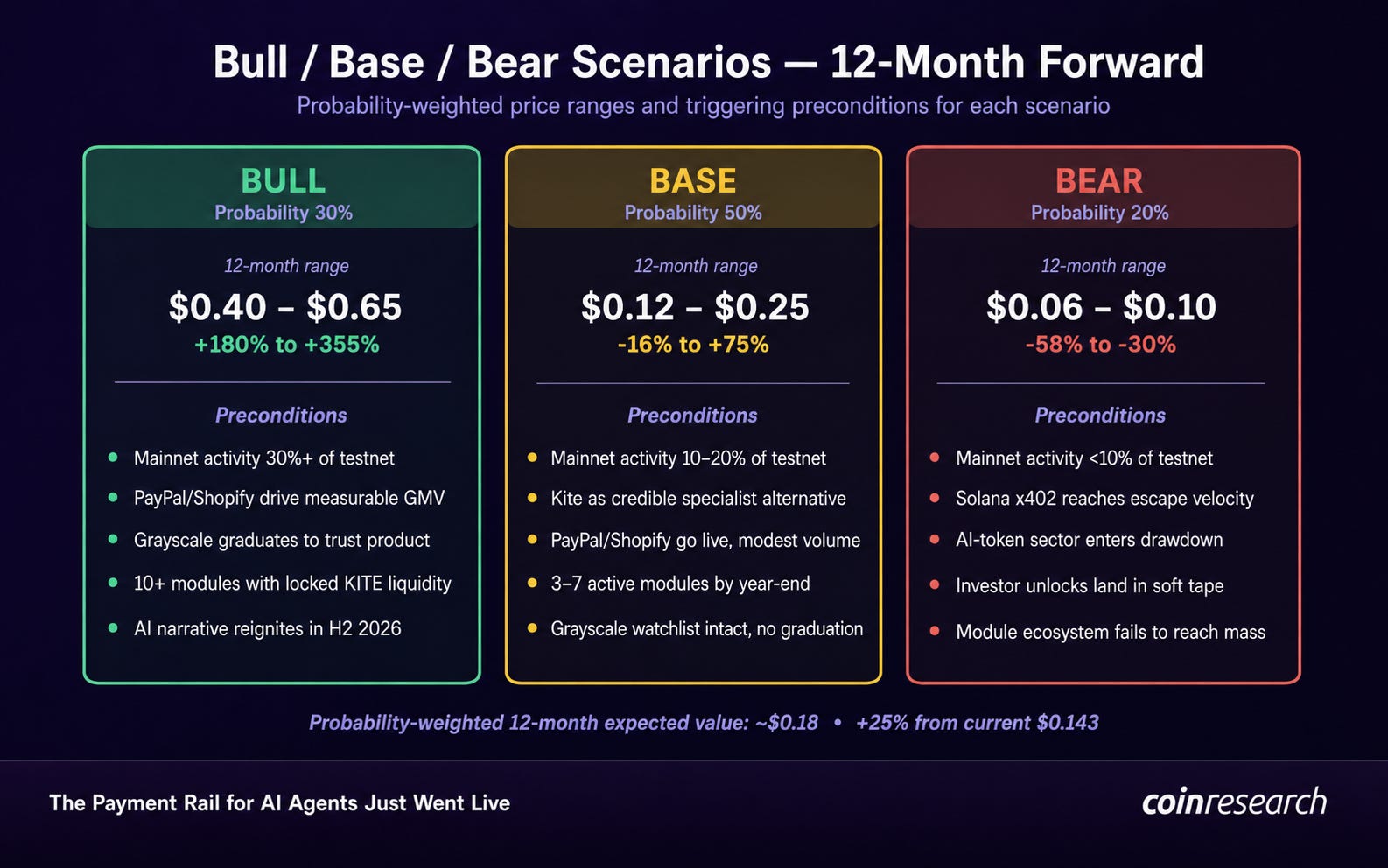
The probability-weighted 12-month expected value works out to approximately $0.18 — about 25% upside from the current $0.143, with meaningful tails on both sides. Not a screaming buy. Not a clear sell. A high-conviction infrastructure bet with material execution risk priced into a 55%-off-ATH entry.
The Bottom Line
KITE entered its mainnet event at a 55% drawdown from ATH, with the strongest institutional cap table in the AI-blockchain category, genuine testnet validation, and a probability-weighted forward expected value above current price. The risk-reward favors accumulation at current levels for investors with infrastructure-investment conviction and a 12-to-24-month horizon. The chart says one thing. The cap table says another. The next 90 days of mainnet usage data will tell you which one was telling the truth.
This article is a preview of our full flagship Research Report on Kite AI ($KITE).
Read the complete deep-dive — including our full 13-section project breakdown, the complete tokenomics flywheel and module-lock mechanics, the full feature comparison matrix across five agent-payment stacks, the three scenario probability bands with detailed triggering preconditions, and our score breakdown across ten dimensions — on
CoinResearch delivers institutional-grade crypto research for investors who want signal, not noise.
Disclaimer: This article is for informational purposes only and does not constitute financial or investment advice. Cryptocurrency investments are highly volatile and speculative. Always conduct your own due diligence before making any investment decisions.