
Crypto lost roughly 30% of its market value, ETF flows reversed and leverage contracted. But stablecoin settlement, tokenization and regulated market infrastructure kept advancing.
The first half of 2026 forced crypto investors to answer a harder question than whether prices were cheap.
They had to decide which part of the market they actually believed in.
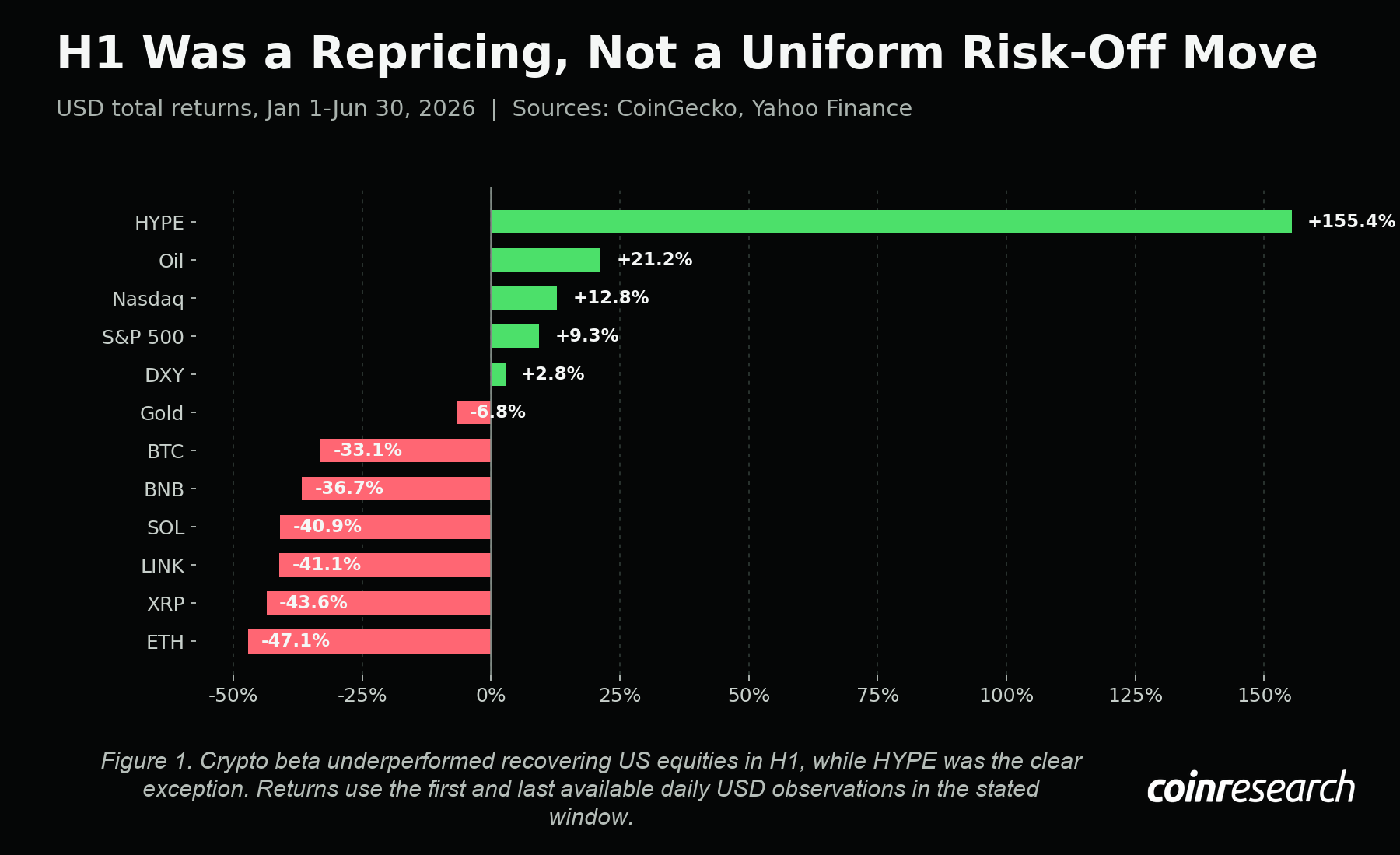
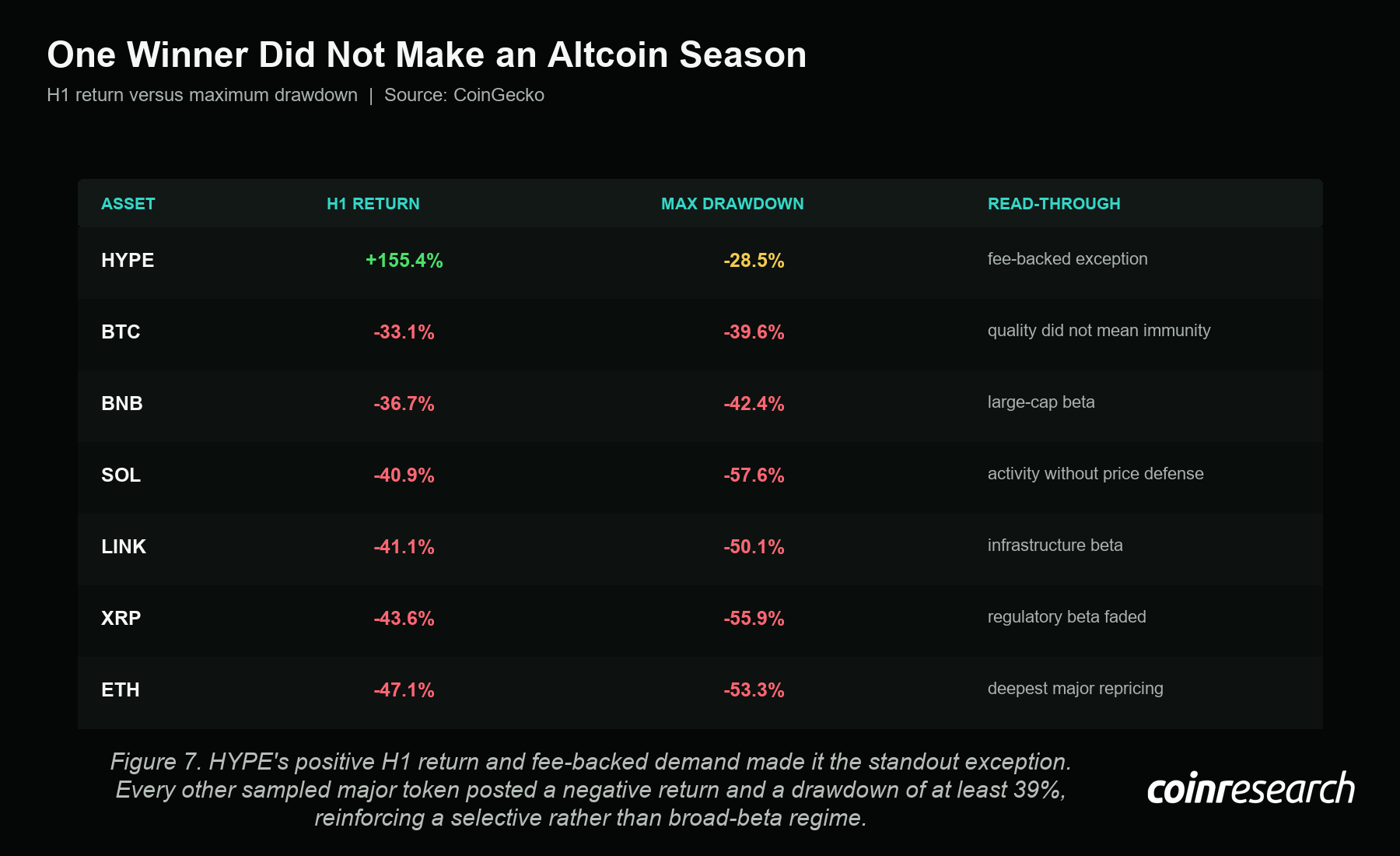
The price layer delivered an unambiguous reset. Total crypto market capitalization fell from approximately $3.02 trillion at the start of the year to $2.1 trillion at June 30, a decline of roughly 30.5%. Bitcoin fell 33.1% on CoinResearch’s daily series. Ether fell 47.1%, Solana fell 40.9%, and most sampled large-cap tokens suffered maximum drawdowns above 40%.
That sounds like a familiar macro story: restrictive rates, a firm dollar, geopolitical shocks and a retreat from speculative assets.
It is only half the story.
The S&P 500 and Nasdaq recovered to positive H1 returns while BTC and ETH ended near their lows. Stablecoin balances remained close to record levels. Tokenized Treasuries and stocks continued to expand. Regulatory work moved from slogans toward market structure. One fee-backed protocol token, HYPE, gained roughly 155% while nearly every other major asset in our sample declined.
The market did not reject everything connected to crypto. It rejected undifferentiated exposure.
That is the central conclusion of CoinResearch’s new flagship report: H1 was a cyclical liquidity reset in the settlement and infrastructure layer, but it exposed structural weakness in broad token beta.
H1 Was a Repricing, Not a Uniform Risk-Off Move
The year began with a familiar consensus. Spot ETFs would keep attracting institutional allocations. Corporate treasury vehicles would remain dependable buyers. Regulatory progress would unlock more demand. Broad crypto beta would benefit as capital moved down the risk curve.
That consensus broke quickly.
January and early February brought the first repricing. BTC began the year near $87,600 and ETH near $2,970. By February 5, BTC had fallen sharply during a cross-asset de-risking episode, ETH traded below $1,800 and SOL broke below $80. CoinGlass recorded $2.14 billion of liquidations on that date, one of the three largest daily events of H1.
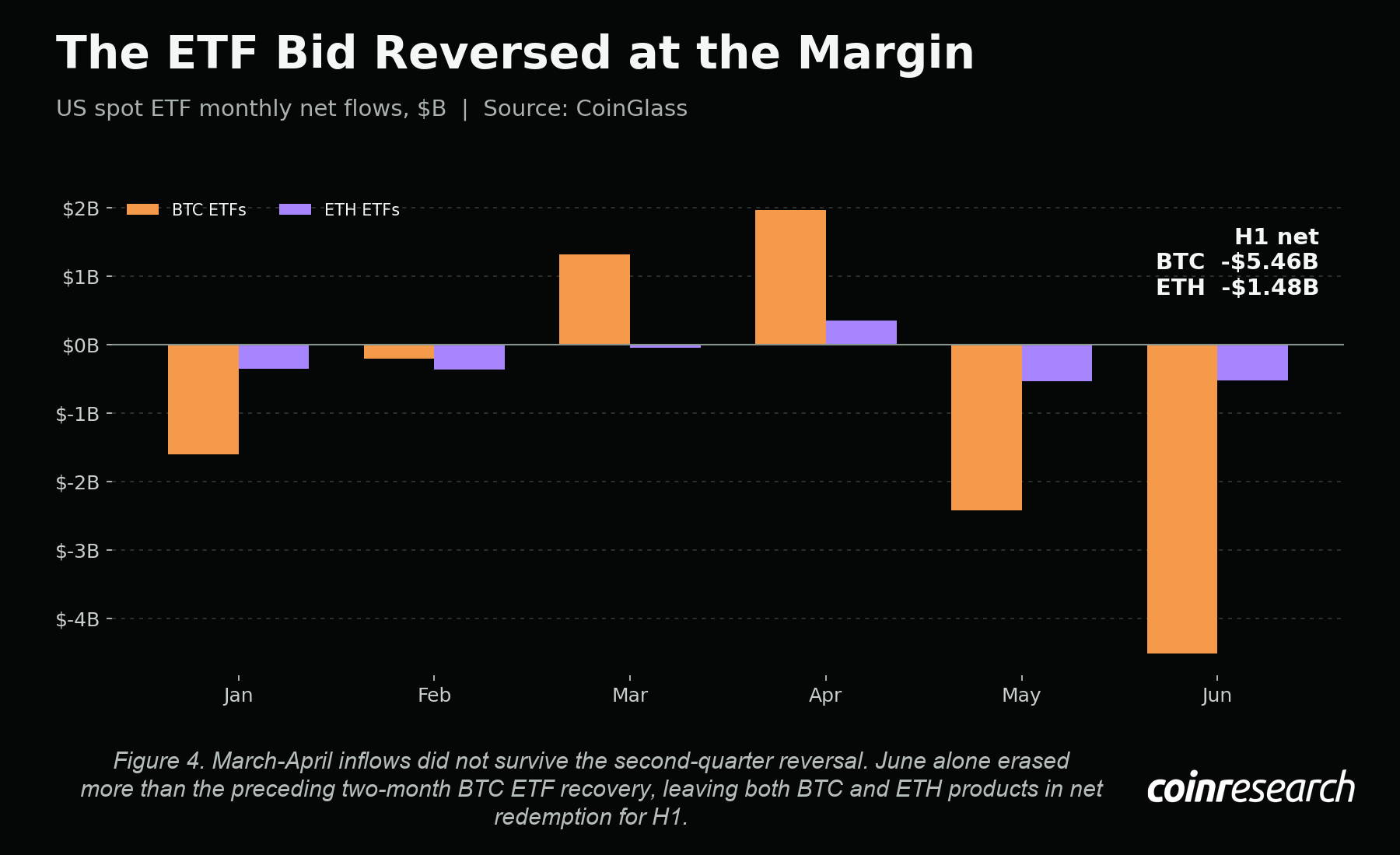
March through May produced a plausible repair. BTC recovered above $80,000. ETF flows turned positive in March and April. Open interest rebuilt from its February low. US equities were recovering, and the US regulatory backdrop looked more constructive.
But the recovery never became broad enough.
Stablecoin balances held, yet spot exchange volume and total DEX volume remained below January. Most major tokens failed to establish sustained relative strength. Then June brought funding stress back: ETF flows reversed, BTC and ETH made new H1 lows, open interest fell and monthly liquidations reached $16.14 billion.
The cross-asset result is what makes H1 different from a generic risk-off event. On CoinResearch’s first-to-last daily series, the Nasdaq gained 12.8%, the S&P 500 gained 9.3% and oil gained 21.2%. BTC fell 33.1% and ETH fell 47.1%.
Crypto had a macro headwind. It also had a crypto-specific funding problem.
Macro therefore became the discount rate, not the whole explanation. The Federal Reserve kept its target range at 3.50%-3.75% throughout H1. Headline inflatian reached 3.5% year over year in June, with energy again contributing pressure. Cash remained competitive with non-yielding assets, and crypto did not receive the falling-rate, weaker-dollar combination that usually supports broad high-beta performance.
Yet equities recovered under the same policy backdrop. The divergence points to constraints inside crypto itself: ETF redemptions, weaker turnover, treasury-vehicle financing concerns, fragmented liquidity and an unresolved value-capture problem across many tokens.
Lower prices were real. A repaired market was not.
Institutional Access Became Institutional Supply
The institutional story did not disappear in H1. It became two-sided.
US spot BTC ETFs recorded $13.17 billion of inflows on positive-flow days and $18.63 billion of outflows on negative-flow days. The net result was $5.46 billion of H1 outflows. Flows were negative in January and February, positive in March and April, then sharply negative in May and June.
ETH ETFs followed the same pattern on a smaller base, ending H1 with approximately $1.48 billion of net outflows.
The wrong conclusion is that institutions abandoned crypto. The products remained substantial pools of assets and processed large two-way flows. The right conclusion is that the marginal institutional buyer became price sensitive.
An ETF is not only a wrapper for demand. It is also an efficient redemption channel.
Corporate treasury demand complicated the picture further. Strategy increased its BTC holdings by a net 173,500 BTC during H1 and ended June with 846,000 BTC. That remained a major source of demand. But the company also made limited BTC sales to fund preferred-stock distributions and replenish dollar reserves.
Those sales were tiny relative to total holdings. Their significance was informational.
BTC had become available for liability management.
Digital-asset treasury companies create a feedback loop. When their equity trades at a premium and financing is available, they can issue securities, buy crypto and reinforce the asset’s price. When that premium contracts or fixed obligations rise, purchases can slow and reserves can become a source of liquidity.
That does not make treasury adoption bearish. It means treasury demand should not be treated as permanently removed supply.
The same principle applies to ETFs. Better access is structurally useful, but it makes both allocation and deallocation easier. H2 confirmation therefore requires more than one positive flow day or another treasury announcement. A durable institutional bid should appear as several weeks of positive flows, growing fund assets after separating price effects, improving spot volume and healthier market depth.
Institutionalization reduced operational friction. It did not remove valuation, funding or liquidity risk.
Leverage Contracted. Fragility Did Not.
H1 removed leverage in quantity, but not in quality.
CoinGlass measured $35.08 trillion of derivatives volume during the half, 15.7% below H1 2025. June 30 open interest was 17.9% below the start of the year. At first glance, that is a healthier market: less turnover, fewer positions and less aggregate leverage.
Liquidations tell a less comforting story.
H1 generated $73.35 billion of liquidations, with long positions accounting for 62.2%. June produced the highest monthly total even though open interest and turnover were lower than at the beginning of the year.
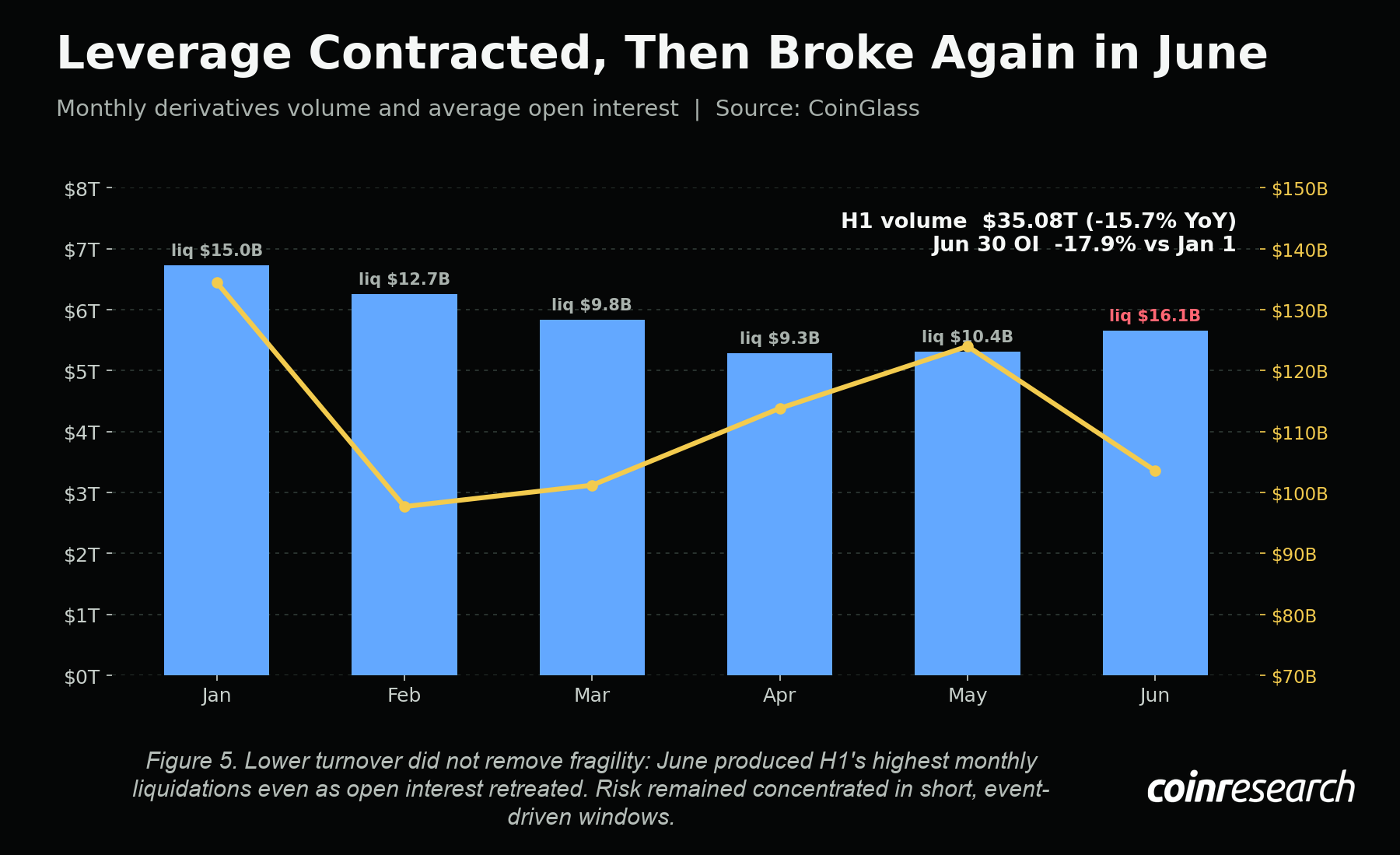
The mismatch matters. A market with less open interest can still be fragile if its executable liquidity contracts even faster. When depth is concentrated across a small number of venues, aggregate statistics can overstate how much risk the system can absorb during stress.
The top ten exchanges handled 81.2% of derivatives volume and 79.3% of average open interest in the CoinGlass dataset. Binance and OKX controlled nearly two-thirds of sampled BTC depth within 1% of the mid-price. When leading venues or market makers reduce balance-sheet capacity at the same time, liquidity can disappear nonlinearly.
That changes what investors should want from the next expansion.
Rising open interest is not automatically constructive. A healthy rebuild should include stronger spot volume, deeper order books, stable funding and broader venue participation. Open interest rising against weak turnover and shrinking depth is not recovery. It is leverage rebuilding faster than liquidity.
For portfolio construction, the implication is plain: leverage should not be the default method for expressing a long-term crypto thesis. The asset class already carries high embedded volatility. A leveraged position is only defensible when the catalyst, liquidity and invalidation point are observable before a liquidation engine makes the decision.
The Rails Kept Moving While Prices Fell
The most constructive H1 evidence came from the parts of crypto designed to move and settle value rather than maximize token beta.
Stablecoin supply ended Q2 near $305 billion, according to CoinGecko’s Q2 industry report. DeFiLlama’s daily series was modestly higher from the first to the last observation of H1, with a peak above $320 billion. Methodologies differ slightly, but the conclusion is the same: stablecoin balances were dramatically more resilient than speculative crypto market value.
That does not mean stablecoins have already become a mass retail-payment network.
Research from the IMF, BIS and Kansas City Fed continues to show that trading, treasury movement and crypto settlement account for much of the activity. Gross blockchain transfer volume can materially overstate real-economy commerce.
Stablecoins nevertheless did three important jobs during the drawdown.
They preserved dollar liquidity inside the crypto system. They served as collateral for exchanges and lending markets. And they connected programmable settlement to regulated financial products.
Tokenization expanded on top of that base. CoinDesk Data and RWA.xyz measured $28.9 billion of distributed tokenized assets in May, including $16.1 billion of tokenized Treasuries and $2.41 billion of tokenized stocks.
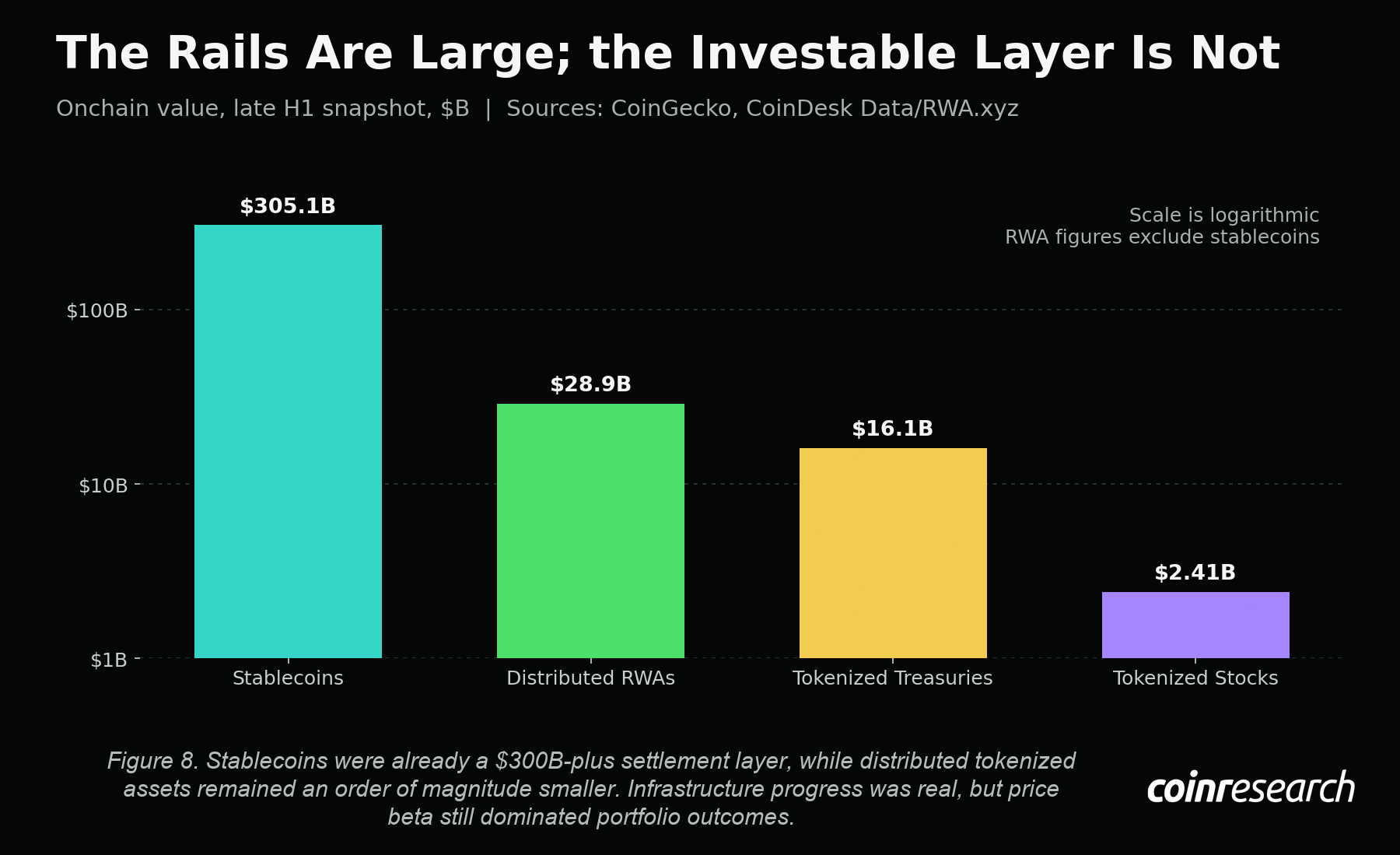
Those numbers remain small relative to stablecoins and tiny compared with conventional capital markets. Their strategic importance is not current scale alone. They give onchain cash somewhere productive to go.
The composition matters. Tokenized Treasuries have a clear use when short-duration yields are high. Tokenized stocks can broaden access, but the legal rights behind them vary. Private credit introduces underwriting and liquidity risks that a blockchain cannot remove. “Tokenized” describes the record and transfer system. It does not certify the underlying asset.
The same distinction applies to smart-contract platforms. Ethereum and Solana continued to host stablecoins, trading, lending, tokenization and consumer applications, yet ETH and SOL both fell sharply. Network usage does not automatically become token-holder value.
That value bridge requires real fees, retained liquidity, differentiated applications, credible supply discipline and a mechanism that lets token demand scale with the network’s success. A fast chain can be economically commoditized. A busy protocol can subsidize activity without creating durable holder value.
H1’s strongest exception proved the point. HYPE gained roughly 155% while BTC, ETH, SOL, BNB, XRP and LINK declined. That was not an altcoin season. It was evidence that the market could still reward one asset with differentiated distribution, product-market fit and fee-backed demand while withdrawing from generic beta.
The market still funded business models. It stopped funding categories.
The Hardest Bear Case Is Bigger Than Another Drawdown
The strongest challenge to a constructive H2 view is not simply that BTC could retest its lows.
It is that H1 may have started a lower-liquidity regime in which speculative tokens must compete with regulated onchain cash and conventional risk assets for capital.
ETFs make redemptions easier. Treasury vehicles can become sellers when financing conditions deteriorate. Cash yields remain competitive. Market depth is concentrated. Many networks still generate activity without creating scarce demand for their tokens. Regulatory clarity may benefit exchanges, custodians and asset issuers more than the existing altcoin universe.
That combination creates a different market from the one investors expected in 2025.
The counterargument is equally serious. Stablecoin liquidity remains available. Infrastructure investment continues. H1 already removed substantial leverage. A modest improvement in inflation, the dollar and ETF flows could convert idle onchain capital into demand quickly.
Both cases can be true enough to reject maximum-beta positioning.
CoinResearch therefore separates the rails from the assets. We remain constructive on blockchain settlement, stablecoins and tokenized-market infrastructure. We are more demanding about the tokens that sit on top of those rails.
The H2 Decision: Selective Repair, Not Broad Beta
The practical question is not whether crypto will recover eventually. It is whether H1 created an attractive entry point for the entire market, or whether funding and token economics must repair first.
Our answer is conditional.
BTC remains the preferred core crypto exposure because it has the deepest liquidity, the clearest monetary role and the most established institutional wrapper. That does not make BTC risk-free. It means its economic claim is more legible than most of the market.
Stablecoin yield and tokenized short-duration assets offer another form of exposure: staying inside the onchain system without assuming full token beta. ETH, SOL and high-quality application tokens retain upside in a liquidity recovery, but the burden of proof is higher. Activity must translate into retained liquidity and defensible value capture.
The H2 allocation logic is therefore:
-
Core liquidity: favor BTC as the primary directional exposure, sized below 2025 risk levels until funding improves.
-
Onchain cash: use regulated stablecoin and tokenized short-duration yield with explicit issuer and custody limits.
-
Selective growth: require real fees, differentiated applications and credible value capture.
-
Optionality: keep ETH, SOL and application exposure smaller until breadth and flows confirm.
-
No default leverage: add leverage only when liquidity and invalidation are observable.
This is not a bearish rejection of crypto. It is a higher evidence standard.
The market has already demonstrated that institutional wrappers, treasury buyers, regulatory progress and rising onchain activity can coexist with a 30% collapse in total value. None of those narratives is sufficient by itself.
The signal we want is convergence: funding improves, spot breadth expands and leverage quality strengthens at the same time. A BTC rally without market depth can be tactical. A stablecoin high without new deployable demand can be defensive. Rising open interest without turnover can be dangerous.
The final rule is simple:
Do not buy the market because it is down. Buy exposure when the funding source, the liquidity structure and the asset’s economic claim can survive without a return to easy money.
Inside the Full CoinResearch Report
This article presents the central diagnosis from The State of Crypto: H1 2026 Reset.
The complete flagship report goes further with:
-
the full H1 cross-asset and market dashboard;
-
BTC and ETH ETF flow attribution;
-
derivatives, liquidation and venue-concentration analysis;
-
the smart-contract platform value-capture framework;
-
the strongest structural bear case and its invalidation;
-
three probability-weighted H2 scenarios and portfolio implications;
-
the complete monitoring dashboard for funding, breadth, liquidity and regulation;
-
the H2 risk register, methodology and primary-source ledger.
Read the full premium report on the CoinResearch platform.
Disclaimer: This report is for informational and educational purposes only and is not investment, legal, tax or accounting advice. Digital assets can lose substantial value and may be illiquid, operationally complex or legally restricted. Historical performance does not guarantee future results. CoinResearch does not provide individualized portfolio recommendations in this report. Investors should verify product terms, custody, jurisdiction, liquidity and tax treatment and obtain professional advice appropriate to their circumstances.