
AI is the biggest infrastructure buildout of our generation. But the financing stack is still broken. USD.AI wants to fix that, on‑chain.
TL;DR
-
USD.AI turns physical GPU hardware into on‑chain collateral and lends stablecoins against it.
-
sUSDai yields ~10%+ APR from real GPU loan interest, not token emissions.
-
CHIP is the governance and backstop token with equity‑like upside if fee distribution is activated.
-
At ICO, CHIP priced at $300M FDV against $630M+ TVL, fairly valued today, asymmetric upside in the bull case.
-
Bull case FDV: $500M–$1B in 18–24 months.
The Problem Nobody Is Talking About
The AI supercycle is real. Hyperscalers are committing hundreds of billions in capex. GPU demand is structurally outpacing supply. Inference workloads are compounding.
But here’s what nobody talks about at conferences:
The mid‑tier AI operator, the GPU farm builder, the inference startup, the data center developer, has almost no access to fast, non‑dilutive capital.
Banks take 60–90 days. Private credit funds take 6–12 months and mostly serve known names. Venture debt comes with equity warrants. The financing stack is slow, expensive, and exclusionary.
Meanwhile, GPU hardware is one of the most liquid, standardized, high‑demand collateral types in the world right now. NVIDIA H100s and A100s have active secondary markets, clear pricing, and strong utilization.
This is the exact gap USD.AI was built to fill.
What USD.AI Is (Simply Put)
USD.AI is an on‑chain credit protocol that:
-
Tokenizes physical GPU hardware as legal collateral (digital warehouse receipts under UCC Article 7)
-
Uses that collateral to back stablecoin loans for AI operators
-
Pays the yield from those loans to stablecoin depositors
Three assets power the stack:
-
USDai, a synthetic dollar pegged 1:1, backed by T‑bills and GPU loans
-
sUSDai, the yield‑bearing staked version, currently earning ~10.43% APR
-
CHIP, the governance and fee‑capture token
The protocol compresses a 6–12 month TradFi financing cycle down to under 7 days, verified hardware goes in, stablecoin loans come out.
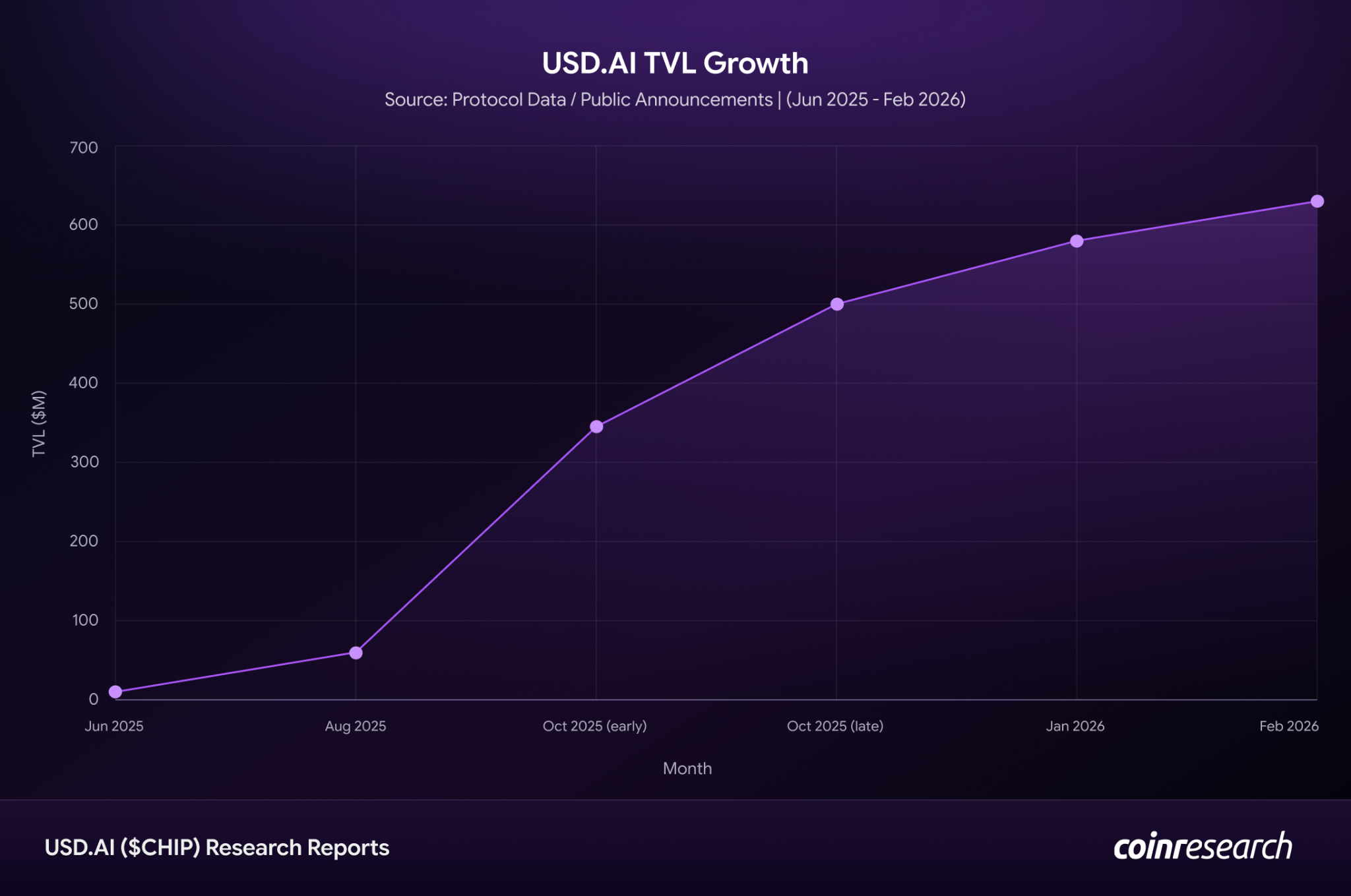
USD.AI TVL Growth (Jun 2025 – Feb 2026), TVL scales from near-zero to over $600M within nine months, highlighting rapid adoption of USD.AI’s GPU‑backed credit platform.
The Three Primitives That Make It Work
This is what separates USD.AI from a generic DeFi lending pool:
CALIBER, Converts physical GPUs in insured, audited data centers into legally enforceable on‑chain NFTs. Each token encodes hardware specs, location, insurance, and redemption rights. This is what makes the collateral bankable.
FiLo Curator (First‑Loss Curator), Loan originators must put their own capital first in line for losses. No originator earns fees unless their borrowers perform. This aligns incentives at every level of the credit stack.
QEV (Queue Extractable Value), Instead of promising instant liquidity against illiquid hardware, USD.AI auctions redemption priority. Urgent redeemers pay a small premium; patient holders earn it.
Together, these three solve the asset‑liability mismatch that has broken most RWA lending experiments before them.
How the Money Works
USD.AI operates like a bank’s net interest margin business, not a DEX.
Net Interest Spread Decomposition, Base‑case GPU loan yield of 20% translates into a 6.57% net protocol spread after sUSDai funding cost, defaults, and admin expenses.
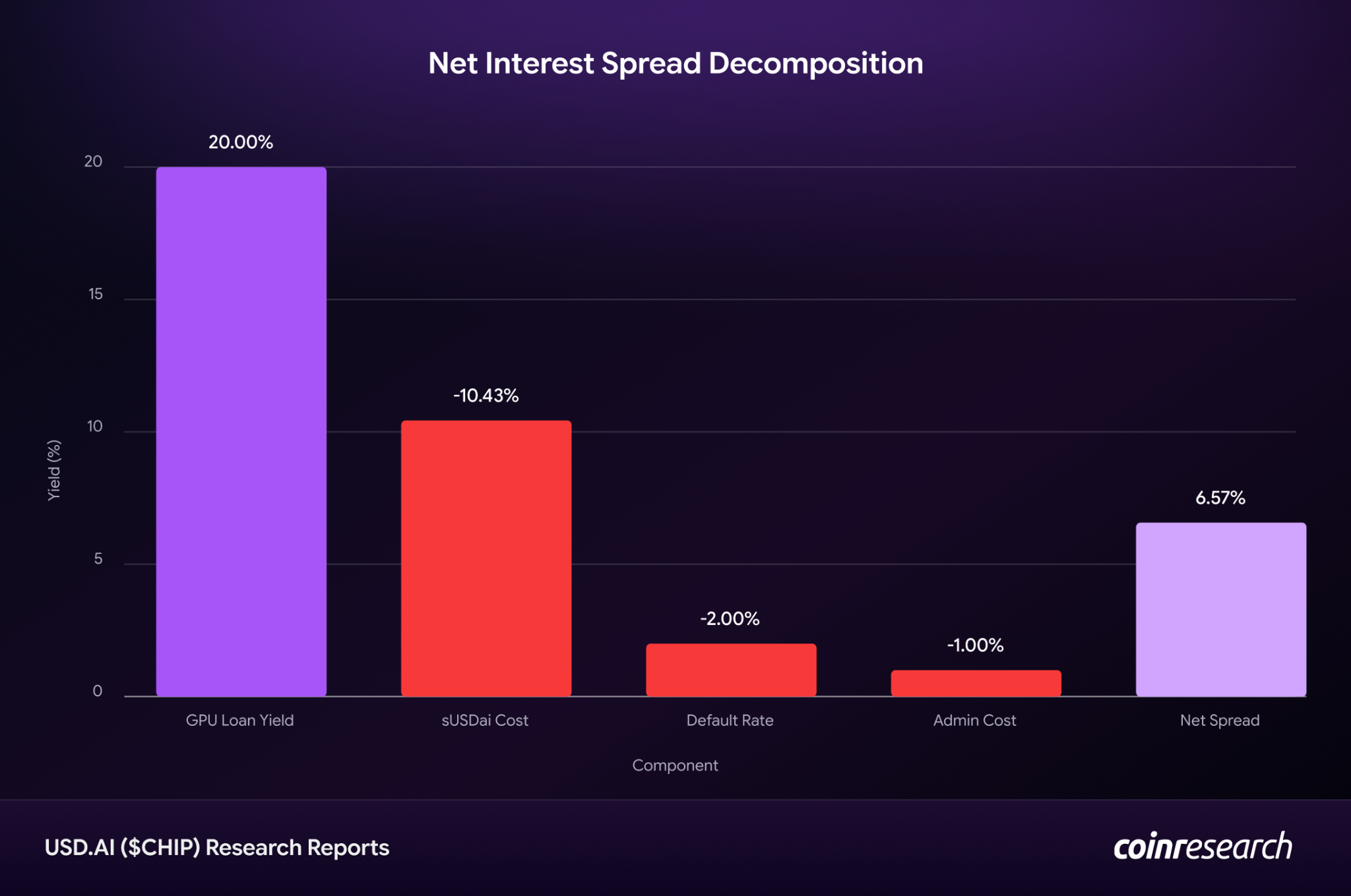
The math in base case:
-
Gross GPU loan yield: ~20%
-
Paid to sUSDai depositors: ~10.43%
-
Estimated defaults: ~2%
-
Admin costs: ~1%
-
Net protocol spread: ~6.57%
At $1B in active loans, that spread generates approximately $30M in annual protocol revenue, real cash flow, not token inflation.
USD.AI’s biggest live deals prove this isn’t theoretical:
-
QumulusAI: $500M non‑recourse GPU financing facility
-
Sharon AI: $500M facility for APAC GPU infrastructure expansion
Real companies. Real hardware. Real loans.
CHIP Token: Governance Today, Equity‑Like Optionality Tomorrow
Total supply: 10 billion CHIP. ICO price: $0.03 (FDV: $300M).
CHIP does four things:
-
Governs risk parameters, collateral standards, and curator approvals
-
Backstops the protocol, staked CHIP absorbs losses before depositors
-
Captures fees, protocol revenue accrues to CHIP stakers via governance
-
Controls curator access, approves which loan originators can participate
The equity analogy: just like equity absorbs bank losses before depositors, CHIP absorbs protocol defaults before sUSDai holders. In return, CHIP earns the fee revenue from taking that risk.
The key unlock to watch: fee distribution mechanics are emerging but not fully live as of March 2026. When they activate, CHIP shifts from governance token to fee‑bearing asset. That transition is the single most important catalyst.
Valuation: Is CHIP Cheap or Expensive?
CHIP Valuation Scenario Range, FDV spans from a $137M bear case to a $1B full bull scenario, with ICO and fair-value ranges clustered around $210M–$302M.
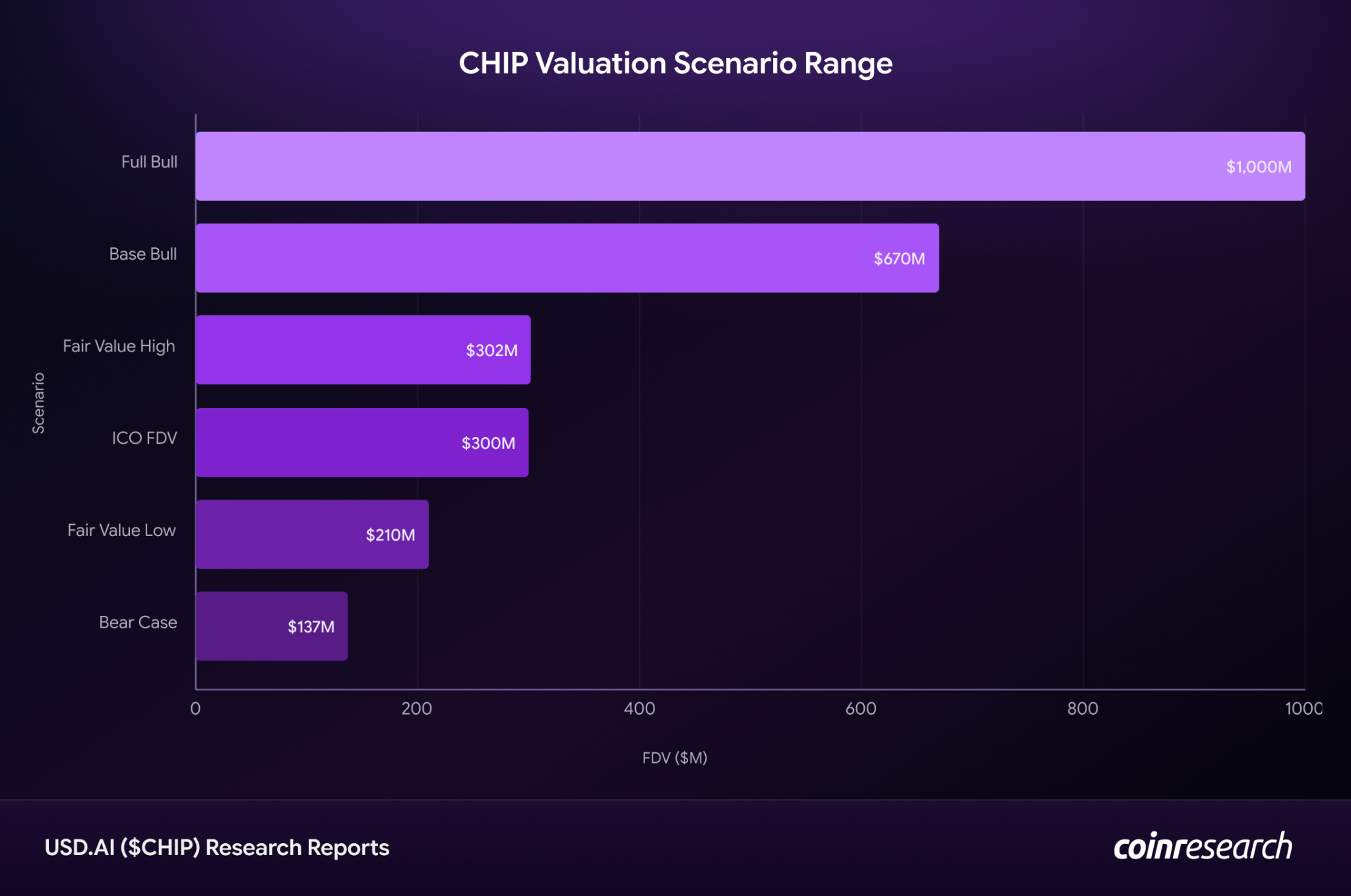
Three lenses on valuation:
-
Revenue multiple (15–25×): $450M–$750M FDV at base case revenue
-
TVL multiple (0.3–0.5×): $189M–$315M FDV at current TVL
-
DCF‑style (14% discount rate): $210M–$302M adjusted FDV
Verdict: CHIP at ICO pricing is fairly valued on base case fundamentals, with asymmetric upside if the bull case plays out. Not a steal, but the option on the bull case is cheap relative to where comparable protocols trade.
How USD.AI Compares to the Field
Comparable Protocol FDV vs TVL, USD.AI sits between discounted RWA credit (Centrifuge) and premium synthetic dollars (Ondo, Ethena) on FDV/TVL multiples.
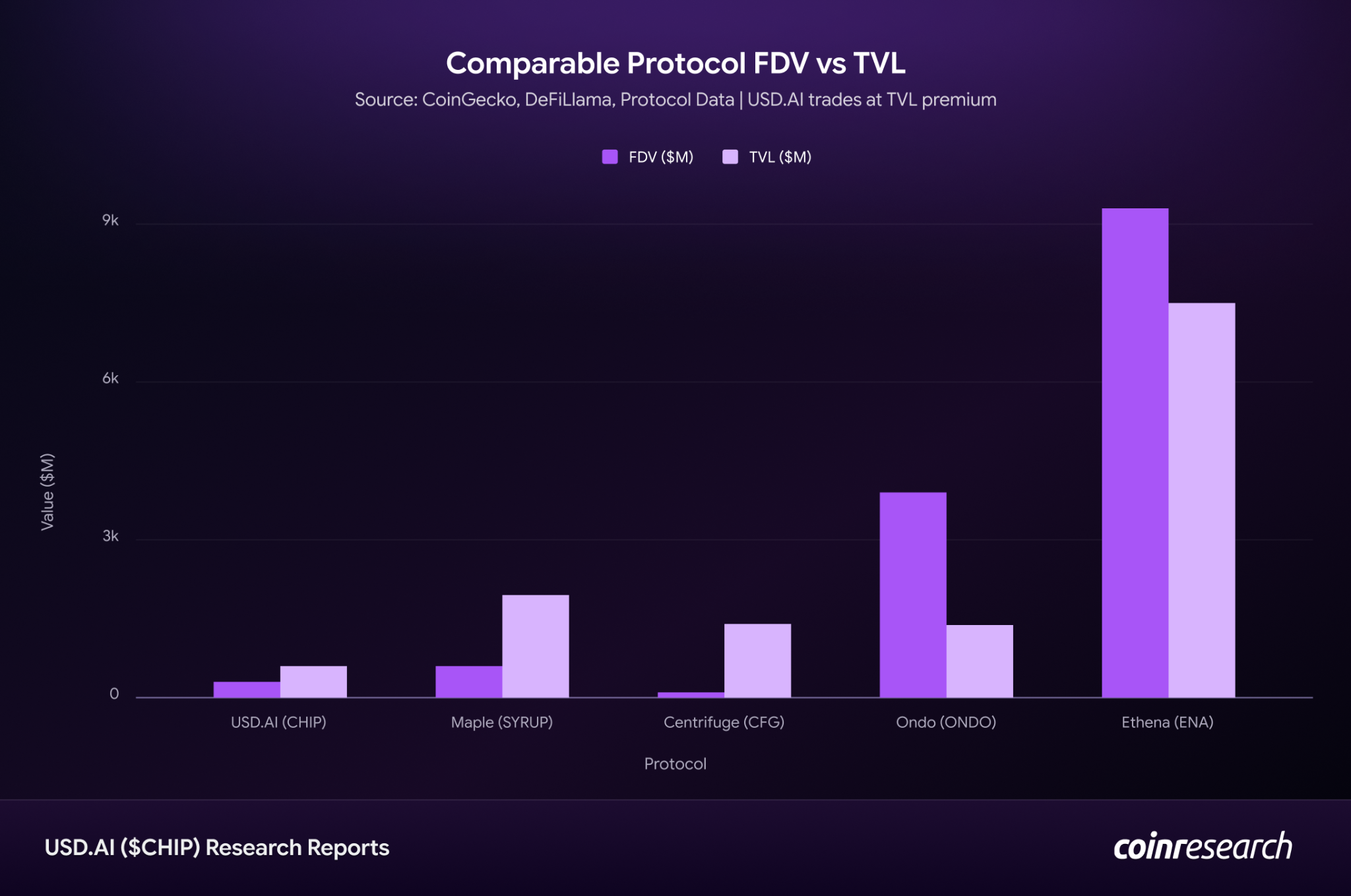
The most direct comparable is Maple Finance (SYRUP): similar revenue base, similar credit architecture, 3× the TVL, two-year track record. The multiple USD.AI converges toward is Maple’s, and if GPU lending commands a premium to institutional crypto lending, it could exceed it.
The cautionary tale is Centrifuge (CFG): $1.4B TVL, only $98M FDV. Governance tokens without credible fee capture trade at steep discounts. CHIP needs to avoid that path.
What Can Go Wrong
A balanced view:
-
Borrower concentration, Two borrowers represent nearly the entire loan pipeline. A single default is a protocol event.
-
GPU depreciation, NVIDIA’s release cycle is 12–18 months. Collateral values can fall faster than loans amortize.
-
Regulatory risk, sUSDai may face securities scrutiny as a yield‑bearing instrument backed by real‑world loans.
-
Token concentration, Top 2 addresses controlled ~96% of CHIP supply at TGE.
-
Fee distribution delay, Every month without live on‑chain fee sharing is a month CHIP underperforms its thesis.
The Investment View
Yield investors → sUSDai at ~10%+ APR is one of the cleanest real‑yield plays in DeFi, hardware‑backed, not emissions‑funded. Size it as a yield satellite.
Long‑term investors → CHIP is a high‑conviction, high‑beta bet on AI infrastructure credit becoming a core DeFi primitive. Small position, watch fee activation and TVL milestones.
Traders → CHIP post‑TGE is event‑driven. 100% unlock at genesis with concentrated holders creates early volatility. Key catalysts: CEX listings, first major loan repayment, fee share activation.
Bottom Line
USD.AI is doing something boring and important: building the credit rails to finance the AI GPU supercycle, on‑chain, with real collateral and real yield.
Whether CHIP becomes a $300M governance token or a $1B+ fee‑bearing asset depends entirely on execution over the next 18 months.
Worth watching closely.
Want the Full Picture?
This article covers roughly 40% of what is in the full USD.AI ($CHIP) research report on CoinResearch.
The full report includes:
-
Complete CHIP token unlock schedule, vesting analysis, and holder concentration breakdown
-
Detailed competitive landscape vs. Maple Finance, Centrifuge, Ondo Finance, Ethena, and MakerDAO
-
Full revenue model with conservative, base, and bull case scenario tables
-
Net interest spread decomposition and protocol cash flow assumptions
-
Valuation model across three methodologies: revenue multiple, TVL multiple, and DCF-style
-
FDV scenario roadmap from $137M bear case to $5B max bull with realistic timelines
-
Collateral risk analysis: GPU depreciation cycles, liquidation complexity, and export control risks
-
Team and backer verification: Framework Ventures, Dragonfly, YZi Labs, Coinbase Ventures, DCG
-
Entry framework and key catalysts to watch in 2026–2027
-
Our full investment thesis and position sizing guidance by investor type
CoinResearch covers the protocols that matter, with the depth that actually helps you make decisions. No hype, no affiliate angles, just structured research.
Access the full USD.AI ($CHIP) report and every future deep dive at coinresearch.ai, starting at $9/month.
Disclaimer: This article is for informational purposes only and does not constitute financial or investment advice. CoinResearch analysts may hold positions in assets discussed. Cryptocurrency investments are highly volatile and speculative. Always conduct your own due diligence before making any investment decisions.