
Crypto exchanges processed $1.45 trillion of traditional-asset trading in the first half of 2026. The product that scaled was not the tokenized share.
Wall Street did move onchain in the first half of 2026, but not in the form most investors expected.
The tokenization narrative imagined legally enforceable shares moving onto blockchains, complete with dividends, voting, redemption, corporate actions, and a place on the issuer’s register. Crypto traders took a shorter route. They traded perpetual contracts referencing stocks, commodities, indices, currencies, and private companies.
The distinction is easy to miss because the ticker looks familiar. A contract marked NVDA can rise when Nvidia rises while giving its holder no Nvidia share, dividend, vote, redemption right, or claim against the company. What moved onchain was price exposure, and that market has become too large to dismiss.
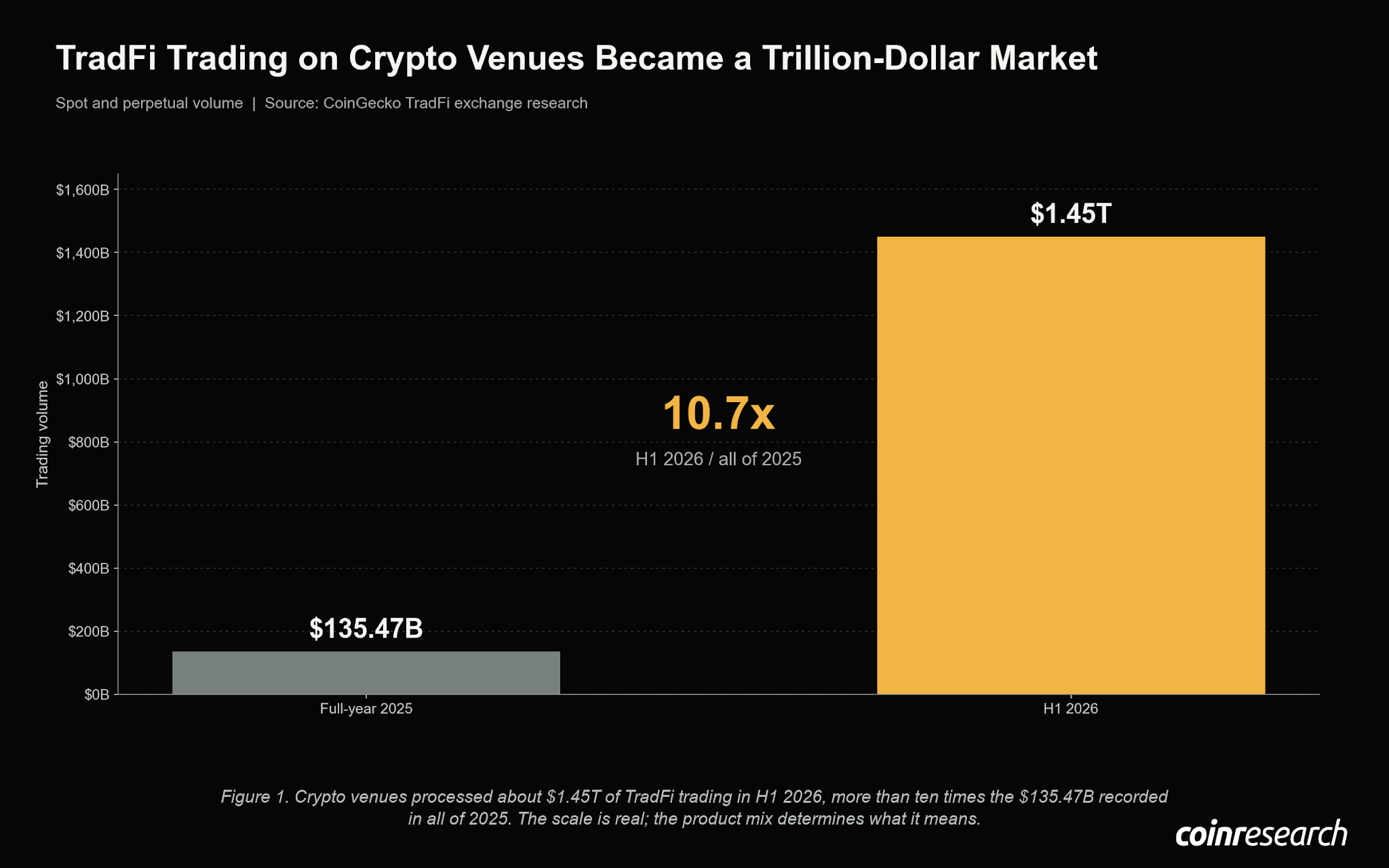
CoinGecko estimates that crypto venues processed $1.45 trillion of traditional-asset spot and perpetual volume in H1 2026, more than ten times the $135.47 billion recorded in all of 2025. Open interest across six covered exchanges rose from $60 million at the beginning of 2025 to $4.67 billion at the end of June. Those numbers describe a genuine financial product. They do not describe the migration of securities ownership.
The Product That Won Was the Perpetual
Perpetual contracts fit machinery that crypto already built. A trader posts stablecoin collateral, chooses a long or short position, and pays or receives funding that helps keep the contract near its reference price. There is no expiry and no need to roll into the next contract month. The venue already has an order book, liquidation engine, margin system, collateral rules, and a user base comfortable with leverage.
Adding Nvidia, gold, oil, or the S&P 500 can therefore feel like adding another market to an existing terminal. Moving ownership is much harder. A share carries legal rights, custody obligations, corporate actions, transfer restrictions, shareholder records, tax consequences, and jurisdictional rules. The issuer or an authorized intermediary must maintain an enforceable chain between the token and the underlying security.
The market followed the lower-friction path. CoinGecko recorded $230 million of monthly traditional-asset perpetual volume in January 2025 and $347.17 billion in May 2026, an increase of roughly 1,472 times. Through May, traditional-asset perpetual volume exceeded spot RWA volume by more than eight times. US stocks then became the largest category by open interest, with June volume reaching $189.84 billion after rising 337.4% from May.
The winning features were continuous access, stablecoin settlement, leverage, and the ability to short. None requires the venue to deliver a shareholder relationship.
A Familiar Ticker Can Hide an Unfamiliar Claim
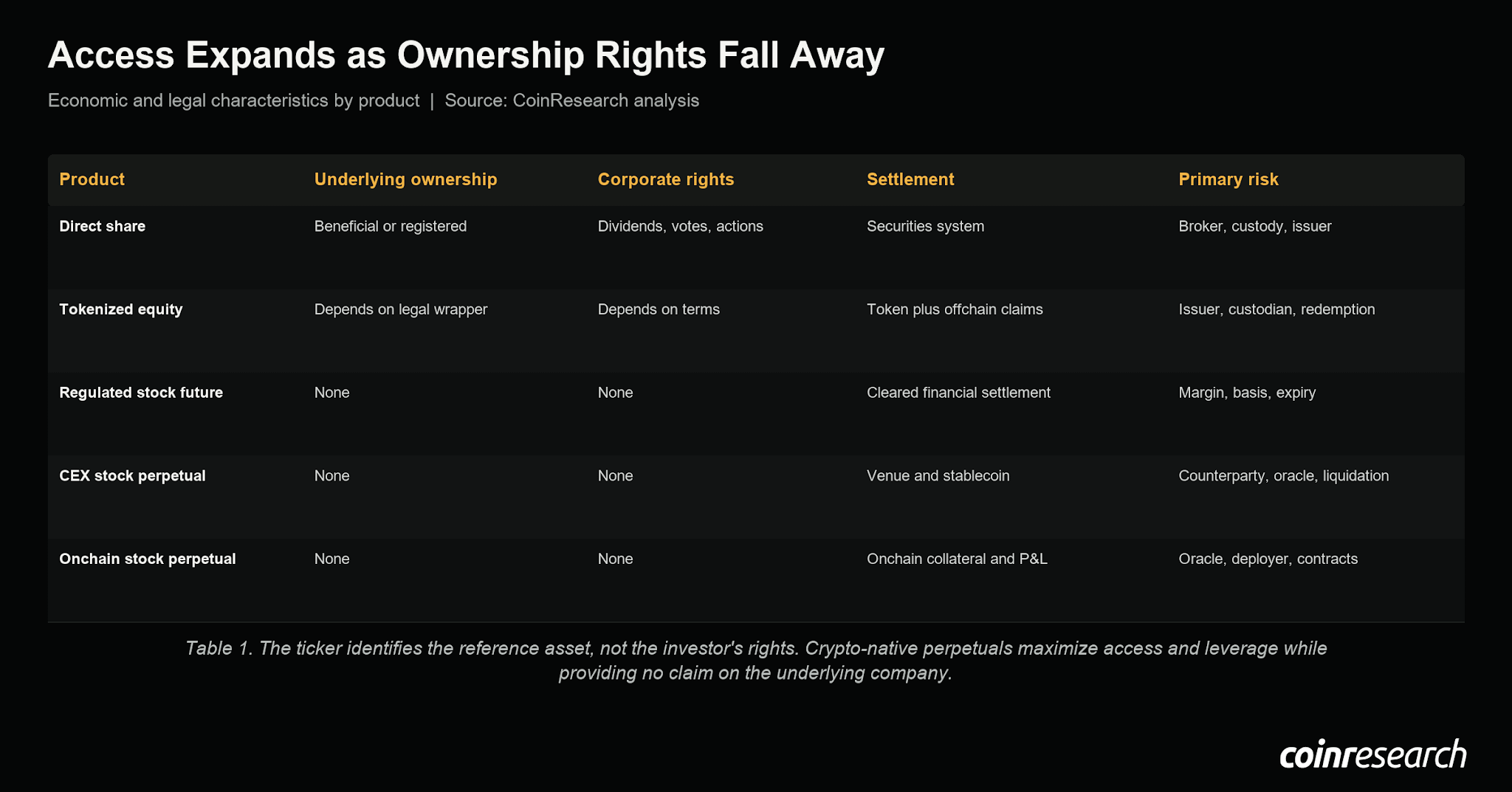
The same company name can sit on products with very different rights. A directly held share gives the investor a recognized relationship with the issuer. Depending on the share class and jurisdiction, that can include dividends, voting, corporate-action treatment, and a legal claim recorded through the securities system.
A properly structured tokenized share may preserve some or all of those rights, but only if the legal wrapper, custodian, transfer agent, redemption process, and eligibility rules make the connection enforceable. A regulated single-stock future provides standardized price exposure through a clearing framework, yet it remains a derivative. A crypto perpetual sits further from ownership: the trader usually receives a contractual profit-and-loss claim settled in stablecoins.
Binance states directly that its stock perpetuals do not confer ownership of the underlying asset. On Hyperliquid’s HIP-3 markets, the deployer defines the market and oracle, sets leverage, operates the contract, and can halt or settle it, while HyperCore supplies the order book and margin infrastructure. Onchain accounting improves transparency, but it does not create shareholder rights or remove operator risk.
For an average investor, the difference is practical rather than semantic. A profitable long perpetual does not receive a dividend. Funding can make a correct view expensive to hold. A position can be liquidated before the investment thesis is realized, and a contract carrying a stock ticker may never be redeemable for a share. The ticker identifies the reference asset. The product documents define what the investor owns.
The Boom Is Large, but Narrow
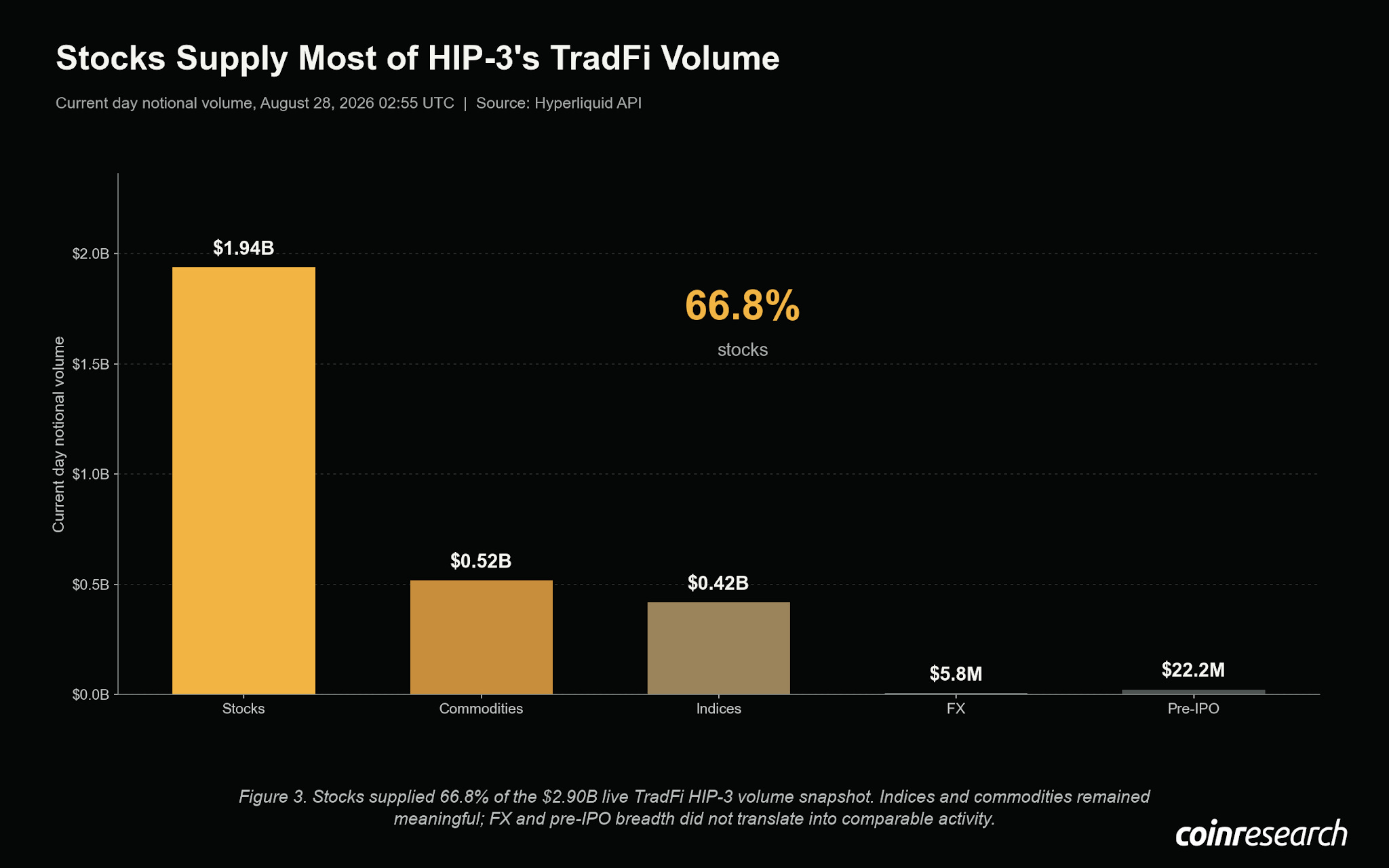
The sector is too large to call a novelty and too concentrated to call mature. CoinResearch refreshed Hyperliquid’s official API at 02:55 UTC on August 28, 2026. The snapshot identified 183 classified traditional-asset HIP-3 markets with approximately $2.90 billion of current-day notional volume and $3.52 billion of calculated notional open interest.
Stocks supplied $1.94 billion, or 66.8%, of volume. Commodities contributed $516.2 million, indices $418.5 million, pre-IPO contracts $22.2 million, and foreign exchange $5.8 million. The contract list was broad, but the activity was not. One deployer, XYZ, represented approximately $2.82 billion, or 97.3%, of the traditional-asset HIP-3 volume. The ten largest contracts accounted for 68.4%.
The comparison with CoinResearch’s August 22 snapshot is more revealing. Current-day volume rose 60.4%, but calculated open interest fell 4.9%. The snapshot volume-to-OI ratio increased from 0.49x to 0.82x. XYZ’s share declined by 2.0 percentage points, yet the top-ten market share increased by 7.1 percentage points.
That is the market-quality tension in one result. The market became busier and slightly less dependent on one operator, but more concentrated in its leading contracts. Faster turnover did not produce more held exposure. Demand can rotate across many tickers while the infrastructure remains economically dependent on one operator.
The next useful signal is not another volume record. It is whether liquidity and open interest persist through quieter periods, whether activity broadens beyond the largest contracts, and whether competing deployers can attract meaningful flow without weakening execution quality.
When Wall Street Closes, the Oracle Becomes the Market
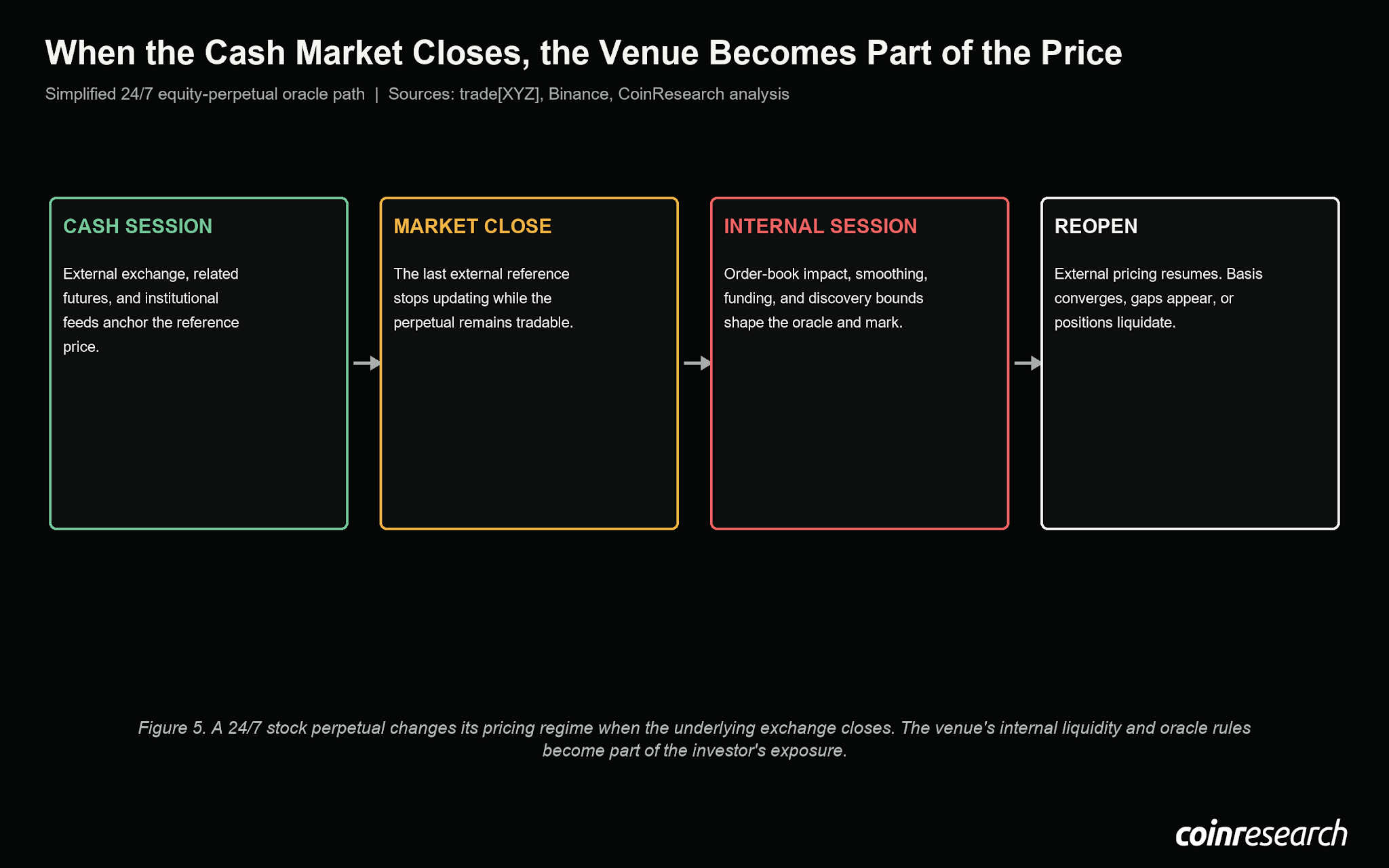
Traditional exchanges close. Crypto perpetuals do not. That creates the defining engineering problem for stock-linked contracts: how should a market trade on Saturday when the underlying stock is not producing a live exchange price?
During normal hours, a venue can anchor the contract to the underlying stock, related futures, market makers, and institutional feeds. Outside those hours, every option is imperfect. A venue can freeze the last external price, stop trading, or allow its own order flow to influence the reference used for funding and liquidation.
Trade[XYZ] prioritizes external pricing while the underlying market is open and shifts toward an exponentially weighted mechanism based on order-book impact prices when those inputs disappear. Binance uses order-book smoothing during closed sessions. MEXC warns that low-liquidity periods can bring slippage, paused index prices, and unfilled conditional orders. Ostium avoids part of the problem by following the underlying stock’s native trading hours.
Each design trades continuous access against reference-price integrity. A deep global market could let investors transfer risk immediately after weekend news and eventually help inform the next cash-market open. In a thin market, however, the venue’s own order flow can begin pricing the position. Funding and liquidation may transfer value before the external market validates the move.
The product race is also moving toward more leverage. Bybit raised dozens of TradFi contracts to 25x and expanded selected MU, SNDK, SOXL, SK Hynix, and Nvidia tiers to as much as 50x. It then added new 25x equity and ETF contracts and a 10x pre-IPO Shein perpetual on August 26-27. That expansion confirms demand for synthetic access, but it also widens the gap between the familiar ticker and the risk an average investor is actually taking.
A trader can therefore be right about the stock and still lose through basis, funding, collateral stress, or forced liquidation. Twenty-four-hour access is a useful feature, not a guarantee of twenty-four-hour price quality.
Where the Economics Accrue
Traditional-asset perpetuals create several potential winners. Venues earn trading fees. Market deployers can receive a share of activity. Market makers earn spread and inventory compensation. Oracle and data providers become critical infrastructure. Stablecoin issuers benefit when more collateral remains inside trading accounts.
The related protocol token does not automatically win. An exchange can grow without sharing revenue with token holders. A deployer can receive fees while the base protocol captures only part of the economics. Incentives, rebates, insurance costs, market-maker agreements, and operating expenses can absorb gross revenue before it reaches an investable asset.
For new capital, the better question is not which token has the strongest “Wall Street onchain” narrative. It is where each dollar of fee value ends, whether the market has durable liquidity, and whether users or operators have an enforceable reason to own the asset. For existing holders, the monitoring work is mechanical: volume, open interest, depth, deployer concentration, oracle incidents, funding, liquidations, and the final recipient of protocol economics.
CoinResearch is constructive on the growth of traditional-asset derivatives over the next 6 to 18 months and neutral on undifferentiated token proxies. The thesis strengthens if open interest persists through quieter markets, order-book depth improves, deployer concentration falls, and off-hours prices converge cleanly when underlying exchanges reopen. Transparent fee routing into an investable asset would make the exposure more compelling.
The view weakens if activity proves event-dependent, long-tail markets go dormant, or a major oracle or liquidation failure shows that continuous trading outran market quality. It would also change if spot tokenized equities close the gap while preserving credible ownership and redemption rights. That would show that blockchains can carry the asset itself rather than only a leveraged reference to its price.
The Bottom Line
Wall Street has moved onto crypto rails, but the first breakout product is the perpetual contract, not the tokenized share. That is a meaningful financial innovation. Crypto venues have created a global distribution layer for traditional-asset risk with stablecoin collateral, long and short access, and trading schedules conventional brokerage infrastructure does not easily match.
It is also a narrower achievement than the tokenization headline suggests. Price exposure moved faster than ownership, and leverage moved faster than investor rights. A trillion-dollar trading statistic does not mean a trillion dollars of shares migrated onto blockchains.
The category should be underwritten as derivatives infrastructure. Its durable winners will be the venues, deployers, market makers, oracle systems, collateral issuers, and tokens that can prove economic capture. Products that borrow a familiar ticker without delivering adequate liquidity, risk controls, or enforceable value will struggle once the novelty fades.
Wall Street moved onchain. For now, it mostly came to trade.
This article is a preview of the full flagship Research Report, Wall Street Moved Onchain. Why the Boom Is Mostly Leverage. The complete Premium report includes the product-rights matrix, venue-architecture comparison, leverage analysis, regulated-market convergence, value-capture map, probability-weighted scenarios, risk framework, and monitoring dashboard on the CoinResearch Platform.
CoinResearch delivers institutional-grade crypto research for investors who want signal, not noise.
Disclaimer: This article is for informational and educational purposes only and does not constitute investment, legal, tax, or trading advice. Perpetual contracts and leveraged derivatives can result in rapid or total loss of collateral. Review exact product terms, legal rights, and jurisdictional restrictions before taking exposure.
.