
Tokenized Treasuries are becoming one of crypto’s clearest real-world use cases, but ONDO still has to prove the token captures the value of the platform.
Ondo is not just an RWA narrative trade. It is a serious tokenized-finance platform with a token-value question.
The RWA market has crossed the point where it can be dismissed as a crypto side quest. Tokenized U.S. Treasuries alone now sit around $10 billion in tracked value, while Ondo’s own platform shows roughly $3.91 billion in distributed asset value.
That matters because RWAs are not trying to replace DeFi speculation. They are trying to answer a more basic question: why should on-chain dollars sit idle when short-term government debt can be tokenized, transferred, and integrated into crypto rails?
Ondo Finance is one of the cleanest expressions of that idea. Its products, especially USDY and OUSG, give investors access to tokenized yield exposure. Its bigger ambition is wider: tokenized securities, market infrastructure, and eventually a dedicated chain for institutional-grade RWAs.
The thesis is strong. The token is more complicated.
What Is Ondo Finance?
Ondo Finance is a real-world asset platform focused on bringing institutional-grade financial products on-chain. Its core products tokenize access to yield-bearing dollar instruments, short-term U.S. Treasuries, and, through newer initiatives, publicly traded securities such as stocks and ETFs.
The important point: Ondo is no longer just a tokenized Treasury issuer.
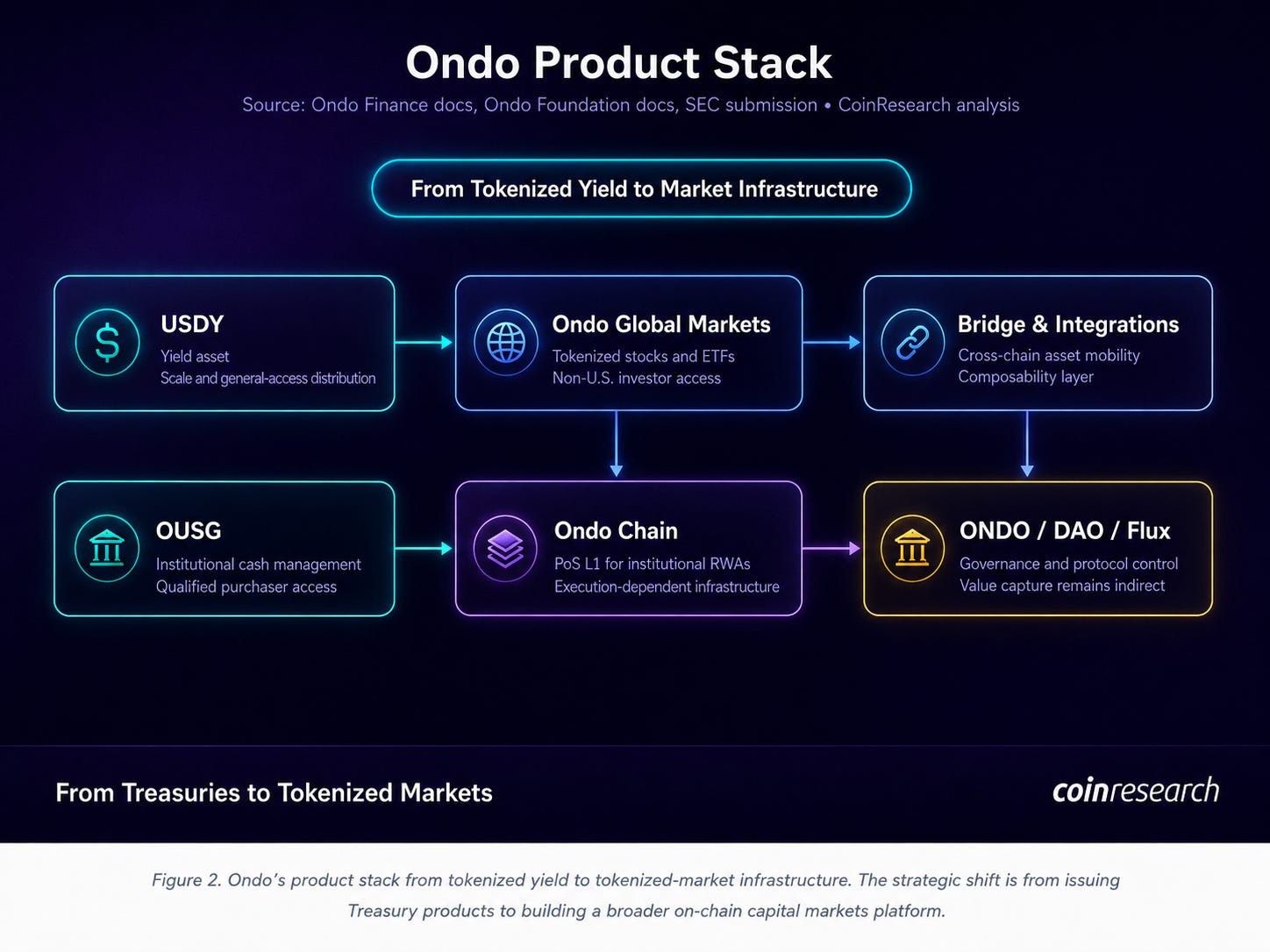
Its stack now includes USDY, OUSG, Ondo Global Markets, Ondo Chain, cross-chain distribution, and governance around ONDO and the Ondo DAO. That gives the project a broader infrastructure angle than many RWA competitors.
Ondo wants to be more than a product. It wants to be a financial rail.
The Problem It’s Solving
Stablecoins proved that dollars want blockchain rails. But most stablecoins do not pay holders native yield. That created a simple gap: on-chain users wanted dollar exposure, liquidity, and yield at the same time.
Tokenized Treasuries filled that gap.
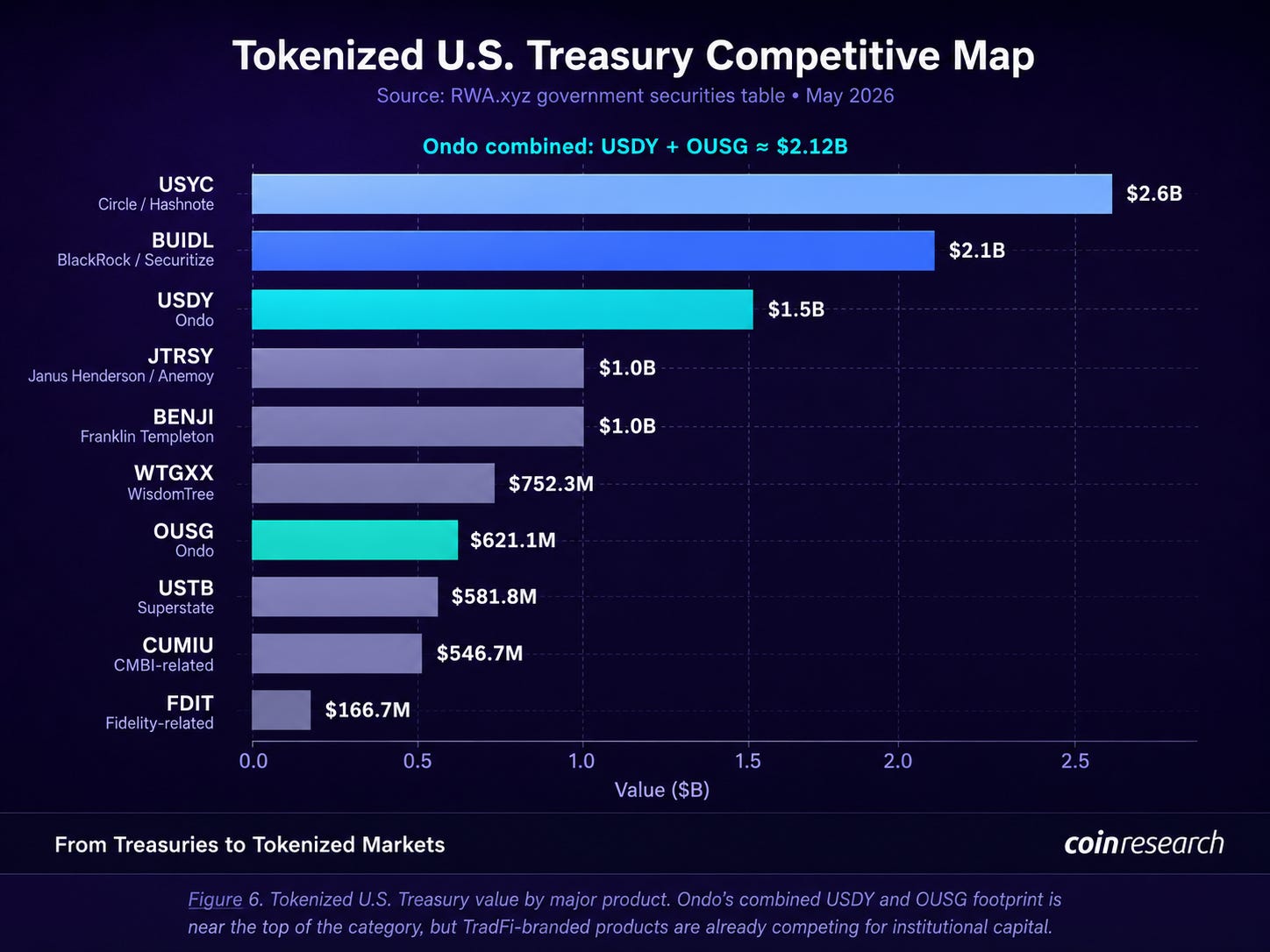
The current tokenized U.S. Treasury market is around $10 billion, with products from crypto-native issuers and major traditional asset managers. That is still small compared with traditional money markets, but large enough to prove demand.
Ondo’s role is to package that demand into usable on-chain products. USDY gives Ondo scale. OUSG gives it institutional credibility. Together, they make Ondo one of the category’s most visible players.
The market is not asking whether tokenized yield can exist anymore. It is asking who controls distribution.
How It Works
Ondo’s mechanism is easier to understand if we separate the products.
USDY is Ondo’s broader yield product. It is structured as a tokenized note and gives eligible non-U.S. investors exposure to dollar-denominated yield. It is not a normal stablecoin. It is a yield-bearing instrument with onboarding, eligibility, and redemption rules.
OUSG is more institutional. It is designed for qualified purchasers and provides exposure to short-term U.S. government securities and money-market-style instruments. It is narrower in access, but stronger as an institutional proof point.
Ondo Chain is the infrastructure bet. Ondo argues that institutional RWAs need compliance-aware transfer rules, identity workflows, issuer controls, reliable settlement, and stronger asset verification than generic blockchains were built to prioritize.
That stack gives Ondo a credible path from product issuer to infrastructure provider.
The Ondo Stack Is Getting Bigger
Ondo’s most important strategic shift is from tokenized Treasuries into tokenized capital markets.
Ondo Global Markets is designed to give eligible non-U.S. investors on-chain exposure to publicly traded securities, including stocks and ETFs. That moves Ondo beyond cash-management products and into a much larger ambition: tokenized access to traditional markets.
This is where the platform becomes more interesting. USDY and OUSG prove demand for tokenized yield. Global Markets tests whether Ondo can move into tokenized securities. Ondo Chain tests whether the project can control more of the settlement and infrastructure layer.
Each step raises the upside. Each step also raises execution risk.
The bigger the stack gets, the more Ondo starts to look like a capital-markets infrastructure company rather than a simple crypto protocol.
How Does It Compare?
The RWA market is now crowded, and Ondo is not competing only with crypto startups.
BlackRock BUIDL: Strongest institutional brand signal. Ondo does not beat BlackRock on reputation, but it can compete on crypto-native distribution and composability.
Franklin Templeton BENJI: A major TradFi tokenized fund product with strong asset-management credibility. Ondo has stronger native crypto mindshare.
Hashnote / USYC: One of the largest tokenized Treasury products by tracked value. Ondo’s edge is a wider product stack, not just one large product.
Superstate USTB: A crypto-native RWA competitor focused on tokenized Treasuries. Ondo currently has broader market visibility and product ambition.
Maple and Centrifuge: More credit and RWA infrastructure oriented. Ondo’s advantage is clearer Treasury and securities positioning.
The competitive threat is not just one rival. It is the chance that traditional institutions capture most tokenization economics while crypto tokens become narrative wrappers.
The Token Disconnect
This is the part investors should not skip.
Ondo as a platform can grow while ONDO as a token underperforms. That is not a contradiction. It is the core risk.
ONDO’s documented role is governance for the Ondo DAO and Flux Finance. Governance has value, but governance is not the same as a direct claim on product revenue, AUM growth, Global Markets fees, or Ondo Chain economics.
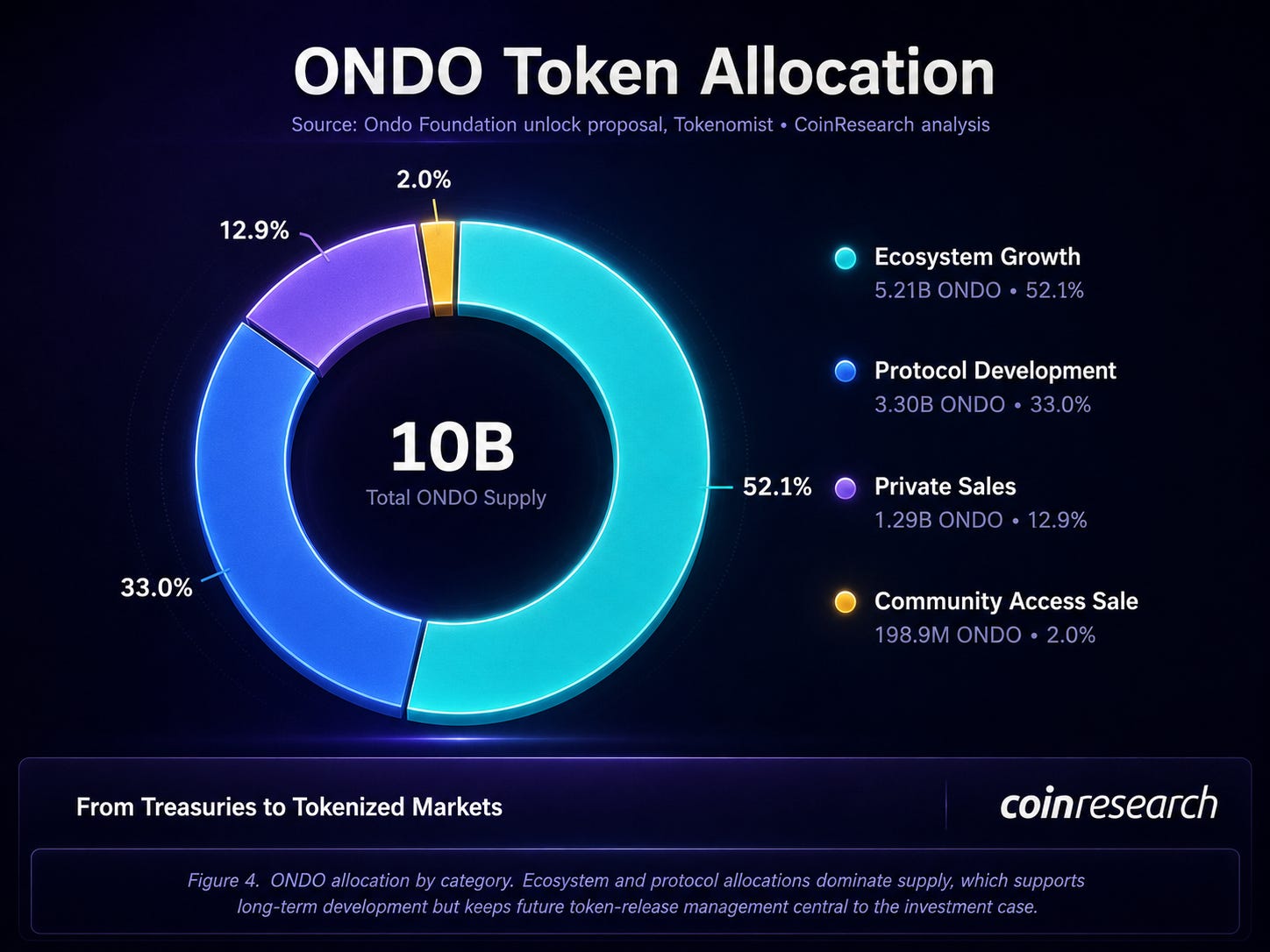
The token also has a supply question. ONDO has a 10 billion total supply, with roughly 48.69% unlocked and about 51.31% still locked or not circulating. The next listed unlock is not immediate, but future supply still matters.
That is why our full report separates the project score from the token score. Ondo the project looks strong. ONDO the token still needs clearer value capture.
The Risks Are Real
Regulatory risk: Ondo operates close to securities markets. Its products rely on eligibility rules, jurisdictional restrictions, KYC, structured issuers, and compliance design. That is a moat, but also a constraint.
Token-value-accrual risk: ONDO does not yet have a clean economic claim on the full Ondo product stack. If governance remains limited while platform value grows elsewhere, tokenholders may not capture enough upside.
Competitive and rate-cycle risk: BlackRock, Franklin, Hashnote, Superstate, and other issuers are already competing for tokenized Treasury demand. If rates fall, the yield advantage versus stablecoins could narrow.
Ondo is strong, but this is not a risk-free RWA proxy.
The Bottom Line
Ondo is one of the strongest RWA platforms in crypto. Its product traction is real, its institutional positioning is credible, and its ambition is bigger than tokenized Treasuries.
But ONDO still has to prove the token captures enough of the platform’s value.
Our stance is HOLD. The project is high quality. The token needs clearer value accrual before it deserves a cleaner Buy rating.
This article is a preview of our full flagship Intelligence Report on Ondo Finance ($ONDO).
Read the complete deep-dive, including the full tokenomics and unlock-schedule breakdown, the six-dimension CoinResearch scorecard, the complete competitive matrix, and our split Buy/Hold/Sell guidance for new vs. existing investors, on
Coinresearch delivers institutional-grade crypto research for investors who want signal, not noise.
Disclaimer: This article is for informational purposes only and does not constitute financial or investment advice. CoinResearch analysts may hold positions in assets discussed. Cryptocurrency investments are highly volatile and speculative. Always conduct your own due diligence before making any investment decisions.