
Tokenized equities can make market exposure more portable, fractional and globally accessible. But the token itself does not determine whether its holder owns a share.
A stock ticker has always carried a simple promise.
Buy one share of a public company and, directly or through a broker, you receive a recognized interest in that company. The exact custody chain can be complicated, but the legal object is familiar. There is an issuer, an official ownership record, a class of stock and a known package of rights.
Tokenized stocks disturb that simplicity.
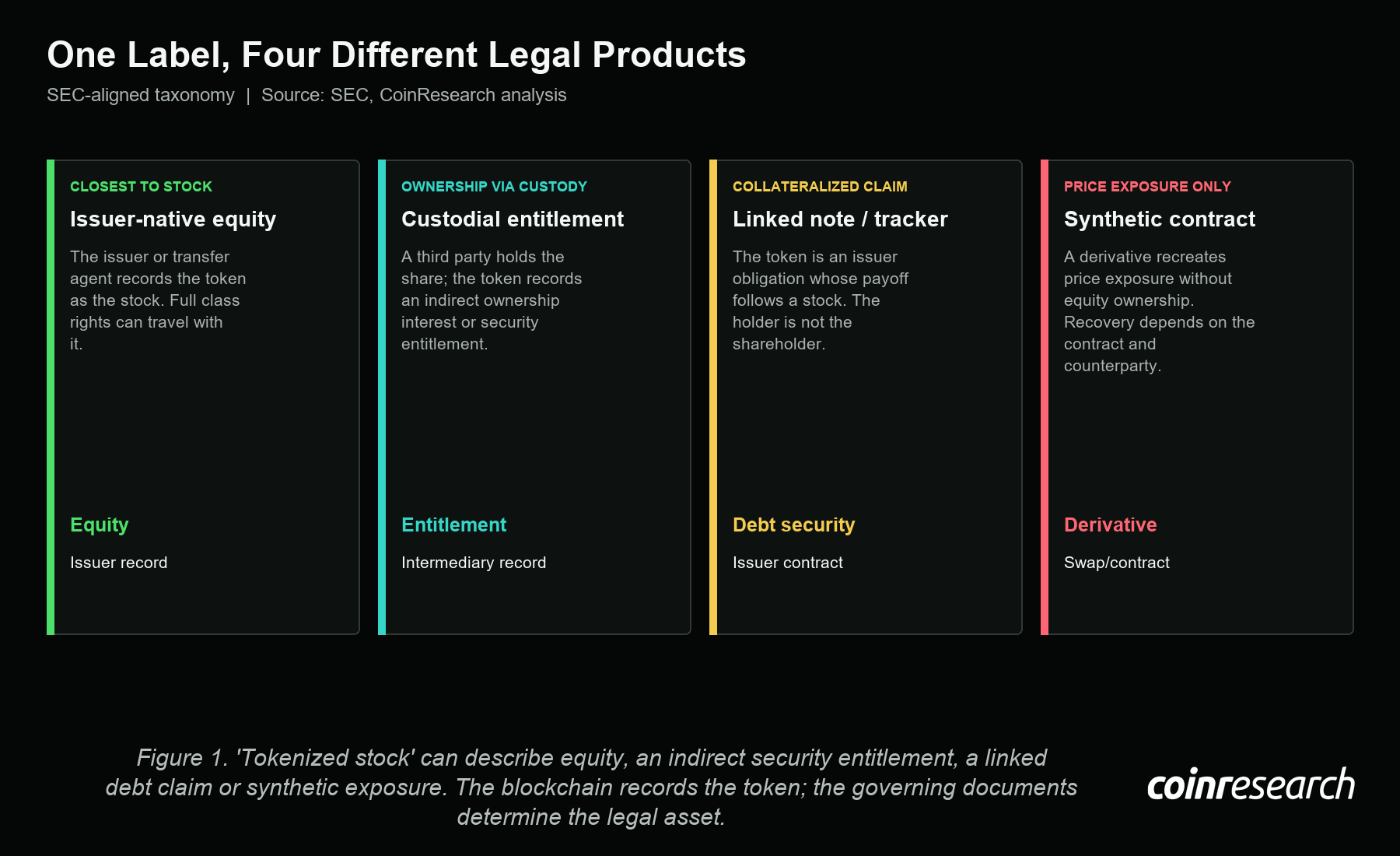
The same company name can now appear inside several products that look nearly identical on a trading screen. One token may represent issuer-native equity recorded onchain. Another may be a beneficial interest in shares held by a custodian. A third may be a debt security whose payoff follows the stock. A fourth may be a derivative with no ownership claim at all.
One Label, Four Different Products
The phrase “tokenized stock” describes a user experience more reliably than it describes a legal structure.
In January 2026, staff from three US Securities and Exchange Commission divisions published a taxonomy separating issuer-sponsored tokenized securities from third-party custodial and synthetic structures. The message was less futuristic than the technology: changing the recordkeeping format does not change the substance of the instrument.
-
An issuer-native security is the closest thing to putting a stock onchain. The company or its transfer agent integrates the blockchain into the official ownership record. A valid token transfer changes who owns the security, and the holder can retain the rights attached to that share class.
-
A custodial entitlement is one step removed. A third party holds the shares while the investor owns an indirect interest or security entitlement. This is not inherently inferior. Conventional brokerage accounts already rely on intermediated ownership. The questions are whether the entitlement is legally effective, whether customer assets are segregated and whether the token ledger reconciles with the controlling books and records.
-
A linked note or tracker gives the investor a claim against the product issuer. The issuer may hold one referenced share for every token and pass through dividend economics. The holder still owns the note, not the public company’s stock.
-
A synthetic contract reproduces price exposure through a derivative. Its value depends on the contract, collateral and counterparty rather than the company’s share register.
The important phrase is “may be backed 1:1.” Backing can make a tracker more robust, but it does not magically turn a debt claim into equity. Collateral answers whether assets support the product. It does not by itself answer who owns those assets, which rights pass through, or what happens if the issuer fails.
How a Conventional Share Becomes an Onchain Token
Most third-party tokenized stocks still begin and end inside the traditional securities system.
A broker or product issuer buys the referenced share. A custodian or depositary holds it. After the purchase settles or is confirmed, a smart contract mints a corresponding token. The investor receives that token through an exchange, app or self-custodied wallet.
From that point, two records matter. The blockchain shows who controls the token. An offchain custody account, transfer-agent system or issuer register determines the legal claim behind it. A reliable product keeps those records reconciled. A weak product leaves the investor with an onchain asset whose offchain enforceability is uncertain.
Corporate actions move in the opposite direction. The company pays a dividend, splits its shares, launches a tender offer or distributes another security through conventional market infrastructure. The custodian receives the event. The token issuer must decide how to translate it into cash, extra token units, a balance adjustment or another treatment.
Redemption is the anchor. The token is returned or burned, the underlying share is sold or released, and the investor receives cash, stablecoins or, in some structures, the share itself. But that route may require KYC, minimum sizes, fees, an eligible jurisdiction and open market hours. A retail investor trading the token on a secondary venue may not be able to redeem directly.
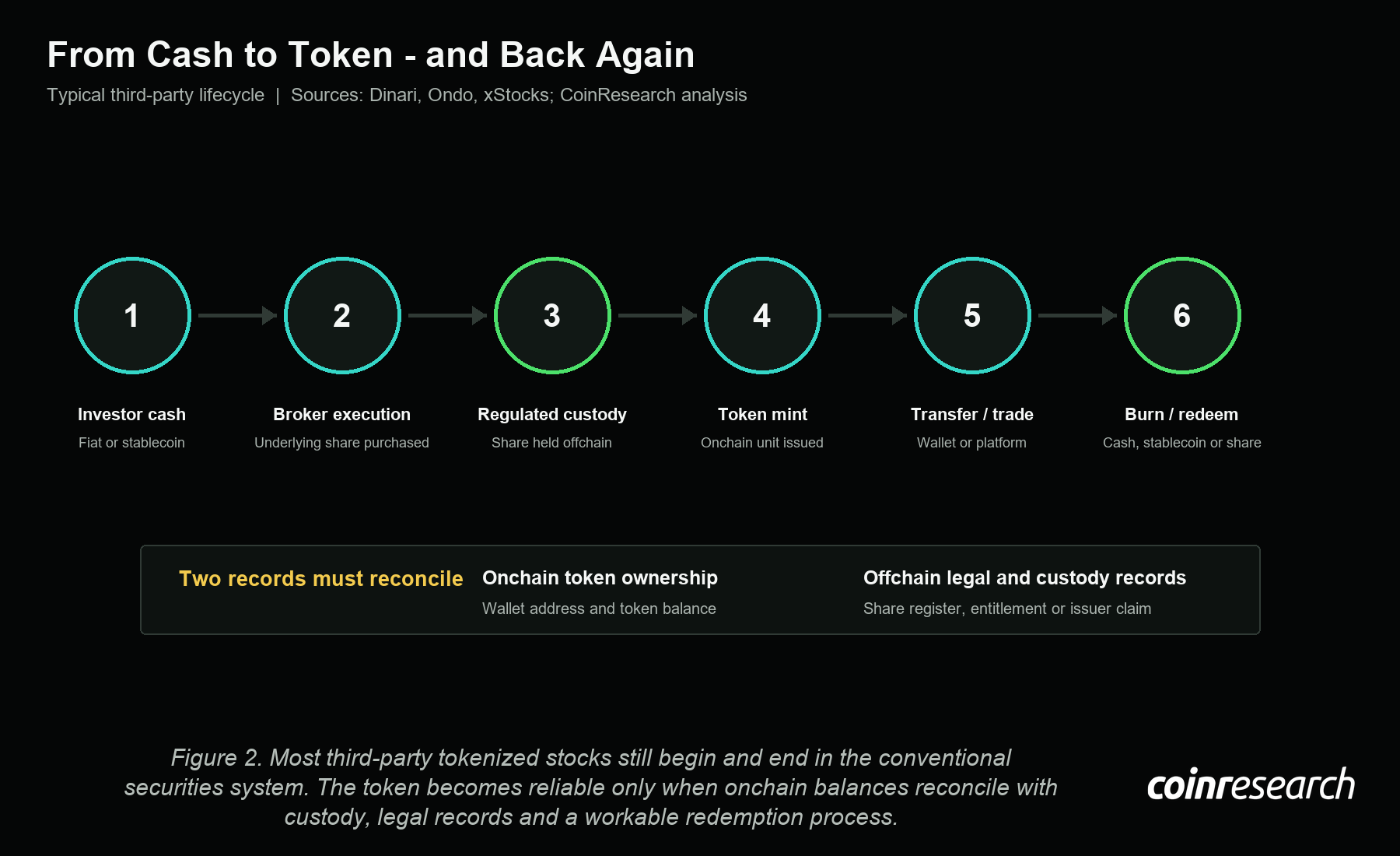
The technology can make the token portable. The legal and operational chain makes it dependable.
The 24/7 Promise Has Two Clocks
The most visible benefit of tokenization is continuous access. A wallet can transfer a token after the exchange closes. A decentralized pool can remain available through the weekend. For investors outside US market hours, that flexibility is genuinely useful.
But trading availability is not the same thing as market liquidity.
At 03:00 on Sunday, the referenced stock is not trading on its primary exchange. The deepest order book is unavailable. The issuer’s broker may not be able to buy or sell the underlying share. Primary minting and redemption may be paused. A market maker quoting the token must warehouse the risk until the conventional market reopens or hedge with an imperfect substitute.
That creates a two-clock market. During exchange hours, arbitrage can connect the token to the share through purchases, sales, minting and redemption. Outside those hours, the price becomes an estimate of where the stock might reopen plus the cost of carrying uncertain risk. Spreads can widen, depth can disappear and a news-driven token can temporarily detach from the underlying asset.
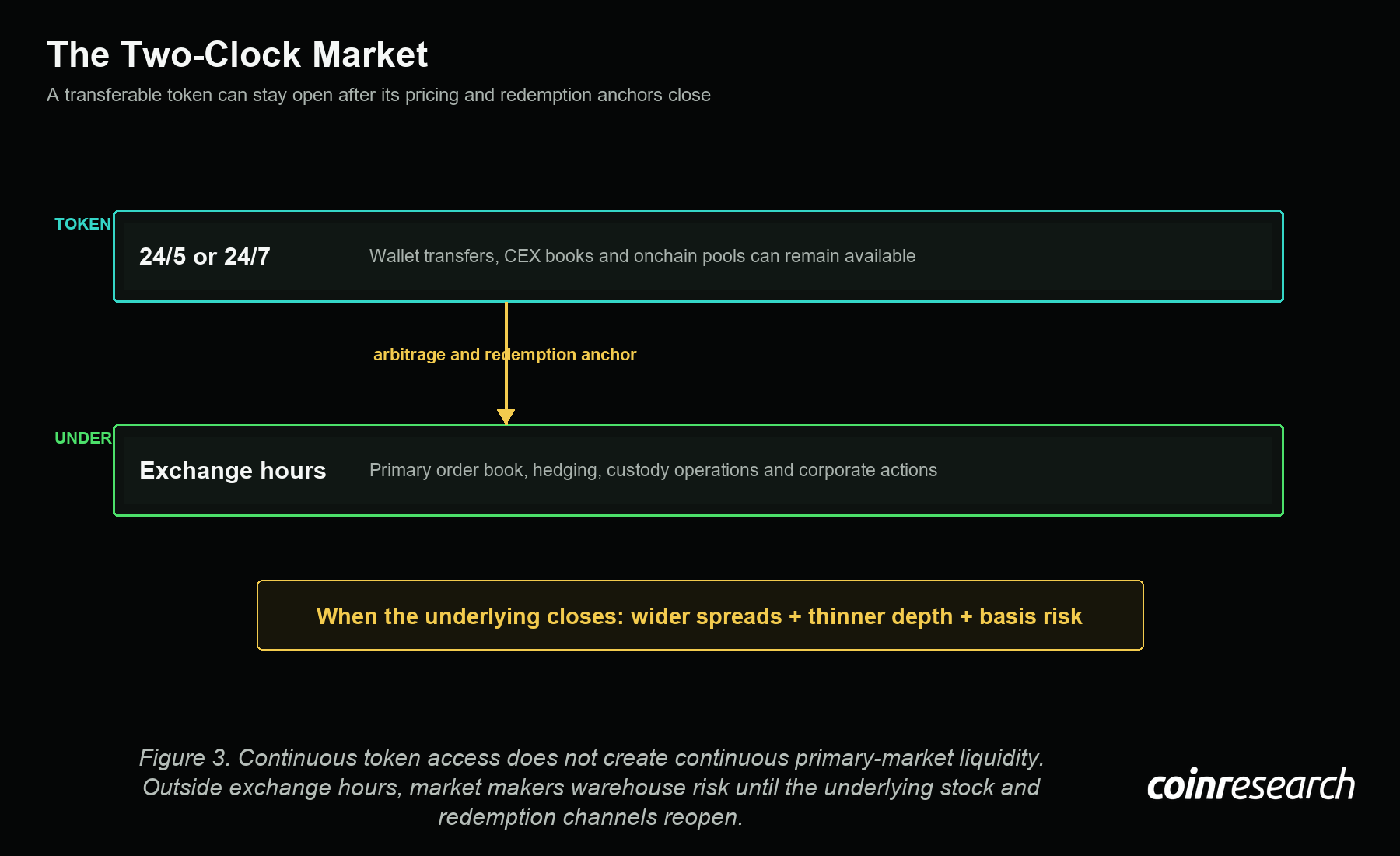
“Trades 24/7” therefore describes access to a venue. It does not promise the same execution quality at every hour.
For an average investor, the practical test is simple: compare the executable token price with the underlying stock during regular market hours, and inspect the spread and available depth for the intended order size. Convenience has value, but only after its cost is visible.
The Market Is Growing, but Wrappers Still Dominate
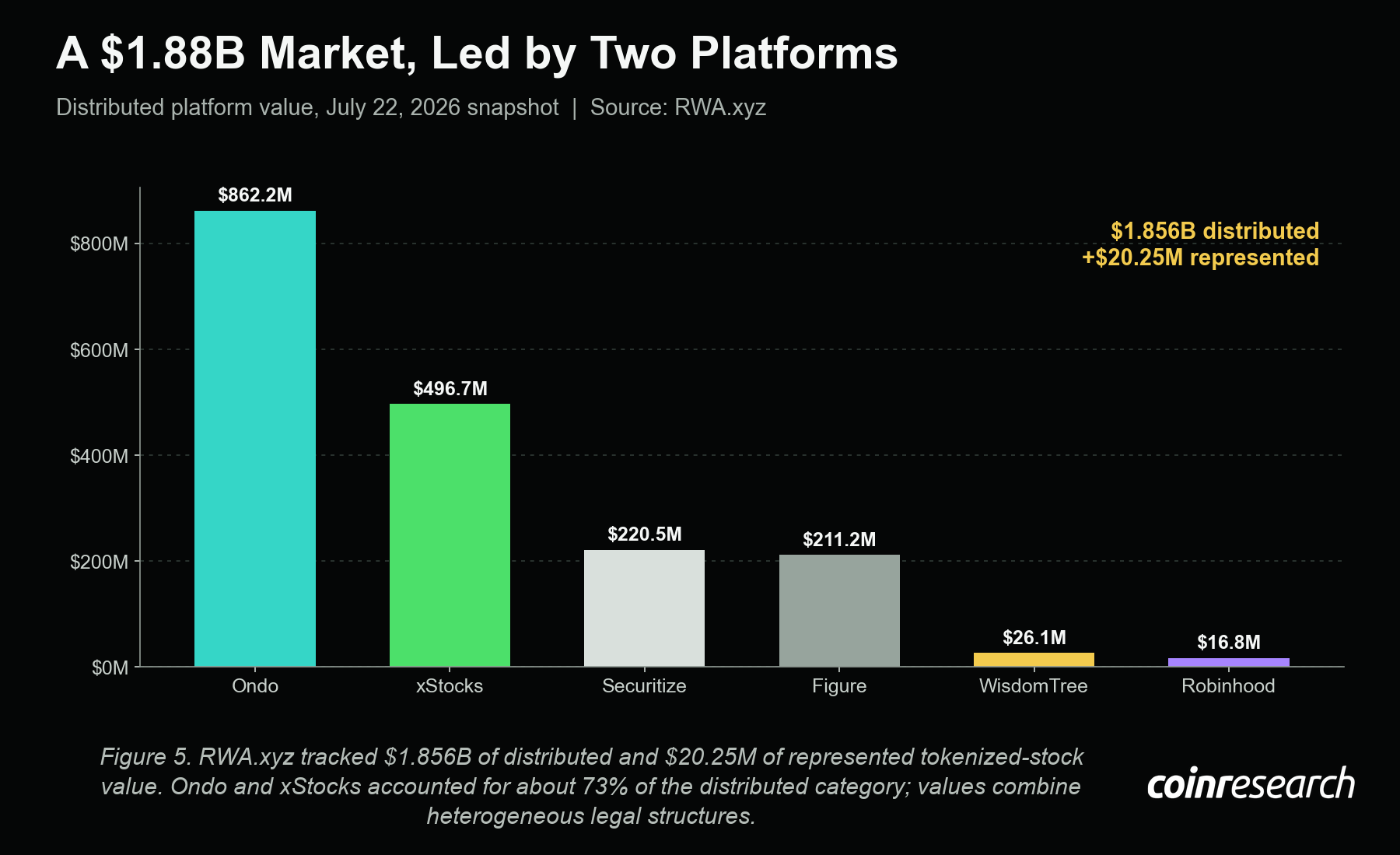
The July 22 market snapshot showed roughly $1.856B of distributed tokenized-stock value and $20.25M of represented value, for approximately $1.876B combined. It also showed about $8.00B of 30-day transfer volume, 168,368 monthly active addresses and 671,487 holder addresses.
Those numbers show that issuance and wallet activity are no longer negligible. They require careful interpretation. A token transfer may be a trade, mint, redemption or movement between wallets. One person can control several addresses. Transfer volume is not automatically exchange trading volume, and holder addresses are not unique investors.
The category is also concentrated. Ondo represented about $862.2M, or 46.4%, of distributed value in the snapshot. xStocks represented roughly $496.7M, or 26.7%. Together they accounted for approximately 73% of the distributed market.
The leading retail products illustrate why legal form matters.
Robinhood’s global Stock Tokens are described as tokenized debt securities. They provide economic exposure but do not give holders legal or beneficial rights in the referenced shares. Kraken’s xStocks disclosure likewise says holders do not own the underlying shares or receive their voting, information or liquidation rights. Ondo Global Markets provides economic exposure, including dividend value after applicable withholding, but says its tokens are not the underlying stocks or ETFs and cannot be exchanged for those assets by the holder.
These products can still be useful. They can lower minimums, reach eligible investors outside the United States, move into self-custodied wallets and interact with onchain applications. They simply should not be confused with direct share ownership.
What Average Investors Gain, and What They May Give Up
Tokenization solves a real distribution problem.
It can provide smaller denominations and broader geographic access. It can let an investor move a position between compatible applications rather than leaving it trapped inside one brokerage account. It can enable atomic settlement against stablecoins, collateral use and automated portfolio strategies. Shared ledgers may also reduce reconciliation work across brokers, custodians and settlement systems.
The trade-off is that a wrapper introduces additional entities and failure paths. The investor may depend on a product issuer, broker, custodian, administrator, smart contract, wallet and secondary market. A conventional regulated brokerage share is already fractional, liquid, inexpensive to trade and protected by a mature legal system. A tokenized wrapper must create enough access or portability to justify the extra structure.
Before buying, an investor should be able to answer five questions:
-
What is the legal instrument? A share, security entitlement, debt security or derivative?
-
Whose name is on the share register or custody account? The investor, an intermediary, a custodian or the token issuer?
-
Which rights pass through? Dividends, votes, information, tenders, spin-offs and liquidation claims?
-
Can the investor redeem directly? For cash, stablecoins or the underlying share, at what minimum and fee?
-
What happens if an intermediary fails? Is the investor an owner, secured claimant or unsecured creditor?
If the documents do not answer those questions plainly, the familiar ticker is doing too much of the marketing.
The Bottom Line
Tokenized stocks are not one product category. They are several different legal claims sharing a common interface.
The bull case is substantial. Equity exposure becomes more portable, programmable and globally distributable. Stablecoins become settlement assets. Securities can move into automated collateral and portfolio systems. Regulated pilots from Nasdaq, DTC and European venues may eventually combine those benefits with the same rights and market structure investors already understand.
The risk is that investors mistake price tracking for ownership. A token can mirror a stock during normal operation while delivering different rights, costs and recovery outcomes when something breaks. A 1:1 reserve can reduce risk without eliminating the product issuer, custodian or redemption chain.
For most average investors today, a conventional regulated brokerage share remains the benchmark when it is available and affordable. A tokenized stock earns a place when its access or portability creates value that the brokerage position cannot provide, and when the legal claim is strong enough to justify the added structure.
The final rule is deliberately plain:
if the documents do not tell you who owes you what when something breaks, you do not yet understand the investment.
This article is a preview of the full flagship CoinResearch report. The complete report includes the provider and rights matrix, all-in cost analysis, regulatory roadmap, failure-chain review, 12-24 month scenario framework, full ten-question retail checklist, methodology and primary-source ledger.
Disclaimer: This article is for informational and educational purposes only and does not constitute financial, legal, tax or investment advice. Tokenized securities and digital assets can lose value, become illiquid or be restricted. Review the governing documents and seek professional advice appropriate to your circumstances.