
The Bounce Gets Its Bid, But Sentiment Refuses to Confirm | Week Ending July 5, 2026
1. The Floor Reclaims, The Fear Remains
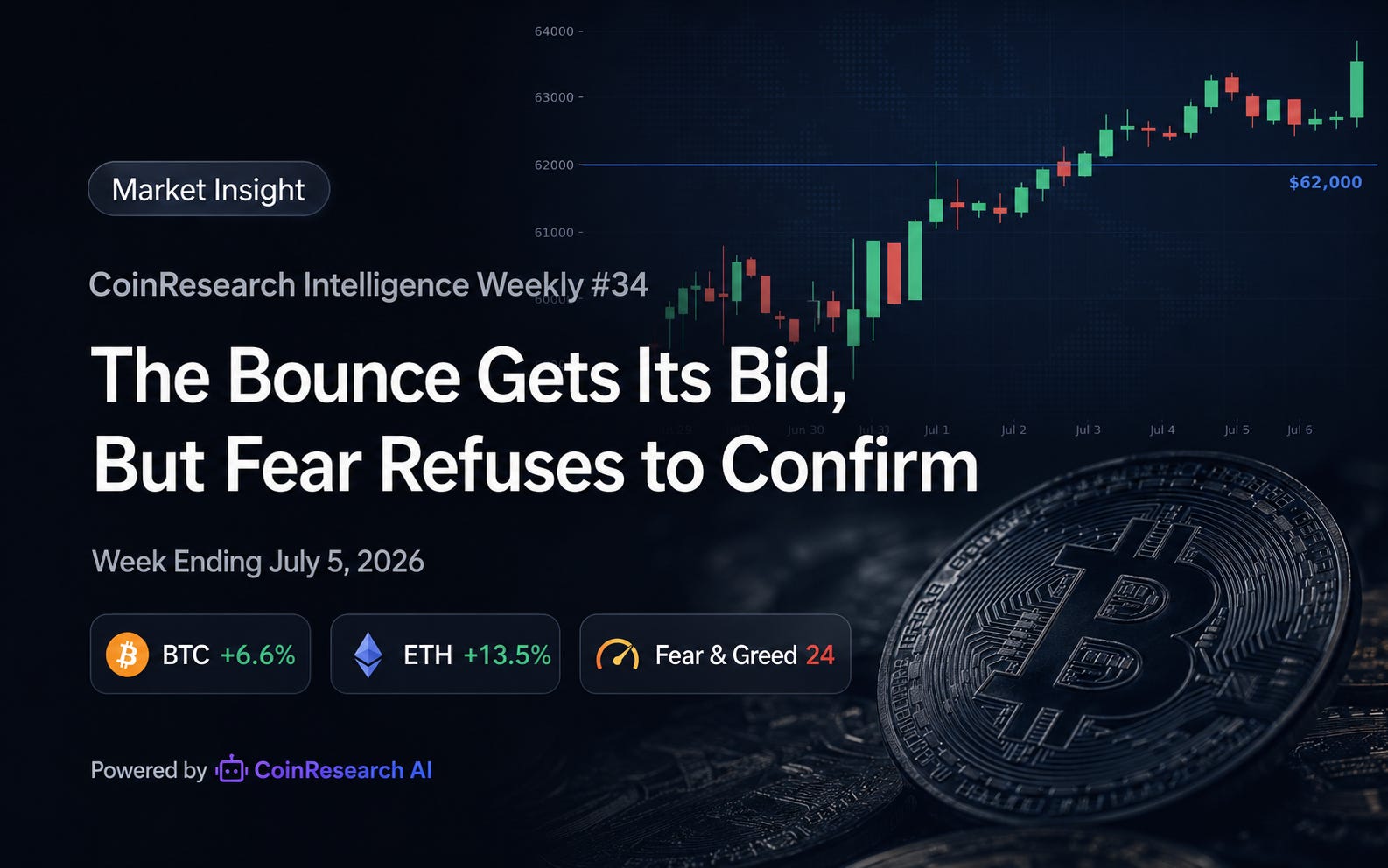
Bitcoin closed the week at $63,546, up +6.6% week-on-week, and Ethereum at $1,783, up +13.5%. The move mattered because it repaired the immediate damage from the prior week’s break: BTC lifted from an intraweek low near $58,331 back above the old $62,000-$63,000 shelf, while ETH outperformed across the same window and pushed its dominance to 9.4%. Total crypto market capitalization held near $2.28 trillion, with Bitcoin dominance easing to 55.8%.
The catalyst mix was cleaner than the price action looked a week ago. June payrolls came in at +57,000, with unemployment at 4.2%, a soft-enough labor print to cool the immediate rate-hike fear that had dominated the prior edition. Spot bitcoin ETFs then posted $221.7 million of net inflows on July 2, ending a 10-session outflow streak that had pulled more than $2.7 billion from the products. That is a turn, not a full repair. June was still a poor month for ETF demand, and BlackRock’s IBIT continued to bleed even on the green-flow day.
The tell is sentiment. Fear & Greed ended the week at 23 – Extreme Fear and printed 24 on Monday, July 6. A market that can rally 6%-14% across the majors while sentiment stays pinned is no longer in freefall, but it is not yet in confirmed risk-on either.
Key themes this week:
-
BTC reclaimed the $62,000-$63,000 shelf, but the market has not escaped the broader defensive regime.
-
ETH led the majors, with dominance rising to 9.4%, a constructive rotation after weeks of weakness.
-
ETF flows stabilized for a day after a 10-session outflow streak, but the institutional bid is still selective.
-
Extreme Fear remains the sentiment anchor, which supports relief rallies but argues against chasing strength.
2. Strengths: Where The Rebound Has Substance
-
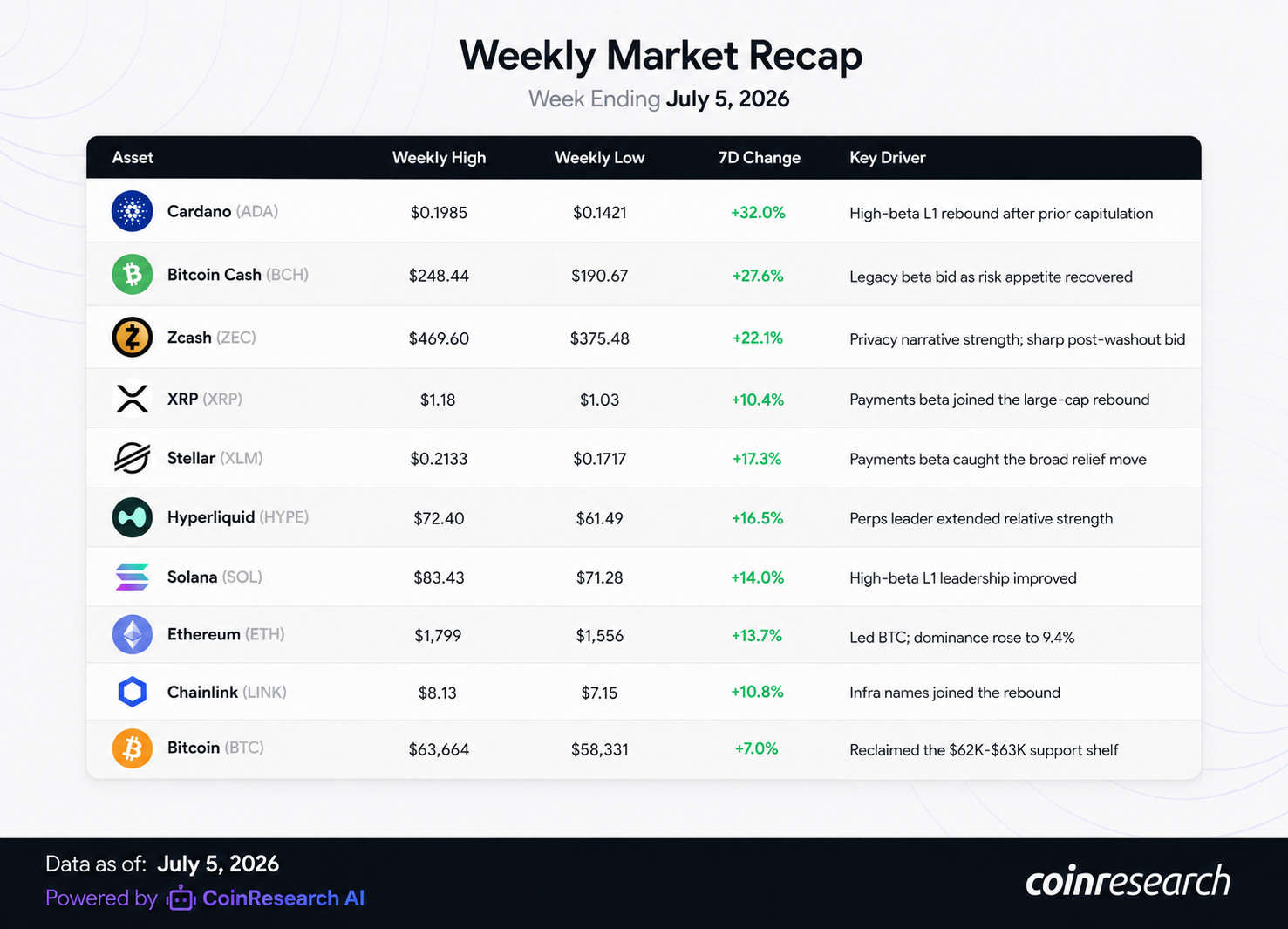
Ethereum finally led from the front. ETH gained +13.5% W/W versus Bitcoin’s +6.6%, and its dominance rose to 9.4%. That is the cleanest sign that the market was willing to add duration risk again rather than only hide in BTC. The caveat: one week of outperformance does not make a new ETH-led regime; the asset is still below the levels that would force broader altcoin re-risking.
-
The $58,000 washout did not become a breakdown cascade. Bitcoin’s weekly low near $58,331 absorbed the prior week’s floor break and reversed back above the old support shelf. That makes $58,000 the first true capitulation reference for this leg. The caveat: reclaimed support is useful only if it holds on the next macro test; below $58,000, the tape goes back to repair mode immediately.
-
The ETF flow streak finally snapped. U.S. spot bitcoin ETFs took in $221.7 million on July 2, the first positive day since June 16, and the inflow came alongside softer labor data. The caveat: the prior 10 sessions still removed more than $2.7 billion, and the flow mix was uneven, with IBIT still showing outflows.
-
High-beta leadership broadened. Solana, Hyperliquid, XRP, Cardano, and Bitcoin Cash all rebounded sharply, a better breadth profile than last edition’s narrow defensive tape. The caveat: bounces off capitulation lows often make the weakest assets look strongest for a few sessions, so breadth needs follow-through rather than a single green week.
3. Weaknesses: What Still Has Not Been Fixed
-
Sentiment did not confirm the rally. Fear & Greed stayed in Extreme Fear for the entire 10-day lookback, with readings from 11 to 24. That keeps positioning light, but it also says the market is still trading from stress rather than confidence.
-
The macro calendar is not finished. This week is quieter than the prior FOMC/PCE stretch, but the next inflation checks are already visible: June CPI on July 14, June PPI on July 15, and the next FOMC on July 28-29. The market has a narrow window to build a base before inflation retakes the screen.
-
ETF demand is stabilizing, not strong. One $221.7 million inflow day is enough to stop the immediate bleeding narrative, but it does not erase a 10-session outflow streak or June’s institutional de-risking. The next test is whether flows can stay positive without a soft-data catalyst.
-
Several model shorts still look valid. A rally that leaves Grade A and Grade B downside setups live is not a clean risk-on tape. It means the bounce improved spot levels faster than it repaired forward model structure.
4. Market Recap: Top 10 Weekly Performance
5. Predictive Analytics & Trade Confluence
Disclaimer: The insights and forecasts presented here are generated by CoinResearch AI’s predictive models and supporting analytics. They are provided for informational and educational purposes only and do not constitute financial advice or investment recommendations. Trading digital assets involves risk, and users should conduct their own research, exercise independent judgment, and use appropriate risk management before making any investment or trading decisions.
DOT-USD (Polkadot)
Reference Price: $0.8773
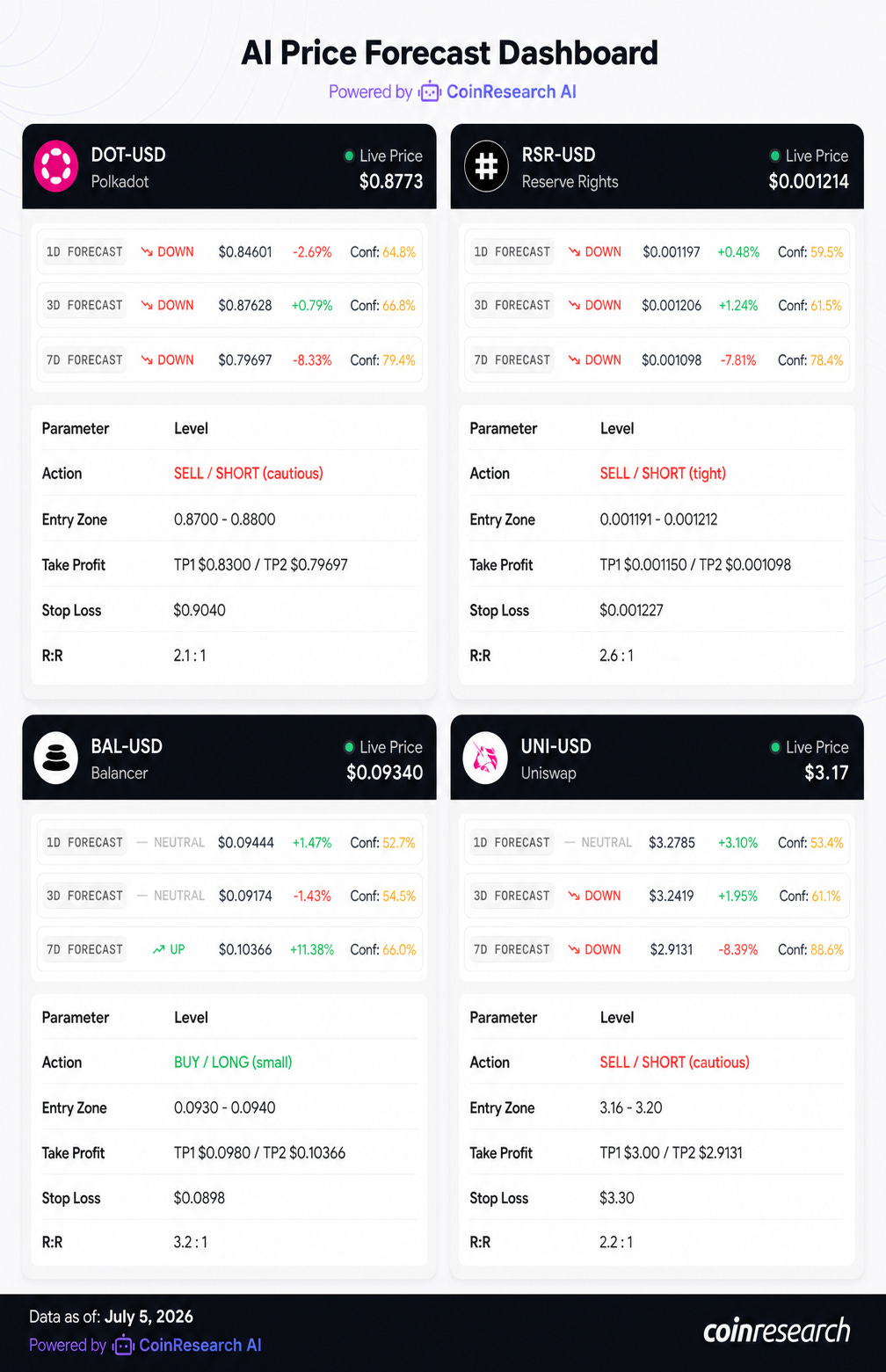
Market Confluence Analysis. DOT returns to the spotlight because the model upgraded it, not because we want to recycle last week’s winner. The new card is Grade A, with the strongest seven-day downside confidence on the board and a modeled path toward the high-$0.79 area. Price is live above the $0.870 entry but still below the $0.904 stop, so the setup is valid but no longer early. The friction is the same as last edition: social sentiment leans bullish, which can turn a good short into a squeeze if sizing is too aggressive. That argues for a small position and no tolerance for a reclaim above the stop.
Trade Action.
-
Action: Sell / Short (cautious)
-
Entry Zone: $0.8700-$0.8800
-
Take Profit: TP1 $0.8300 / TP2 $0.79697
-
Stop Loss: $0.9040
-
R:R: 2.1:1 to the model target
-
Rationale: Grade A downside signal, strong seven-day confidence, and a valid live price below stop.
-
Invalidation: A sustained move above $0.9040 breaks the capped-risk short structure.
-
Analyst Note. We accept the repeat because the model earned it, but we do not treat last week’s win as permission to oversize. DOT is a valid short while it stays below $0.904; above that, the trade is gone.
-
Verdict: SELL (cautious).
RSR-USD (Reserve Rights)
Reference Price: $0.001214
Market Confluence Analysis. RSR is the highest reward-to-risk Grade A short on the board, but it comes with two important caveats. First, the live price is already above the $0.001191 entry and close enough to the $0.001227 stop that late execution matters. Second, the prior RSR call in edition #32 was directionally right after the fact but stopped first, which is exactly the kind of sequence that damages a good thesis. The model still points down across the horizons, and social activity is not large enough to create the same crowded-squeeze veto we applied to TIA in #33. The trade is valid, but only as a tight, tactical short.
Trade Action.
-
Action: Sell / Short (tight risk)
-
Entry Zone: $0.001191-$0.001212
-
Take Profit: TP1 $0.001150 / TP2 $0.001098
-
Stop Loss: $0.001227
-
R:R: 2.6:1 to the model target
-
Rationale: Grade A downside setup with high seven-day confidence and acceptable reward-to-risk.
-
Invalidation: A close or sustained trade above $0.001227 invalidates the short; no re-entry without a reset.
Analyst Note. This is the best paper short by reward-to-risk, but it is also the easiest one to mishandle because the stop is nearby. If entry is not clean, no trade is better than forcing it.
Verdict: SELL (tight).
BAL-USD (Balancer)
Reference Price: $0.09340
Market Confluence Analysis. BAL is the counterweight to a board that otherwise leans short. It is a Grade B long, live above the $0.093 entry, with the best reward-to-risk on the board at 3.2:1 and a seven-day upside target near $0.10366. The drawback is not price; it is data quality. The social layer shows no meaningful activity, so this is almost entirely a model-and-price trade. In a rebound tape where ETH and high-beta alts are leading, that is acceptable, but it keeps size small. The trade does not need a story. It needs the stop to hold.
Trade Action.
-
Action: Buy / Long (small)
-
Entry Zone: $0.0930-$0.0940
-
Take Profit: TP1 $0.0980 / TP2 $0.10366
-
Stop Loss: $0.0898
-
R:R: 3.2:1 to the model target
-
Rationale: Best reward-to-risk setup, valid above entry, and aligned with a relief tape led by higher beta assets.
-
Invalidation: A break and hold below $0.0898 cancels the long thesis.
Analyst Note. This is not a broad endorsement of the long book. It is a small tactical long in the one setup where price, reward-to-risk, and the weekly tape line up cleanly enough.
Verdict: BUY (small).
UNI-USD (Uniswap)
Reference Price: $3.17
Market Confluence Analysis. UNI is the cleanest large-cap short, which matters because the rest of the spotlight skews into smaller names. The model’s seven-day downside confidence is high, the live price is sitting directly around the $3.18 entry, and the $3.30 stop leaves enough room to avoid immediate noise. The tension is social: sentiment is very bullish, so the trade is explicitly model-versus-crowd. In a confirmed bull tape, that would be a reason to pass. In a relief rally with sentiment still stuck in Extreme Fear, it is a reason to size modestly and keep the stop mechanical.
Trade Action.
-
Action: Sell / Short (cautious)
-
Entry Zone: $3.16-$3.20
-
Take Profit: TP1 $3.00 / TP2 $2.9131
-
Stop Loss: $3.30
-
R:R: 2.2:1 to the model target
-
Rationale: Grade B short with strong seven-day downside projection and a live price inside the entry band.
-
Invalidation: A sustained move above $3.30 invalidates the setup and signals the crowd is winning.
Analyst Note. UNI is the institutional-quality version of this week’s bearish model view: liquid, cleanly defined, and not already invalidated. It is still a short against a bounce, so the stop is the trade.
Verdict: SELL (cautious).
6. Token Launch & Ecosystem Radar
A curated look at three high-signal projects approaching major milestones that have not yet launched their tokens.
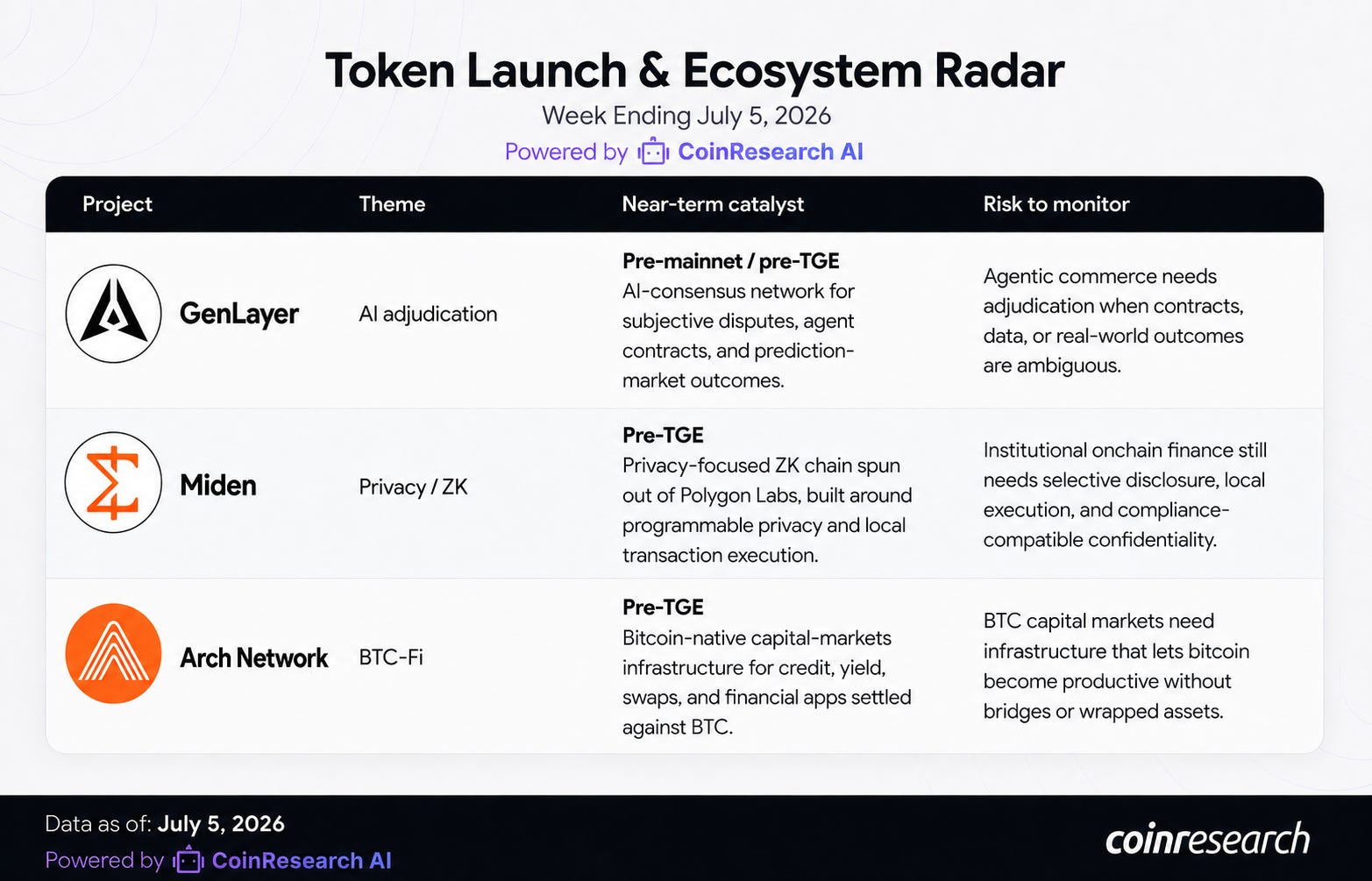
GenLayer – an AI-consensus network for resolving subjective disputes, agent contracts, and prediction-market outcomes at machine speed.
-
Why watch it: The market is moving from AI agents as chatbots to AI agents as economic actors. GenLayer is targeting the missing layer in that stack: adjudication when contracts, data, or real-world outcomes are ambiguous.
-
Current Status: Pre-mainnet and pre-TGE. The public roadmap points to Q4 2026 mainnet, with no token trading on CoinGecko under an exact GenLayer listing as of the live check.
-
Monitoring Rationale: If agentic commerce becomes a real market, dispute resolution and subjective consensus become core infrastructure rather than a side feature. GenLayer is one of the few teams building directly at that layer.
Miden – a privacy-focused ZK chain spun out of Polygon Labs, built around programmable privacy and local transaction execution.
-
Why watch it: Miden sits at the intersection of two durable themes: privacy and scalable ZK execution. The project raised $25 million in seed funding co-led by a16z crypto, 1kx, and Hack VC, and the round included token warrants.
-
Current Status: Pre-TGE. Live market checks did not show an exact official Miden token listing on CoinGecko; the project is preparing mainnet-era infrastructure while remaining pre-token for tracker purposes.
-
Monitoring Rationale: Privacy has struggled as a tradeable narrative, but institutional onchain finance still needs selective disclosure, local execution, and compliance-compatible confidentiality. Miden is a credible candidate if that theme returns.
Arch Network – Bitcoin-native capital-markets infrastructure for credit, yield, swaps, and financial apps settled against BTC.
-
Why watch it: BTC-Fi is moving beyond wrapped bitcoin on other chains. Arch’s pitch is native Bitcoin settlement without forcing users into bridges, wrapped assets, or separate custody workflows.
-
Current Status: Pre-TGE. ICO-tracker data shows no live market cap or token price, and CoinGecko search returned no exact Arch Network token listing during the live check.
-
Monitoring Rationale: If Bitcoin capital markets deepen, infrastructure that lets BTC become productive without leaving its security model should matter. Arch is one of the clearer institutional BTC-Fi candidates.
7. Strategic Recap & Forward Outlook
This was the week the market stopped falling apart, not the week it proved a new uptrend. Bitcoin reclaimed the shelf, Ethereum led, ETF flows finally printed green, and the labor data gave risk assets a cleaner macro excuse to bounce. Those are real positives. The restraint comes from the things that did not move: Fear & Greed stayed in Extreme Fear, ETF demand remains damaged after a long outflow streak, and the next inflation data is only one week away.
So the portfolio stance stays mixed and light. We take the model’s two Grade A shorts because they are valid, include BAL as the working tactical long, and use UNI as the liquid expression of the bearish seven-day forecast. No trade is still a trade, but this week the better rule is smaller trade is also a trade. Let the reclaim prove itself above $67,000 before chasing, and let the $58,000 floor define the downside line.
Forward Outlook – Week of July 6-12, 2026
-
Macro Watch. The immediate calendar is lighter than the last two editions. The key event is the July 8 FOMC minutes from the June 16-17 meeting, followed by July 9 initial jobless claims. The larger inflation tests sit just outside this edition’s week: June CPI on July 14 and June PPI on July 15, both at 8:30 AM ET. The next FOMC is July 28-29.
-
BTC Key Levels. The first support band is now $62,000-$63,000, the shelf BTC reclaimed into the close. Below that, $58,000-$58,500 is the capitulation low zone that must hold. Resistance is $65,000-$67,000, then $70,000. A close above $67,000 would turn this from relief into repair; a loss of $58,000 would put the prior breakdown back in control.
-
Altcoin Outlook. ETH leadership is the constructive part of the tape, and high-beta participation improved. The risk is that many of the biggest weekly winners are rebound trades from distressed levels rather than new leadership. We want to see ETH hold dominance above 9%, SOL and HYPE retain relative strength, and BTC dominance continue easing without BTC losing its floor.
For full prediction dashboards, institutional quality research report, visit
CoinResearch Intelligence Weekly is published for educational and informational purposes only. Nothing in this newsletter constitutes financial advice. Cryptocurrency markets are highly volatile – past performance does not guarantee future results. Always conduct your own research and consult a qualified financial advisor before making any investment decisions.