
ETF Money Returned. The Crowd Didn’t. | Week Ending August 9, 2026
1. ETF Money Returned. The Crowd Didn’t.
Bitcoin closed Sunday at $64,856, up 2.19% week-on-week, while Ethereum closed at $1,909, up 1.45%. The rebound had real funding behind it. US spot Bitcoin ETFs took in approximately $865.3 million from August 3-7, and spot Ethereum ETFs added about $243.7 million. That demand helped BTC recover from a weekly low near $62,456 and kept ETH above $1,900 into the weekend.
The crowd did not follow. Fear & Greed ended Sunday at 31 – Fear, after touching 25 – Extreme Fear twice during the week. The disconnect makes sense. July payrolls fell by 23,000 and prior months were revised lower, but both ISM surveys still showed expanding business activity. Manufacturing prices also remained hot. Investors received enough growth weakness to worry about demand, but not enough disinflation to assume easy policy relief. ETF buyers funded the rebound while retail sentiment stayed defensive. That makes this a better market than last week, but not yet a broad risk-on turn.
Key themes this week:
-
Institutional demand returned: BTC and ETH ETFs recorded positive five-session flows.
-
Price recovered faster than sentiment, with Fear & Greed still stuck in Fear.
-
Weak payrolls collided with stronger activity surveys and elevated manufacturing prices.
-
The next move runs through CPI, PPI, and retail sales rather than Monday momentum.
2. Strengths: What Is Holding
-
ETF demand became a working price cushion. Spot BTC ETFs recorded inflows in every session from August 3-7, while ETH products finished the same window net positive. This is the clearest improvement from the prior week because it supplied actual marginal demand rather than a sentiment-only bounce.
-
Bitcoin recovered without handing the gains back at the close. BTC traded near $62,456 during the week and closed roughly $2,400 above that low. The rebound also carried price back toward the $65,200-$65,400 resistance area that capped the previous decline.
-
Large-cap breadth improved. SOL gained 3.70%, ADA rose 2.70%, BNB added 2.53%, and HYPE advanced 2.44% on the Sunday-close comparison. Capital moved beyond Bitcoin instead of concentrating in one defensive winner.
-
Economic activity did not collapse with payrolls. The July ISM Manufacturing PMI rose to 55.6, and Services PMI reached 54.1. Business activity and new orders remained expansionary.
3. Weaknesses: What Has Not Been Repaired
-
Sentiment rejected the price rebound. Fear & Greed ended at 31 and spent two days at 25. That tells us the rally did not generate broad conviction, despite positive ETF flows and higher closes in BTC and ETH. A fearful market can keep climbing, but it is more vulnerable to abrupt reversals around data.
-
The labor report introduced a real growth problem. US nonfarm payrolls fell by 23,000 in July, unemployment held at 4.1%, and May and June were revised down by a combined 103,000 jobs. The weakness is not automatically bullish for crypto. If it reflects deteriorating demand rather than a clean path to lower rates, risk appetite can fall before policy support arrives.
-
Inflation pressure has not disappeared from the activity data. Manufacturing prices paid remained at 71.1 even as hiring weakened. That mix complicates the usual bad-news-is-good-news trade. A soft labor print may support rate-cut expectations, but sticky input costs can limit how far the market runs with that conclusion.
-
Ethereum still lacked leadership. ETH rose 1.45% from Sunday close to Sunday close and attracted positive ETF flows, but it underperformed BTC. ETH dominance remained near 10.05%, compared with BTC dominance around 56.66%. A durable altcoin expansion normally needs ETH to do more than follow Bitcoin higher.
4. Market Recap: Weekly Performance
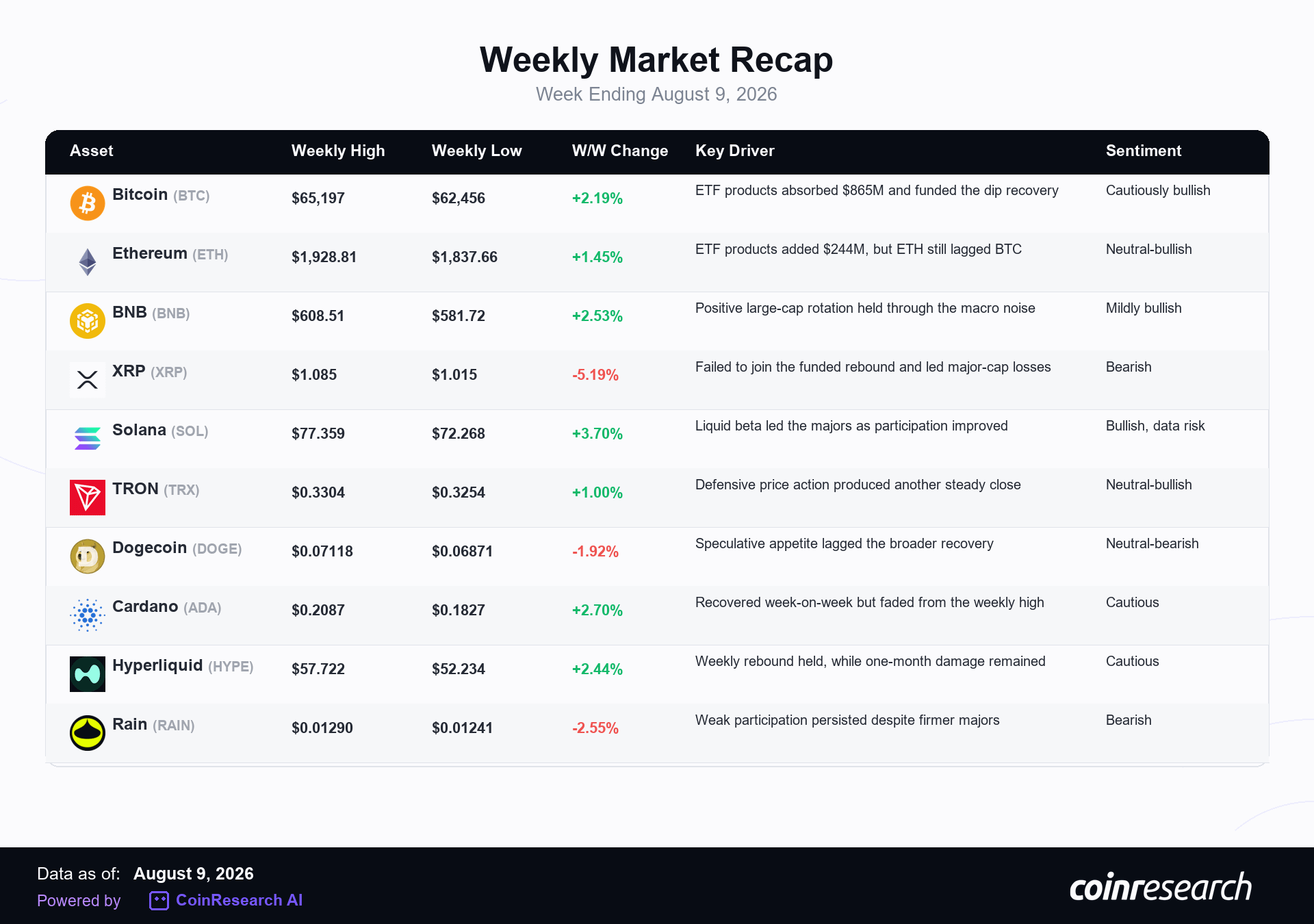
The board improved, but the distribution remained selective. SOL led the liquid majors at +3.70%, followed by ADA at +2.70%, BNB at +2.53%, and HYPE at +2.44% on the Sunday-close comparison. BTC gained 2.19% and ETH added 1.45%, while XRP lost 5.19%, RAIN fell 2.55%, and DOGE slipped 1.92%. Total crypto market capitalization stood near $2.30 trillion at the research pull. The week was a funded rebound with incomplete breadth: stronger than a dead-cat bounce, weaker than a market-wide reset.
5. Predictive Analytics & Trade Confluence
Disclaimer: The insights and forecasts presented here are generated by CoinResearch AI’s predictive models and supporting analytics. They are provided for informational and educational purposes only and do not constitute financial advice or investment recommendations. Trading digital assets involves risk, and users should conduct their own research, exercise independent judgment, and use appropriate risk management before making any investment or trading decisions.
POL-USD (POL)
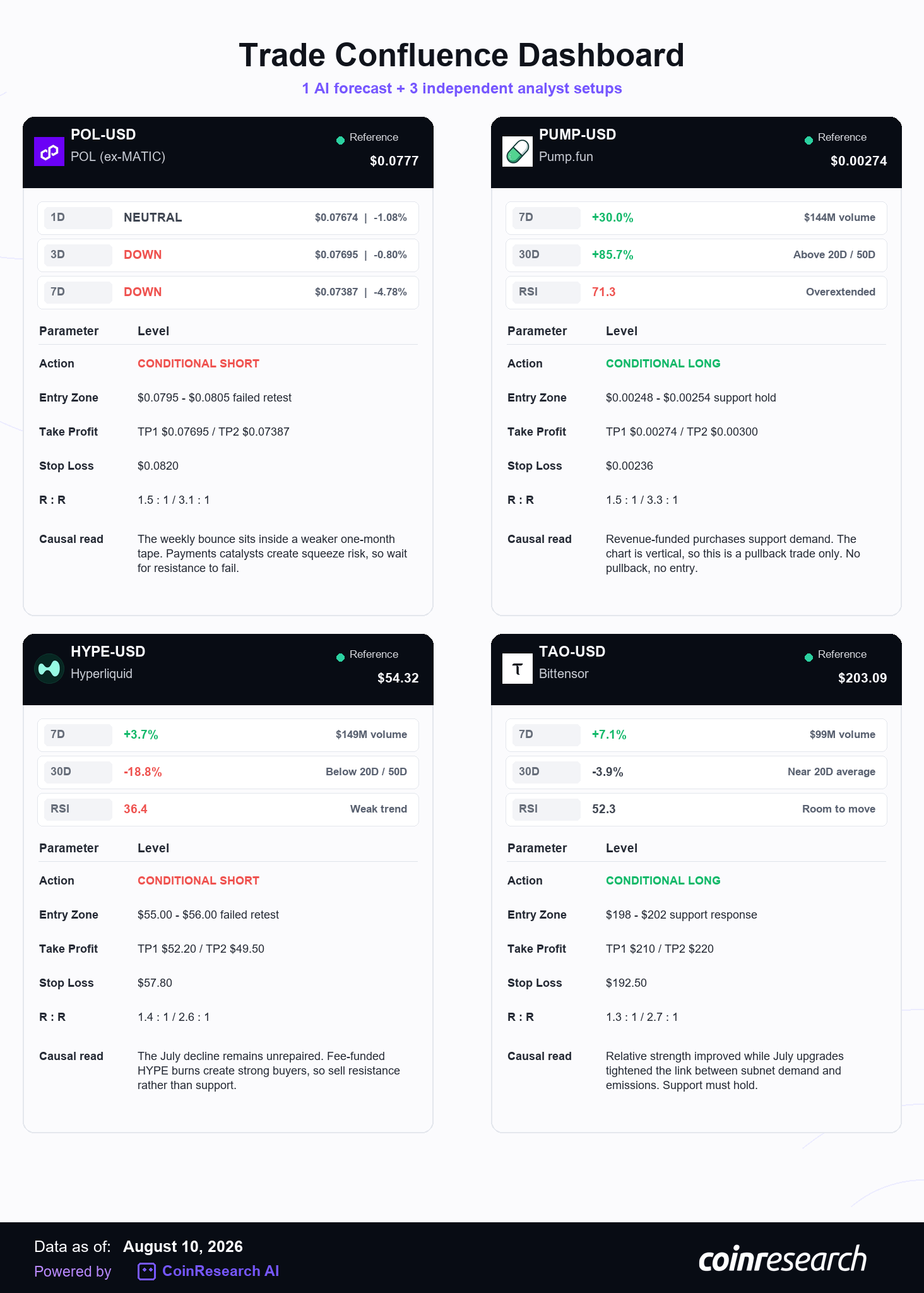
Reference Price: $0.0777
Market Confluence Analysis: The forecast model turns bearish over the three- and seven-day horizons. The likely cause is that POL’s weekly rebound is running into a weaker one-month structure. Price gained roughly 6.8% over seven days but remained down about 2.1% over 30 days at the live pull. The forecast is treating the bounce as mean reversion rather than a new trend.
We think the direction is plausible, but the timing is early. Polygon has live fundamental support from payments integrations, including Mento Protocol’s July deployment, while the community is debating changes to POL inflation and a possible buyback-and-burn mechanism. Those developments can keep buyers engaged even if the broader chart remains weak. CPI and PPI add another reason not to short Monday’s price. The cleaner trade is to let POL rebound into resistance, then act only if buyers fail there.
Trade Action:
-
Action: Conditional Short after a failed post-data retest.
-
Entry Zone: $0.0795-$0.0805. No entry before the inflation releases and no chase below the zone.
-
Take Profit: TP1 $0.07695. TP2 $0.07387.
-
Stop Loss: $0.0820.
-
R:R: Approximately 1.5:1 to TP1 and 3.1:1 to TP2 from the midpoint.
-
Rationale: The rebound has not repaired the one-month structure, but current price is below the preferred entry and Polygon-specific catalysts create squeeze risk.
-
Invalidation: Acceptance above $0.0820, or a catalyst-driven continuation that turns the weekly bounce into a sustained recovery.
Analyst Note: The forecast may be right about where POL finishes the week and still be wrong about where to enter. We want the failed retest, not a market short into support.
Verdict: CONDITIONAL SHORT, wait for $0.0795-$0.0805 after the data.
PUMP-USD (Pump.fun)
Reference Price: $0.00274
Market Confluence Analysis: PUMP is outside today’s forecast universe, so this is an independent analyst setup. The real-market case starts with trend and value capture. PUMP gained roughly 30% over seven days and 86% over 30 days, traded about $144 million in the latest 24-hour snapshot, and remained above both its 20-day and 50-day average. Pump.fun also publishes an onchain purchase-and-burn mechanism funded by part of protocol revenue. That creates observable token demand rather than a vague ecosystem promise.
The chart is stretched. Daily RSI was near 71 at the research pull, and price was pressing the $0.00274 monthly high. Buying here would be dumb. The setup only works if the market gives back part of the breakout, holds the former acceleration zone, and then turns higher after the inflation data. The burn mechanism supports the cause. It does not justify chasing a vertical chart.
Trade Action:
-
Action: Conditional Long on a post-data pullback and support hold.
-
Entry Zone: $0.00248-$0.00254. Require a rejection of lower prices and a close back inside the zone.
-
Take Profit: TP1 $0.00274. TP2 $0.00300.
-
Stop Loss: $0.00236.
-
R:R: Approximately 1.5:1 to TP1 and 3.3:1 to TP2 from the midpoint.
-
Rationale: Strong price momentum, deep liquidity, and an active purchase-and-burn mechanism support continuation, but the current chart is overextended.
-
Invalidation: A close below $0.00236 would break the breakout structure and show that the pullback is becoming a reversal.
Analyst Note: This is a buy-the-pullback trade. No pullback, no trade. Paying the current vertical price would destroy the edge.
Verdict: CONDITIONAL LONG, buy support at $0.00248-$0.00254 after the data.
HYPE-USD (Hyperliquid) – Analyst Setup
Reference Price: $54.32
Market Confluence Analysis: HYPE is also outside today’s forecast universe. Price gained about 3.7% over seven days but remained down roughly 18.8% over 30 days. It still traded below its 20-day and 50-day averages, with daily RSI near 36. That is a weak trend wearing a one-week bounce. The bearish cause is straightforward: the market has not repaired the damage from the July selloff.
The fundamental counterweight is real. Hyperliquid routes protocol fees toward community mechanisms, including automated HYPE purchases and burns through the assistance fund. The chain also ties HYPE staking to market deployment and fee benefits. That gives the token stronger value capture than most declining altcoins and makes a market short near support reckless. We want the bounce first. If price retests the $55-$56 area and fails, the chart has offered a cleaner place to sell while the long-term buyers define our stop.
Trade Action:
-
Action: Conditional Short after a failed post-data retest.
-
Entry Zone: $55.00-$56.00. Require rejection and a close back below $55.00.
-
Take Profit: TP1 $52.20. TP2 $49.50.
-
Stop Loss: $57.80.
-
R:R: Approximately 1.4:1 to TP1 and 2.6:1 to TP2 from the midpoint.
-
Rationale: The one-month trend remains broken and price is below its medium-term averages, while protocol buybacks make entry location and stop discipline essential.
-
Invalidation: Acceptance above $57.80 would break the failed-retest thesis and point to a broader recovery.
Analyst Note: HYPE is not a bad asset. It is a damaged chart with strong buyers underneath it. That is exactly why the short belongs at resistance, not at $54 support.
Verdict: CONDITIONAL SHORT, sell a failed $55-$56 retest.
TAO-USD (Bittensor) – Analyst Setup
Reference Price: $203.09
Market Confluence Analysis: The analyst case is a support trade built on improving relative strength. TAO gained about 7.1% over seven days, traded near its 20-day average, and held above the $198-$202 support area after testing $210. The chart is not overbought. Daily RSI sat near 52, leaving room for another move if support survives the data.
Bittensor also shipped material protocol changes in July. Runtime releases consolidated the software stack, made subnet ownership contestable through conviction, and introduced an emission gate that shifts rewards away from idle subnets toward those attracting stronger demand. That does not guarantee a higher TAO price. It does tighten the economic link between network demand and emissions. We think that cause is strong enough to buy a confirmed support response, but not strong enough to ignore a break below the range.
Trade Action:
-
Action: Conditional Long on a confirmed support hold.
-
Entry Zone: $198-$202 after the inflation data. Require a sweep-and-reclaim or a higher low inside the zone.
-
Take Profit: TP1 $210. TP2 $220.
-
Stop Loss: $192.50.
-
R:R: Approximately 1.3:1 to TP1 and 2.7:1 to TP2 from the midpoint.
-
Rationale: Improving weekly relative strength, neutral momentum, nearby support, and July protocol upgrades create a cleaner long than chasing already-extended leaders.
-
Invalidation: A close below $192.50 would break the support thesis and reopen the lower July range.
Analyst Note: TAO has a real cause and a usable chart. The trade still needs support to answer before capital goes in.
Verdict: CONDITIONAL LONG, buy a confirmed $198-$202 support response.
6. Token Launch & Ecosystem Radar
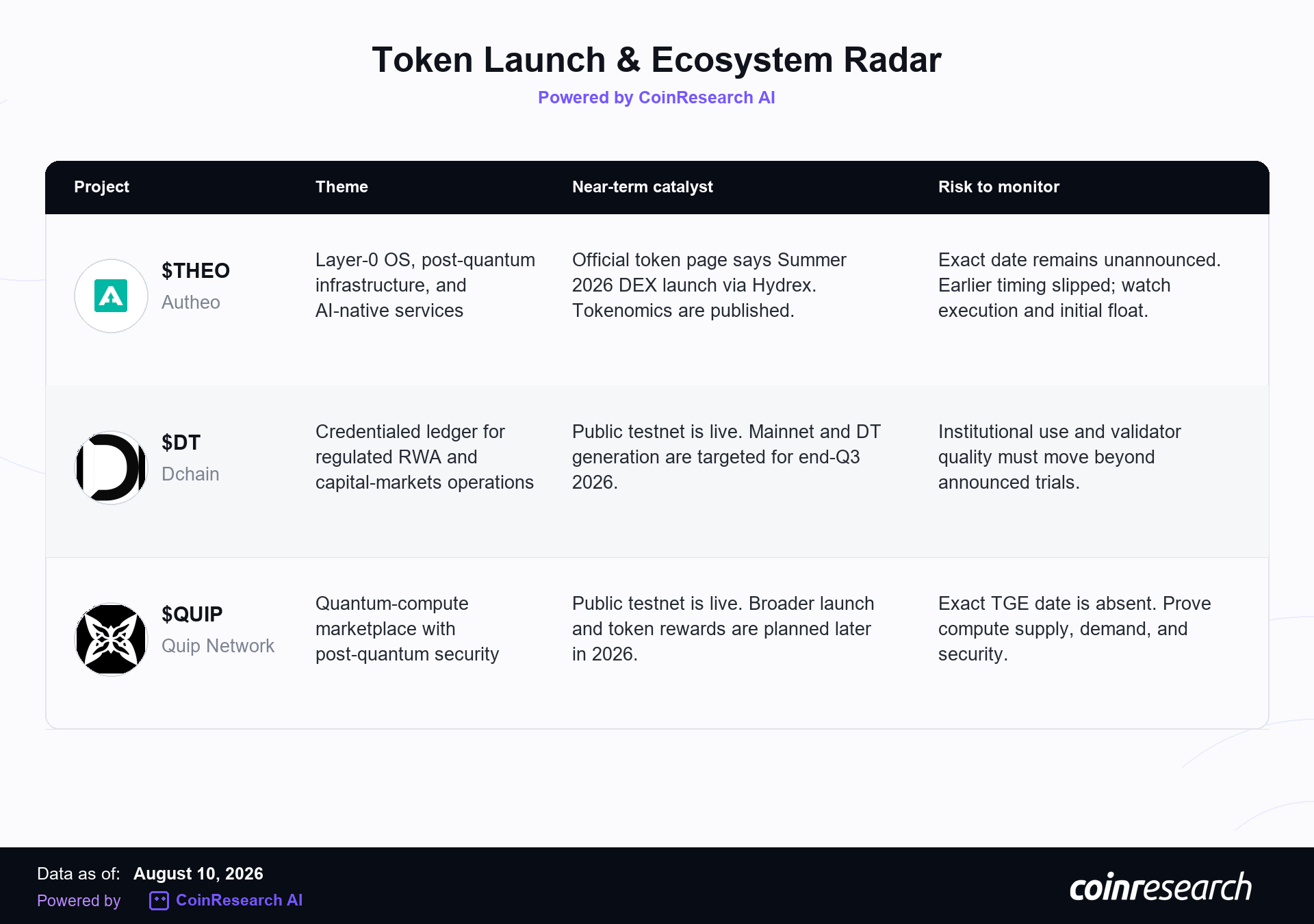
Autheo ($THEO) – a modular Layer 1 positioning its token around network security, governance, and ecosystem participation.
-
Why watch it: Autheo has published token allocations and emissions, and its official launch page still describes a Summer 2026 token listing. The current plan points to a 7 billion token supply and approximately 9.2% initial circulation, giving us a concrete framework to evaluate before trading begins.
-
Current Status: Pre-TGE. The listing window remains Summer 2026, but an exact date has not been announced. Earlier timing expectations have slipped, so the official launch page matters more than third-party calendars.
-
Monitoring Rationale: Watch the confirmed exchange schedule, final circulating supply, validator participation, and whether ecosystem usage develops before liquidity incentives dominate the network.
Dchain ($DT) – a purpose-built ledger for regulated real-world assets and capital-markets operations.
-
Why watch it: Dchain is targeting credentialed issuance, trading, settlement, and compliance rather than a general-purpose chain narrative. The public testnet gives the project an observable product surface before the token exists.
-
Current Status: Pre-TGE. The official roadmap targets mainnet toward the end of Q3 2026, with DT generated at mainnet. No live CoinGecko market was found in the current check.
-
Monitoring Rationale: Track testnet participation, validator composition, issuer commitments, mainnet readiness, and whether regulated institutions use the network for real transactions rather than announced trials.
Quip Network ($QUIP) – a network combining a quantum-compute marketplace with post-quantum security infrastructure.
-
Why watch it: Quip has a public testnet and a differentiated technical thesis: coordinate quantum computing resources while protecting network activity with post-quantum cryptography. That is more specific than attaching a quantum label to a generic chain.
-
Current Status: Pre-TGE. The project describes a broader launch later in 2026 and token rewards at TGE, but an exact token date remains unannounced.
-
Monitoring Rationale: Watch testnet usage, available compute supply, developer demand, independent security review, and final token utility. The theme is interesting. The proof must come from usable capacity and repeat demand.
7. Strategic Recap & Forward Outlook
The week repaired funding before it repaired confidence. ETF buyers returned, BTC and ETH closed higher, and several liquid majors participated. At the same time, Fear & Greed stayed in Fear, ETH did not lead, and the labor report raised a growth concern that stronger activity surveys did not cleanly resolve. This is not the same market as last week. It is also not a confirmed expansion. The useful question is whether institutional demand can survive the inflation data and pull sentiment higher with it.
Section 5 reflects that tension without forcing weak forecast cards into trades. POL is the forecast-backed setup. PUMP, HYPE, and TAO are separate analyst trades built from live liquidity, real OHLC structure, and project-specific causes. The distinction matters. A forecast candidate still has to survive the chart, and an analyst setup should not borrow credibility from a forecast that never covered it.
Forward Outlook – Week of August 10-16, 2026
-
Macro Watch. July CPI is scheduled for Wednesday, August 12 at 8:30 a.m. ET. July PPI follows Thursday, August 13 at 8:30 a.m. ET, and July retail sales arrive Friday, August 14 at 8:30 a.m. ET. CPI and PPI will test whether weak payrolls can become a policy-relief story. Retail sales will show whether the labor slowdown has reached household demand.
-
BTC Key Levels. The immediate support reference is the $62,456 weekly low. The first recovery band sits near $65,200-$65,400. A post-data reclaim would strengthen the ETF-led rebound and expose the upper-$67,000 forecast area. A close below support would show that flows were not enough to absorb renewed macro selling.
-
Altcoin Outlook. SOL and BNB showed improving participation, but ETH still needs to outperform BTC before the move deserves an altcoin-expansion label. Favor liquid relative-strength names, avoid chasing one-week rebounds into data, and keep weak one-month structures on confirmation-only status.
-
Trade Confluence Summary. POL is a conditional failed-retest short after the data. PUMP is a pullback long at $0.00248-$0.00254. HYPE is a failed-retest short at $55-$56. TAO is a support-response long at $198-$202. None are market orders. Each needs the stated price response after the inflation data before it becomes active.
For full prediction dashboards, trade setups, and live forecast signals, visit
Disclaimer: CoinResearch Intelligence Weekly is published for educational and informational purposes only. Nothing in this newsletter constitutes financial advice. Cryptocurrency markets are highly volatile – past performance does not guarantee future results. Always conduct your own research and consult a qualified financial adviser before making investment decisions.