
The Bid Came Back. Now Don’t Chase It. | Week Ending August 23, 2026

1. The Bid Came Back. Now Don’t Chase It.
Last week crypto got friendly inflation data and still fell. This week the missing buyer showed up. Bitcoin closed Sunday near $77,712, up 23.6% week on week, while Ethereum closed around $2,462, up 31.4%. Total crypto market capitalization reached about $2.61 trillion. The move was not built on a vague narrative. US spot Bitcoin ETFs absorbed approximately $1.92 billion from August 17-21, and spot Ethereum ETFs added another $692.6 million.
That demand hit a market that began the week scared and under-positioned. Fear & Greed moved from 31 – Fear on Monday to 73 – Greed at the Monday refresh. BTC dominance stood near 59.24%, while ETH dominance reached 11.25%. The bid came back, then price ran faster than the market could build support beneath it. That changes the question. We no longer need to ask whether buyers exist. We need to ask how much buying remains after a vertical week.
Key themes this week:
-
BTC and ETH ETF products took in roughly $2.61 billion combined.
-
Fear flipped to Greed in six days as shorts and cautious positioning were forced to adjust.
-
ETH outperformed BTC, but BTC dominance still rose as capital concentrated in large liquid assets.
-
The August 24 model run arrived after the rally; entry quality matters more than forecast confidence.
2. Strengths: What Changed
-
ETF demand returned with size. Bitcoin products recorded five straight positive sessions and took in roughly $1.92 billion. Ethereum products added about $692.6 million. Last week’s missing buyer did not merely reappear; it bought every US session.
-
The rally broadened beyond Bitcoin. On the Sunday-close convention, ETH gained 31.4%, XRP 53.2%, SOL 28.0%, DOGE 34.2%, and HYPE 43.8%. This was not a one-coin squeeze. The caveat is that a broad vertical move can leave equally broad air pockets beneath price.
-
Ethereum finally showed leadership. ETH outpaced BTC and ETH dominance rose by almost one percentage point from last week’s research pull. The caveat is that ETH still needs sustained ETF demand after the first burst; one strong week does not repair a multi-month relative trend by itself.
3. Weaknesses: What the Rally Did Not Fix
-
Sentiment moved too far, too quickly. Fear & Greed jumped from 31 to 73 in seven days. That is not an automatic sell signal. It is a warning that the easy asymmetry from fearful positioning has already been spent.
-
The Fed is still arguing about tighter policy. The July meeting held rates at 3.50%-3.75%, but the vote was 9-3 and all three dissenters wanted a 25 bp hike. The minutes said inflation remained elevated and several participants favored tighter policy. Crypto rallied through that message. It did not make the message disappear.
-
The market is now vulnerable to an inflation reset. July PCE and the second estimate of Q2 GDP both arrive August 26. A hot inflation print would test whether ETF demand can keep absorbing supply once the macro story becomes less friendly.
4. Market Recap: Weekly Performance
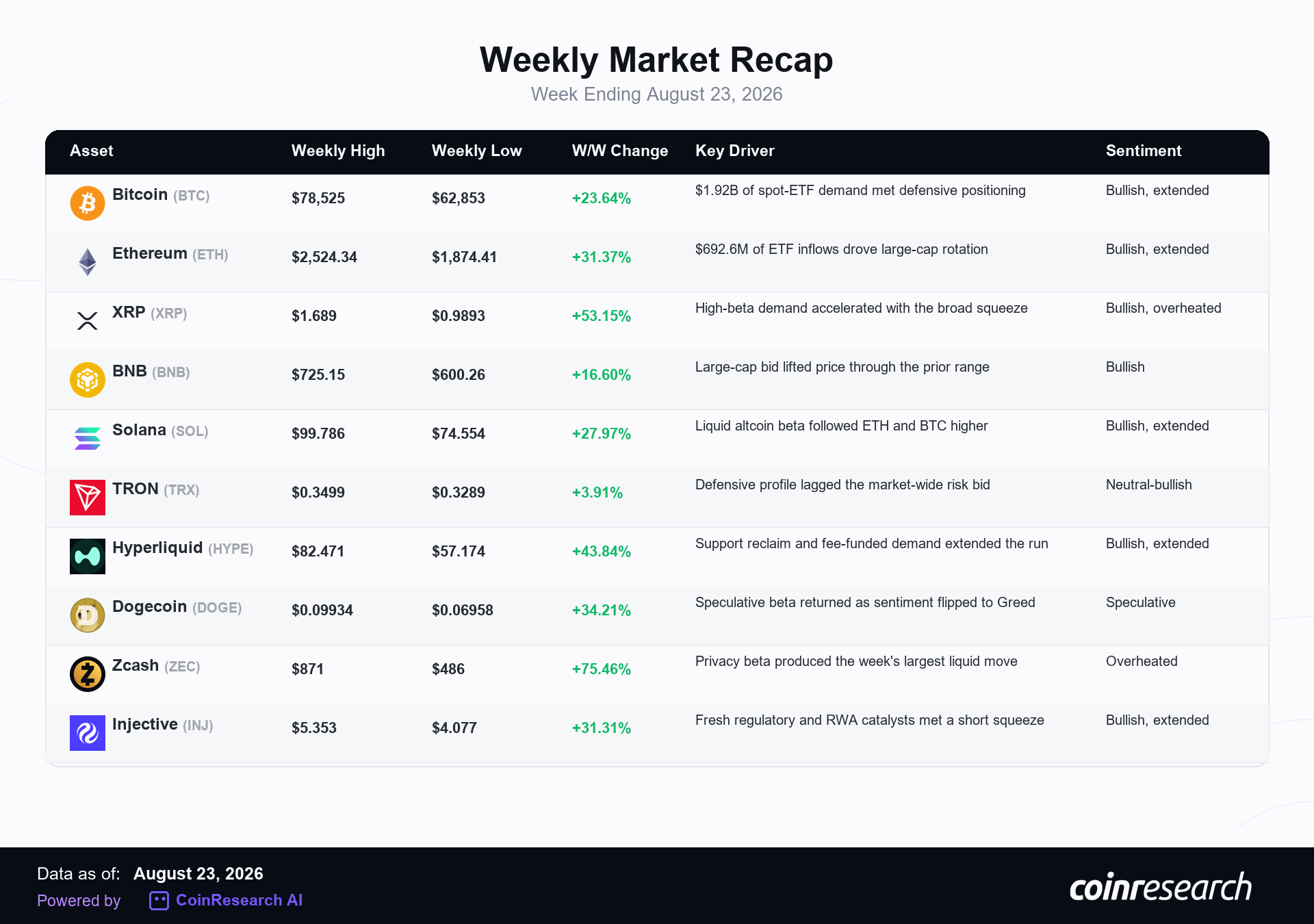
This was the mirror image of last week. BTC and ETH surged, ETF flows were positive every US session, and Fear & Greed flipped from Fear to Greed. Using the August 24 00:00 UTC CoinGecko point as the August 23 close, BTC gained 23.6% and ETH 31.4%. XRP, HYPE, DOGE, SOL, and ZEC all outperformed BTC. BNB gained 16.6%, while TRX lagged at 3.9%. Total market capitalization stood near $2.61 trillion at the research pull.
5. Predictive Analytics & Trade Confluence
Disclaimer: This section combines CoinResearch AI forecast analysis with separately labeled analyst setups outside the current forecast universe. All material is provided for informational and educational purposes only and does not constitute financial advice or an investment recommendation. Trading digital assets involves risk. Readers should conduct their own research, exercise independent judgment, and use appropriate risk management.
INJ-USD (Injective)
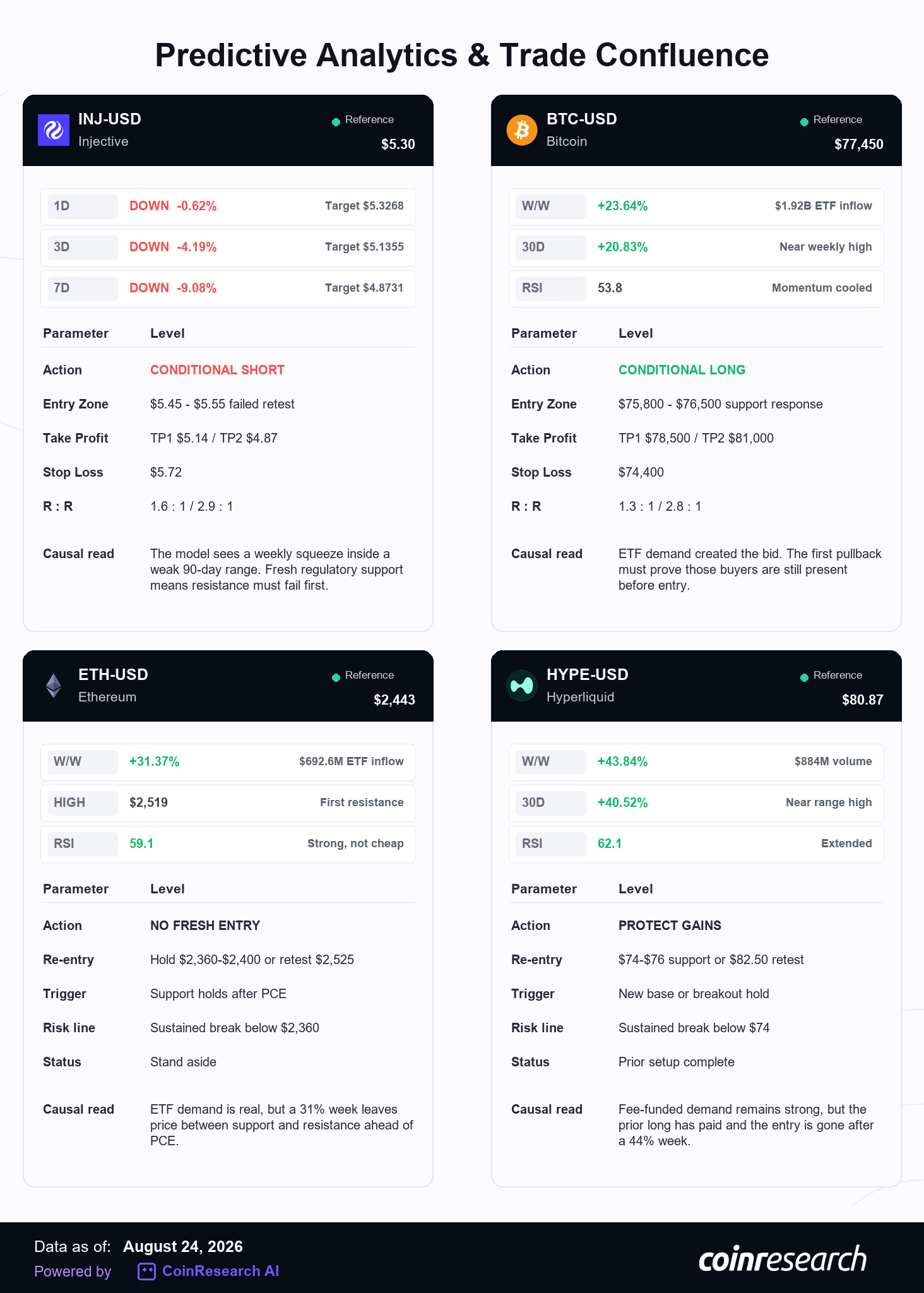
Reference Price: $5.30
Market Confluence Analysis: The model turns bearish across its short and weekly horizons because INJ’s move looks like a squeeze inside a still-damaged larger range. INJ gained about 31.3% from Sunday close to Sunday close, yet its 30-day return was only around 2.6% and it remained below its 90-day high. The likely model read is mean reversion: price moved from the bottom of its monthly range to the top in one week without building much support in between.
We agree that the move is stretched. We do not think the short is automatic. Injective became an SEC-registered transfer agent on August 19, has recent institutional RWA pilots, and runs recurring community buybacks that permanently burn committed INJ. Those are observable reasons for buyers to defend the token, not noise the chart can dismiss. The bearish case therefore needs price to prove that the good news is already reflected.
Trade Action:
-
Action: Conditional Short after a failed retest.
-
Entry Zone: $5.45-$5.55. Require rejection and a close back below $5.45.
-
Take Profit: TP1 $5.14. TP2 $4.87.
-
Stop Loss: $5.72.
-
R:R: Approximately 1.6:1 to TP1 and 2.9:1 to TP2 from the midpoint.
-
Rationale: The model is reading a 31% weekly squeeze inside a weak 90-day structure. The retest prevents us from shorting momentum while buyers still control the tape.
-
Invalidation: Acceptance above $5.72 would turn resistance into support and show that the repricing is holding.
Analyst Note: The causal read is simple: the model sees a stretched rebound; the market sees fresh regulatory and tokenomics support. We only take the short if price resolves that argument in favor of sellers.
Verdict: CONDITIONAL SHORT, wait for $5.45-$5.55 to fail.
BTC-USD (Bitcoin)
Reference Price: $77,450
Market Confluence Analysis: Bitcoin is an independent analyst setup. The reason for the rally is visible: US spot products absorbed about $1.92 billion across five positive sessions while the market began the week in Fear. That combination forced defensive positioning to chase a real source of demand. BTC closed 23.6% higher, but its approximate four-hour RSI had cooled into the mid-50s while price consolidated below the $78,500 weekly high.
Our interpretation is that the demand mechanism is more durable than a simple short squeeze, but the entry at $77,450 is poor. ETF buying can continue and still allow a sharp retracement because the move from the mid-$60,000s to the high-$70,000s happened quickly. The trade is not “buy because flows were positive.” It is buy only if the first meaningful pullback shows that those buyers are still present.
Trade Action:
-
Action: Conditional Long on a confirmed support response.
-
Entry Zone: $75,800-$76,500. Require a sweep-and-reclaim or a higher low inside the zone.
-
Take Profit: TP1 $78,500. TP2 $81,000.
-
Stop Loss: $74,400.
-
R:R: Approximately 1.3:1 to TP1 and 2.8:1 to TP2 from the midpoint.
-
Rationale: ETF flows supplied the bid, but the pullback must show that demand remains active after the vertical repricing.
-
Invalidation: A sustained close below $74,400 would lose the breakout shelf and expose a deeper retracement toward $70,000-$72,000.
Analyst Note: The market has already paid traders who bought the breakout. Our edge now comes from making the breakout prove it can survive a retest.
Verdict: CONDITIONAL LONG, buy only a confirmed $75,800-$76,500 support response.
ETH-USD (Ethereum)
Reference Price: $2,443
Market Confluence Analysis: ETH outperformed BTC with a 31.4% weekly gain while US spot ETH products took in about $692.6 million. That is the clean bullish case: institutional demand improved at the same time capital rotated into higher beta. ETH also pulled back from roughly $2,519 and held above the $2,360-$2,400 area, so the rally has begun testing its first layer of support.
We think the cause is real, but much of it is already in price. ETH’s four-hour RSI remained near 59, the weekly range was unusually wide, and the August 26 PCE release sits close enough to punish a late entry. A fresh long here would offer less upside to the prior high than downside to a meaningful structural stop. Strong asset, weak geometry.
Trade Action:
-
Action: No fresh entry. Watch the pullback.
-
Entry Zone: None at the reference price. Reassess only after $2,360-$2,400 holds through the macro release or after a clean $2,525 breakout retest.
-
Take Profit: Not assigned.
-
Stop Loss: Not assigned.
-
R:R: Not applicable.
-
Rationale: ETF demand and relative strength are bullish, but the current price sits between support and resistance after a 31% week.
-
Invalidation: A sustained break below $2,360 would show that the first support shelf failed. Acceptance above $2,525 after consolidation would create a new setup.
Analyst Note: ETH is the best example of a bullish thesis that does not need to become a trade today. The cause can be durable while the entry remains late.
Verdict: NO FRESH ENTRY, let $2,360-$2,400 or $2,525 resolve first.
HYPE-USD (Hyperliquid)
Reference Price: $80.87
Market Confluence Analysis: HYPE gained 43.8% week on week and reached the low $80s after last edition’s support-reclaim long hit TP1. The underlying demand mechanism remains better than most altcoins: Hyperliquid routes protocol fees to community mechanisms, including automated HYPE purchases and burns, so rising trading activity can create direct token demand.
That mechanism does not create a floor at any price. HYPE is now near its 30-day and 90-day highs, and core-contributor tokens continue to vest monthly. The same fee flywheel that made the pullback attractive near $58 does not make a 44% weekly extension attractive near $81. The thesis worked. The entry is gone.
Trade Action:
-
Action: Protect gains. No fresh entry.
-
Entry Zone: None. Watch $74-$76 as the first meaningful support band.
-
Take Profit: Not assigned for a new position.
-
Stop Loss: Not assigned for a new position.
-
R:R: Not applicable.
-
Rationale: Fee-funded token demand is real, but the market has already repriced that strength aggressively and the prior setup has completed its job.
-
Invalidation: A sustained break below $74 would warn that the run is unwinding. A consolidation above $82.50 followed by a successful retest would create new structure.
Analyst Note: A good mechanism is not permission to chase. Last week’s trigger gave us the trade; this week’s price gives us the reason to stop pressing it.
Verdict: NO FRESH ENTRY, protect gains and wait for a new base.
6. Token Launch & Ecosystem Radar
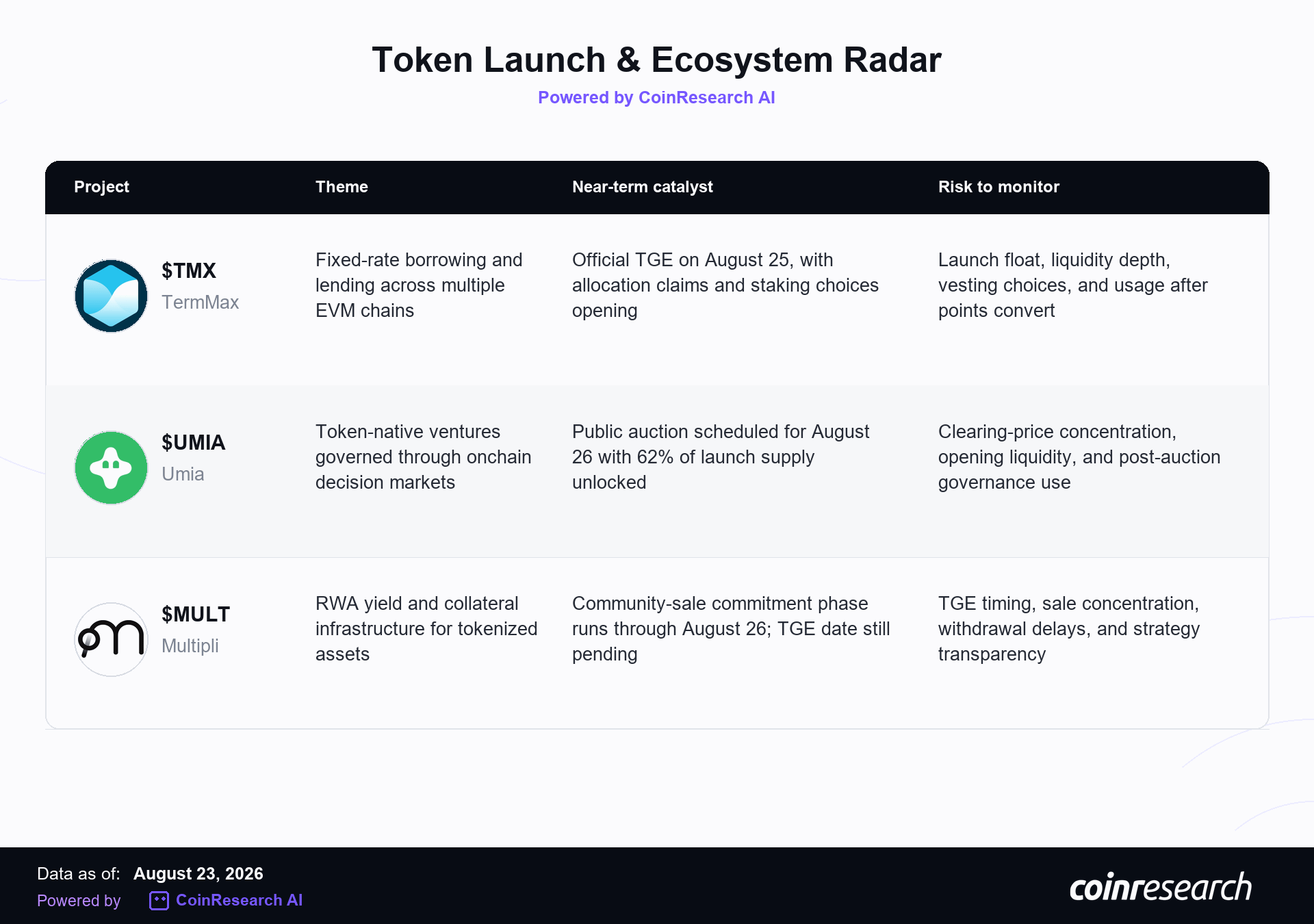
TermMax ($TMX) – a multi-chain fixed-rate borrowing and lending protocol built around predictable maturities rather than floating-rate debt.
-
Why watch it: TermMax has a live product, disclosed token mechanics, and an official August 25 launch. TMX staking is designed to connect governance and protocol incentives, while the launch follows months of fixed-rate market expansion across EVM chains.
-
Current Status: Pre-TGE. The official launch is scheduled for August 25, 2026. CoinGecko lists TMX but says it is not yet available to trade on tracked exchanges.
-
Monitoring Rationale: Watch the opening float, staking choices, liquidity depth, and whether borrowing demand holds after points convert into tokens. The launch risk is that usage built around incentives fades once rewards become liquid.
Umia ($UMIA) – a token-native venture and governance stack that uses decision markets and a legal wrapper to make tokenholder votes enforceable.
-
Why watch it: Umia is testing a different launch design. The public auction is the largest single allocation, 62% of the 40 million launch supply is unlocked from day one, and tokenholders are meant to direct protocol strategy and treasury deployment through decision markets.
-
Current Status: Pre-TGE. The official auction is scheduled for August 26, 2026. No live UMIA market was found in the current check.
-
Monitoring Rationale: Watch the clearing price, bidder concentration, opening liquidity, and whether a high initial float produces cleaner price discovery or simply immediate distribution. Governance only matters if tokenholders use it after the auction ends.
Multipli ($MULT) – an RWA yield and collateral protocol that packages tokenized assets behind more usable onchain products.
-
Why watch it: Multipli is not launching an empty ticker. Its product work centers on yield-bearing xTokens and a plan to make fragmented tokenized real-world assets usable as common collateral. The community sale gives the market an early read on demand for that thesis.
-
Current Status: Pre-TGE. The official community-sale commitment phase opened August 17 and runs through August 26, 2026. The official sources reviewed did not confirm the final TGE date, so timing remains a live risk.
-
Monitoring Rationale: Track the final TGE schedule, sale concentration, withdrawal delays, custody and strategy transparency, and whether the RWA pitch converts into repeat deposits after rewards. A sale is not product-market fit.
7. Strategic Recap & Forward Outlook
Last week good news could not create a bid. This week flows did. Bitcoin and Ethereum ETF products took in roughly $2.61 billion, BTC closed 23.6% higher, ETH gained 31.4%, and sentiment flipped from Fear to Greed. That answers the demand question for one week. It does not answer whether buyers will keep paying after a vertical move or whether the first pullback exposes a thin base.
The prior calls also gave us a useful split. HYPE rewarded the support trigger and reached TP1. POL never printed the required failed retest, crossed the stop first, and stayed a no-trade. That is what conditional execution is supposed to do: participate when the market confirms the idea and refuse the trade when it does not.
Forward Outlook – Week of August 24-30, 2026
-
Macro Watch. July Personal Income and Outlays, including PCE inflation, lands Wednesday, August 26 at 8:30 a.m. ET alongside the second estimate of Q2 GDP and corporate profits. Jackson Hole follows August 27-29 under the theme “Financial Innovation: Implications for Payments and Policy.” After a vertical rally, even a small policy surprise can matter because positioning is no longer defensive.
-
BTC Key Levels. Resistance sits around the week’s $78,525 high. The first tactical support test is $75,800-$76,500, followed by structural invalidation near $74,400. Losing that shelf would expose the broader $70,000-$72,000 breakout area.
-
Altcoin Outlook. ETH, XRP, HYPE, DOGE, and SOL all showed strong beta. Do not confuse beta with a durable project-specific bid. Favor pullbacks that hold reclaimed levels and tokens with visible demand mechanisms. Avoid chasing low-liquidity names after a market-wide squeeze.
For full prediction dashboards, trade setups, and live forecast signals, visit
Disclaimer: CoinResearch Intelligence Weekly is published for educational and informational purposes only. Nothing in this newsletter constitutes financial advice. Cryptocurrency markets are highly volatile – past performance does not guarantee future results. Always conduct your own research and consult a qualified financial adviser before making investment decisions.