
Capitulation Intensifies as Bitcoin Touches $60K: Navigating the Deepest Drawdown Since 2022 as Bessent Slams the Door on Government Bailouts | Week Ending February 8, 2026
The first full week of February 2026 delivered the most violent drawdown since the FTX-era collapse of 2022, as Bitcoin plummeted from $78,000 to an intraday low of approximately $60,000 on February 5—marking a staggering 52% decline from its October 2025 all-time high of $126,080. The sell-off was catalyzed by a convergence of devastating macro forces: Treasury Secretary Scott Bessent’s February 4 congressional testimony explicitly rejecting any government authority to purchase Bitcoin or bail out crypto firms, massive Bitcoin ETF outflows totaling approximately $938 million across February 4–5 alone, a brief partial government shutdown that delayed the January jobs report and stalled regulatory progress, and the continuation of tariff-driven uncertainty under the Trump administration. Sentiment has collapsed into extreme fear territory (Fear & Greed Index: 7–23), total crypto market capitalization has stabilized around $2.34 trillion after shedding nearly $500 billion in a single week, and the market is now grappling with whether the Friday recovery back above $70,000 represents genuine demand or simply a dead-cat bounce in a deepening bear market.

Strengths
-
Severe deleveraging resets market structure
Over $16B in liquidations wiped out excess leverage, normalizing funding rates and open interest. This reduces the risk of cascading liquidations and creates a healthier base for recovery. -
Strong demand confirmed at $60K support
Bitcoin’s sharp rebound from ~$60K to above $70K within 24 hours validates heavy buy-side interest in the $58K–$62K zone, reinforcing it as a key structural floor. -
Selective institutional rotation into altcoins
While Bitcoin ETFs saw outflows, Solana, XRP, and Ethereum spot ETFs recorded net inflows, indicating institutional appetite for selective altcoin exposure at distressed valuations.
Weaknesses
-
Government rejection of Bitcoin purchases kills a major bull narrative
The Bessent testimony removes expectations of a U.S. strategic Bitcoin reserve expansion, clarifying that government holdings will come only from asset seizures. -
ETF holders under water create persistent sell pressure
With average ETF entry prices near $90K and BTC around $70K, institutional investors face ~22% unrealized losses, sustaining redemption-driven selling. -
Drawdown exceeds 50%, a historical danger zone
The drop from $126K to ~$60K mirrors past cycle declines that preceded prolonged bear markets, increasing the risk of extended consolidation or downside.
Market Recap
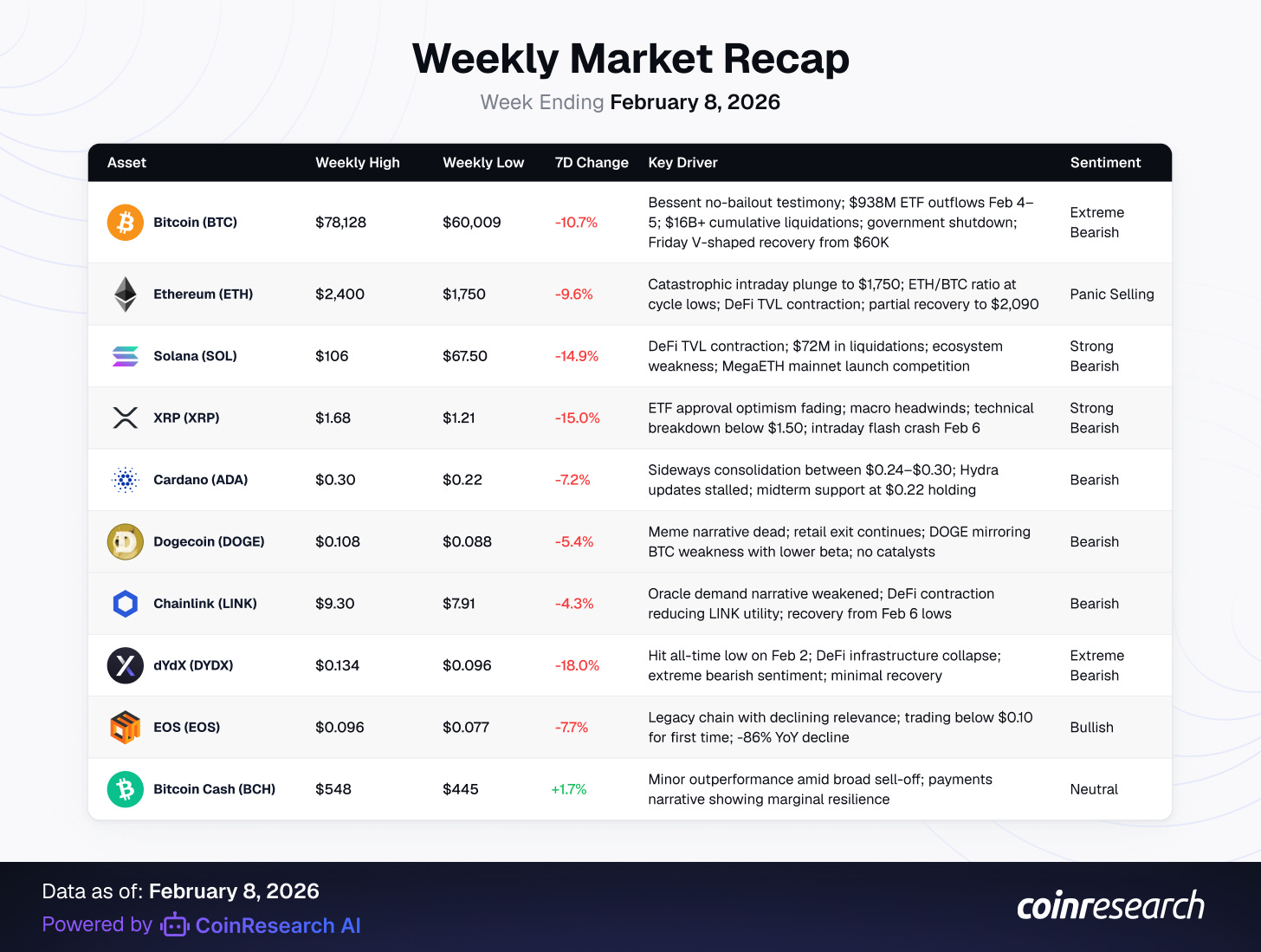
The week ending February 8, 2026, marks the deepest single-week capitulation event since the FTX collapse in November 2022. Bitcoin’s intraday plunge to ~$60,000 on February 5—triggered by Treasury Secretary Bessent’s no-bailout testimony and accelerating ETF outflows—erased over $500 billion in total crypto market cap within days. The Friday recovery back above $70,000 was driven by short-covering and technical mean reversion rather than genuine institutional re-entry. With the Fear & Greed Index at extreme lows (7–23), the market structure now resembles the capitulation phases of prior bear cycles. ETH’s flash crash to $1,750 and Solana’s plunge to $67.50 confirm that no corner of the crypto market was spared. Until the macro backdrop shifts (Fed dovish pivot, tariff de-escalation, or sustained ETF inflows), any recovery should be treated as a bear market rally rather than the beginning of a new uptrend.
AI/ML Model Insight & Market Confluence
CoinResearch AI integrates our Directional Prediction models (RF/XGBoost) and RNN Price Forecast models.
Below are the RNN forecast outputs cross-validated with structure, momentum, and sentiment context.
Disclaimer:
The insights and forecasts presented here are generated by CoinResearch AI’s predictive models and supporting analytics. They are provided for informational and educational purposes only and do not constitute financial advice or investment recommendations. Trading digital assets involves risk, and users should conduct their own research, exercise independent judgment, and use appropriate risk management before making any investment or trading decisions.

Dogecoin (DOGE-USD) | Current Price: $0.096
Price Prediction Model (RNN):
-
24H Forecast: $0.089 (-6.93% downside) | Accuracy: 88.06%
-
3D Forecast: $0.089 (-7.15% downside) | Previous 3D Forecast: $0.091, Accuracy: 0% (likely backend error)
-
1W Forecast: $0.088 (-7.45% downside) | Previous 1W Forecast: $0.11, Accuracy: 0% (likely backend error)
Directional Model (Trend):
-
24H: ❌ Bearish | Accuracy: 57.14%
-
3D: ❌ Bearish | Accuracy: 78.57%
-
1W: ❌ Bearish | Accuracy: 85.71%
Analysis: Full Bearish Alignment with Structural Collapse
This week’s DOGE outputs represent a significant shift from last edition’s mixed signals. Both the price prediction model and directional models now align bearish across all three timeframes, forecasting -6.93% to -7.45% downside with the 24H model showing strong 88.06% accuracy. The directional model’s 1W accuracy has jumped to 85.71% (compared to 57.14% bullish last edition), confirming that the bearish momentum has strengthened considerably.
Context:
Dogecoin is trading at $0.096—down 60% year-over-year and more than 85% from its all-time high. The meme cycle that briefly sustained DOGE through early 2025 has fully collapsed, with retail participation at multi-year lows and no viral catalyst on the horizon. Unlike last week, where model divergence (bearish near-term, bullish 1W) created a no-trade scenario, this week’s unanimous bearish alignment across all timeframes removes any ambiguity. The token has broken below $0.10 psychological support—a level that had held since late 2024—and external forecasters project continued weakness with a minimum price around $0.094 through mid-February before any potential recovery.
We agree with the AI models. The full bearish alignment, combined with the absence of any fundamental catalyst and the broader market’s extreme-fear regime, makes DOGE a clear avoid this week.
Trade Action: NO TRADE / AVOID
Conviction Level: MODERATE-HIGH (Models agree, fundamentals non-existent, sentiment dead)
Invalidation Conditions:
-
Elon Musk viral tweet or DOGE-related announcement (DOGE’s only proven demand driver)
-
Bitcoin reclaims $80,000+ on daily close (lifts all memecoins via beta)
-
Break above $0.11 on daily close with elevated volume (invalidates bearish structure)
Ethereum (ETH-USD) | Current Price: $2,073.27
Price Prediction Model (RNN):
-
24H Forecast: $1,945.17 (-6.18% downside) | Accuracy: 87.09%
-
3D Forecast: $1,879.78 (-9.33% downside) | Previous 3D Forecast: $2,752.79, Accuracy: 0% (error)
-
1W Forecast: $1,838.06 (-11.35% downside) | Previous 1W Forecast: $3,008.94, Accuracy: 0% (error)
Directional Model (Trend):
-
24H: ✅ Bullish | Accuracy: 85.71%
-
3D: ❌ Bearish | Accuracy: 85.71%
-
1W: ❌ Bearish | Accuracy: 85.71%
Analysis: Critical Model Divergence at 24H Creates Complexity
Ethereum presents the most analytically interesting setup of the three assets. The price prediction model forecasts significant downside across all timeframes (-6.18% to -11.35%), while the directional model shows a notable 24H bullish signal at 85.71% accuracy—contradicted by bearish 3D and 1W readings at the same 85.71% accuracy. This divergence suggests the models are detecting short-term mean reversion potential (after the extreme $2,400→$1,750 swing this week) while confirming that the medium-term structural trend remains firmly bearish.
Context:
Ethereum’s week was catastrophic. The token plunged from ~$2,400 to an intraday low of approximately $1,750 on February 6—a 27% intraweek drawdown—before recovering to ~$2,090. ETH is now down ~40% year-to-date and ~60% from its 2025 highs. The ETH/BTC ratio continues to make fresh cycle lows, confirming Ethereum’s structural underperformance. However, several counterpoints exist: Ethereum ETFs attracted $14.06 million in net inflows on February 3 (second consecutive positive day), on-chain activity metrics remain stable, and the flash crash to $1,750 was met with aggressive buying that suggests genuine demand at the $1,750–$1,850 zone.
We partially agree with the AI models. The 24H bullish directional signal (85.71% accuracy) is credible given the extreme oversold conditions, and a short-term bounce is plausible. However, we agree with the 3D and 1W bearish consensus—ETH’s structural weakness (collapsing DeFi TVL, L2 competition, institutional capital flight) makes any sustained recovery unlikely without a broader macro shift. The RNN price targets ($1,838–$1,945) represent reasonable downside scenarios if the bear market intensifies.
Trade Action: TACTICAL HOLD / WAIT FOR CONFIRMATION
-
For existing holders: HOLD with tight stop-loss at $1,750 (below Feb 6 intraday low)
-
For new entries: WAIT for either (a) a confirmed reclaim of $2,200 on daily close for a long entry, or (b) a break below $1,750 for a tactical short
-
Take Profit (if long from lower levels): $2,200–$2,300 (resistance zone)
-
Stop Loss: $1,740 (below Feb 6 capitulation low)
-
Risk/Reward: Unfavorable for new longs at current levels (limited upside vs. significant downside risk)
Invalidation Conditions:
-
Break below $1,750 on daily close (opens $1,500–$1,600 as next support)
-
Bitcoin fails to hold $65,000 (drags ETH into further forced liquidation)
-
Fed signals dovish pivot or rate cuts (would be strongly bullish for ETH/risk assets)
dYdX (DYDX-USD) | Current Price: $0.10
Price Prediction Model (RNN):
-
24H Forecast: $0.094 (-12.15% downside) | Previous 24H: $0.079, Accuracy: 0% (error)
-
3D Forecast: $0.095 (-11.33% downside) | Previous 3D: $0.11, Accuracy: 0% (error)
-
1W Forecast: $0.13 (+28.03% upside) | Previous 1W: $0.15, Accuracy: 0% (error)
Directional Model (Trend):
-
24H: ❌ Bearish | Accuracy: 64.29%
-
3D: ❌ Bearish | Accuracy: 71.43%
-
1W: ❌ Bearish | Accuracy: 92.86%
Analysis: Extreme Model Divergence with Near-Zero Confidence in RNN
dYdX presents a uniquely challenging setup. The price prediction model shows severe near-term bearishness (-12.15% at 24H, -11.33% at 3D) followed by a dramatic +28.03% recovery at 1W. However, the directional model uniformly disagrees, showing bearish readings across all timeframes—including an exceptionally high 92.86% bearish accuracy at 1W. Critically, all previous RNN forecasts show 0% accuracy, strongly suggesting backend calibration errors. This means the RNN price targets should be treated with extremely low confidence.
Context:
dYdX hit an all-time low of approximately $0.098 on February 2, confirming the complete collapse of the token’s market structure. As a decentralized perpetuals exchange, DYDX’s token value is theoretically tied to trading volume and protocol revenue. However, the extreme fear environment (Fear & Greed: 7) and DeFi sector-wide contraction have crushed both metrics. The token is now trading 99.6% below its all-time high of $27.86, making it one of the worst performers in the entire crypto market on a peak-to-trough basis.
We disagree with the RNN’s 1W bullish price target and side with the directional model’s high-conviction bearish signal. The 0% accuracy across all previous RNN forecasts for DYDX eliminates any credibility for the +28.03% upside target. The 92.86% 1W bearish accuracy from the directional model—the highest accuracy reading across any of this week’s three assets—strongly suggests continued downside or at best sideways action.
Trade Action: AVOID / NO TRADE
Conviction Level: LOW
Rationale: dYdX is a structurally impaired token at all-time lows with no visible catalyst for reversal. The DeFi infrastructure sector remains under severe pressure, and DYDX lacks the institutional interest, retail speculation, or fundamental improvement needed to generate a sustainable bounce. This is a capital preservation scenario—the risk of further drawdown significantly outweighs any speculative upside.
Invalidation Conditions:
-
dYdX protocol announces major partnership, fee restructuring, or significant volume increase
-
Broader DeFi sector outperformance led by a crypto market relief rally above $2.5T market cap
-
Break above $0.15 on daily close with elevated volume (would invalidate the all-time-low breakdown)
Summary of Model Insights:
This week’s model outputs confirm the continuation and deepening of the bear market regime:
-
Dogecoin (DOGE): Full bearish alignment across all models and timeframes—a decisive shift from last edition’s model divergence. The 88.06% 24H accuracy and 85.71% 1W directional accuracy make this a high-conviction avoid. No trade.
-
Ethereum (ETH): Complex divergence—24H bullish directional signal (85.71%) vs. bearish price model and bearish 3D/1W directional readings. This suggests a short-term bounce is possible, but the structural trend remains bearish. Hold with tight stops; avoid new longs at current levels.
-
dYdX (DYDX): Extreme model disagreement (RNN says +28% at 1W, directional says bearish at 92.86%). Given 0% RNN accuracy across all previous forecasts, we side entirely with the directional model. Avoid.
Key Takeaway: The AI models are reflecting a market in deep distress. Unlike last edition—where at least one asset (DOGE at 1W) showed a speculative bullish glimmer—this week’s outputs are overwhelmingly bearish with higher conviction and better accuracy scores. The market is telling us that the capitulation is not yet complete, and the only rational strategy remains capital preservation (cash, stablecoins) with patience to deploy only at confirmed structural reversal points.
Note: This dashboard presents a snapshot of 3 sample forecasts from CoinResearch AI’s predictive models. The full version includes over 100 continuously updated AI-driven forecasts, accessible to users directly on our platform starting from $9/mo.
Token Launch & Ecosystem Radar
A curated look at three high-signal projects approaching major milestones. Each combines strong backers, transparent development, and real execution momentum.
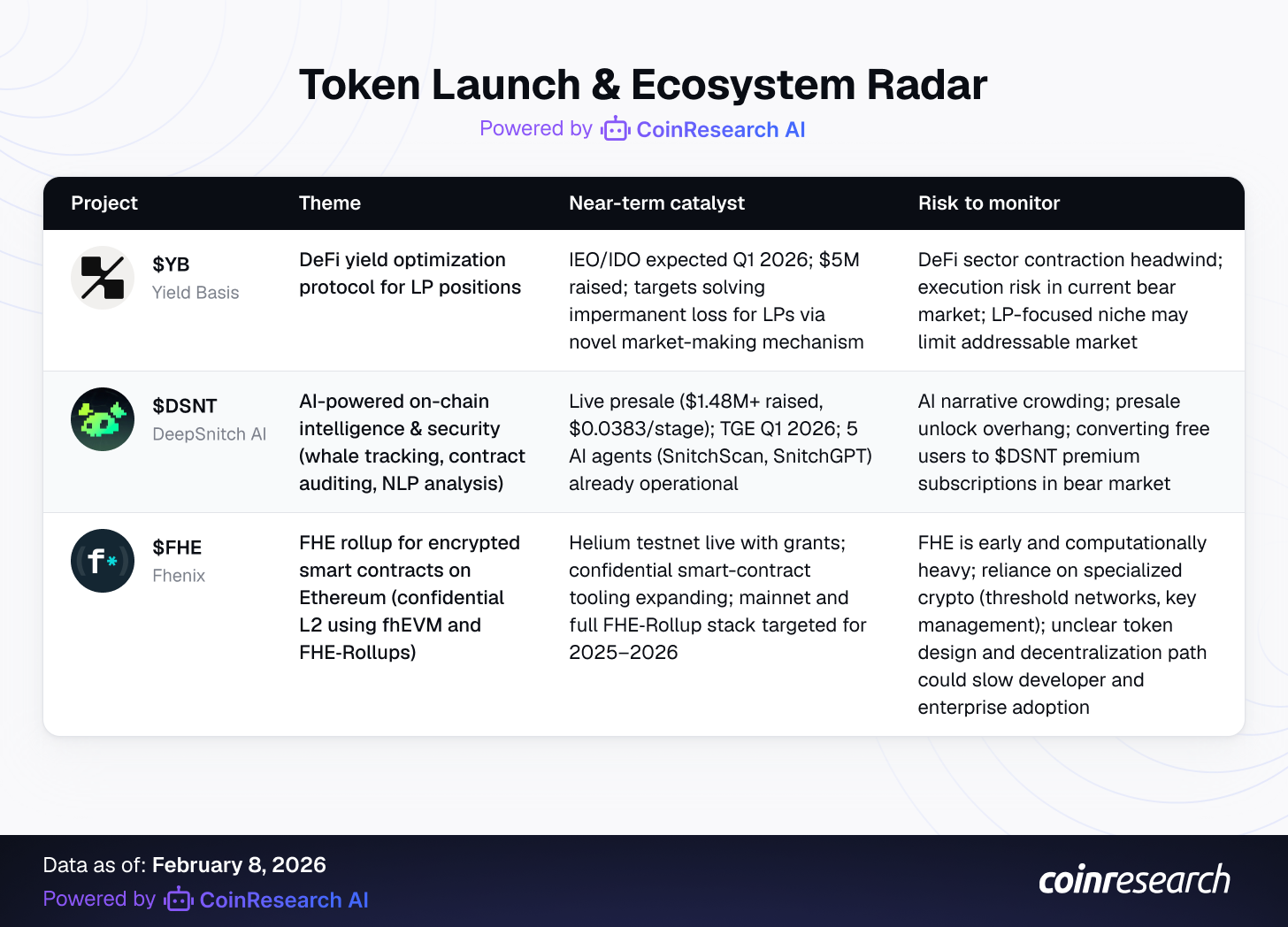
Yield Basis ($YB) | DeFi Yield Optimization Protocol
-
Launch Date: IEO/IDO expected Q1 2026; $5M raised in early funding; token not yet live on exchanges.
-
Thesis: Yield Basis targets one of DeFi’s most persistent problems—impermanent loss for liquidity providers. The protocol introduces novel market-making mechanisms designed to optimize LP yields while reducing downside risk during volatile market conditions. In the current bear market, where DeFi TVL is contracting and LP returns are compressed, a solution that genuinely mitigates impermanent loss would attract significant capital from yield-seeking participants who are currently sidelined.
-
Risk: The DeFi sector contraction is a headwind for any new protocol launch. LP-focused products serve a niche audience, which may limit initial adoption. Execution risk is elevated given the bear market environment—many DeFi projects launching in downturns fail to achieve critical mass before running out of runway.
DeepSnitch AI ($DSNT) | AI-Powered On-Chain Intelligence & Security
-
Launch Date: Token in presale since mid‑2025; DSNT launch and Tier‑1/2 listings targeted for 2026 once allocation completes and bonus campaigns end.
-
Thesis: AI-first crypto intelligence stack using five specialized agents (SnitchScan, SnitchFeed, SnitchGPT, AuditSnitch, etc.) to detect rug pulls, track whales, and surface real-time trading signals from on-chain and social data, giving traders institutional-grade surveillance in a single interface.
-
Risk: Heavy reliance on presale incentives and “100x” marketing; crowded AI narrative; need to convert free tool users into recurring, DSNT-linked revenue and ship beyond scanners to justify valuation once the token lists in a risk-off market.
Fhenix ($FHENIX) | FHE Smart-Contract Layer for Encrypted Compute
-
Launch Date: Mainnet targeted for Q1 2026; no public token listing yet, with FHE devnet and early ecosystem partners already live.
-
Thesis: Fully homomorphic encryption chain that lets dApps compute directly on encrypted data, enabling privacy-preserving DeFi, on-chain AI, and institutional use cases that can’t touch today’s transparent L1/L2 stacks.
-
Risk: FHE remains early and capital‑intensive; competition from other FHE projects (Zama, Inco, Mind Network) and uncertainty over whether developers will build beyond pilots before the next cycle.
Strategic Recap & Forward Outlook
The week ending February 8, 2026, represents the deepest single-week capitulation since the FTX collapse and confirms that the crypto market is in a full-blown bear cycle. Bitcoin’s flash crash to ~$60,000 and subsequent recovery to ~$70,000 marks a new phase: the market has transitioned from controlled correction to violent capitulation-and-bounce patterns characteristic of bear market bottoms—or bear market rallies before further lows.
Key Takeaways:
-
$60,000 is the new critical pivot. Bitcoin’s successful defense of this level (bouncing 17% within 24 hours) establishes $58,000–$62,000 as the cycle’s capitulation zone. A sustained break below $60,000 would open $50,000 as the next major target. Conversely, a reclaim of $80,000+ on weekly close would be the first structural bullish signal since January.
-
Bessent’s testimony is a permanent narrative shift. The Treasury Secretary’s under-oath rejection of Bitcoin purchases and crypto bailouts eliminates the “government bid” speculation that had supported prices. The market must now price in a reality where the U.S. strategic Bitcoin reserve grows only through asset seizures, not open market operations.
-
Ethereum’s $1,750 flash crash is a structural warning. ETH’s 27% intraweek swing and continued ETH/BTC ratio deterioration confirm that Ethereum’s investment thesis is under serious pressure. The next test will be whether $2,000 holds as psychological support, or whether ETH revisits the $1,700–$1,800 zone established during the Feb 6 capitulation.
-
ETF flows are the single most important signal to watch. The market cannot sustainably recover without institutional ETF inflows turning positive. The February 4–5 combined outflows of ~$938M demonstrate that the “smart money” is actively de-risking. A reversal in this trend would be the earliest signal of a genuine bottom.
Forward Outlook (Week Ending February 15, 2026):
The base case for the coming week is a choppy consolidation between $65,000 and $75,000 for Bitcoin, as the market digests the Bessent aftermath, awaits the delayed January jobs report (now expected mid-February), and processes the implications of the government shutdown’s resolution. Ethereum is likely to trade in a $1,900–$2,200 range, with $2,000 as the key psychological level. Altcoins should remain bifurcated—newly launching projects with genuine utility (MegaETH, Aztec) may show idiosyncratic strength from early-stage demand, while broad-beta altcoins continue to underperform.
Key catalysts for the week ahead:
-
MegaETH mainnet launch (Feb 9): Could inject fresh narrative energy into the L2 sector and provide a temporary lift to Ethereum sentiment
-
Delayed January jobs report: When released, strong employment data would reinforce “higher-for-longer” Fed narrative (bearish for crypto); weak data could spark relief rally on recession/rate-cut hopes
-
Bitcoin ETF flow data: Consecutive days of net inflows would be the most bullish signal possible; continued outflows confirm bear market continuation
-
Trump tariff developments: Any escalation or de-escalation in trade tensions will move risk assets broadly
Disclaimer: This analysis is for informational purposes only and should not be construed as investment advice. Cryptocurrency markets carry substantial risk, including the potential loss of principal. Past performance does not guarantee future results. Always conduct your own due diligence and consult a qualified financial advisor before making investment decisions.