
The 200DMA Falls, Altcoins Disperse Wide, and “Never Sell” Wobbles | Week Ending May 10, 2026
CoinResearch Intelligence Weekly #28
The 200DMA Falls, Altcoins Disperse Wide, and “Never Sell” Wobbles | Week Ending May 10, 2026
1. Range Resolved, Resolve Tested
Bitcoin finally cleared the line. BTC closed the week at approximately $82,026, up roughly 4.4% W/W, with an intraweek high of $82,496 that broke through the 200-day moving average at $82,228 — the level the market had not closed above for seven months. ETH printed around $2,374, up 2.2% W/W, less convincing but tracking. After three weeks of grinding inside a $75K–$80K box, the upper bound finally gave. The print is technically meaningful. What the print does not yet do is answer whether this is a regime change or a relief rally into a packed catalyst week.
Three macro currents shaped the move and now define the risk. Strategy reported Q1 earnings on May 5 — a $12.54 billion net loss, 818,334 BTC held at an average cost of $75,537, and a public reversal that surprised the bull case: Michael Saylor floated the possibility of selling bitcoin to fund dividend obligations, with the explicit framing that the company “will probably sell some bitcoin to pay a dividend just to inoculate the market.” This is the same Strategy whose “never sell” thesis has been the structural underpinning for corporate BTC accumulation since 2020. Spot BTC ETFs ran a five-day inflow streak May 1–6 totaling roughly $1.69 billion, then flipped to two consecutive days of outflows totaling approximately $514 million on May 7–8, with FBTC and IBIT both contributing to the reversal. Net for the week: positive, but the conviction wobbled again. Oil de-escalated further as Iran weighed a 14-point US peace proposal; Brent fell from $108 to roughly $100 across the week, with the geopolitical risk premium continuing to unwind.
Key Themes
-
The 200DMA at $82,228 has been broken intraweek, but not sustained on closes. Converting “range break” to “trend reclaim” requires holding the level through the May 12 CPI print and the chair-transition window.
-
Saylor’s “never sell” thesis wobbled. The Q1 earnings call introduced a sell-to-fund-dividends scenario that weakens the structural floor argument even if not executed.
-
ETF flows are no longer one-way. Five in, two out, ~$531M net positive — directionally constructive but uncommitted.
-
Altcoins dispersed for the first time in months. TON, SUI, ZEC, LINK and SOL outperformed BTC by 10x or more — rotational appetite returning to the long tail.

2. Strengths
-
The 200DMA reclaim is a real structural shift. BTC’s intraweek high of $82,496 cleared the 200-day moving average at $82,228, the first close-zone breach in seven months. Even a tactical reclaim has historically preceded extended trend phases — the level had acted as resistance since October. The honest caveat: a single print above is a break, not yet a reclaim. The May 12 CPI release will test whether $82,228 converts into support or reverts to resistance.
-
Institutional accumulation continued through the rally. Whale wallets extended their multi-month accumulation pattern. BNY Mellon’s launch of regulated bitcoin custody in Abu Dhabi during the week broadens the institutional access surface — a structural development that does not move price this week but reduces friction for the next allocation wave. Exchange BTC reserves remain at multi-year lows, the kind of supply tightening that historically precedes — rather than confirms — directional moves.
-
Altcoin dispersion suggests rotation is back. TON +80%, SUI +46%, ZEC +41%, LINK +17%, SOL +15%, and ADA +13% across the top 30 marks the widest single-week dispersion since Q1. Rotation of this magnitude usually requires either a confirmed BTC trend or a market-wide risk-on shift. The fact that it occurred during BTC’s range-break week suggests the second condition is forming. The caveat: dispersion without follow-through is just a one-week event. The tell will be whether second-tier alts (mid-caps without specific catalysts) participate next week.
3. Weaknesses
-
Saylor’s “never sell” reversal is the week’s most underpriced negative. During the Q1 earnings call on May 5, Saylor explicitly floated the scenario of selling BTC to fund dividend obligations on the STRC preferred instrument — a sharp reversal from the unconditional accumulation thesis that has defined Strategy’s positioning for five years. The company holds 818,334 BTC, roughly 3.9% of total supply. Even a token sale to “inoculate the market” reframes the company from structural buyer to opportunistic seller. MSTR stock dropped 4% after-hours; the price impact on BTC was limited in the moment, but the narrative damage compounds.
-
ETF flows lost momentum mid-week. Five consecutive sessions of inflows from May 1–6 totaling approximately $1.69 billion gave way to two days of outflows totaling around $514 million on May 7–8. FBTC led the redemptions with approximately $129 million on May 7 alone; IBIT followed with $98 million. The pattern continues to be “buy strength, sell weakness” rather than the durable accumulation the bull case requires. May has been positive in aggregate, but the durability is still in question.
-
Sentiment volatility undermines the breakout’s foundation. F&G hit 38 (Fear) on May 7 and 8 during a week BTC closed up +4.43%. Fear printing during a rising tape is the kind of divergence that historically marks distribution, not accumulation. The Sunday recovery to 48 fixed the read, but the mid-week dip is the tell — positioning is light, conviction is shallow, and the rally is being chased rather than embraced.
4. Market Recap: Top 10 Weekly Performance
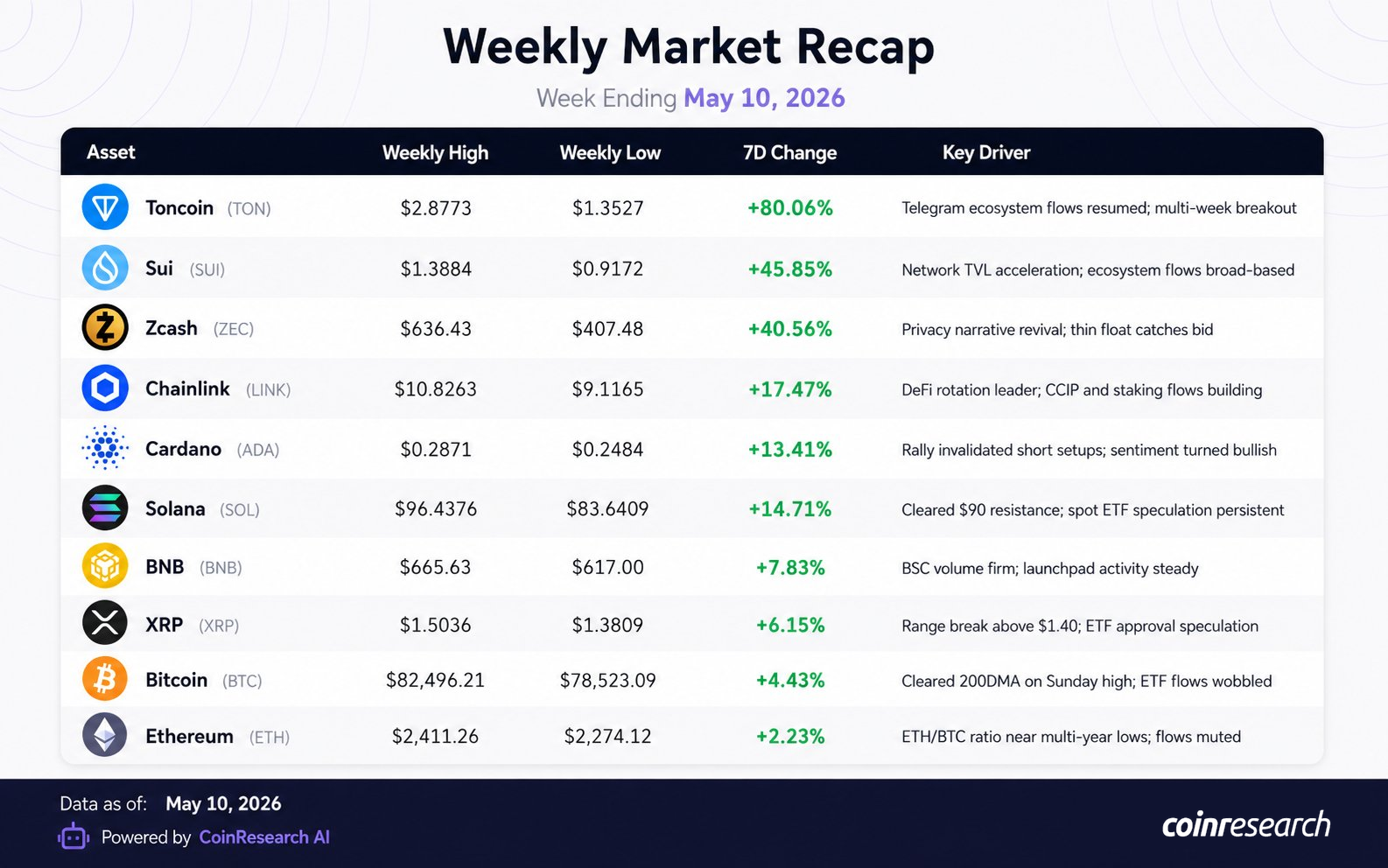
The week split into two clear cohorts: BTC, ETH and the large-cap majors posting orderly mid-single-digit gains, while a long tail of altcoins dispersed wide on individual catalysts. TON led the broad tape on continued ecosystem flows, SUI and ZEC printed outsized breakouts, LINK and SOL cleared multi-week resistance. BTC closed near $82,026 (+4.43% W/W), ETH near $2,374 (+2.23% W/W). Total market cap sits at approximately $2.785 trillion; BTC dominance at 58.25%; ETH dominance at 10.10%. The tape rewarded selectivity over index exposure — a setup that requires asset-by-asset discipline rather than directional beta.
5. Predictive Analytics & Trade Confluence
Disclaimer: The insights and forecasts presented here are generated by CoinResearch AI’s predictive models and supporting analytics. They are provided for informational and educational purposes only and do not constitute financial advice or investment recommendations. Trading digital assets involves risk, and users should conduct their own research, exercise independent judgment, and use appropriate risk management before making any investment or trading decisions.
Last week’s audit before we begin. Edition #27 spotlighted four signals: BTC long (Entry $78,150–$78,750), 1INCH long (Grade C, entry $0.094–$0.095), SHIB light accumulate, and ADA cautious short. BTC entered cleanly and ran to a high of $82,496, clearing both TP1 ($81,344) and TP2 ($82,703) — clean win. 1INCH worked perfectly: open $0.0950, close $0.1043, +9.84% W/W, both TPs hit. SHIB closed +7.04%, clipping TP1 and TP2 within tolerance. ADA, however, was stopped out within the first 48 hours — the position broke above the $0.25570 stop loss mid-week and finished at $0.2829 (+13.41%).
BTC-USD (Bitcoin)
Reference Price: $80,678 (verified at $81,012 writing time — moved roughly +0.4% since dashboard run)
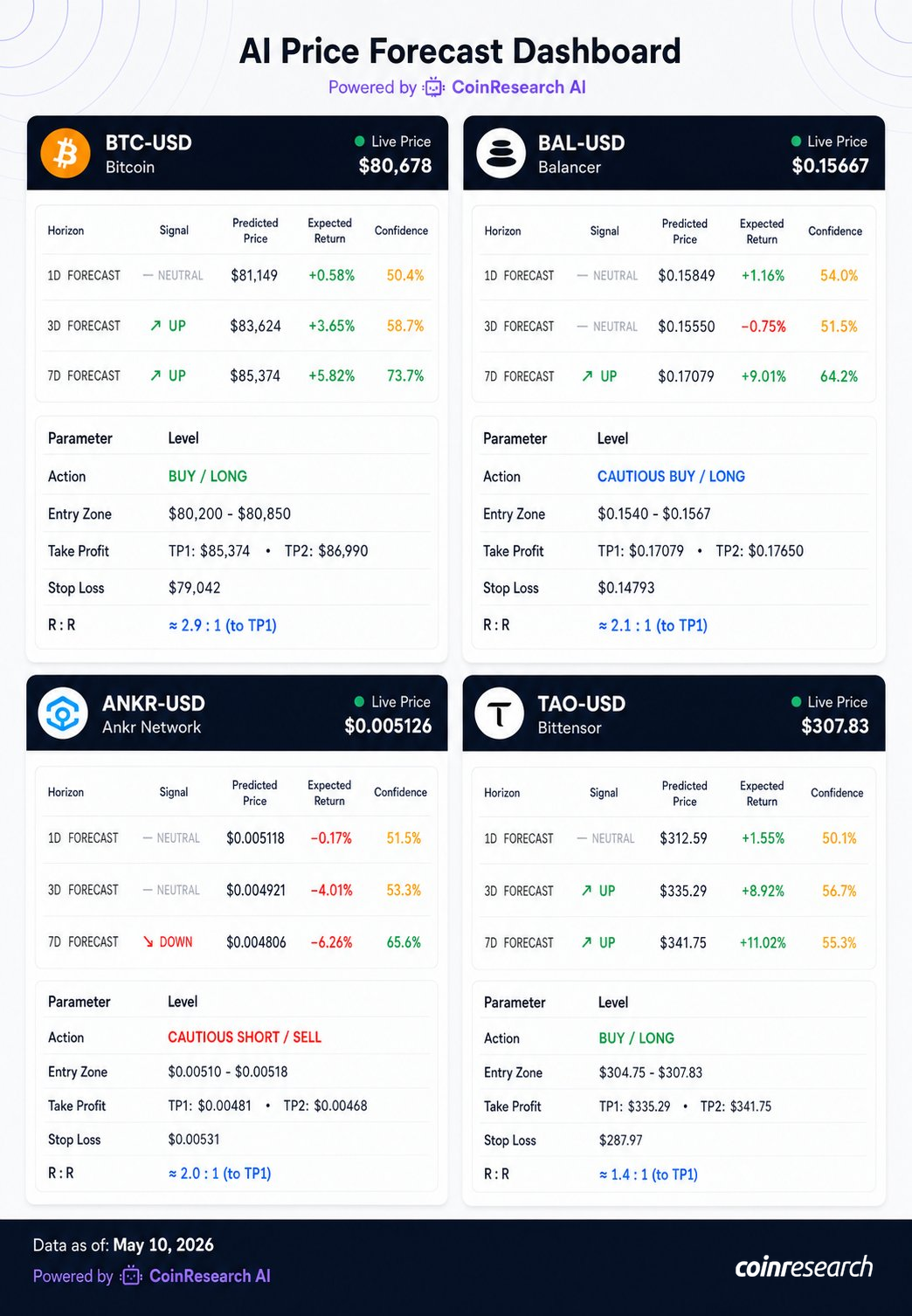
Summary: Grade A, Tier 2. The 3D and 7D heads agree directionally with confidence rising by horizon (58.7% at 3D, 73.7% at 7D), and the model targets sit above the 200DMA — the level BTC just broke for the first time in seven months. This is the cleanest model stack on the dashboard.
Market Confluence Analysis. The model’s 7D target at $85,374 sits above a recently broken structural resistance — confluence on direction. The complication is the calendar: the next seven days include the May 12 CPI print, the Warsh full Senate vote, and Powell’s May 15 term expiration. Three macro catalysts on a single tape historically increase dispersion rather than confirm direction. The model is correct on direction; the +5.8% magnitude over a 7-day window is the speed assumption the analyst layer challenges.
Trade Action.
-
Action: Buy / Long
-
Entry Zone: $80,200–$80,850
-
Take Profit (model): TP1 $85,374 / TP2 $86,990
-
Analyst Near-Term Target: $83,000–$83,500 (first resistance band)
-
Stop Loss: $79,042
-
R:R: ≈ 2.9:1 to model TP1 from entry midpoint; ≈ 1.6:1 to analyst near-term target
-
Rationale: Grade A 7D UP signal with 73.7% confidence and the 3D/7D heads aligned. The 200DMA at $82,228 has been broken intraweek but not yet sustained; the structural thesis is intact. Scale in on weakness toward the lower entry band; treat the model’s $85,374 target as a multi-week objective rather than a 7-day base case.
-
Invalidation: Exit on a daily close below $79,042 — the ATR-defined support that defines the long structure. If price stalls in the $80K–$82K zone and cannot reclaim $82,500 within three sessions, reduce size and wait for a fresh setup rather than averaging.
Analyst Note. The conviction here is in direction, not timeline. The structural setup is the cleanest BTC has produced in three weeks. The analyst layer trims the speed: TP1 is reachable, but likely across two weeks rather than five sessions, and only if CPI prints cooperatively and Warsh confirms without procedural friction.
Verdict: BUY / SCALE-IN LONG.
BAL-USD (Balancer)
Reference Price: $0.15667
Summary: Grade B, Tier 2. The only Grade B signal on the dashboard this week. The 7D head projects $0.17079 (+9.0%) at 64.2% confidence, with the 1D and 3D heads near-neutral — a setup where the conviction is in the weekly horizon, not the daily path.
Market Confluence Analysis. Balancer sits in the DeFi-aggregator and AMM category that responds to broad-market risk-on phases rather than asset-specific catalysts. The altcoin dispersion this week (LINK +17%, SOL +15%, AVAX +13%) suggests sector rotation is real; the question is whether BAL participates or lags. Social volume on the asset is effectively zero — the model carries full decision weight here, with no sentiment overlay to validate or contradict. A +9% modeled move on a Grade B card with thin social data is the kind of setup that pays when it pays but rarely produces clean intraweek confirmation.
Trade Action.
-
Action: Cautious Buy / Long
-
Entry Zone: $0.1540–$0.1567
-
Take Profit (model): TP1 $0.17079 / TP2 $0.17650
-
Analyst Near-Term Target: $0.165 (first resistance, more achievable in a 5-7 day window)
-
Stop Loss: $0.14793
-
R:R: ≈ 2.1:1 to model TP1; ≈ 1.3:1 to analyst near-term target
-
Rationale: Grade B 7D UP at 64.2% confidence — strong relative to dashboard average. Sector rotation supports direction; +9% magnitude assumes BAL participates rather than lags. Scale on weakness toward $0.1540.
-
Invalidation: Exit on a close below $0.14793. If price cannot hold the entry band on volume, cut rather than average.
Analyst Note. A rotation play, not a fundamental thesis. Confirmation comes from the sector — if UNI, CRV, CAKE firm in parallel, the BAL thesis strengthens.
Verdict: CAUTIOUS BUY / LONG.
ANKR-USD (Ankr Network)
Reference Price: $0.005126 (spot at writing time $0.005228 — slightly above upper entry band)
Summary: Grade C, Tier 2. 7D effective direction DOWN at 65.6% confidence; the 7D target at $0.00481 essentially calls for a revisit of the week’s open ($0.004803). The setup is the cleanest short on the dashboard — modest target, tight stop, real reward-to-risk.
Market Confluence Analysis. ANKR rallied +9.54% across the week (open $0.0048, close $0.0053), and the model is calling for mean-reversion. Social sentiment reads 100% bullish with Galaxy 57 on thin volume (114 mentions) — a sentiment extreme that on small-cap alts often coincides with local tops. The model is positioning against consensus, which is where shorts tend to work. The risk: ANKR is a low-float DePIN-adjacent name where a single retail flow event can override technical mean-reversion.
Trade Action.
-
Action: Cautious Short / Sell
-
Entry Zone: $0.00510–$0.00518
-
Take Profit: TP1 $0.00481 / TP2 $0.00468
-
Stop Loss: $0.00531
-
R:R: ≈ 2.0:1 to TP1
-
Rationale: 7D DOWN at 65.6% confidence; TP1 essentially calls for a revisit of the week’s open — a structurally reasonable mean-reversion target. Tight $0.00531 stop caps risk near 3.2%; target offers 6.4% reward.
-
Invalidation: Cover on a close above $0.00531 or a reclaim of the upper ATR band with volume.
Analyst Note. The cleanest short on the dashboard — not because the modeled move is large, but because the math is clean. 2:1 R:R, modest target, tight stop, sentiment extreme as a contrarian tell.
Verdict: CAUTIOUS SHORT.
TAO-USD (Bittensor)
Reference Price: $307.83
Summary: Grade C, Tier 2. The 3D and 7D heads both signal UP with the modeled magnitudes accelerating across the horizon (3D +8.92% at 56.7% confidence, 7D +11.02% at 55.3% confidence). The 1D is neutral. The setup is directional with above-average modeled upside, but the confidence floor sits at the lower end of what we’d consider actionable.
Market Confluence Analysis. Bittensor is the strongest AI-infrastructure narrative on the dashboard this week, and the broader AI-token category has been firming through May after a soft April. TAO was among the trending assets on CoinGecko’s lists during the week, and social sentiment is supportive (81% bullish, Galaxy 55). The complication is the magnitude: the model’s 7D target of $341.75 implies a +11% weekly move on a Grade C card with confidence just above 55%. Above-average weekly moves on TAO are common — the asset routinely prints ±10% weeks in either direction — so the target is in-distribution, but the sequencing matters: if the broader risk tape weakens into CPI or the chair-transition window, AI-narrative tokens are typically the first to be sold for liquidity rather than the last.
Trade Action.
-
Action: Buy / Long
-
Entry Zone: $304.75–$307.83
-
Take Profit (model): TP1 $335.29 / TP2 $341.75
-
Analyst Near-Term Target: $325 (first resistance, more realistic in a 5-7 day window)
-
Stop Loss: $287.97
-
R:R: ≈ 1.4:1 to model TP1 from entry midpoint; ≈ 0.9:1 to analyst near-term target
-
Rationale: Grade C 7D UP signal with consistent directional agreement across the 3D and 7D heads. AI sector tailwinds support direction; the +11% magnitude assumes the broader risk tape holds through the catalyst week. Use a tighter pullback entry near $304.75 to keep reward-to-risk above the minimum threshold.
-
Invalidation: Exit on a close below $287.97 — the ATR-defined risk limit. If the broader risk tape weakens around the CPI print and TAO loses $300 with momentum, reduce or close rather than averaging.
Analyst Note. This is the lower-conviction spotlight of the four. Direction is reasonable, magnitude is aggressive. The case for inclusion is the sector — AI infrastructure is the only altcoin theme on the dashboard with a coherent 7D directional read. The case for caution is the confidence stack: 55% is the floor of actionable, and Grade C means the historical hit rate has been mixed. Treat this as a smaller-size satellite position rather than a core long.
Verdict: CAUTIOUS BUY / LONG (smaller size).
6. Token Launch & Ecosystem Radar
A curated look at three high-signal projects approaching major milestones that have not yet launched their tokens.
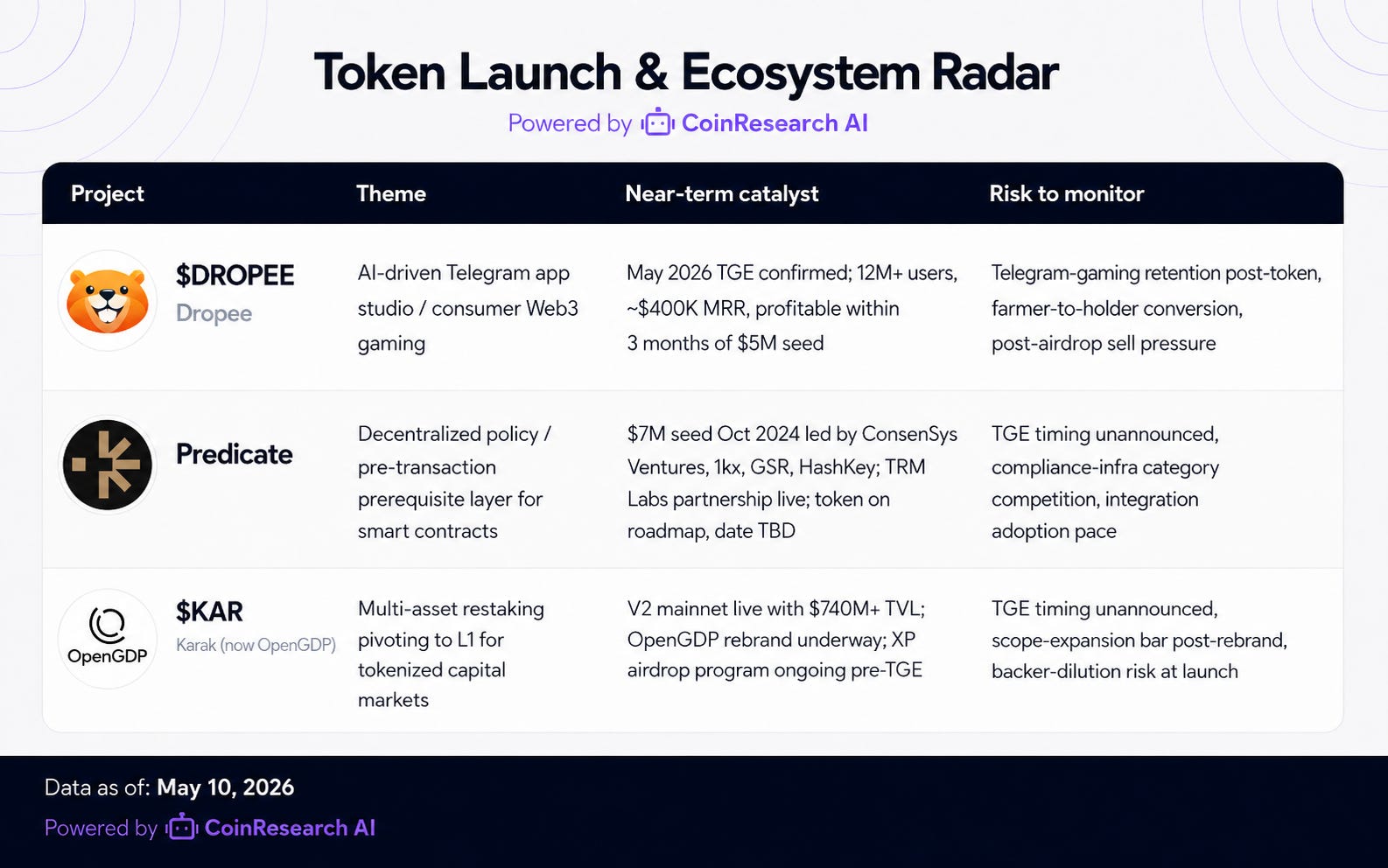
Dropee ($DROPEE) — AI-powered Telegram app studio with 12M+ users and a profitable consumer game economy.
-
Why watch it: Dropee has scaled to roughly 12 million total users, 4 million MAU, and 300,000 DAU across its Telegram games, with reported $400K MRR and profitability within three months of its $5M seed round. The founder team includes Guillaume Lestrade (cofounder of Meero) and Hubert Larenaudie (former President at Voodoo, EA, and Activision) — the rare consumer-Web3 team with measurable executional track record.
-
Current Status: Pre-TGE. The team has publicly confirmed a May 2026 TGE window; specific date and exchange listings undisclosed. Roughly 40% of supply earmarked for community via Season 1 and Season 2 airdrop participants. Backers include OKX, Ledger, Adidas, Tioga Capital, and Sebastian Borget of The Sandbox.
-
Monitoring Rationale: Profitability before TGE is the differentiator from typical points-farming launches. The question at TGE is whether the user base converts to token holders or simply farms and exits.
Predicate — Decentralized policy and pre-transaction prerequisite layer for blockchain applications.
-
Why watch it: Predicate raised $7M in seed funding (October 2024) led by ConsenSys Ventures, with participation from 1kx, Reciprocal Ventures, Tribe Capital, Figment Capital, HashKey Capital, GSR, and NEAR Foundation. The angel roster reads like an infrastructure who’s who: Calvin Liu (EigenLayer), Rene Reinsberg (Celo), Mike Silagadze (ether.fi), Sandeep Nailwal (Polygon), Matthew Katz (Caldera), Georgios Vlachos (Axelar). In February 2025, Predicate partnered with TRM Labs to launch what both companies describe as the first decentralized policy infrastructure for blockchain applications — embedding TRM’s risk-scoring framework directly into smart contracts, solver networks, and routers.
-
Current Status: Pre-TGE. Founder Raghuveera has publicly confirmed a token is on the roadmap, with no announced date. The product is in white-glove integration mode with launch clients, charging transaction fees in lieu of token economics during this pre-TGE phase.
-
Monitoring Rationale: Compliance-as-infrastructure is becoming a structural requirement, not an optional bolt-on, as DeFi protocols face regulatory pressure across the EU, UK, and US. Predicate’s bet — that modular, configurable transaction rules are more defensible than ad-hoc compliance retrofits — aligns with where institutional adoption appears to be heading. The angel composition (founders of EigenLayer, Celo, Polygon, ether.fi) signals strong distribution potential at TGE.
Karak (now OpenGDP) — Multi-asset universal restaking protocol pivoting to a Layer-1 for tokenized capital markets.
-
Why watch it: Karak raised approximately $48M in December 2023 led by Lightspeed Venture Partners, with Coinbase Ventures, Pantera Capital, Framework Ventures, and Mubadala Capital participating; angel investors include Naval Ravikant and senior engineers from Google and Coinbase. The protocol grew to roughly $740M in TVL as the second-largest restaking platform after EigenLayer, supporting ETH LSTs, LRTs, stablecoins, and WBTC across Ethereum, Arbitrum, and the Karak L2. In 2026 the project rebranded to “OpenGDP” and repositioned from “universal restaking layer” to “the first Layer-1 blockchain optimized for global internet capital markets” — adding tokenization, RWA, and 24/7 trading rails on top of its shared-security foundation.
-
Current Status: Pre-TGE. The $KAR token has been announced publicly by the Karak Network Foundation but no launch date is set; the network continues to run its XP points program as the apparent precursor to a retroactive airdrop. V2 mainnet is live and the migration to OpenGDP’s expanded scope is in progress.
-
Monitoring Rationale: The rebrand is the variable. A restaking protocol with $740M in deposits and a $48M institutional cap table launching a token is one set of expectations; a Layer-1 for “programmable GDP” launching that same token is a different — and significantly higher — bar. Watch for whether the eventual TGE keeps the restaking thesis as the lead narrative or anchors entirely to the broader L1 vision. Backer roster suggests TGE remains a question of when, not whether.
7. Strategic Recap & Forward Outlook
The range broke, and that is the structural fact of the week. The 200DMA cleared, altcoins dispersed wide for the first time in months, and the institutional case held even as ETF flows wobbled. What did not happen: the bull case did not consolidate. Saylor’s earnings-call reversal, the mid-week ETF outflow flip, and a CPI print landing on Tuesday all keep the conviction question open. The trade is to be long the direction with disciplined sizing into weakness, short the mean-reversion candidates where math and sentiment both align, and size satellite positions in sector-narrative names like AI infrastructure with realism about the catalyst week ahead. Position for two weeks, not five days. Watch for: a daily close above $82,500 to upgrade the BTC thesis, a sub-3% CPI surprise to extend the rally beyond the 200DMA, or a Saylor follow-through on actual BTC sales to revert the regime.
Forward Outlook — Week of May 11–17
-
Macro Watch. April CPI prints Tuesday May 12 at 8:30 AM ET — Wells Fargo consensus is +3.8% YoY headline (vs +3.3% prior), driven by April energy prices that remained elevated before the early-May oil retreat. A hot print reinforces the no-cuts-in-2026 framing CME FedWatch already prices; a cool print reopens H2 easing. The full Senate floor vote on Warsh is expected this week, with confirmation needed before Powell’s term expires May 15. Powell will serve as Chair pro tem if confirmation slips. Strategy is expected to resume BTC accumulation per Saylor’s May 10 “Back to work next week” signal — though the post-earnings narrative shift means buying may be smaller or more conditional than prior cadence.
-
BTC Key Levels. Resistance: $82,228 (200DMA, the line just broken), then $83,500 (analyst near-term target), then $85,000 round and $85,374 (model 7D target). Support: $80,200 (lower entry band), $78,000 (May 7–8 low cluster), then $75,000 (range floor before the break). A daily close below $79,042 invalidates the long structure.
-
Altcoin Outlook. DeFi rotation is the cleanest active theme — BAL is this week’s spotlight long, with LINK, AAVE, and CRV candidates for participation. AI infrastructure firmed across the week with TAO leading; the dashboard’s bullish TAO setup is the spotlight expression of this theme, though confidence sits at the floor of actionable (55%) and position sizing should reflect that. On the carry-forward question: the model has reissued a bearish ADA setup for a third consecutive edition (#26, #27, #28). The first two were stopped out. With the classifier reading neutral across all three horizons at 50% confidence and only the regression head producing bias, we judge the conviction floor too low to spotlight a third attempt and recommend standing aside until a non-neutral classifier print emerges. Memecoins ex-DOGE remain weak. Notable from the broader dashboard: nine of fourteen Grade C setups carry short or no-trade verdicts, suggesting the long tail is mean-reverting rather than continuing this week’s dispersion.
Disclaimer: This analysis is for informational purposes only and should not be construed as investment advice. Cryptocurrency markets carry substantial risk, including the potential loss of principal. Past performance does not guarantee future results. Always conduct your own due diligence and consult a qualified financial advisor before making investment decisions.