
Choppy Consolidation Meets Cooling Inflation: Bitcoin Range-Bound as Markets Digest a Shifting Macro Backdrop | Week Ending February 15, 2026
The second full week of February 2026 delivered a stark contrast to the prior week’s violent capitulation. Bitcoin consolidated within a $65,000–$71,400 range—precisely the choppy corridor outlined in last edition’s forward outlook—as the market transitioned from panic selling to tentative stabilization. The week’s defining macro event was the release of the January CPI report on Friday, February 13 (delayed two days by the brief government shutdown): headline inflation decelerated to 2.4% year-over-year—an eight-month low—while core CPI eased to 2.5%, the lowest reading since March 2021. The cooler-than-expected print briefly ignited a relief rally, pushing BTC from $66,200 to above $69,000 within hours. However, the enthusiasm was short-lived: Bitcoin ETF flows remained net negative for the week, with a cumulative outflow of approximately $121 million across the February 10–13 window, led by $410 million in single-day outflows on February 12.

Strengths
-
Inflation deceleration provides macro relief. The January CPI at 2.4% YoY (vs. 2.7% in December) represents the sharpest month-over-month improvement in the headline rate since mid-2024, reinforcing the disinflation trajectory that markets have been waiting for. Core CPI at 2.5%—its lowest since March 2021—strengthens the case for eventual Fed rate cuts, which would be structurally bullish for risk assets including crypto.
-
Bitcoin holds $65,000 consolidation floor. Despite multiple intraweek retests of the $65,000–$66,000 zone (with the weekly low at $65,070 on February 12), Bitcoin successfully defended this support level, preventing a retest of the catastrophic $60,000 zone from the prior week. This validates $65,000–$66,000 as the new near-term structural floor.
-
Selective altcoin strength signals risk appetite returning. Dogecoin surged +14.7% for the week, XRP gained +5.9%, and Cardano rose +4.3%—outperforming Bitcoin’s roughly flat performance and suggesting that speculative capital is cautiously re-engaging with higher-beta assets at distressed valuations.
Weaknesses
-
ETF flows remain net negative, confirming persistent institutional de-risking. Despite brief positive inflows of $272 million on February 10, the week’s cumulative flows turned negative again, headlined by a $410 million outflow on February 12—the largest single-day outflow since the February 4–5 capitulation. The absence of sustained institutional inflows remains the single biggest obstacle to a genuine recovery.
-
Extreme Fear sentiment persists, limiting upside potential. The Fear & Greed Index at approximately 9–20 represents the seventh consecutive week in Extreme Fear territory—the longest such streak since the 2022 bear market. This level of sentiment compression indicates that market participants are still positioned defensively, with limited willingness to take on new risk.
-
Bitcoin range-bound behavior masks underlying weakness. While the $65,000–$71,400 consolidation range appears stable on the surface, the declining volume and absence of strong bid-side conviction suggest this is a distribution phase rather than accumulation. The inability to reclaim $72,000 on a daily close reinforces the bearish structure established since January.
Market Recap
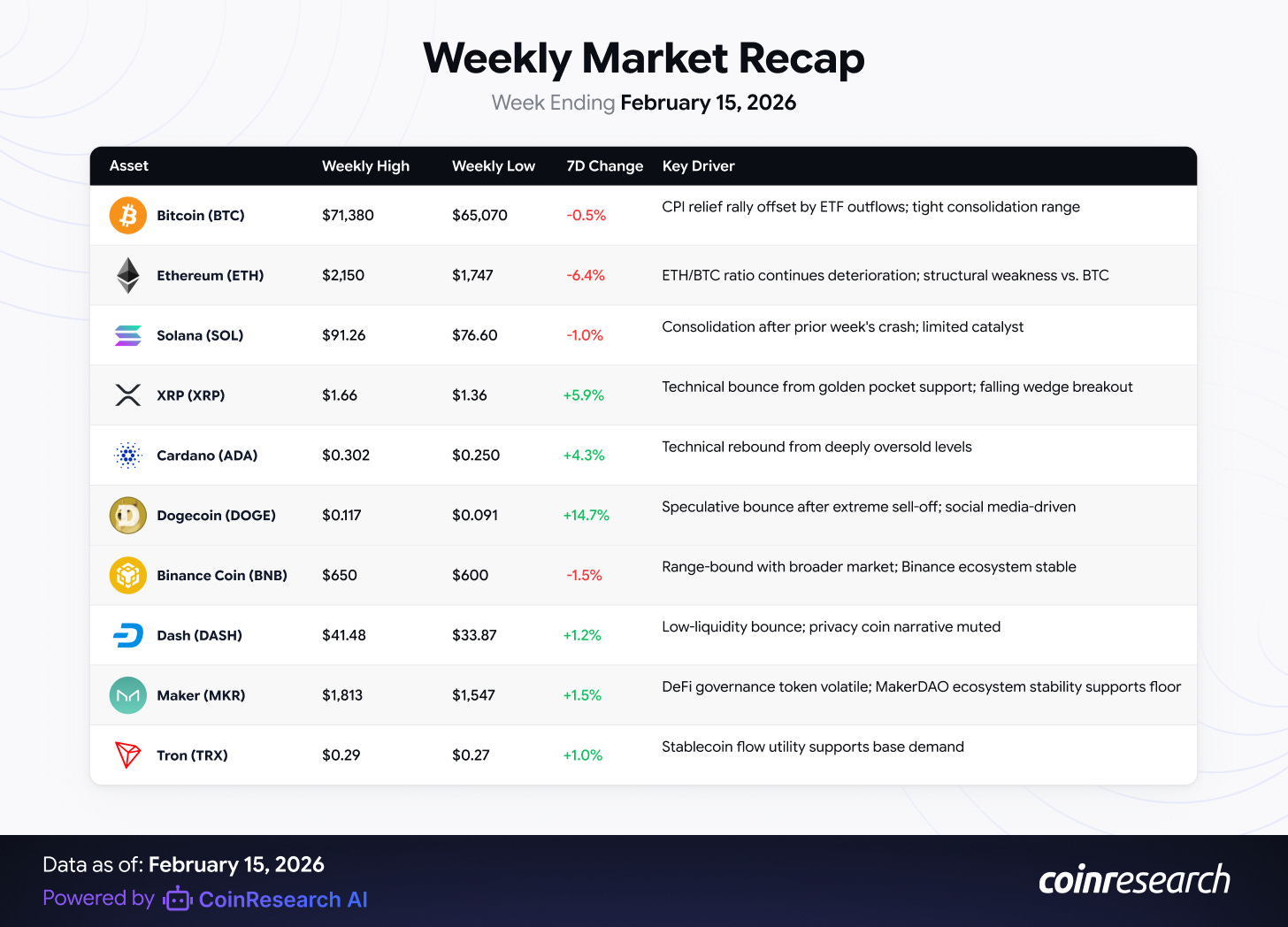
Overall Market Sentiment: Extreme Fear (Fear & Greed Index: ~9–20). Total crypto market capitalization: ~$2.4 trillion. Bitcoin dominance: ~60–62%.
AI/ML Model Insight & Market Confluence
CoinResearch AI integrates our Directional Prediction models (RF/XGBoost) and RNN Price Forecast models.
Below are the RNN forecast outputs cross-validated with structure, momentum, and sentiment context.
Disclaimer:
The insights and forecasts presented here are generated by CoinResearch AI’s predictive models and supporting analytics. They are provided for informational and educational purposes only and do not constitute financial advice or investment recommendations. Trading digital assets involves risk, and users should conduct their own research, exercise independent judgment, and use appropriate risk management before making any investment or trading decisions.
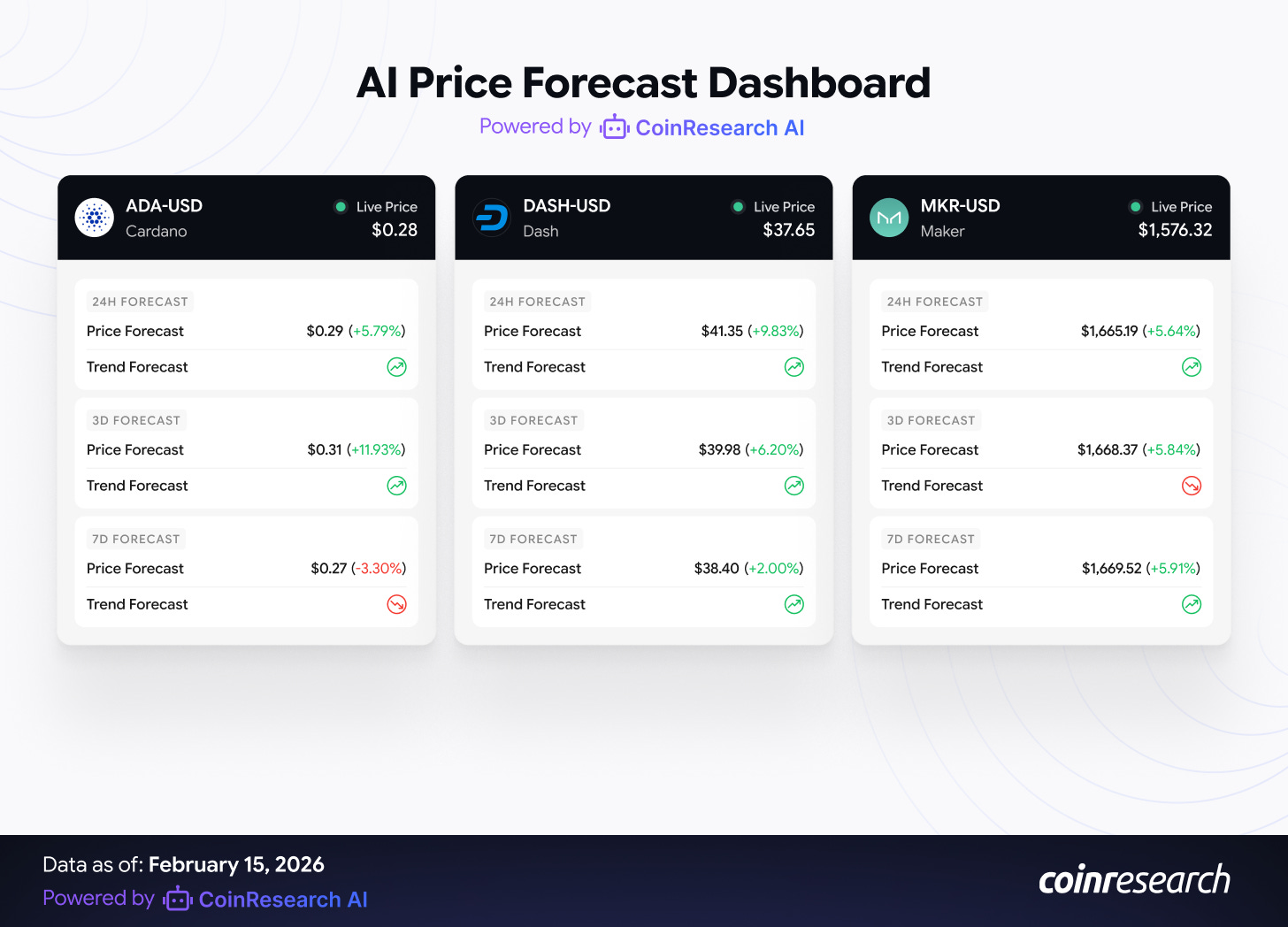
Maker (MKR-USD) | Reference Price: $1,576.32
Price Prediction Model (RNN):
-
24H Forecast: $1,665.19 (+5.64%) | Previous 24H Forecast: $1,656.36 | Accuracy: 94.26%
-
3D Forecast: $1,668.37 (+5.84%) | Previous 3D Forecast: $1,653.34 | Accuracy: 94.46%
-
1W Forecast: $1,669.52 (+5.91%) | Previous 1W Forecast: $1,655.91 | Accuracy: 94.29%
Directional Model (Trend):
-
24H: ✅ Bullish | Win Rate: 35.71%
-
3D: ❌ Bearish | Win Rate: 71.43%
-
1W: ✅ Bullish | Win Rate: 64.29%
Analysis: High-Conviction RNN Bullish vs. Mixed Directional Signals
This week’s MKR outputs present a notably compelling setup. The RNN price prediction model is uniformly bullish across all three timeframes, forecasting +5.64% to +5.91% upside with exceptionally high accuracy scores (94.26%–94.46%). These are among the highest accuracy readings across any asset in this or the previous edition—a marked improvement from the calibration errors (0% accuracy) that plagued several models last week. The previous forecasts also tracked reality closely ($1,653–$1,656 vs. actual movement), lending further credibility.
However, the directional model presents mixed signals: 24H bullish at a weak 35.71% win rate, 3D bearish at 71.43%, and 1W bullish at 64.29%. The 3D bearish signal at 71.43% win rate is the most statistically significant directional reading and creates meaningful tension with the RNN’s bullish consensus.
Context:
Maker is trading at $1,576, up roughly 15% from its January lows near $1,370. MKR has been one of the more resilient DeFi governance tokens during this correction, benefiting from MakerDAO’s revenue-generating stability (DAI remains a top-3 stablecoin by market cap) and the protocol’s recent rebranding to Sky/Endgame. External forecasters project MKR’s February 2026 range at $1,569–$2,071, placing the current price near the lower bound. The cooler CPI print is modestly positive for DeFi governance tokens, as rate-cut expectations increase the attractiveness of yield-bearing DeFi protocols.
We cautiously agree with the RNN model’s bullish thesis. The 94%+ accuracy scores across all timeframes are difficult to dismiss, and the fundamental backdrop (DeFi protocol with real revenue, cooler inflation) supports moderate upside. However, the 3D bearish directional signal at 71.43% accuracy suggests that the path to $1,665+ may not be linear—a pullback in the 3-day window is plausible before the 1W bullish target materializes.
Trade Action: CAUTIOUS BUY (Small Position)
-
Entry: Current levels (~$1,576)
-
Take Profit (TP): $1,665–$1,700 (aligned with RNN targets and February upper range)
-
Stop Loss (SL): $1,500 (below recent consolidation support)
-
Risk/Reward: ~1.7:1 (favorable)
-
Conviction Level: MODERATE (RNN accuracy is strong, but directional model divergence and Extreme Fear macro environment warrant position sizing discipline)
Invalidation Conditions:
-
Break below $1,500 on daily close (invalidates near-term bullish structure)
-
Bitcoin breaks below $65,000 (risk-off cascade would drag MKR lower)
-
Unexpected Fed hawkish statement or tariff escalation (macro override)
-
DeFi-specific black swan (smart contract exploit, DAI depeg event)
Cardano (ADA-USD) | Reference Price: $0.28
Price Prediction Model (RNN):
-
24H Forecast: $0.29 (+5.79%) | Previous 24H Forecast: $0.26 | Accuracy: 92.67%
-
3D Forecast: $0.31 (+11.93%) | Previous 3D Forecast: $0.27 | Accuracy: 96.47%
-
1W Forecast: $0.27 (-3.30%) | Previous 1W Forecast: $0.26 | Accuracy: 94.20%
Directional Model (Trend):
-
24H: ✅ Bullish | Win Rate: 50.0%
-
3D: ✅ Bullish | Win Rate: 42.86%
-
1W: ❌ Bearish | Win Rate: 85.71%
Analysis: Short-Term Bullish Confluence with Critical 1W Divergence
Cardano presents the most analytically complex setup of the three assets this week. The RNN model is bullish near-term (+5.79% at 24H, +11.93% at 3D) but turns bearish at 1W (-3.30%). The directional model mirrors this pattern: bullish at 24H and 3D, but bearish at 1W with a notably high 85.71% accuracy. This convergence across both independent model systems at the 1W timeframe—combined with the RNN’s exceptional 96.47% accuracy on the 3D forecast—paints a clear picture: ADA is poised for a short-term bounce that is likely to fade by week’s end.
The previous RNN forecasts were remarkably accurate (previous 24H: $0.26 and 3D: $0.27 vs. actual price trajectory), establishing credibility for the current readings.
Context:
ADA is trading at $0.28, down approximately 70% year-to-date and roughly 75% from its early 2025 highs near $1.17. The token posted a +4.3% gain this past week, suggesting the beginnings of a technical rebound from deeply oversold conditions. Cardano’s broader fundamental picture remains mixed: the ecosystem continues development activity, but TVL growth has stagnated and the token lacks a near-term catalyst equivalent to an ETF filing or major protocol upgrade. External algorithmic models project ADA’s 2026 range at $0.27–$0.80, with the current price sitting at the absolute floor of that range.
Our analysts agree with the models’ consensus view. The short-term bullish signal is credible given ADA’s extreme oversold conditions and the CPI-driven risk-on impulse, but the high-conviction 1W bearish signal (85.71% directional accuracy, confirmed by RNN’s -3.30% target) strongly suggests this is a dead-cat bounce rather than a trend reversal. The setup favors a quick tactical trade, not a position build.
Trade Action: TACTICAL SHORT-TERM LONG (3-Day Max Hold)
-
Entry: Current levels (~$0.28)
-
Take Profit (TP): $0.30–$0.31 (aligned with RNN 3D target of $0.31)
-
Stop Loss (SL): $0.265 (below this week’s support zone)
-
Risk/Reward: ~2:1 (favorable for a tactical trade)
-
Conviction Level: MODERATE (Strong model confluence at 24H/3D, but 1W bearish consensus means exits must be disciplined)
-
Critical: Close position by Day 3–4. The 1W bearish signal at 85.71% accuracy is the highest conviction reading across this week’s entire model suite. Do not hold through the week.
Invalidation Conditions:
-
Failure to break above $0.295 within 48 hours (momentum stall, exit at breakeven)
-
Bitcoin drops below $66,000 (risk-off cascade overrides altcoin bounce)
-
Break below $0.25 on daily close (invalidates entire rebound thesis)
-
Sudden macro shock—tariff escalation, Fed emergency statement
Dash (DASH-USD) | Reference Price: $37.65
Price Prediction Model (RNN):
-
24H Forecast: $41.35 (+9.83%) | Previous 24H Forecast: $41.54 | Accuracy: 89.00%
-
3D Forecast: $39.98 (+6.20%) | Previous 3D Forecast: $40.52 | Accuracy: 91.73%
-
1W Forecast: $38.40 (+2.00%) | Previous 1W Forecast: $39.16 | Accuracy: 95.35%
Directional Model (Trend):
-
24H: ✅ Bullish | Win Rate: 64.29%
-
3D: ✅ Bullish | Win Rate: 42.86%
-
1W: ✅ Bullish | Win Rate: 71.43%
Analysis: Full Bullish Alignment—A Rare Signal in an Extreme Fear Market
Dash presents the most unambiguous bullish setup across this week’s three assets. Both the RNN price model and the directional model are uniformly bullish across all three timeframes—a full alignment that is exceptionally rare given the Extreme Fear macro backdrop. The RNN forecasts +9.83% upside at 24H (89.00% accuracy), +6.20% at 3D (91.73%), and +2.00% at 1W (95.35%). Notably, the 1W forecast accuracy of 95.35% is the highest single accuracy reading across any model output in this edition. The directional model confirms with bullish signals at 24H (64.29%), 3D (42.86%), and 1W (71.43%).
Previous forecasts tracked reality well: the 24H prediction of $41.54 and 3D prediction of $40.52 were above actual price but within the expected variance given the extreme volatility. This maintains the model’s credibility.
Context:
Dash is trading at $37.65, having bounced +1.2% this week after hitting a low of $33.87 on February 12. The token is up 34.5% year-over-year, making it one of the few major cryptocurrencies in positive annual territory—a reflection of DCG founder Barry Silbert’s recent statement that 5–10% of Bitcoin capital may flow into privacy-focused crypto assets. However, Dash remains a low-liquidity, low-attention asset: 24H trading volume is modest, and the token’s market cap places it well outside the top 100. External forecasts project DASH’s February range at $38.57–$39.74, placing the current price slightly below the expected floor.
We cautiously agree with the models, but with a significant caveat: Dash’s low liquidity amplifies both upside and downside moves, making the 95.35% 1W accuracy less reliable than it would be for a higher-cap asset. The privacy coin narrative (boosted by Silbert’s comments) and the full model alignment justify a small speculative position, but position sizing must be minimal given the thin order books.
Trade Action: SPECULATIVE BUY (Small Position, Tight Risk Management)
-
Entry: Current levels (~$37.65)
-
Take Profit (TP1): $39.50–$40.00 (aligned with 3D RNN target and external forecast floor)
-
Take Profit (TP2): $41.00–$41.50 (aligned with 24H RNN target—aggressive, use partial exit)
-
Stop Loss (SL): $35.50 (below Feb 12 weekly low support)
-
Risk/Reward: ~1.5:1 at TP1, ~1.8:1 at TP2
-
Conviction Level: LOW-MODERATE (Full model alignment is bullish, but Dash’s low liquidity, thin market cap, and bear-market macro environment limit conviction. Size accordingly—this is a 1–3% of portfolio position maximum.)
Invalidation Conditions:
-
Break below $34.00 on daily close (invalidates rebound structure)
-
Bitcoin breaks below $65,000 (macro-driven risk-off will crush low-cap alts disproportionately)
-
Volume fails to materialize—if the move toward $40+ occurs on declining volume, exit immediately
-
Regulatory crackdown on privacy coins (structural narrative killer)
Summary of Model Insights
This week’s model outputs represent a meaningful shift from last edition’s overwhelmingly bearish consensus:
-
Maker (MKR): RNN bullish across all timeframes with 94%+ accuracy—among the highest-quality signals we’ve seen. Directional model provides mixed confirmation (24H bullish, 3D bearish, 1W bullish). Cautious buy with disciplined risk management.
-
Cardano (ADA): Both model systems converge on a short-term bullish / medium-term bearish thesis. The 3D bullish signal (96.47% RNN accuracy + directional confirmation) paired with a high-conviction 1W bearish signal (85.71% directional accuracy) creates a clear tactical trade: ride the bounce, but exit before Day 4.
-
Dash (DASH): Full bullish alignment across all models and timeframes—the first such signal in recent editions. The 95.35% 1W RNN accuracy is the highest reading this week. However, Dash’s low liquidity and small market cap demand minimal position sizing.
Key Takeaway: Unlike last edition—where every model output pointed to continued capitulation—this week’s models are detecting early signs of mean reversion at deeply oversold levels. This does not mean the fear period is over; it means the pace of decline is decelerating, and tactical opportunities are emerging for disciplined traders with tight stops. The shift from “avoid everything” to “selective, small-position trades with defined risk” is itself a meaningful signal about where we are in the cycle: the transition from acute panic to cautious consolidation.
Note: This dashboard presents a snapshot of 3 sample forecasts from CoinResearch AI’s predictive models. The full version includes over 100 continuously updated AI-driven forecasts, accessible to users directly on our platform starting from $9/mo.
Token Launch & Ecosystem Radar
A curated look at three high-signal projects approaching major milestones. Each combines strong backers, transparent development, and real execution momentum.
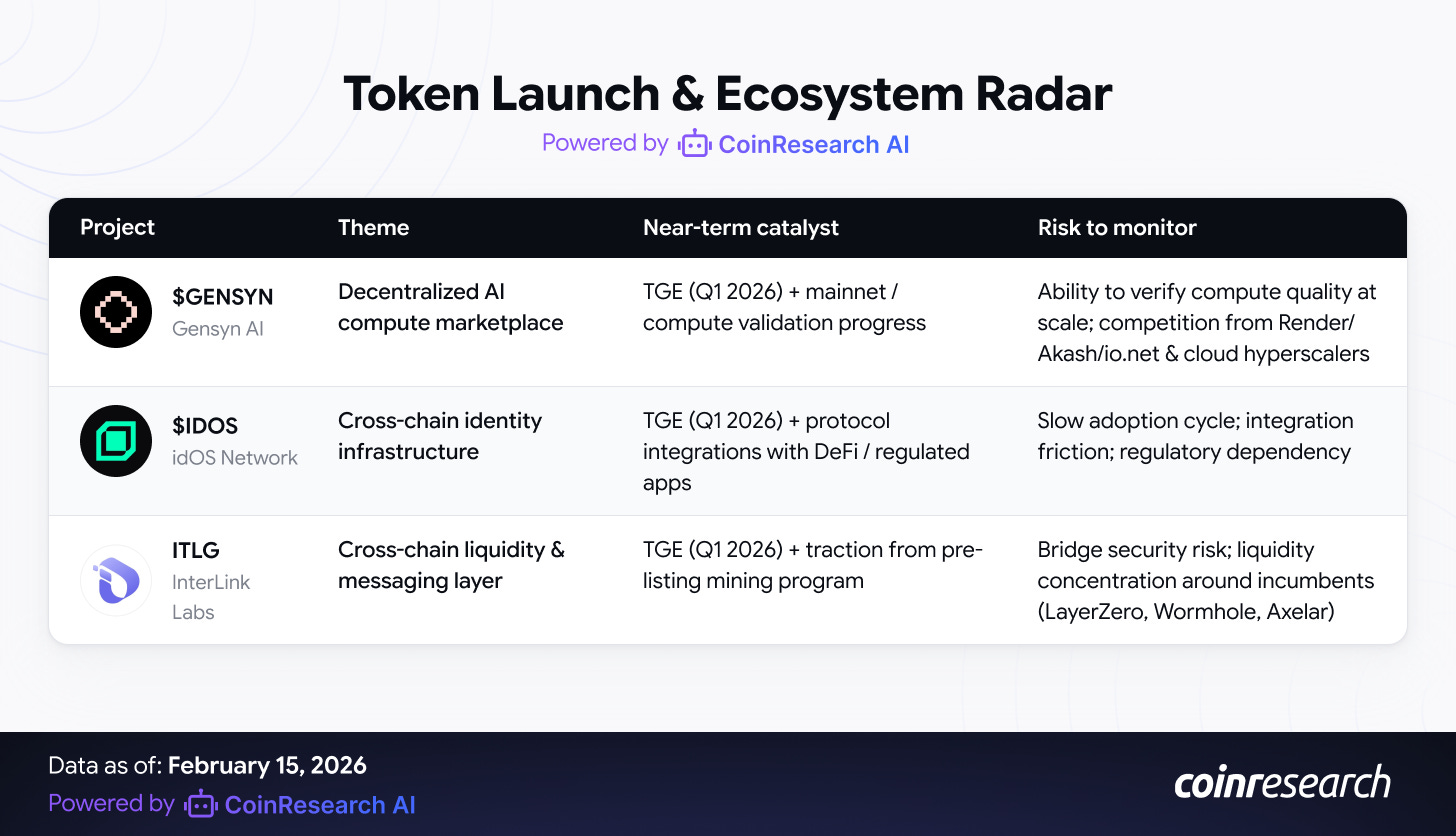
Gensyn AI ($GENSYN) | Decentralized AI Compute Network
-
Launch Date: Token Generation Event (TGE) expected in Q1 2026; token not yet live on exchanges, with testnet and early ecosystem partnerships already active.
-
Thesis: Gensyn is building a decentralized marketplace for machine‑learning compute, allowing anyone with spare GPU/TPU resources to train AI models and earn rewards, effectively turning idle hardware into an on‑chain yield source. This positions Gensyn at the intersection of two dominant narratives—AI infrastructure and crypto coordination—with a design that could undercut centralized clouds on pricing while widening access to high‑end compute.
-
Risk: Verifying compute quality, latency, and uptime in a permissionless network is technically complex; failure to solve this at scale could limit adoption. Gensyn also competes directly with established decentralized compute projects (Render, Akash, io.net) and hyperscale cloud providers, raising execution risk in an already crowded category.
idOS Network ($IDOS) | Identity Infrastructure Layer for Web3
-
Launch Date: Token launch targeted for Q1 2026; TGE scheduled but token not yet broadly listed on major exchanges.
-
Thesis: idOS is building a shared identity infrastructure that lets users carry a single, privacy‑preserving identity across multiple chains and apps, with permissions and attestations managed on‑chain. In a cycle where regulation, KYC/AML, and compliant on‑ramps are tightening, a neutral identity layer that protocols can plug into could become critical plumbing for DeFi, gaming, and consumer apps, especially as ETF‑driven institutions demand cleaner counterparty data.
-
Risk: Identity is a slow‑moving, regulation‑heavy vertical where sales cycles are long and integration costs are high. idOS faces competition from both Web2 identity providers and other on‑chain identity stacks; if developers default to simpler, app‑specific KYC or custodial flows, a shared identity layer could struggle to reach network‑effect escape velocity.
InterLink Labs (ITLG) | Cross‑Chain Liquidity & Messaging Hub
-
Launch Date: TGE and token launch confirmed for Q1 2026, with distribution currently happening via an airdrop‑style “mining” program that allows users to accumulate ITLG ahead of listing.
-
Thesis: InterLink Labs is building an infrastructure layer focused on secure cross‑chain messaging and liquidity routing, aimed at unifying fragmented liquidity across L1s and L2s. As more rollups and app‑chains come online, routing capital and messages between them becomes a core bottleneck; InterLink’s design—combining messaging, bridge security, and order‑flow optimization—targets this pain point directly, positioning ITLG as a picks‑and‑shovels play on the multi‑chain future.
-
Risk: Cross‑chain infrastructure is a hyper‑competitive segment, with entrenched players like LayerZero, Wormhole, and Axelar already live. Any security incident (bridge exploit, message spoofing) would be catastrophic for trust and token value, and if major ecosystems consolidate around a small handful of incumbent bridges, InterLink could struggle to attract meaningful flow despite a well‑executed TGE.
Strategic Recap & Forward Outlook
The week ending February 15, 2026, marks the beginning of a potential stabilization phase following the most violent capitulation since 2022. While the surface-level narrative is one of consolidation—Bitcoin range-bound between $65,000 and $71,400—the underlying dynamics reveal a market at an inflection point between continued deterioration and the earliest stages of recovery.
Key Takeaways:
-
The CPI inflection changes the macro calculus. January’s 2.4% headline CPI and 2.5% core CPI represent the most encouraging inflation readings in months, bringing the prospect of Fed rate cuts back into the conversation. While the Fed is unlikely to cut imminently (especially with Warsh’s hawkish appointment looming), the direction of travel is now clearly deflationary—a necessary precondition for any sustained crypto recovery.
-
ETF flows remain the market’s single most important pulse check. The $410 million outflow on February 12 demonstrates that institutional de-risking is not yet complete. However, the pace of outflows has decelerated from the $938 million two-day hemorrhage during the February 4–5 capitulation, and brief inflow days (Feb 10: +$272M) show that institutional capital has not permanently abandoned the space. The market cannot sustainably recover until weekly ETF flows turn consistently positive.
-
Altcoin relative strength is an early-cycle signal—not a recovery confirmation. DOGE’s +14.7%, XRP’s +5.9%, and ADA’s +4.3% weekly gains are notable in an Extreme Fear environment. Historically, altcoin outperformance during late-stage capitulation phases has signaled that risk appetite is beginning to return at the margins. However, this signal has a high false-positive rate in bear markets—speculative bounces that ultimately fail. Use for position building only with strict stop-losses.
-
$65,000 is the new line in the sand for Bitcoin. The successful defense of the $65,000–$66,000 zone through multiple intraweek tests establishes this as the cycle’s critical support level. A sustained break below $65,000 would open $60,000 as the next target—and potentially trigger a deeper capitulation toward $50,000 that several on-chain models have flagged. Conversely, a weekly close above $72,000 would be the first meaningful bullish structural signal since January.
Forward Outlook (Week Ending February 22, 2026):
The base case for the coming week is continued consolidation within a slightly expanded $66,000–$73,000 range for Bitcoin, as the market digests the CPI data and awaits further macro catalysts. The cooler inflation print marginally tilts the balance toward the upside, but ETF flow data will be the determining factor—consecutive days of net inflows would validate the consolidation-as-accumulation thesis, while continued outflows would expose $65,000 support to further testing. Ethereum is expected to trade between $1,850 and $2,200, with $2,000 remaining the key psychological battleground. Altcoins may continue to show selective strength as speculative capital tentatively re-engages, though broad-based rallies remain unlikely without a clear macro catalyst.
Key catalysts for the week ahead:
-
Bitcoin ETF flow data (daily): Consecutive net inflows would be the strongest possible bullish signal; continued outflows extend the bear thesis
-
FOMC Meeting Minutes (February 19): Any language suggesting openness to rate cuts in H2 2026 would be moderately bullish; hawkish hold language extends the risk-off environment
-
OpenSea SEA token launch timing: If confirmed for late February/early March, could inject fresh narrative energy into the market
-
Trump tariff developments: Any escalation toward Europe or China would immediately pressure risk assets; de-escalation would provide relief
-
On-chain accumulation signals: Watch for whale wallet activity and exchange outflows—early accumulation at these levels would be a high-signal indicator
Disclaimer: This analysis is for informational purposes only and should not be construed as investment advice. Cryptocurrency markets carry substantial risk, including the potential loss of principal. Past performance does not guarantee future results. Always conduct your own due diligence and consult a qualified financial advisor before making investment decisions.