
The Reluctant Reclaim: Price Steadies While Sentiment Stays Terrified — All Eyes on the Fed | Week Ending June 14, 2026

1. A Floor That Holds, A Crowd That Won’t Believe It
Bitcoin closed the week at $65,714, up +3.9% week-on-week, and Ethereum finished at $1,725, up +2.2%. On the tape, that is a green week. In the mind of the market, it is nothing of the sort. The Fear & Greed Index sits at 20 — Extreme Fear — having printed as low as 8 on June 8, and it has not left the Extreme Fear band once in ten days. Total crypto market capitalization is $2.32 trillion, with Bitcoin dominance elevated at 56.6% and Ethereum dominance pressed down to a structurally weak 8.9%.
The violence was last week’s story: between the May 31 and June 7 closes, Bitcoin fell roughly 14% from the mid-$73,000s toward $61,000, dragged down by a cluster of macro forces that have not gone away — sticky inflation, fading odds of a near-term Fed cut after firm jobs data, renewed U.S. dollar strength, and elevated geopolitical risk around the U.S.–Iran standoff. This week was the aftermath: a tense, low-conviction stabilization in which the $61,000 floor held and price clawed back to the mid-$65,000s without ever convincing anyone the bottom is in.
Key themes this week:
-
Bitcoin reclaims the mid-$65,000s (+3.9% W/W), but Extreme Fear (F&G 20) signals a disbelieved bounce, not a trend change.
-
ETF flows inflected positive on June 12 after a record ~$3.4B early-June exodus — the first tangible sign of stabilizing demand.
-
Ethereum remains the structural laggard: $1,725 and 8.9% dominance underline a market that still prefers Bitcoin over duration risk.
-
The June 17 FOMC is the week’s binary; a hold is expected, but the dot plot and tone decide whether the floor becomes a base.
2. Strengths: Where the Floor Is Getting Its Support
-
The ETF bid came back. After four brutal weeks and a record ~$3.4 billion single-week outflow, U.S. spot Bitcoin ETFs turned net positive on June 12, with every one of the twelve funds avoiding outflows for the first time in weeks. The caveat: one green day is an inflection, not a trend — it must be confirmed through the FOMC before it counts as a demand floor rather than a dip-buy.
-
The $61,000 level held under maximum pressure. Bitcoin’s weekly low of roughly $61,000 came amid cascade liquidations of $800 million to $1.1 billion and forced supply, including Strategy’s first Bitcoin sale in nearly four years. That the level absorbed both is a structural tell. The caveat: floors that are tested repeatedly tend to weaken, and a single risk-off catalyst from the Fed could see it retested immediately.
-
Sentiment is washed out, which is historically constructive. Ten consecutive days of Extreme Fear, with the index bottoming at 8, is the kind of capitulation reading that has marked durable local lows more often than tops. The caveat: “oversold” is a condition, not a catalyst — Extreme Fear can persist for weeks, and contrarian setups need a spark to pay off.
-
Liquidity rotated rather than fled. Cardano’s +10.6% week and Solana’s +7.5%, alongside positive moves in Dogecoin (+3.5%) and Chainlink (+3.4%), show capital probing higher-beta names rather than abandoning the asset class outright. The caveat: this is shallow, tactical rotation on light conviction, not the broad altcoin participation that confirms a risk-on regime.
3. Weaknesses: The Headwinds That Capped the Bounce
-
The macro vise is still tightening. Firm jobs data has pushed expected Fed cuts further out, lifting the dollar and draining the rate-cut premium that crypto had priced for the back half of the year. Until that repricing stabilizes, every rally faces a structural ceiling.
-
Ethereum’s relative weakness is a market-quality problem. At $1,725 and just 8.9% dominance, ETH is signaling that capital prefers Bitcoin’s reserve narrative to Ethereum’s growth-and-duration profile. A market where the second-largest asset cannot hold its share is a market with a narrow base.
-
The bounce has no breadth conviction. Fear & Greed at 20 after a +3.9% Bitcoin week is itself the warning: price recovered, but participants did not. Disbelief rallies unwind quickly when the catalyst that drove the short-covering passes.
-
Event risk is concentrated and binary. With the FOMC on June 17, Retail Sales and PPI mid-week, and a Juneteenth market holiday thinning liquidity on June 19, the week’s outcome hinges on a single data point in a low-liquidity tape — a setup that amplifies whatever direction the Fed delivers.
4. Market Recap: Top 10 Weekly Performance
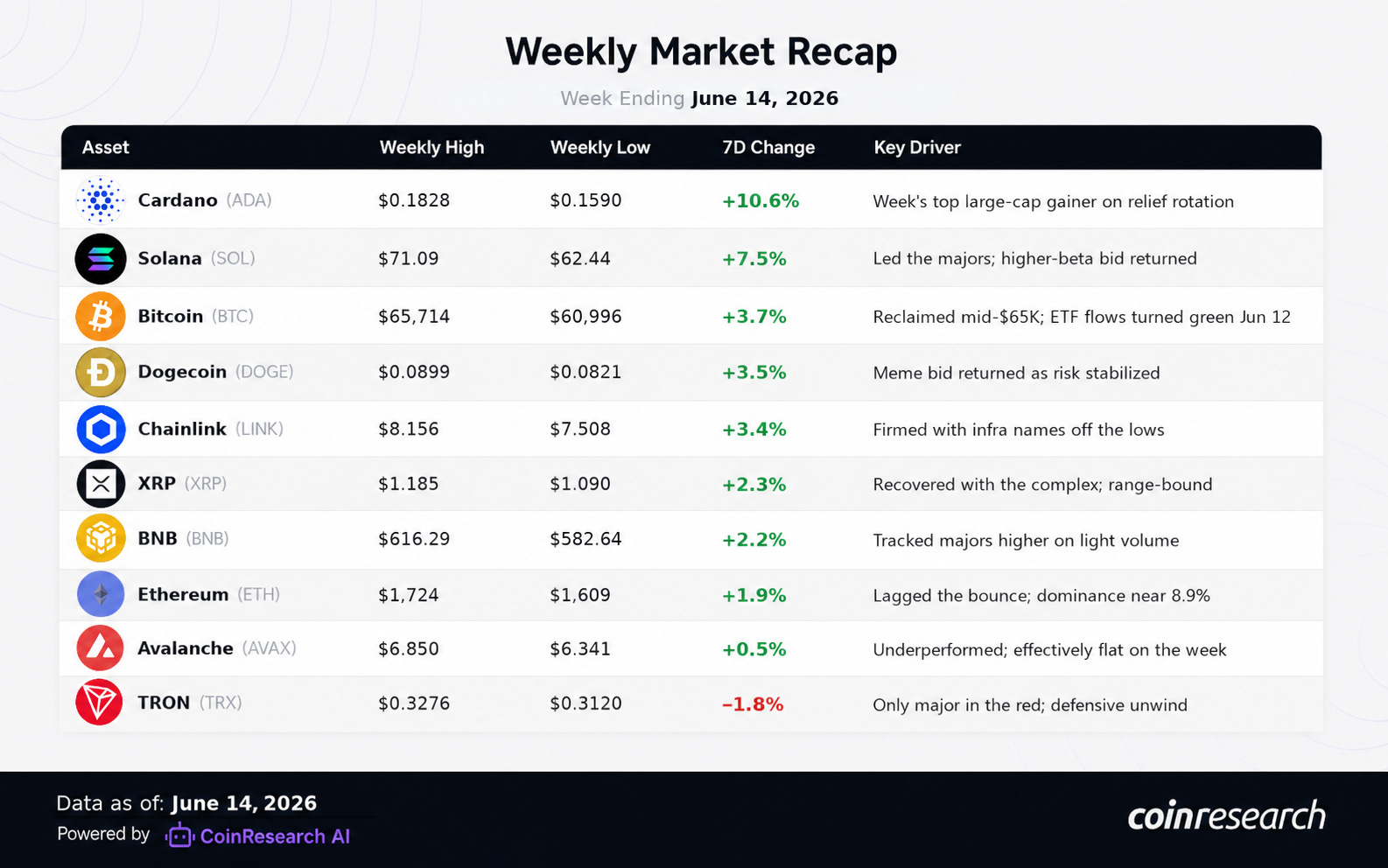
5. Predictive Analytics & Trade Confluence
Disclaimer: The insights and forecasts presented here are generated by CoinResearch AI’s predictive models and supporting analytics. They are provided for informational and educational purposes only and do not constitute financial advice or investment recommendations. Trading digital assets involves risk, and users should conduct their own research, exercise independent judgment, and use appropriate risk management before making any investment or trading decisions.
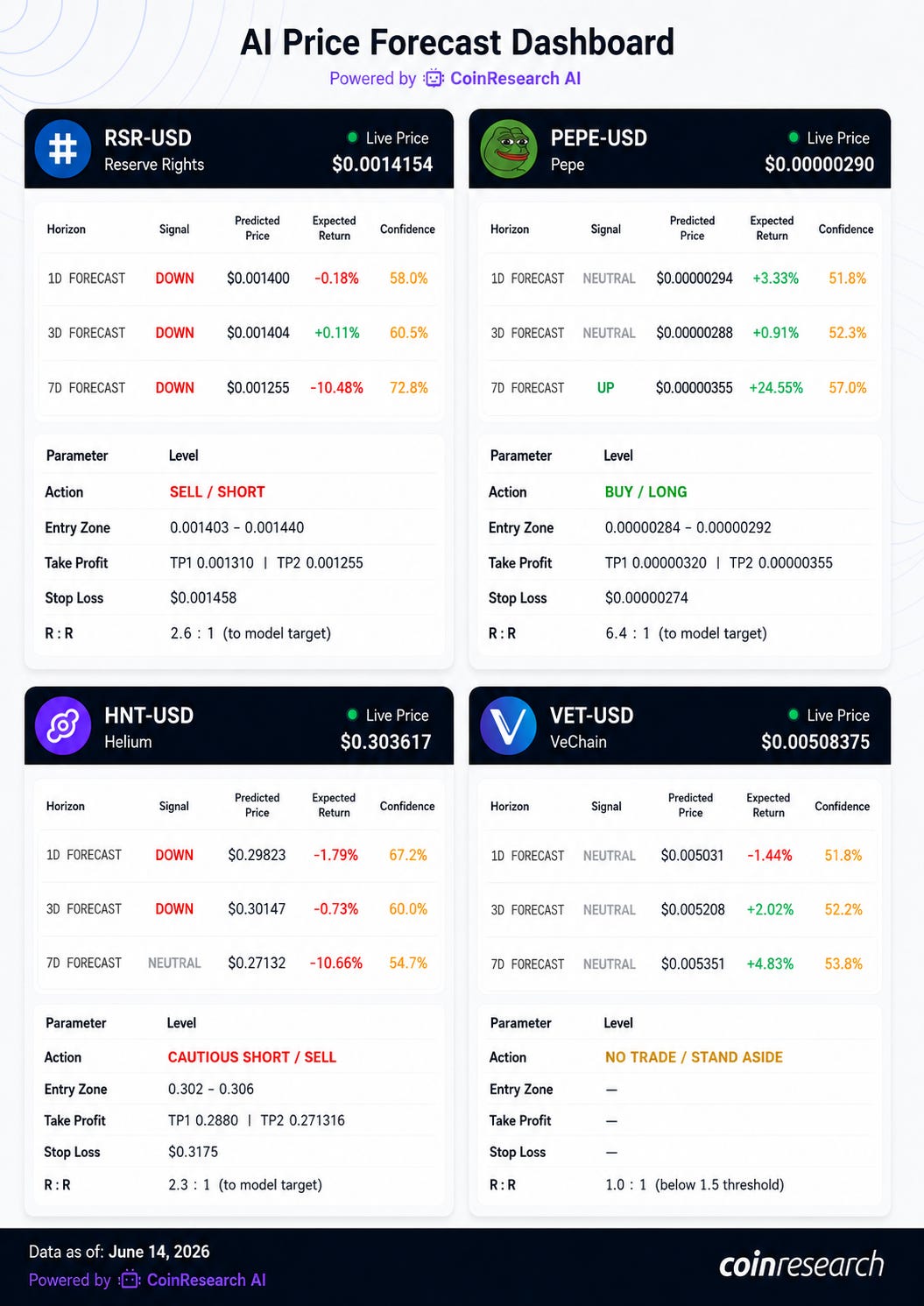
RSR-USD (Reserve Rights)
Reference Price: $0.0014154
Market Confluence Analysis: This is the cleanest signal on the board and the rare case where model, sentiment, and tape align. The 7-day path implies roughly −10% toward $0.001255, the classifier and regression heads agree, and social sentiment is genuinely bearish at 27% bullish — there is no crowded-long crowd to squeeze the short. The one discipline point is entry: at $0.0014154 price is already trading above the model’s $0.0014025 entry and grinding toward the $0.001458 stop. This is a sell-into-strength setup, not a chase.
Trade Action:
-
Action: Sell / Short
-
Entry Zone: $0.001403–$0.001440 (prefer the upper band on strength, below the stop)
-
Take Profit: TP1 $0.001310 / TP2 $0.001255
-
Stop Loss: $0.001458
-
R:R: 2.6:1 to the model target
-
Rationale: Highest-grade signal of the week; aligned model, sentiment, and downtrend with a defined, tight invalidation.
-
Invalidation: A sustained reclaim above $0.001458 breaks the structure and voids the short.
Analyst Note: We agree with the model. RSR was a NO TRADE in Edition #31 — invalidated on the bounce before it could fill — and it returns this week as a Grade A with price actually inside a workable zone. The risk is not the thesis but the entry: in Extreme Fear, low-cap shorts are vulnerable to sharp relief squeezes, so size modestly and respect the $0.001458 line.
Verdict: SELL
PEPE-USD (Pepe)
Reference Price: $0.00000290
Market Confluence Analysis: The 7-day confidence is only 57% — modest — but the asymmetry is what makes this interesting. A 6.4:1 reward-to-risk means the trade pays even at a low hit rate, and the social picture is the strongest on the board: a 72 Galaxy Score and 86% bullish posts across half a million engagements. PEPE is also the one spotlight asset already working in its favor, trading above the $0.00000284 entry. The honest caveat is regime: meme-coin longs are pure beta, and if the FOMC sours risk appetite, PEPE will fall faster than the majors. This is a position to express the upside of a stabilizing tape, sized accordingly.
Trade Action:
-
Action: Buy / Long
-
Entry Zone: $0.00000284–$0.00000292
-
Take Profit: TP1 $0.00000320 / TP2 $0.00000355
-
Stop Loss: $0.00000274
-
R:R: 6.4:1 to the model target
-
Rationale: Asymmetric reward-to-risk with model and sentiment aligned to the upside; already working.
-
Invalidation: A clean break below $0.00000274 voids the tight-risk structure.
Analyst Note: We part company with the model slightly on conviction — 57% is not a high-confidence call — but we agree on the trade, because the math does the work. The risk here is correlation, not the signal: in a true risk-off break, this is the first thing sold. Keep size small, treat the stop as non-negotiable, and let the 6.4:1 do the heavy lifting.
Verdict: BUY (small)
HNT-USD (Helium)
Reference Price: $0.303617
Market Confluence Analysis: The short-term picture is the most convincing part: 67% confidence on the 1-day down, price already trading below the $0.304 entry, and 24-hour momentum slightly negative. Sentiment supports it at 22% bullish. What lowers conviction is the model’s internal disagreement — the regression head drives the bearish 7-day target while the classifier is neutral, so this is a tiebreaker trade, not a unanimous call. It works as a tactical short into near-term weakness, but the 7-day target near $0.27 should be treated as a stretch goal rather than a base case.
Trade Action:
-
Action: Sell / Short (cautious, reduced size)
-
Entry Zone: $0.302–$0.306
-
Take Profit: TP1 $0.2880 / TP2 $0.271316
-
Stop Loss: $0.3175
-
R:R: 2.3:1 to the model target
-
Rationale: High near-term down-confidence and aligned bearish sentiment; already working below entry.
-
Invalidation: A hold above $0.3175 negates the near-term downside structure.
Analyst Note: We take the model’s near-term read but discount its 7-day enthusiasm, because dual-head divergence on a high-volatility, low-cap name is exactly where overshoot risk lives. This is a small, disciplined tactical short — bank TP1 and trail the rest rather than holding for the full target.
Verdict: SELL (cautious)
VET-USD (VeChain)
Reference Price: $0.00508375
Market Confluence Analysis. This is the textbook no-trade. The model offers no genuine directional edge — three neutral horizons and a tiebreaker long — and the reward-to-risk is only 1.0:1, below our minimum threshold. More telling is the social data: 95% bullish across 2.56 million engagements is not confirmation, it is a crowded-long warning. When a low-conviction model signal collides with euphoric one-sided sentiment and a sub-1.5 reward-to-risk, the disciplined response is to do nothing. There is no asymmetry to harvest here.
Trade Action:
-
Action: No Trade
-
Entry Zone: n/a
-
Take Profit: n/a
-
Stop Loss: n/a
-
R:R: 1.0:1 (below threshold)
-
Rationale: No directional edge, sub-threshold reward-to-risk, and contrarian-bearish crowded-long sentiment.
-
Invalidation: A directional model signal (non-tiebreaker) with R:R above 1.5 would put VET back on the board.
Analyst Note: We disagree with treating this as a long at all. The model’s tiebreaker bias and the 95% bullish crowd point the same way, and that agreement is the problem — it is the configuration in which relief rallies exhaust. No trade is also a trade, and this is one of them.
Verdict: NO TRADE
6. Token Launch & Ecosystem Radar
A curated look at three high-signal projects approaching major milestones that have not yet launched their tokens. Each was verified pre-TGE against a live check this week, and none has appeared in a prior edition.
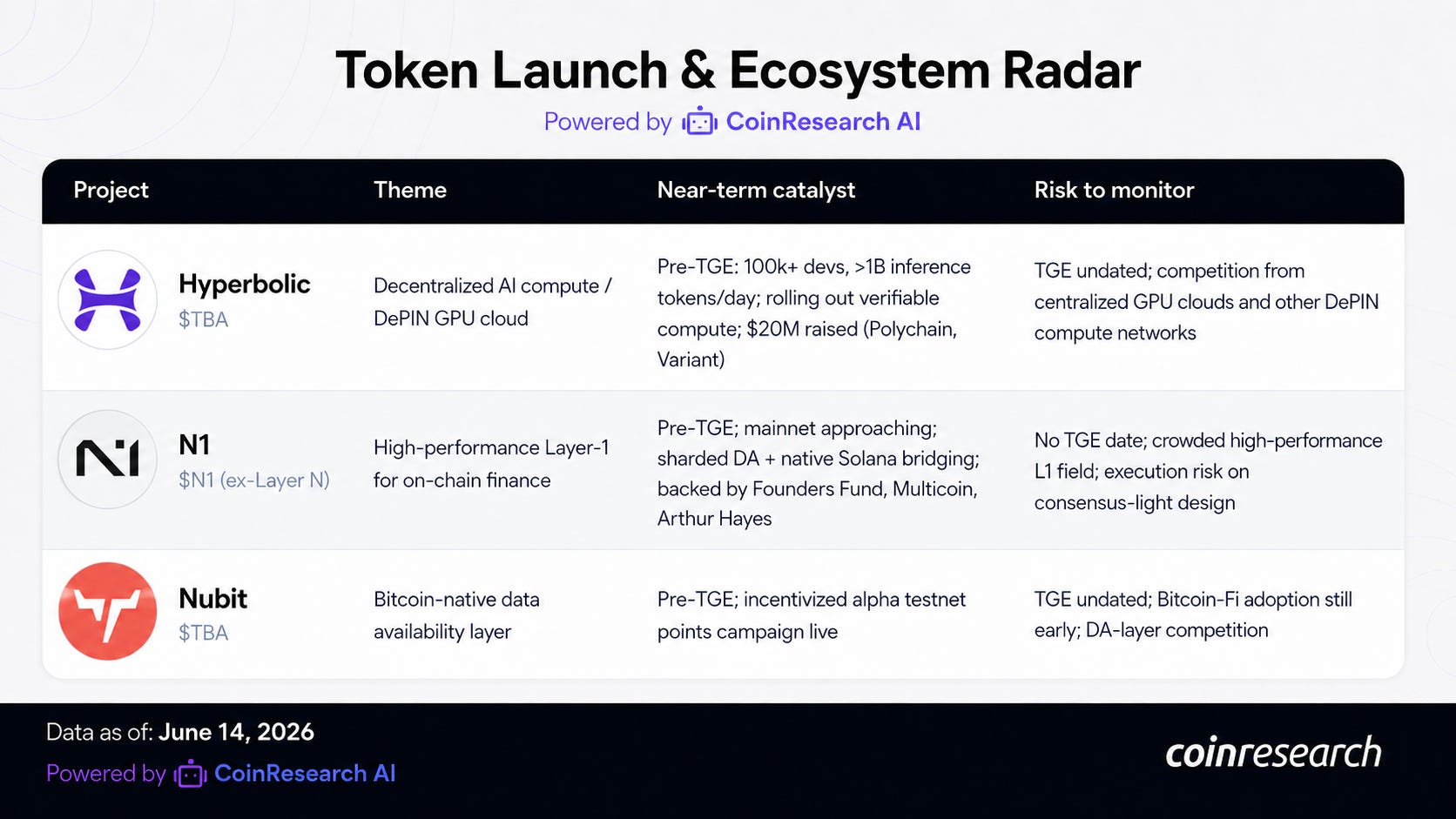
Hyperbolic ($TBA — a decentralized AI cloud offering open-access GPU compute and inference at a fraction of hyperscaler pricing.
-
Why watch it: Hyperbolic powers over 100,000 developers and processes more than a billion inference tokens per day, and it is rolling out cryptographic verification of that compute — the missing trust layer for decentralized AI. It sits squarely in the AI-compute narrative that has been the most durable theme of this cycle.
-
Current Status: No token yet. The team has raised roughly $20 million from Polychain and Variant Fund, with participation from Lightspeed Faction, IOSG and others; a token generation event has not been dated.
-
Monitoring Rationale: If decentralized compute is to compete with AWS and Azure, verifiable inference is the wedge — and Hyperbolic is one of the few networks shipping it at scale rather than describing it on a roadmap.
N1 ($N1, formerly Layer N — a high-performance Layer-1 built for scalable on-chain applications, with sharded data availability and native Solana bridging.
-
Why watch it: N1’s architecture removes consensus from the common path to enable asynchronous, unordered transactions and very high throughput — a credible answer to the performance ceiling that still constrains on-chain finance. The backer list is unusually strong for a pre-token L1.
-
Current Status: No token and no TGE date. Investors include Founders Fund, Multicoin Capital and Arthur Hayes, with mainnet positioned as the next milestone.
-
Monitoring Rationale: Infrastructure that can host serious financial applications without the latency penalty is the prerequisite for the next wave of on-chain markets; N1 is one of the more technically differentiated bets in that lane.
Nubit ($TBA — a Bitcoin-native data availability layer aiming to bring cheap, scalable DA to the Bitcoin ecosystem.
-
Why watch it: As BitVM, inscriptions and Bitcoin-Fi push more activity toward Bitcoin, the chain’s lack of affordable data availability becomes a real bottleneck. Nubit targets exactly that gap, positioning itself as infrastructure for a maturing BTC application layer.
-
Current Status: No token. An incentivized alpha testnet points campaign is live, with no TGE date announced.
-
Monitoring Rationale: Bitcoin-Fi is one of the few narratives gaining structural share even in a risk-off tape; the DA layer that underpins it is a high-leverage place to be early.
7. Strategic Recap & Forward Outlook
The floor held, the ETF bid flickered back to life, and price quietly recovered — but a +3.9% Bitcoin week that leaves sentiment at Extreme Fear is a market that recovered in price without recovering in conviction. That is a fragile combination, and it resolves on June 17. A Fed that validates a steady path lets the $61,000 floor become a base and the disbelief bounce extend; a Fed that pushes cuts further out sends price straight back to test it. Our posture is therefore deliberately balanced rather than directional: one clean short, one asymmetric long, both small, and the discipline to stand aside where the model offers no edge. Respect the $61,000 line, keep risk light into the decision, and let the Fed — not the forecast — set the trend. If you trade one thing this week, trade your size.
Forward Outlook — Week of June 15–21, 2026
-
Macro Watch. The FOMC decision on June 17 is the week’s fulcrum. The fed funds rate is expected to hold at 3.50–3.75%; the market reaction will hinge on the updated projections and the tone around the path of cuts, not the level. Retail Sales for May (June 17) and PPI plus Jobless Claims (June 18, pulled forward) frame the inflation-and-demand read, and the Juneteenth holiday on June 19 will thin liquidity into the back half of the week — amplifying whatever the Fed delivers.
-
BTC Key Levels. Resistance sits at $66,000–$67,000 (the week’s reclaim ceiling), then $70,000 as the psychological line that separates a bounce from a trend repair. Support is $63,000, then the line that matters: $61,000 — the floor that held last week. A decisive loss of $61,000 reopens the move toward $58,000.
-
Altcoin Outlook. Momentum favors high-beta majors with their own catalysts — Cardano and Solana led this week, and the meme complex (PEPE, DOGE) is showing relative life. Fading: Ethereum, where $1,725 and 8.9% dominance signal capital is not yet ready to pay for duration. Until BTC dominance rolls over from 56.6%, broad altcoin participation stays capped and rotation stays shallow.
CoinResearch Intelligence Weekly is published for educational and informational purposes only. Nothing in this newsletter constitutes financial advice. Cryptocurrency markets are highly volatile — past performance does not guarantee future results. Always conduct your own research and consult a qualified financial advisor before making any investment decisions.