
The Dot Plot Flips: A Hawkish Fed Ends the Bounce and Sends Bitcoin Back to the Floor | Week Ending June 21, 2026

1. The Fed Reprices the Reclaim
Bitcoin closed the week at $63,232, down −3.8% week-on-week, and Ethereum at $1,705, down −1.2%. The headline number understates the round trip: early in the week the relief bounce extended to an intraweek high of $67,204 — tagging the exact resistance band we flagged seven days ago — before the Federal Reserve took the wind out of it. The June 17 FOMC held rates at 3.50–3.75% (Kevin Warsh’s first meeting as chair, a unanimous 12–0), but the projections turned hawkish: the dot plot flipped from cuts to hikes, with the median 2026 path rising to 3.8% from 3.4% in March and nine of eighteen officials now penciling in at least one hike. The Fed lifted its core PCE forecast to 3.6% and stripped the easing bias from its statement.
Risk assets read it cleanly. Bitcoin gave back the entire bounce and round-tripped to the $62,000–$63,000 support shelf, the spot-ETF bid that had flickered to life on June 12 reversed straight back into outflows, and the Fear & Greed Index stayed welded to 20 — Extreme Fear, its third consecutive week without leaving the band. The one bright spot was relative: Ethereum outperformed, its dominance ticking up to 9.1% as ETH briefly tagged $1,843. Total market capitalization eased to $2.30 trillion with Bitcoin dominance at 56.3%.
The macro vise we named as last week’s central risk did not just persist — it tightened. With rate-cut hope now priced out and core PCE landing June 25, the path of least resistance is a market that has to prove the floor again rather than one building a base on top of it.
Key themes this week:
-
The June 17 FOMC flipped the dot plot from cuts to hikes (median 3.8%, PCE forecast to 3.6%), repricing the entire rally.
-
Bitcoin tagged $67K resistance, then round-tripped to the $62–63K support; −3.8% W/W, still Extreme Fear.
-
ETF inflows reversed to outflows post-FOMC — the brief demand inflection did not survive the hawkish shock.
-
Core PCE on June 25 is the week’s binary; after a Fed that raised its own inflation forecast, the print sets the tone.
2. Strengths: What Is Still Working Under the Fed’s Shadow
-
Ethereum quietly took the lead. ETH fell just −1.2% W/W versus Bitcoin’s −3.8%, tagged $1,843 intraweek, and lifted its dominance to 9.1% from 8.9% — the first sign in weeks that capital is willing to hold duration risk over pure reserve exposure. The caveat: one week of relative strength off a deeply depressed base is rotation, not leadership; ETH is still under $1,750.
-
The $62–63K support absorbed the hawkish shock. Even with the dot-plot flip and renewed ETF outflows, Bitcoin’s weekly low held at $62,304 — above the $61,000 floor that defined the prior two weeks. That the level held through a genuine macro catalyst is more meaningful than holding on a quiet tape. The caveat: support that is tested this often tends to thin out, and a hot PCE could put $61,000 back in play immediately.
-
High-beta pockets refused to break. Solana (+4.3% on the week) and Hyperliquid (+7.3%) gained even as the majors rolled over, a sign that selective risk appetite survives in names with their own catalysts. The caveat: this is narrow, idiosyncratic strength — not the broad participation that signals a durable risk-on turn.
-
Sentiment remains washed out. A third straight week pinned in Extreme Fear (F&G 20, with intraweek prints as low as 13) keeps positioning light and expectations low — the conditions from which sharp relief rallies are launched when a catalyst finally cooperates. The caveat: “oversold” is a condition, not a trigger, and the next scheduled catalyst (PCE) leans bearish, not bullish.
3. Weaknesses: The Headwinds the Fed Just Reinforced
-
Rate-cut hope is gone, and that is a regime change. The dot-plot flip from cuts to potential hikes removes the single biggest tailwind the market had penciled in for the second half of 2026. Higher-for-longer raises the opportunity cost of holding a non-yielding asset, and CoinShares attributed the renewed ETF outflows directly to investors scaling back fixed-supply exposure on the news.
-
The bounce failed precisely at resistance. Bitcoin’s rejection at $67,204 — the level we flagged as the line separating a bounce from a trend repair — confirms that overhead supply is real and that buyers are not yet willing to chase. A failed breakout often retraces the entire move, which is exactly what happened.
-
ETF demand is not a floor yet. The June 12 inflow that looked like an inflection lasted barely a session before the hawkish FOMC flushed it. Until flows string together consecutive green weeks through a macro test, the structural-demand thesis stays unproven.
-
Event risk is front-loaded and one-directional. With core PCE, final Q1 GDP, and jobless claims all stacked on June 25, the week’s outcome hinges on a single inflation print — and it lands after a Fed that just raised its own PCE forecast to 3.6%, skewing the risk toward confirmation of the hawkish path.
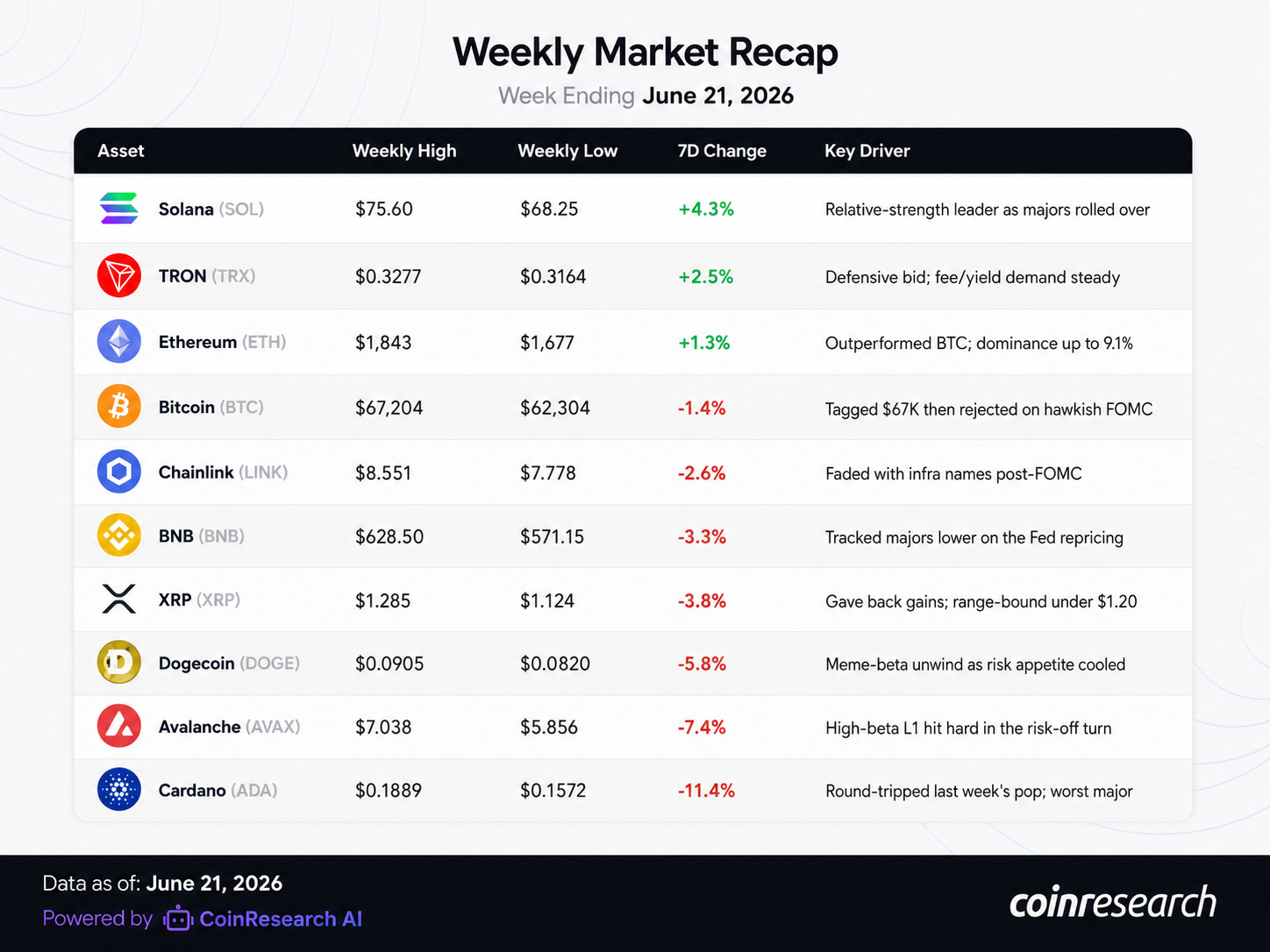
4. Market Recap: Top 10 Weekly Performance
Bitcoin closed at $63,232 (−3.8% W/W) and Ethereum at $1,705 (−1.2%), both rejected from mid-week highs after the FOMC. Solana (+4.3%) was the standout among the majors and Hyperliquid (+7.3%) led the broader complex, while the rest skewed red: Cardano (−11.4%) round-tripped its prior-week leadership to become the week’s worst major, with Avalanche (−7.4%) and Dogecoin (−5.8%) close behind. Total market capitalization held at $2.30 trillion with Bitcoin dominance easing to 56.3% — a defensive, risk-off tape with sentiment locked in Extreme Fear.
5. Predictive Analytics & Trade Confluence
Disclaimer: The insights and forecasts presented here are generated by CoinResearch AI’s predictive models and supporting analytics. They are provided for informational and educational purposes only and do not constitute financial advice or investment recommendations. Trading digital assets involves risk, and users should conduct their own research, exercise independent judgment, and use appropriate risk management before making any investment or trading decisions.
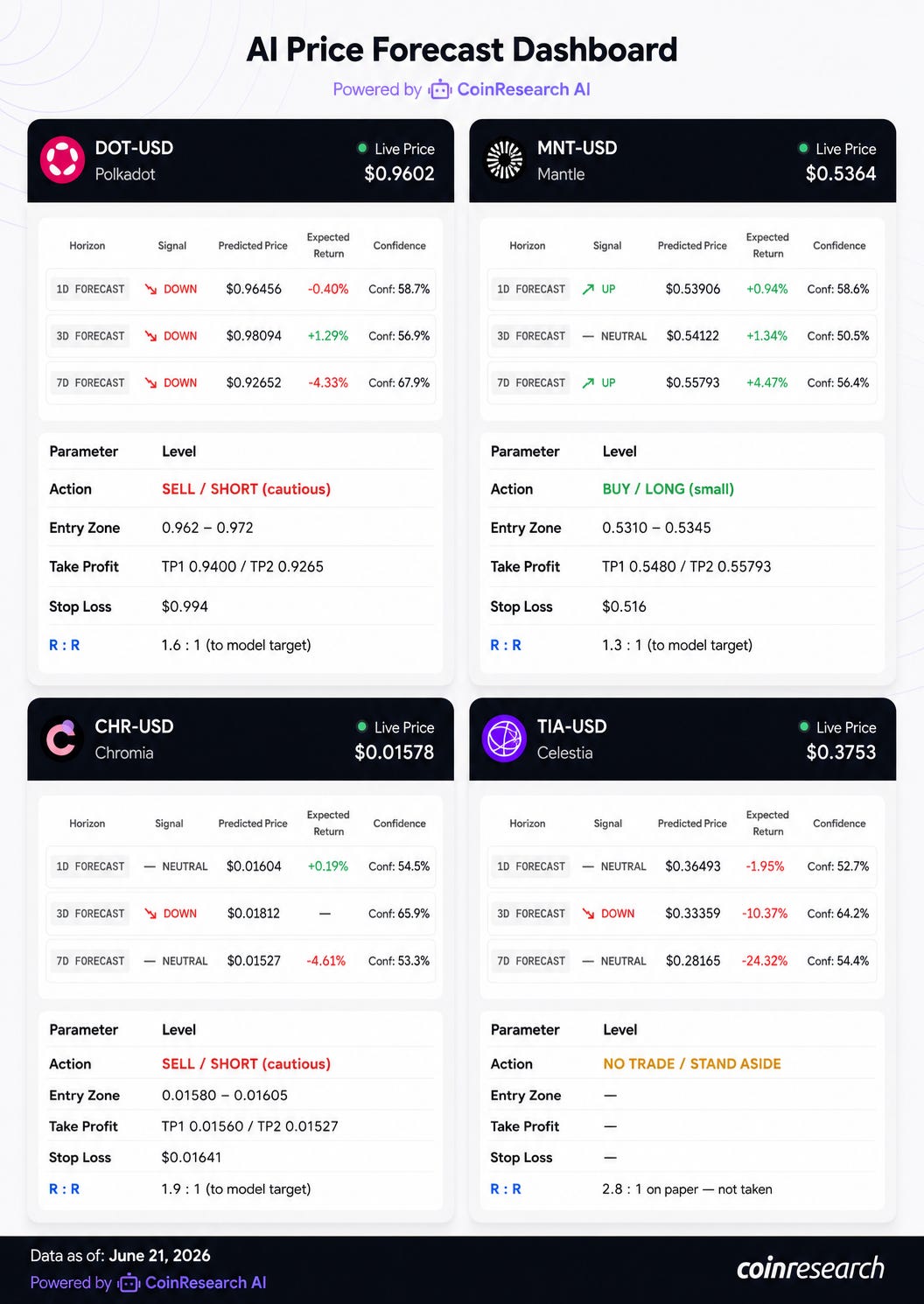
DOT-USD (Polkadot)
Reference Price: $0.9602
Market Confluence Analysis. This is the cleanest short available and it is already working, trading below the $0.97 entry with negative 24-hour momentum. The model, the tape, and the post-FOMC risk-off backdrop align to the downside. The honest tension is sentiment: at 70% bullish, the crowd is leaning long, which is the same configuration that squeezed our shorts last week. The difference is degree — DOT’s social book is moderate, not the euphoric extreme we see elsewhere this week — but it argues for cautious sizing and strict respect for the $0.994 stop rather than a wide, hopeful short.
Action: Sell / Short (cautious size)
-
Entry Zone: $0.962–$0.972
-
Take Profit: TP1 $0.9400 / TP2 $0.9265
-
Stop Loss: $0.994
-
R:R: 1.6:1 to the model target
-
Rationale: Highest-grade signal of the week; aligned model, downtrend, and macro, already working below entry.
-
Invalidation: A sustained reclaim above $0.994 negates the near-term downside structure.
Analyst Note. We agree with the model but trim conviction on the modest 1.6 reward-to-risk and the long-leaning crowd. This is a take-it-but-keep-it-small short: bank TP1, trail the rest, and do not widen the stop if the squeeze comes.
Verdict: SELL (cautious)
MNT-USD (Mantle)
Reference Price: $0.5364
Market Confluence Analysis. In a tape this bearish, a long has to earn its place, and MNT does so on signal quality rather than hype: both model versions agree on upside, and price is already working above the $0.5325 entry. The contrarian logic is that a washed-out, Extreme-Fear market with light positioning is precisely where a small long on a name with its own bid can pay. The caveats are real — the 1.3 reward-to-risk is thin, the Galaxy Score of 6 signals almost no genuine social conviction behind the 88% bullish ratio, and any hot PCE print would pressure the whole complex. This is a small, tactical position, not a high-conviction call.
Action: Buy / Long (small)
-
Entry Zone: $0.5310–$0.5345
-
Take Profit: TP1 $0.5480 / TP2 $0.55793
-
Stop Loss: $0.516
-
R:R: 1.3:1 to the model target
-
Rationale: Cleanest directional long with V2=V3 agreement on 1D and 7D; already working above entry.
-
Invalidation: A close below $0.516 fails the long thesis.
Analyst Note. We take the model’s signal but size it down hard — the thin R:R and near-zero social conviction make this a probe, not a position. It is here as the contrarian counterweight in a one-sided bearish book.
Verdict: BUY (small)
CHR-USD (Chromia)
Reference Price: $0.01578
Market Confluence Analysis. CHR is the mirror image of the squeeze-trap problem: it is a short with bearish model bias that is already working (down −4.8% on the day, trading below the $0.01605 entry), and crucially its social book is thin — 110 mentions and under 7,000 engagements. There is no large crowded-long position to fuel a squeeze, which is exactly why we are comfortable taking this short when we are not comfortable taking others this week. The dual-head divergence keeps conviction modest, so it is framed as a cautious, fast trade rather than a hold-for-the-full-target position.
Action: Sell / Short (cautious)
-
Entry Zone: $0.01580–$0.01605
-
Take Profit: TP1 $0.01560 / TP2 $0.01527
-
Stop Loss: $0.01641
-
R:R: 1.9:1 to the model target
-
Rationale: Working short with a bearish 3D/7D bias and a thin social book — low squeeze risk relative to peers.
-
Invalidation: A close above $0.01641 breaks the tiebreaker short.
Analyst Note. We prefer this short to the louder ones precisely because nobody is talking about it. Tiebreaker conviction means small size and a quick hand on TP1.
Verdict: SELL (cautious)
TIA-USD (Celestia)
Reference Price: $0.3753
Market Confluence Analysis. On the model alone, TIA looks like the most attractive short here — a 64% three-day down read and a model path implying double-digit downside. The veto comes from the social data: 3.2 million engagements at 87% bullish is one of the most crowded one-sided long books in our universe. That is the precise setup that stopped our RSR and HNT shorts last week — a euphoric crowd that squeezes shorts higher before any decline. Shorting into it, in an Extreme-Fear tape prone to violent relief bounces, is taking the model’s edge and handing it back to variance. The disciplined response is to pass.
Action: No Trade
-
Entry Zone: n/a
-
Take Profit: n/a
-
Stop Loss: n/a
-
R:R: 2.8:1 on paper — not taken
-
Rationale: Model edge is real, but a 3.2M-engagement, 87%-bullish crowd makes the squeeze risk asymmetric against the short.
-
Invalidation: A cooling of the social book (or a clean break below $0.36 on volume) would put the short back on the table.
Analyst Note. This is the lesson from last week applied in real time: the best-looking short on the screen is the one we are choosing not to take, because the crowd on the other side is exactly the crowd that squeezed us. No trade is also a trade.
Verdict: NO TRADE.
6. Token Launch & Ecosystem Radar
A curated look at three high-signal projects approaching major milestones that have not yet launched their tokens. Each was verified pre-TGE against a live check this week, and none has appeared in a prior edition.
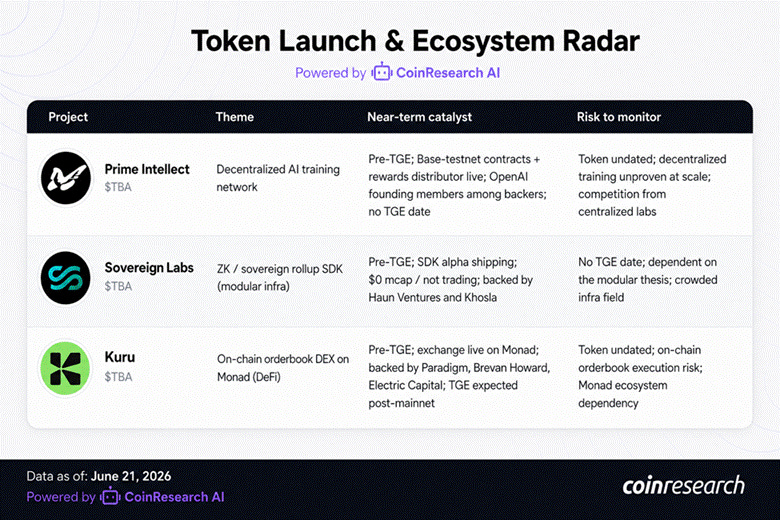
Prime Intellect ($TBA — a decentralized AI training network building an open stack for distributed model training and self-improving agents.
-
Why watch it: Prime Intellect attacks the most capital-intensive part of AI — training — by pooling globally distributed compute, and counts founding members of OpenAI among its backers. Decentralized training (not just inference) is the frontier of the AI-crypto thesis, and few teams are credibly attempting it at scale.
-
Current Status: No token. Smart contracts and a rewards distributor are live on the Base Sepolia testnet, with a token implied at mainnet; no TGE date announced.
-
Monitoring Rationale: If verifiable, incentivized decentralized training works, it creates an entirely new asset class for compute — and Prime Intellect is one of the clearest pure-plays on that bet.
Sovereign Labs ($TBA — a toolkit for building interoperable, zero-knowledge sovereign rollups.
-
Why watch it: The Sovereign SDK lets developers spin up ZK rollups that settle anywhere, a credible answer to the fragmentation problem as the rollup landscape multiplies. The team is backed by Haun Ventures and Khosla, and the SDK alpha is shipping.
-
Current Status: No token (zero market cap, not trading); SDK in alpha; no TGE date.
-
Monitoring Rationale: Infrastructure that standardizes how sovereign rollups are built and connected is high-leverage if the modular thesis continues to play out — exactly the kind of pick-and-shovel bet that tends to matter more than any single chain.
Kuru ($TBA — a fully on-chain central-limit orderbook DEX building the trading hub for the Monad ecosystem.
-
Why watch it: Kuru brings a true on-chain orderbook — not just an AMM — to a high-throughput L1, with integrated discovery, a trading terminal, and a launchpad. It is backed by Paradigm, Brevan Howard Digital, and Electric Capital across seed and Series A rounds.
-
Current Status: No token (shows no live price or trading); the exchange is live on Monad, with a TGE widely expected to follow the ecosystem’s mainnet momentum.
-
Monitoring Rationale: On-chain orderbooks have struggled on slower chains; if Kuru proves the model works on Monad, it becomes core DeFi infrastructure for one of the most anticipated new ecosystems.
7. Strategic Recap & Forward Outlook
The reclaim was real until the Fed decided it wasn’t. A dot-plot flip from cuts to hikes is a regime change, not a headline, and it leaves Bitcoin defending the same support it has defended for a month — now without the rate-cut tailwind it had been counting on. We are positioned defensively and lightly: one cautious short aligned with the tape, one small contrarian long, one quiet short the crowd has ignored, and a deliberate pass on the trade that looks best but carries the worst squeeze risk. Everything routes through core PCE on June 25. Until then, respect $61,000, keep size small into the print, and let the data — not the bounce — decide the trend. The discipline that hurt to apply last week is the discipline that protects capital this week.
Forward Outlook — Week of June 22–28, 2026
-
Macro Watch. The week is quiet until Thursday, June 25, which stacks the catalysts: core PCE for May (the Fed’s preferred inflation gauge, consensus ~2.6% YoY), final Q1 GDP (≈1.6%), initial jobless claims (≈225K), and durable goods. After a Fed that just raised its own PCE forecast to 3.6% and dropped its easing bias, the PCE print is the binary — a hot read confirms higher-for-longer and pressures risk; a soft read is the only near-term relief valve.
-
BTC Key Levels. Resistance is now overhead and proven at $67,000 (this week’s rejection), then $70,000. Support steps down to $62,000–$63,000 (the week’s shelf), then the line that still matters: $61,000. A decisive loss of $61,000 on a hot PCE reopens $58,000.
-
Altcoin Outlook. Relative strength sits with Ethereum (dominance turning up), Solana, and Hyperliquid — names with their own catalysts. Fading: the high-beta L1 and meme cohort (ADA, AVAX, DOGE), which led the downside. Until Bitcoin dominance rolls over from 56.3% and the macro tape stabilizes, broad altcoin participation stays capped.
For full prediction dashboards, trade setups, and live model signals, visit
CoinResearch Intelligence Weekly is published for educational and informational purposes only. Nothing in this newsletter constitutes financial advice. Cryptocurrency markets are highly volatile — past performance does not guarantee future results. Always conduct your own research and consult a qualified financial advisor before making any investment decisions.