
The 200DMA Rejection: Hot CPI, a New Fed Chair, and the Range Falls Lower | Week Ending May 17, 2026
1. Reclaim Reversed, Conviction Tested
Last week’s breakout failed. Bitcoin closed near $76,814, down 6.49% W/W, after rejecting the 200DMA it had reclaimed only seven days earlier. ETH was hit harder, closing near $2,116, down 10.65% W/W, fully erasing the prior week’s relief move. The 200DMA at $82,228 has flipped back into resistance, April’s range has cracked lower, and the market is now testing where the next floor forms.
The reversal was macro-led. April CPI printed hotter than expected at 3.8% YoY, pushing rate-cut expectations further out and lifting implied odds of a year-end hike to roughly 30%. The confirmation of Kevin Warsh as Fed Chair added to the hawkish read, while ETF flows confirmed the risk-off turn: spot BTC ETFs posted about $1.0B in weekly net outflows, ending a six-week inflow streak, and ETH ETFs saw roughly $254M in redemptions.
Sentiment followed the damage. Fear & Greed fell from 47, or Neutral, to 27, or Fear, with the sharpest deterioration coming late in the week. That suggests fear was a reaction to the macro repricing, not the initial trigger.
Counterpoints were limited. BNB held up best among major decliners at −3.33% W/W, HYPE was the only large-cap green at +5.63%, and the AI cluster now offers the cleanest contrarian setup into next week, especially AGIX.
The takeaway: this is no longer a breakout market. The tape favors range, dispersion, and selective positioning over broad directional beta.
Key Themes
-
The 200DMA reclaim failed within five sessions. BTC closed below $82,228 every day from Tuesday onward; the level is resistance again, not support.
-
Hot CPI plus a new Fed chair = the cuts thesis is on indefinite hold. Year-end rate-hike odds at ~30% (CME) reframes positioning. The “Fed cuts unlock alts” narrative is paused, not dead.
-
ETF flows flipped decisively negative. −$1.0B BTC ETF outflows broke a 6-week inflow run; ETH ETFs extended their losing streak. The marginal institutional buyer stepped back.
-
Altcoin dispersion compressed back to “everything sells.” Last week’s standouts (TON, SUI, ZEC, LINK, SOL) mean-reverted hard. Selectivity matters more than ever — index exposure is the punishment.

2. Strengths
-
BTC dominance held flat despite the drawdown. BTC dominance ended the week at 58.26%, nearly unchanged from 58.25% the prior week, even as Bitcoin posted its weakest weekly close since early April. That matters because the selloff was broad but not disorderly: alts did not collapse disproportionately, and BTC dominance did not spike toward 60%. The caveat is the next 48 hours. If dominance breaks above 60 while alts keep falling, the regime turns materially uglier.
-
Strategy kept accumulating, but at a slower pace. Strategy bought another 535 BTC for $43M at an average price of $80,340, bringing total holdings to 818,869 BTC. The buy was smaller than prior months’ cadence, but it still reinforces the institutional accumulation thesis and aligns with Saylor’s stated “buy more if others sell” posture. The signal remains supportive, but the scale has clearly downshifted.
-
AI tokens now offer the cleanest contrarian setup. AGIX was one of the week’s worst performers at −20.76% W/W, but the model now flags it as the strongest reversal candidate: Grade C, 7D UP, 72.6% confidence, with an aggressive +38.55% implied target. This is not a claim that AI was strong this week. It is a setup where AI sold hard and the model now sees reversal potential. Treat it as a satellite trade, not a core position.
3. Weaknesses
-
Hot CPI moved the liquidity thesis against crypto. April CPI came in at 3.8% YoY, the highest since May 2023, with pressure from energy, shelter, and core components. That weakened the case for near-term cuts, pushed rate-hike odds higher, and delayed the expected easing path. For crypto, this matters directly because the bull case still depends heavily on liquidity expansion.
-
Warsh confirmation added policy uncertainty. Kevin Warsh was confirmed as Fed Chair in a narrow 54-45 Senate vote, and markets read the transition as hawkish rather than dovish. His emphasis on monetary discipline clashes with political pressure for faster cuts, while Powell remaining on the Board through 2028 keeps a moderate voice inside the FOMC. Until Warsh’s first FOMC on June 16-17, every speech becomes a market-moving policy signal.
-
ETF flows broke the six-week inflow streak. Spot BTC ETFs posted roughly −$1.0B in weekly net outflows, including a −$635M single-day outflow on May 13. ETH ETFs also lost around $254M across the week. The pattern shows institutional flows are no longer steady accumulation. They are now reacting to macro headlines, removing the bid that helped support BTC through April.
4. Market Recap: Weekly Performance
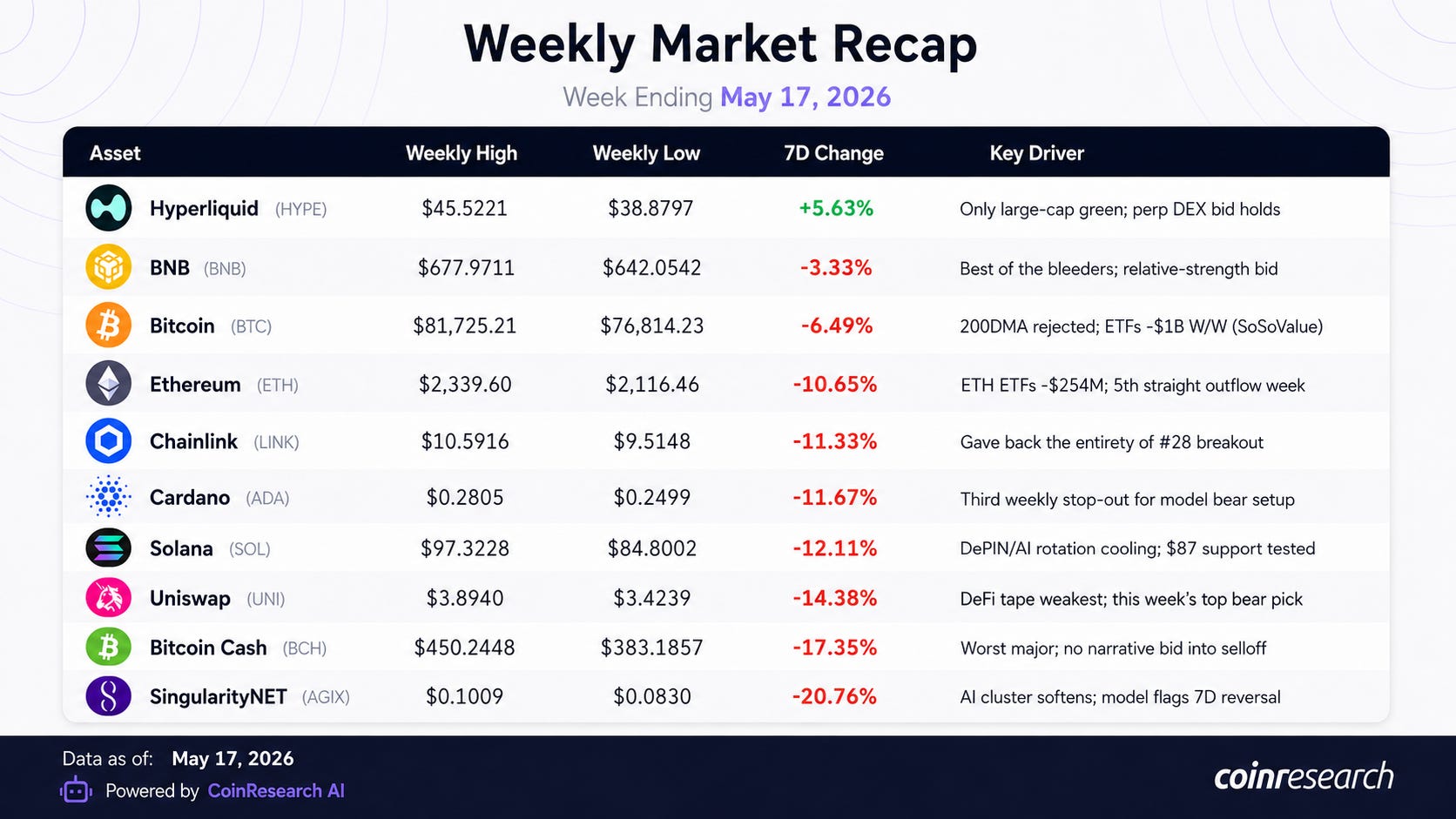
The market became a broad selloff as last week’s altcoin strength reversed. HYPE was the only large-cap green at +5.63%, while BNB held up best among decliners at −3.33%. Bitcoin closed near $76,814, down 6.49%, after rejecting the 200DMA. ETH fell harder at −10.65%.
Former standouts like LINK, SOL, ADA, and BCH gave back their gains, with BCH down 17.35% and AGIX down 20.76%. Total market cap fell to $2.643T, BTC dominance stayed flat at 58.26%, and ETH dominance slipped to 9.63%.
The takeaway: discipline mattered more than conviction. Stops protected capital; stubborn beta got punished.
5. Predictive Analytics & Trade Confluence
Disclaimer: The insights and forecasts presented here are generated by CoinResearch AI’s predictive models and supporting analytics. They are provided for informational and educational purposes only and do not constitute financial advice or investment recommendations. Trading digital assets involves risk, and users should conduct their own research, exercise independent judgment, and use appropriate risk management before making any investment or trading decisions.
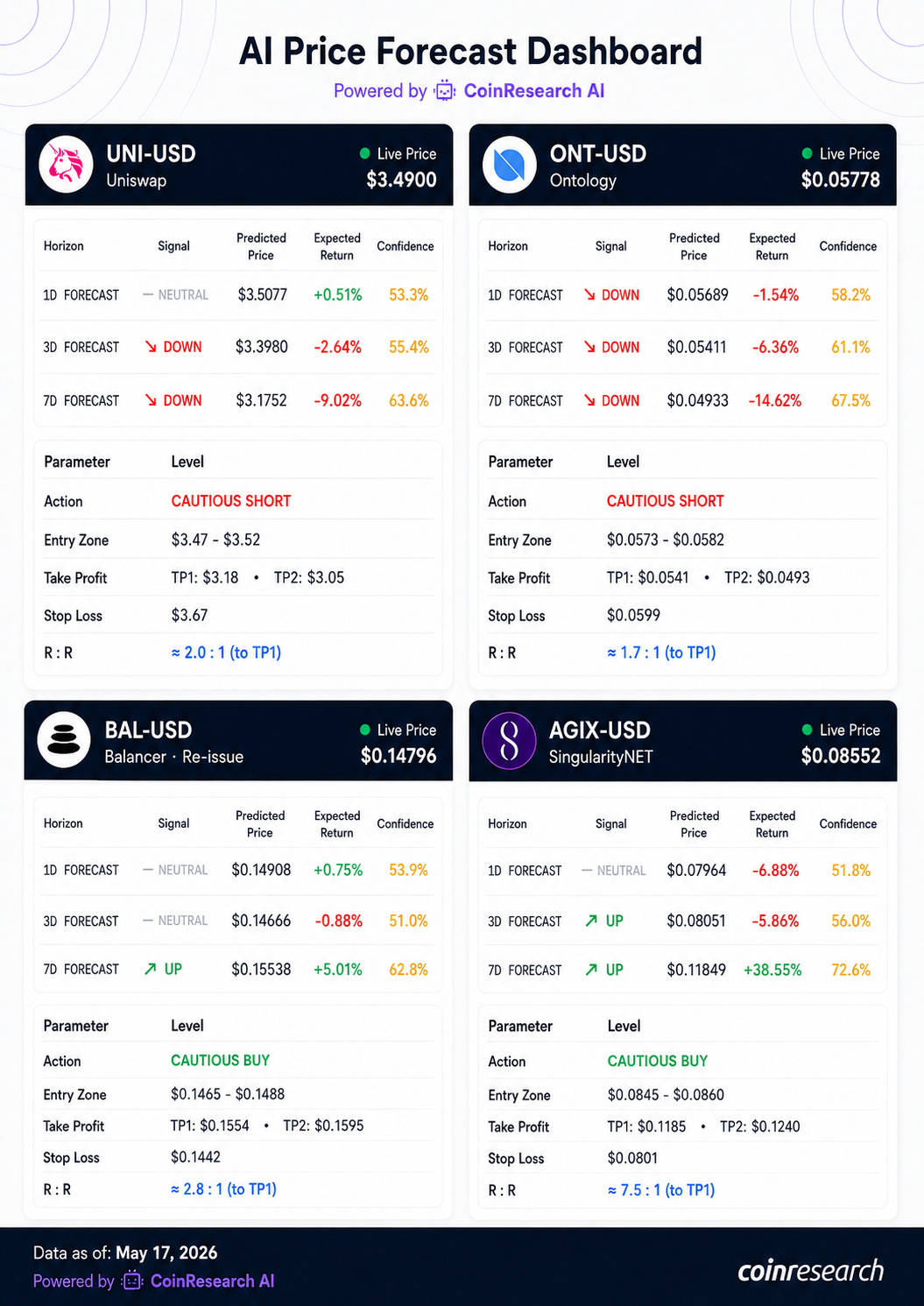
UNI-USD (Uniswap)
Reference Price: $3.49
Market Confluence Analysis. The setup is the classic model-versus-crowd configuration: high social positivity (86% bullish, Galaxy 65, 91K engagements) against a directional model that calls for a 9% decline over the week. UNI is the largest DEX token by market share and historically tracks the broader DeFi tape, which is now in clean downtrend with FLOW and BAL also pointing lower on the dashboard. Spot has already moved $0.06 below the dashboard reference price ($3.49 → $3.43), which means the highest-quality short entries near the upper band ($3.52) are already gone; this is now a continuation short rather than a fresh setup. The 7D target at $3.18 sits below the May lows.
Trade Action.
-
Action: Cautious Short / Sell (reduced from clean entry — price already inside the model’s downside trajectory)
-
Entry Zone: $3.47–$3.52 (upper band preferred; current $3.43 is below entry — wait for a relief bounce)
-
Take Profit: TP1 $3.18 / TP2 $3.05
-
Stop Loss: $3.67
-
R:R: ≈ 1.3:1 to TP1 from current spot; ≈ 1.8:1 from upper entry band
-
Rationale: 7D DOWN at 63.6% confidence with directional agreement at 3D and 7D. DeFi tape weak; relief bounce is the better entry rather than chasing at $3.43.
-
Invalidation: Daily close above $3.67. If the broader risk tape stabilizes and UNI reclaims $3.55 with volume, stand aside.
Analyst Note. The setup is structurally clean, but the timing is awkward — the dashboard ran when UNI was at $3.49, and the asset has already moved $0.06 in the model’s favor by writing time. Patience for a relief bounce toward the upper entry band is the higher-quality entry; chasing $3.43 with the stop still at $3.67 produces sub-1.5:1 reward-to-risk.
Verdict: CAUTIOUS SHORT (wait for $3.50-$3.52 entry).
ONT-USD (Ontology)
Reference Price: $0.05778
Market Confluence Analysis. Ontology is a low-float identity-and-data-services L1 with thin liquidity and limited social signal — exactly the asset class where directional model edge tends to be cleanest because the asset has fewer overlapping narratives competing for the price. Sentiment is supportive of upside (83% bullish) but on minimal volume (38), which makes it a contrarian tell rather than a structural support. The 7D target at $0.0493 implies a return to early-Q1 levels. The complication is liquidity: thin-float assets can move fast in either direction, and the +0.6% intraday bounces on light volume don’t invalidate a multi-day bear thesis but can run a tight stop.
Trade Action.
-
Action: Cautious Short / Sell
-
Entry Zone: $0.0573–$0.0582 (price already below upper band; consider on relief bounce)
-
Take Profit: TP1 $0.05410 / TP2 $0.04930
-
Stop Loss: $0.05990
-
R:R: ≈ 2.4:1 to TP1 from current spot; ≈ 3.0:1 from upper entry band
-
Rationale: Strongest dashboard signal by confidence (67.5%) and magnitude (−14.62%). All three horizons agree DOWN. Sentiment-as-contrarian on thin volume.
-
Invalidation: Daily close above $0.0599 — model’s defined risk limit. If the asset bounces sharply on volume back into the entry zone, exit and wait.
Analyst Note. This is the dashboard’s highest-conviction trade by every measure that matters. The asset has already moved part-way into the trade ($0.05778 → $0.05582 since the dashboard ran), but the reward-to-risk to TP1 remains workable at roughly 2.4:1. The thin-liquidity profile is the real risk — a single $5M flow can move the price 5% in either direction and trigger the stop without invalidating the thesis. Size accordingly.
Verdict: CAUTIOUS SHORT.
BAL-USD (Balancer) — RE-ISSUE AFTER STOP-OUT
Reference Price: $0.14796
Summary: Grade B, Tier 2. The same setup re-issued at a lower entry. Last week’s BAL long was stopped out Saturday May 16 when the daily close broke $0.14793. The model now flags a long at $0.148 reference — essentially the previous stop level — with the same 62.8% confidence and a similar +5% modeled move.
Market Confluence Analysis. This is the dashboard’s own audit moment: a stop-then-re-issue at a meaningfully lower entry. The bearish read is that the model is “averaging down” on a setup that already failed; the bullish read is that the new entry reflects updated risk-reward — the same expected upside, but with the entry $0.008 lower and the stop $0.004 lower. Math actually improves slightly. Sentiment is technically 100% bullish but on minimal social volume (24 posts), so it’s noise. The complication is the macro setup: BAL’s prior signal failed not on asset-specific weakness but on broad DeFi de-risking. If the DeFi tape continues to weaken under the macro pressure, the re-issued setup will fail for the same reason.
Trade Action.
-
Action: Buy / Long (model re-issue after stop-out)
-
Entry Zone: $0.1465–$0.1488 (spot at $0.146 is inside the lower entry band)
-
Take Profit: TP1 $0.15540 / TP2 $0.15950
-
Stop Loss: $0.14420
-
R:R: ≈ 4.4:1 to TP1 from current spot ($0.146); ≈ 1.9:1 from entry midpoint
-
Rationale: Re-issued Grade B 7D UP signal at lower entry. Stop is materially below the prior stop, expected return is similar; the math works if DeFi tape stabilizes.
-
Invalidation: Daily close below $0.1442. If macro pressure on DeFi continues and AAVE/UNI/CRV continue to break, BAL will follow regardless of the model signal — close on weakness rather than averaging.
Analyst Note. The most honest framing of this position is: the model is asking us to take the same trade again, $0.008 lower, after last week’s version stopped. The improved reward-to-risk (4.4:1 from spot to TP1) makes it mechanically attractive, but the macro context that broke last week’s setup has not changed. Smaller size is the right adjustment, and a hard rule on the stop is non-negotiable.
Verdict: CAUTIOUS BUY — reduced size.
AGIX-USD (SingularityNET)
Reference Price: $0.08552
Market Confluence Analysis. SingularityNET sits in the AI-token cluster, which sold hard alongside the broader tape this week — AGIX itself was the worst performer on the recap table at −20.76% W/W per CoinGecko. The setup is contrarian by construction: the model is calling a reversal into a sector that just capitulated. The 7D confidence at 72.6% is unusually high for a Grade C card — the historical hit-rate on Grade C is lower than Grade A/B, but the conviction stack on this specific setup is the strongest the dashboard has produced this week. The structural complication: the 1D and 3D heads are negative in expected return (−6.88% and −5.86%), meaning the model anticipates further near-term drawdown before the 7D upside materializes. This is not a fresh-entry-and-hold setup — it’s a “buy the dip” setup where the dip is still in progress. The 95% bullish social sentiment on rising volume (85K engagements, up materially from the 30K-50K range on most dashboard names) is real signal, not noise — engagement spikes on capitulation often precede reversals.
Trade Action.
-
Action: Cautious Buy / Long (smaller size — Grade C with strong model conviction, but 1D/3D suggest near-term weakness first)
-
Entry Zone: $0.0845–$0.0860 (spot at $0.0836 is below entry; consider scaling in on further weakness toward $0.080)
-
Take Profit: TP1 $0.11849 / TP2 $0.12400
-
Stop Loss: $0.08006
-
R:R: ≈ 7.4:1 to TP1 from current spot
-
Rationale: Highest 7D confidence on dashboard with strongest modeled upside. AI cluster sold hard this week and the model is calling for a 7D reversal; wide stop relative to spot creates strong reward-to-risk.
-
Invalidation: Daily close below $0.08006 — the ATR-defined support. If AI tokens roll over in sympathy with the broader tape, the relative-strength thesis fails fast.
Analyst Note. This is the speculative satellite of the four spotlights. The math is the cleanest on the dashboard, but a Grade C card with negative near-term forecasts (1D −6.88%, 3D −5.86%) and a large 7D target requires the trader to be comfortable holding through a probable drawdown to the stop level. The right framing: small position, hard stop, accept that this is a higher-variance trade than the Grade B picks.
Verdict: CAUTIOUS BUY — smaller size, expect drawdown before upside.
6. Token Launch & Ecosystem Radar
A curated look at three high-signal projects approaching major milestones that have not yet launched their tokens.
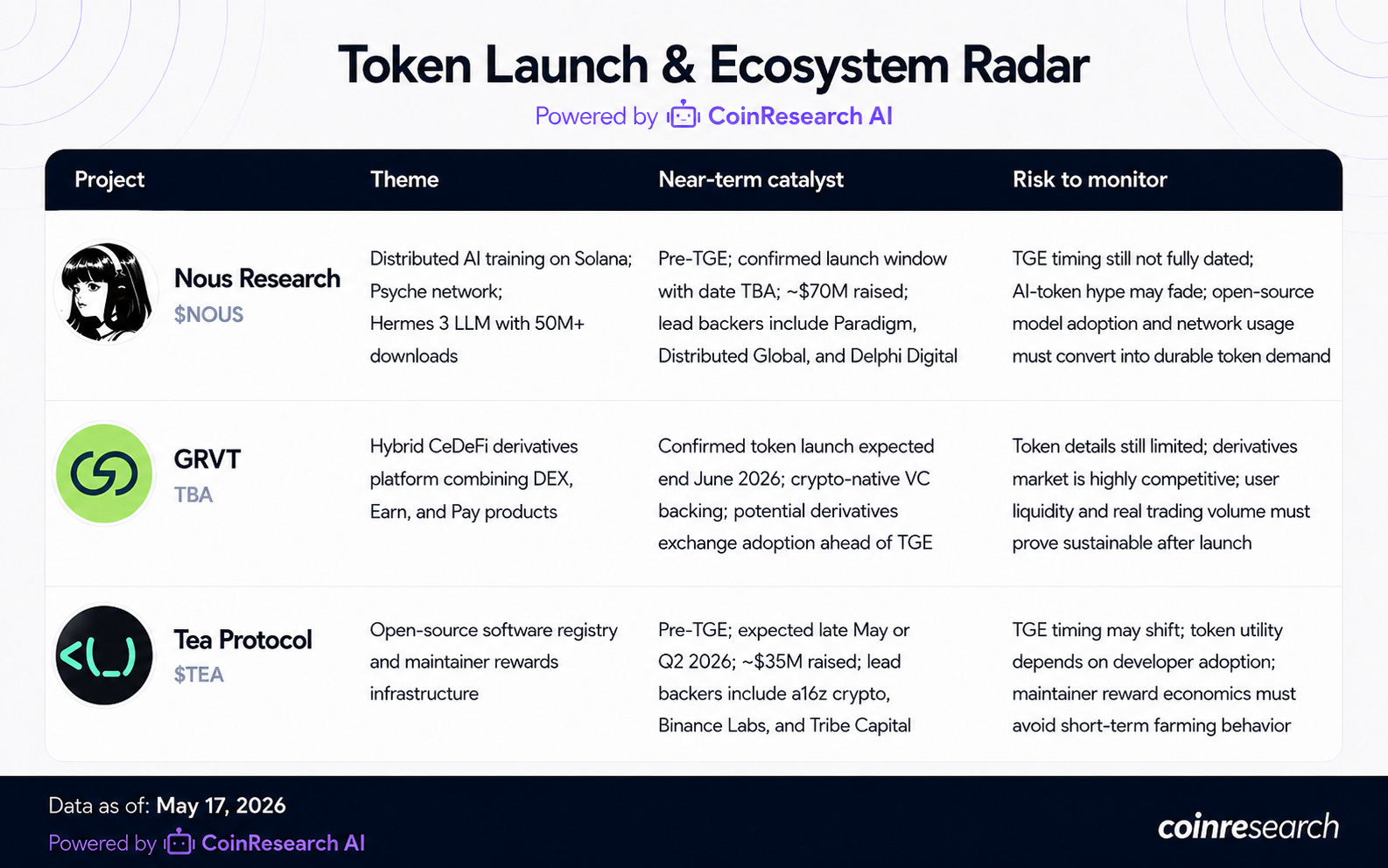
Nous Research — Decentralized AI training network on Solana, building Psyche — the infrastructure layer that lets globally distributed GPUs train large open-source language models cooperatively.
-
Why watch it: Nous attacks the single biggest structural bottleneck in modern AI: the fact that frontier model training has consolidated around a handful of closed labs with the compute concentration to run trillion-token pre-training jobs. The team’s research stack — DeMo (Decoupled Momentum Optimization), DisTrO (its production successor), and the Psyche coordination layer on Solana — reduces inter-GPU bandwidth requirements by several orders of magnitude, making cooperative training across heterogeneous hardware actually viable. The Consilience 40B run, a 40-billion-parameter MLA-architecture model pre-trained across 20T tokens via the testnet, is the largest distributed pre-training run conducted over the internet to date. The Hermes 3 family of open-source models derived from the same research stack has surpassed 50 million downloads.
-
Current Status: Pre-TGE. $50M Series A led by Paradigm at ~$1B valuation (April 2025), preceded by approximately $20M in seed rounds from Distributed Global, Delphi Digital, Hack VC, and North Island Ventures. The token launch is publicly confirmed but undated — a reserved Psyche allocation is referenced in Venice’s VVV token documentation, but Nous itself has not announced a TGE date as of mid-May 2026. Psyche testnet has been live since May 2025; the team announced in November 2025 that it is now transitioning from “provability” runs to “performance” runs (parallel pre-training, post-training, and RL of state-of-the-art open-source models). Co-founders Karan Malhotra and Bowen Peng remain the public face of the project; co-founder Jeffrey Quesnelle leads research.
-
Monitoring Rationale: Nous is a rare crypto-AI project that exists primarily as a research effort with a token mechanism layered on top — not the other way around. The Hermes 3 download volume is a tangible adoption metric independent of any token speculation, and the Paradigm-led valuation at $1B in April 2025 set an institutional floor that’s difficult to dismiss. The structural question at TGE is whether the value of cooperative training accrues to compute providers (analogous to Bitcoin miners), to model creators, or to end users — and whether Psyche’s design captures enough of that value flow at the protocol layer to sustain $NOUS price discovery once the token unlocks.
GRVT — Hybrid CeDeFi exchange combining centralized order book performance with on-chain settlement, targeting institutional and prosumer derivatives traders.
-
Why watch it: GRVT is positioned as one of the cleaner attempts to merge centralized exchange UX with on-chain settlement guarantees — a wedge that has historically failed for structural reasons (custody friction, regulatory ambiguity, fragmented liquidity) but which the post-FTX environment has made strategically valuable. The project operates a three-pillar product structure: Trade (spot and derivatives), Earn (yield infrastructure with Aave integration on the roadmap), and Pay (real-world payments rail). Spot trading went live in late April 2026.
-
Current Status: Pre-TGE. Per the project’s revised timeline published in March 2026 (MEXC News, Bitget Wallet), the token generation event is scheduled for end of June 2026. The team explicitly delayed the TGE from earlier targets to allow spot markets and yield infrastructure to launch first — a deliberate pacing decision that prioritizes platform readiness over token velocity. Token supply will be fixed at 1 billion units. The current focus is the ongoing trading competition designed to build pre-TGE user activity and liquidity depth.
-
Monitoring Rationale: The CeDeFi narrative is one of the few sectors with both a coherent product thesis and verifiable post-FTX demand from institutional traders. Whether GRVT executes on the launch as the macro tape continues to weaken is the dominant variable.
Tea Protocol ($TEA) — Decentralized protocol that rewards open-source software maintainers based on the dependency graph of how their packages are used.
-
Why watch it: Tea Protocol attacks a structural problem that has existed since the modern open-source movement began: maintainers of foundational libraries earn nothing while building the dependency stack that the entire software economy runs on. The protocol’s approach is to use on-chain attestation and a dependency-weighted reward mechanism (the “Proof of Contribution” model) to distribute token rewards across the maintainer graph. The team has raised approximately $35M in total funding across seed and Series A from a16z crypto, BinanceLabs, and Tribe Capital, among others. Backed by long-time open-source advocate Max Howell (creator of Homebrew).
-
Current Status: Pre-TGE. Per the project’s published roadmap, the Token Generation Event is targeted for the late-May / early-Q2 2026 window, with mainnet launch and the TEA DAO going live simultaneously. The protocol’s testnet has logged measurable maintainer signup over the past two quarters; the open question is whether the dependency-graph attestation infrastructure is robust enough to handle real reward distribution at scale.
-
Monitoring Rationale: This is the rare project where the narrative is genuinely orthogonal to typical crypto cycles — open-source maintainer compensation is a real economic problem with a quantifiable market (the global open-source software economy). Whether the token mechanism solves it sustainably is the structural test.
7. Strategic Recap & Forward Outlook
This was a reset week, not a crash week. BTC gave back the prior week’s gains in roughly the same shape — orderly, broad, with dominance held flat — which keeps the structural floor thesis alive even as the directional thesis is broken. The macro reset is real: hot CPI plus a new Fed chair with no dovish signal extracted yet means the rate-cut narrative is on hold for now, and the institutional bid that supported April has stepped back. The right posture for the coming week is range-trading discipline: short the model’s highest-confidence bearish setups, long the AI relative-strength outlier with smaller size, accept that the BAL re-issue is the model auditing itself. The trade-of-the-week is not in the directional call — it’s in not being long index exposure into a tape that has lost its institutional bid. When conditions change — a cool May CPI on June 11, a dovish Warsh signal, an ETF inflow reversal — the directional thesis comes back. Until then, position size beats position direction.
Forward Outlook — Week of May 18–24
-
Macro Watch. Powell exits as Chair on Friday with Warsh’s first speech as Chair likely this week — every Warsh statement will be priced as a policy signal until the June 16-17 FOMC. Strategy’s Monday 8-K filing (May 18) will confirm whether Saylor’s “Big Dot Energy” tease translated into another disclosed BTC purchase; the size of that purchase will tell us whether the post-earnings-call accumulation pace is holding or stepping down further. The $1.5B 2029 convertible note repurchase by Strategy settles May 19. The April PPI release was already May 13; the next major data release is the May 22 University of Michigan inflation expectations preliminary read — historically a smaller print but one that captures the household response to the CPI shock.
-
BTC Key Levels. Resistance: $78,500 (intra-week recovery high), then $82,228 (200DMA — now resistance again), then $85,000. Support: $77,400 (the new Sunday close zone), then $75,000 (the range floor from April’s consolidation), then $72,000 (the late-March swing low). A daily close below $75,000 invalidates the consolidation thesis and opens the lower band toward $70,000. A daily close above $80,500 with volume would suggest the macro shift is being digested and the range holds.
-
Altcoin Outlook. DeFi continues to weaken on a model-confluence basis — three of the four Grade B signals on the dashboard are DeFi shorts (UNI, FLOW, BAL is a long but a re-issue after stop). L1-alt weakness is broader: NEAR, ONT, ICP all sitting in cautious-short or no-trade territory. The AI cluster sold hard this week (AGIX −20.76%, TAO −11%+) but the model now flags AGIX and TAO as the two directionally bullish setups with 7D confidence above 55% — these are contrarian reversal trades into capitulation, not relative-strength trades. Grade C labels mean position sizing should reflect the historical hit-rate. Memecoins ex-DOGE remain weak; the long tail has not produced a clean directional signal this week. Strategically: short the model-confluent setups, treat the AI longs as smaller satellite positions, avoid index exposure.
Disclaimer: This analysis is for informational purposes only and should not be construed as investment advice. Cryptocurrency markets carry substantial risk, including the potential loss of principal. Past performance does not guarantee future results. Always conduct your own due diligence and consult a qualified financial advisor before making investment decisions.