
Regulatory clarity arrived just in time to cushion, but not stop, a hawkish Fed-driven correction | Week Ending March 22, 2026
The week ending March 22, 2026 was driven by two opposing forces: major regulatory progress and a hawkish Federal Reserve. Crypto started near short-term highs but sold off after macro pressure returned.
On March 18, the FOMC kept rates at 3.50–3.75%, but Powell signaled fewer cuts ahead, citing 3.1% core PCE, oil above $116 due to the US-Iran conflict, and a weakening labor market. The shift toward a stagflation narrative pushed Bitcoin down about 5% and weighed on the broader market.
Geopolitical tensions kept energy prices elevated, reinforcing the higher-for-longer outlook. Bitcoin still outperformed equities and gold year-to-date, but post-FOMC de-risking limited upside.
A key positive came on March 17, when the SEC and CFTC classified 16 major cryptocurrencies as digital commodities under CFTC oversight, advancing the Crypto Clarity Act and marking the most important U.S. regulatory step since 2017.

2. Strengths-Bullish Developments of the Week
-
Historic regulatory clarity: The SEC-CFTC joint interpretation established a five-category token taxonomy (digital commodities, digital collectibles, digital tools, stablecoins, digital securities), naming 18 specific tokens as digital commodities. This is a final rule, not interpretive guidance, carrying binding legal weight and removing the SEC’s enforcement power over these assets. This directly de-risks institutions that had previously been hesitant to hold or offer exposure to “securities-risk” tokens.
-
Morgan Stanley ETRADE crypto expansion: Morgan Stanley announced plans to integrate cryptocurrency trading directly into the E*TRADE brokerage platform, extending crypto access to millions of retail brokerage accounts. Survey data cited shows 73% of institutions plan to increase digital asset allocations in 2026.
-
Polkadot’s “Pi Day” supply shock: The Polkadot protocol implemented its March 14 emission reduction event, slashing annual token issuance by 53.6% from 120 million to 56.88 million DOT annually, with a hard supply cap of 2.1 billion introduced. DOT finished the week as a top performer at +5.2%, outperforming the broader market by a significant margin.
-
THORChain cross-chain expansion: THORChain’s plans to bring native Zcash swaps continued to attract developer and trader attention, expanding cross-chain liquidity infrastructure. RUNE maintained relative strength above $0.40 despite broad market weakness, and the model (see Section 5) projects a notable recovery over the 7-day horizon.
3. Weaknesses-Headwinds and Risk Factors
-
FOMC hawkish pivot destroyed rate-cut hopes: The dot plot revision to 0–1 cuts, down from the 2 cuts priced by markets, triggered an immediate repricing of risk assets. Crypto was not immune: BTC dropped from a weekly high of $76,020 (Mar 17) to a weekly low of $67,330 (Mar 22), a decline of approximately 11.4% peak-to-trough within a single week. This reinforces the market’s ongoing sensitivity to Fed policy rhetoric.
-
ETH severely underperformed: Ethereum dropped 8.1% for the week, extending its six-month losing streak from September 2025. ETH now trades 52% below its 52-week high, and spot Ethereum ETFs have suffered over $2 billion in March outflows. The ETH/BTC ratio continues to deteriorate, reflecting sustained narrative and capital challenges.
-
Extreme Fear streak extends to 46 days: The Crypto Fear & Greed Index remained pinned at 10–11 (extreme fear) for the 46th consecutive day, the longest such streak since the post-Terra collapse of 2022. The index closed the week at approximately 25, registering a slight improvement but still deeply in fear territory.
-
Altcoin bloodbath: The majority of top-cap altcoins suffered steep losses: LINK (-8.40%), DOGE (-7.49%), BNB (-6.99%), SOL (-6.64%), ADA (-7.13%). The only meaningful outperformers among top assets were TRX (+3.88%), DOT (+5.20%), and HYPE (+2.87%), demonstrating the highly selective nature of any positive momentum.
-
LayerZero unlock pressure: 25.71 million ZRO tokens (~$55.5M) were unlocked on March 20, adding sell pressure to an already vulnerable altcoin market. Total scheduled token unlocks for the week of March 23-29 exceed $438 million, creating a persistent supply-side headwind for the immediate forward period.
4. Market Recap
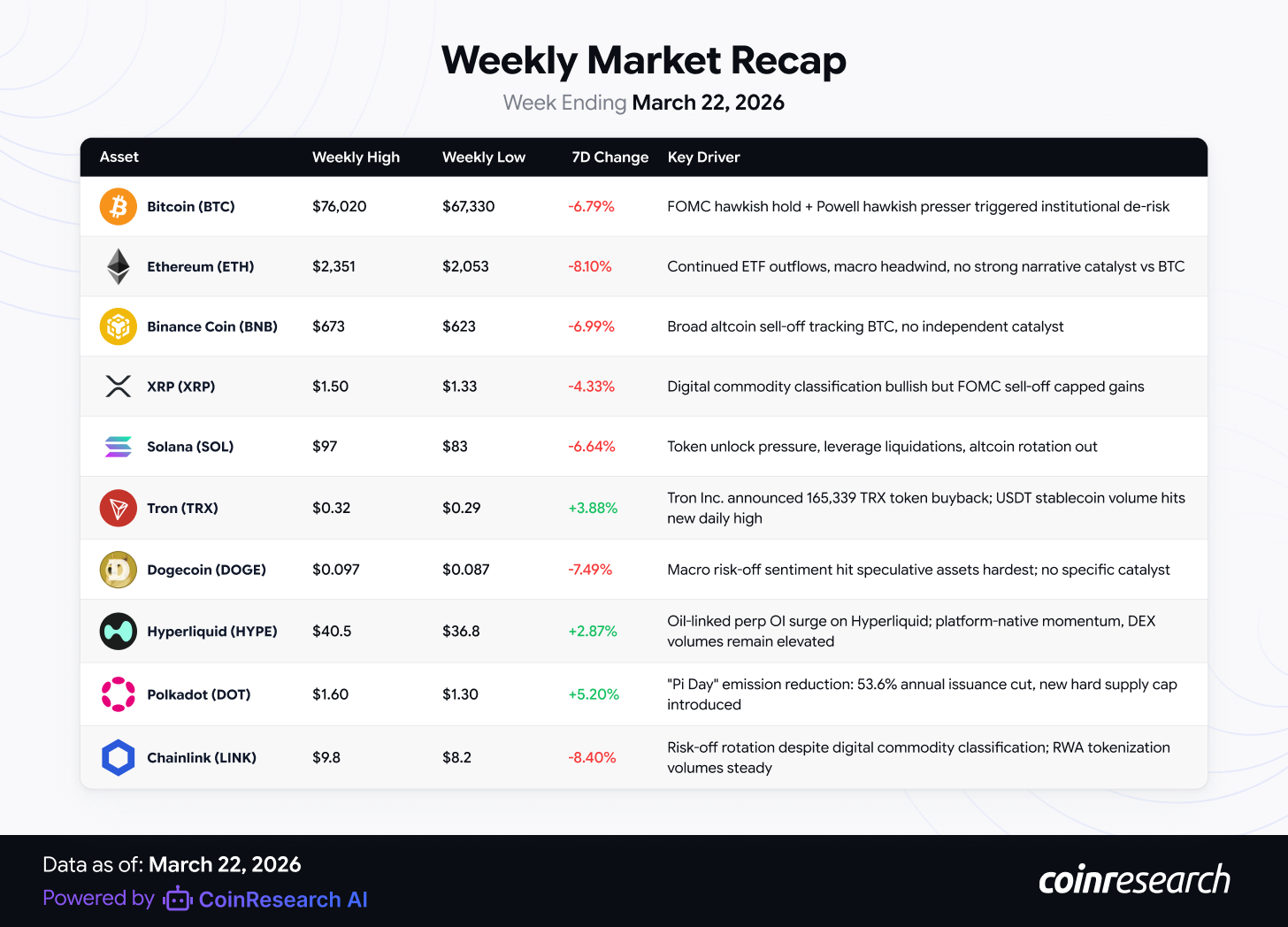
Overall Sentiment: Bearish-to-neutral. Post-FOMC selling pressure dominated, with narrow outperformance in supply-shock and buyback-driven names (DOT, TRX) and platform-native demand (HYPE). The regulatory clarity from the SEC-CFTC classification provided a structural floor but could not overcome macro headwinds in the short term.
5. AI/ML Model Insight & Market Confluence
CoinResearch AI integrates the Price Prediction Machine-Learning with real-world technical indicators, sentiment data, and macro context.
Below are the latest model outputs for the 2nd week of March, 2026, cross-validated with market structure, momentum, and geopolitical risk assessment.
Disclaimer:
The insights and forecasts presented here are generated by CoinResearch AI’s predictive models and supporting analytics. They are provided for informational and educational purposes only and do not constitute financial advice or investment recommendations. Trading digital assets involves risk, and users should conduct their own research, exercise independent judgment, and use appropriate risk management before making any investment or trading decisions.
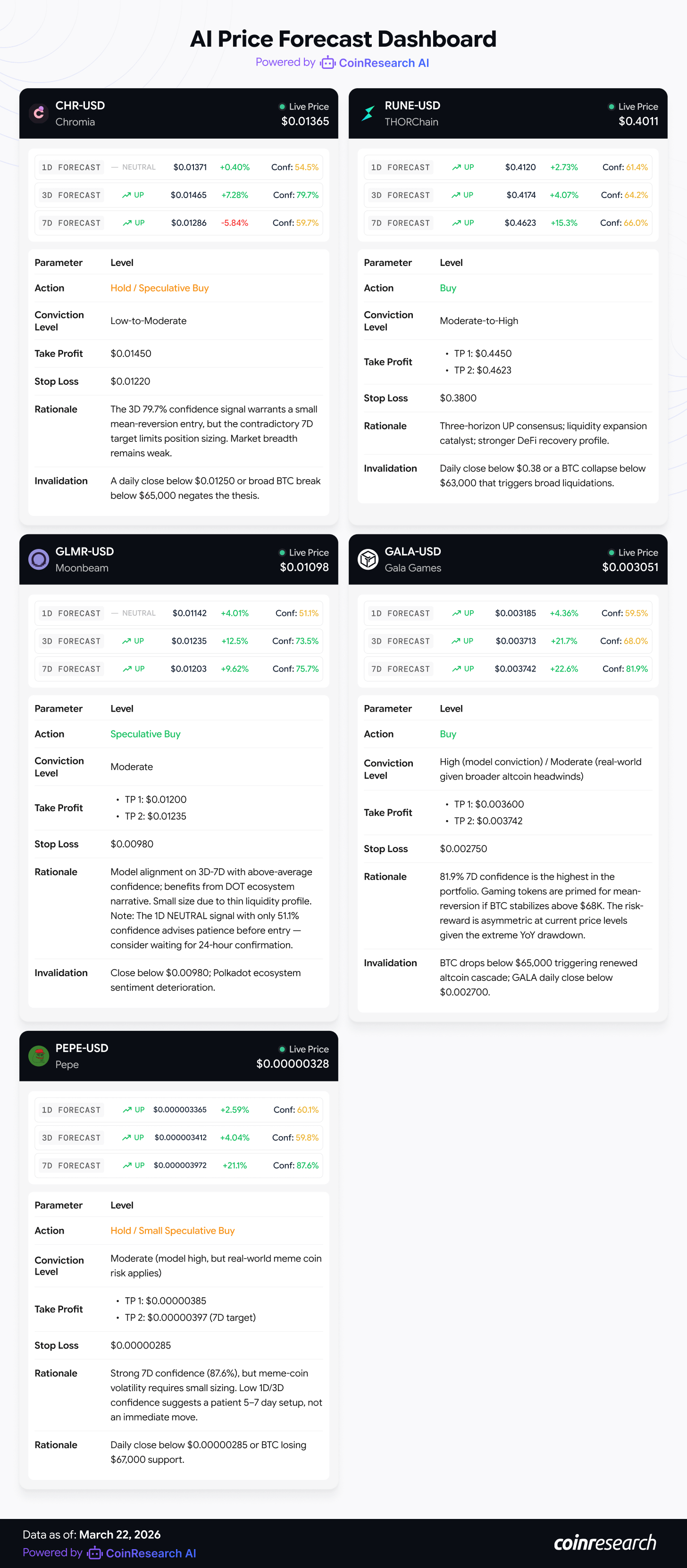
Chromia (CHR)-Reference Price: $0.01365
Analysis: The model presents a conflicting signal set, bullish over 3 days but net-bearish over 7 days, with the 7D target actually below the current price. The highest conviction signal is the 3D UP at 79.7% confidence. Real-world context: CHR has declined approximately 17.58% over the past 7 days, leaving it heavily oversold in the short term. The 3D bounce scenario is plausible as a mean-reversion trade, but the 7D DOWN target at $0.01286 suggests any recovery may be short-lived in the context of broader market weakness.
Trade Action: HOLD / SPECULATIVE BUY (small size)
-
Conviction Level: Low-to-Moderate
-
TP: $0.01450 (3D model target, slightly conservative)
-
SL: $0.01220 (below recent support zone)
-
Rationale: The 3D 79.7% confidence signal warrants a small mean-reversion entry, but the contradictory 7D target limits position sizing. Market breadth remains weak.
-
Invalidation: A daily close below $0.01250 or broad BTC break below $65,000 negates the thesis.
THORChain (RUNE)-Reference Price: $0.4011
Analysis: This is the most consistent bullish signal in today’s model output, all three horizons are directionally aligned to the upside with increasing magnitude. The 7D 15.3% target implies RUNE reclaiming $0.46, which would represent a return toward its recent local high. Real-world context: RUNE has shown 13.1% 7-day strength per CoinGecko and its weekly range is $0.3974–$0.4592, suggesting the model is targeting the upper end of the recent range. The THORChain-Zcash native swap expansion narrative provides a fundamental tailwind. Capital.com data shows RUNE’s weekly range has already tested $0.4592, and a break above that level would be technically significant.
Trade Action: BUY
-
Conviction Level: Moderate-to-High
-
TP1: $0.4450 | TP2: $0.4623 (model target)
-
SL: $0.3800 (below current structure)
-
Rationale: Three-horizon consensus UP signal, narrative catalyst (cross-chain liquidity expansion), and consistent model confidence across timeframes. RUNE benefits from DeFi infrastructure positioning, which often recovers faster than pure speculative altcoins post-correction.
-
Invalidation: Daily close below $0.38 or a BTC collapse below $63,000 that triggers broad liquidations.
Moonbeam (GLMR)-Reference Price: $0.01098
Analysis: GLMR shows improving momentum, the 1D is cautiously neutral (low 51.1% confidence), but both 3D and 7D flip UP with notably high confidence (73.5% and 75.7%). Real-world context: GLMR is currently near multi-year lows at $0.01098. Its Polkadot ecosystem positioning means it directly benefits from the DOT supply shock narrative and the regulatory clarity provided to DOT as a digital commodity. Volume has been low, which makes breakout moves potentially sharp when they occur.
Trade Action: SPECULATIVE BUY (small position)
-
Conviction Level: Moderate
-
TP1: $0.01200 | TP2: $0.01235 (3D model target)
-
SL: $0.00980 (key structural support)
-
Rationale: Model alignment on 3D-7D with above-average confidence; benefits from DOT ecosystem narrative. Small size due to thin liquidity profile. Note: The 1D NEUTRAL signal with only 51.1% confidence advises patience before entry, consider waiting for 24-hour confirmation.
-
Invalidation: Close below $0.00980; Polkadot ecosystem sentiment deterioration.
Gala Games (GALA)-Reference Price: $0.003051
Analysis: GALA produces the highest multi-horizon confidence of the portfolio, particularly the 7D signal at 81.9% is among the strongest outputs the model has generated. The consistency (all UP, increasing % gain with high terminal confidence) is notable. Real-world context: GALA trades at $0.003051, down -77.80% year-over-year, placing it in deep value territory from a historical perspective. Gaming tokens have been among the hardest-hit during the 2025-2026 correction cycle, and mean-reversion from compressed valuation levels historically produces sharp recoveries. Gate.com data shows GALA’s 5-day 7-day gain of +5.70%, suggesting early accumulation is already underway.
Trade Action: BUY
-
Conviction Level: High (model conviction) / Moderate (real-world given broader altcoin headwinds)
-
TP1: $0.003600 | TP2: $0.003742 (7D model target)
-
SL: $0.002750 (below recent support structure)
-
Rationale: 81.9% 7D confidence is the highest in the portfolio. Gaming tokens are primed for mean-reversion if BTC stabilizes above $68K. The risk-reward is asymmetric at current price levels given the extreme YoY drawdown.
-
Invalidation: BTC drops below $65,000 triggering renewed altcoin cascade; GALA daily close below $0.002700.
Pepe (PEPE)-Reference Price: $0.00000328
Analysis: PEPE’s 7D signal is the highest-confidence call in the entire model output at 87.6%. The 21.1% projected gain over 7 days, if realized, would bring PEPE near $0.00000397, still far below its $0.00002803 all-time high. Real-world context: PEPE has declined -7.20% over the past week and -54.48% year-over-year. Meme coins in their extreme-fear compression phases historically produce violent short-covering rallies, especially when BTC stabilizes. The 1D and 3D signals are modestly bullish (low 60% confidence), suggesting the model sees limited near-term edge but strong medium-term mean-reversion potential.
Trade Action: HOLD / SMALL SPECULATIVE BUY
-
Conviction Level: Moderate (model high, but real-world meme coin risk applies)
-
TP1: $0.00000385 | TP2: $0.00000397 (7D target)
-
SL: $0.00000285 (below recent support cluster)
-
Rationale: The 87.6% 7D confidence is striking. However, meme coin volatility means this target can overshoot or undershoot significantly. Position sizing must be small relative to portfolio. The low 1D/3D confidence (59-60%) suggests no immediate catalyst, this is a patient 5–7 day hold thesis.
-
Invalidation: Daily close below $0.00000285; BTC fails to hold $67,000 into the week.
Note on model disagreement: The model broadly signals UP across all 5 assets in at least one horizon. However, the real-world macro context, FOMC hawkishness, $438M+ token unlocks, and the 46-day extreme fear streak, creates a higher bar for these moves to materialize. No trade is also a trade: if BTC breaks below $65,000, none of these theses are valid, and the appropriate action is to remain in stablecoins until support is confirmed.
6. Token Launch & Ecosystem Radar
A curated look at three high-signal projects approaching major milestones that have not yet launched their tokens. Each combines strong backers, transparent development, and real execution momentum.
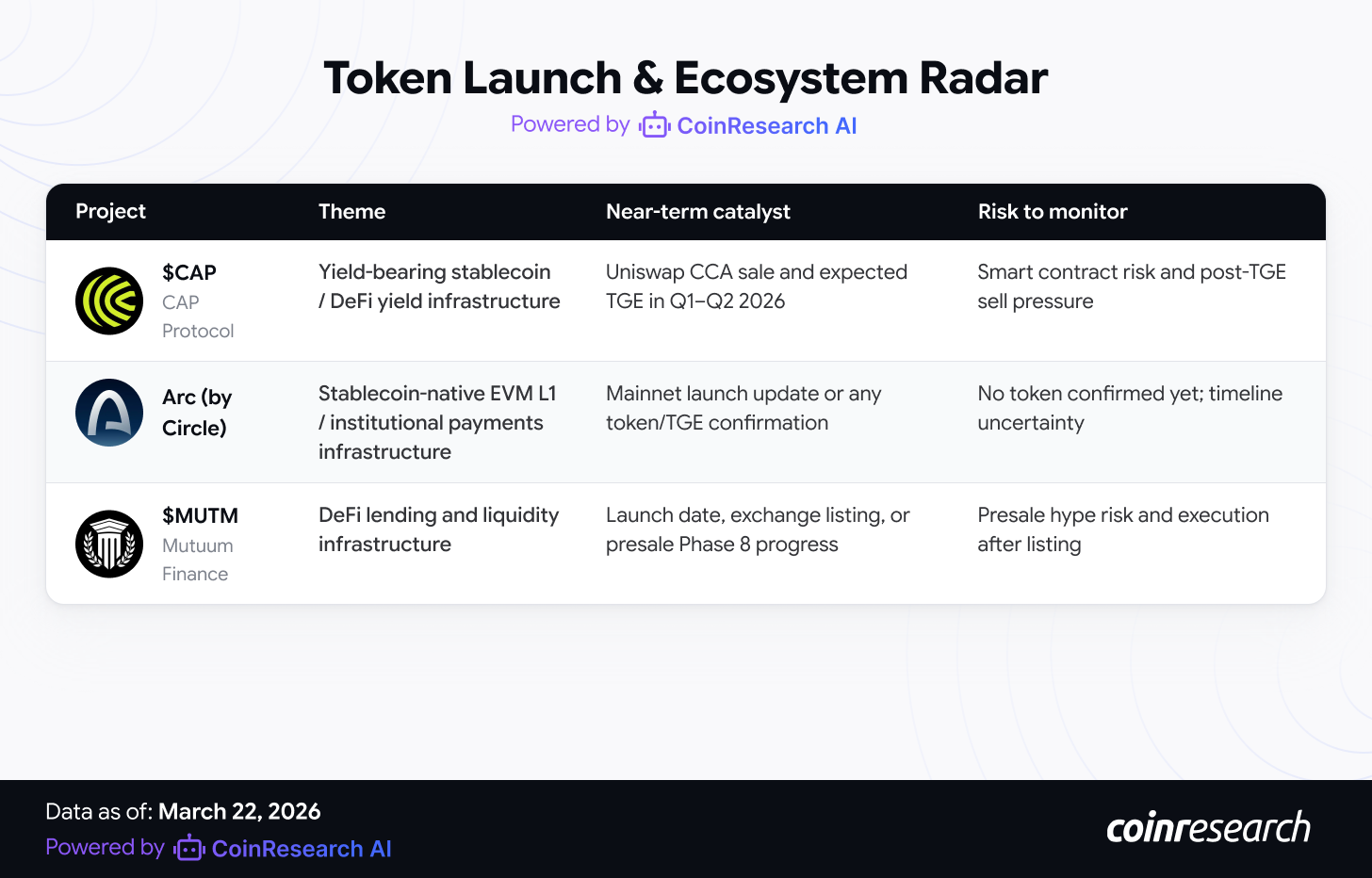
CAP Protocol ($CAP), Yield-Bearing Stablecoin Engine
What it is: A stablecoin protocol issuing cUSD and stcUSD (yield-bearing variant) that bridges institutional yield sources, HFT firms, private credit, MEV extraction, directly into DeFi. Holds over 80% of reserves in Aave V3, generating a 5.2% average yield passed through to stcUSD holders. PayPal USD was the protocol’s launch partner.
Status: Mainnet launched August 2025; Uniswap Continuous Clearing Auction (CCA) sale registration opened February 5, 2026. The CCA mechanism, designed to prevent bot sniping and ensure fair price discovery, is Uniswap’s new flagship token launch format. Token launch is the most imminent of the three projects covered here, with TGE expected Q1–Q2 2026.
Why to watch:
-
$500 million TVL in five months is among the fastest organic growth trajectories of any stablecoin protocol in 2025–2026, generating $4 million in real cumulative yield at a 5.2% average rate.
-
The “Stabledrop” distribution model, rewarding early participants with cUSD (a yield-generating stablecoin) rather than a governance token, is being cited by Bankless and other DeFi analysts as a paradigm shift.
-
The CCA launch on Uniswap’s main frontend gives CAP maximum retail visibility at TGE.
Risk: Smart contract vulnerabilities carry heightened impact at $500M TVL without a multi-year audit track record. Early token holders from the CCA sale may create immediate sell pressure at TGE.
Arc (by Circle), EVM L1 for Stablecoin-Native Finance
Category: Layer 1 Blockchain / Institutional Payments Infrastructure
Status: Testnet active; mainnet targeted for 2026; no token confirmed but community expectation is high
Why Watch: Circle, the issuer of USDC, is building Arc, an EVM-compatible Layer 1 optimized for stablecoin transactions with USDC as the native gas token. Sub-second finality, built-in FX engine, and compliance-friendly architecture make Arc the most credible institutional payments chain being built. With the SEC-CFTC digital commodity classification now cementing USDC’s stablecoin status, Arc’s regulatory positioning is uniquely clear. The ongoing Crypto Clarity Act stablecoin provisions create a direct regulatory tailwind for stablecoin infrastructure plays. If Circle launches a governance token, the initial float will likely be small relative to the fully diluted value, creating a high-conviction early-mover opportunity.
Catalyst to Watch: Arc mainnet launch announcement; any Circle governance token whitepaper or TGE indication.
Mutuum Finance (MUTM), Decentralized Lending Protocol
Category: DeFi / Lending & Liquidity
Status: Protocol V1 live; token presale in Phase 7 at $0.04 (from $0.01 start = +300%); $20.8M raised, 19,000+ holders
Why Watch: In a market where DeFi infrastructure with real yield has consistently outperformed speculative tokens (Aave’s +1.9% week vs. -6-8% for most others this week), Mutuum Finance occupies a compelling niche. With over $20.8M in presale funding before public listing, the community uptake reflects genuine product-market interest in decentralized lending infrastructure. The token launch price is confirmed at $0.06, representing a 500% return from the first presale round. As DeFi protocols increasingly benefit from regulatory clarity (the SEC-CFTC joint interpretation explicitly cleared staking, DeFi lending, and protocol interactions from securities classification), MUTM is entering the market at an unusually clear legal juncture.
Catalyst to Watch: Official launch date announcement; public listing exchange confirmation; transition to Phase 8 of presale.
7. Strategic Recap & Forward Outlook
Edition #21 captures a market at a crossroads. The regulatory environment improved dramatically, the SEC-CFTC joint interpretation resolves years of legal uncertainty and provides the strongest institutional green light the U.S. market has ever received. Yet the macro environment deteriorated: stagflation risk is no longer theoretical, with oil above $116, Q4 2025 GDP at 0.7%, and the Fed explicitly signaling fewer cuts ahead.
The result was predictable: institutions who had bought the prior week’s recovery took profits post-FOMC, BTC dominance climbed to 58.1% as altcoins bled, and the Fear & Greed index inched up from 10 to 25, still deep in extreme fear territory after 46 consecutive days. The contradiction between excellent regulatory progress and poor short-term price action is, historically, one of the most common setups for medium-term bull resets.
Key data points to carry forward:
-
BTC weekly range: $76,020 (Mar 17 high) → $67,330 (Mar 22 low)
-
ETH: -8.1% on the week, sitting at $2,053-$2,078
-
Total market cap: $2.48T → $2.34T (intra-week)
-
F&G Index: 25 (improving from 10, but still extreme fear)
-
BTC dominance: 58.1%
Forward Outlook: Week of March 23–29, 2026
The near-term technical picture is guarded but not without opportunity. Bitcoin must defend the $67,000–$68,000 zone, which now represents both a technical support cluster and the psychological round-number floor. A weekly close below $66,000 would open the path toward the $63,000–$65,000 zone, a scenario the model’s RUNE, GALA, and PEPE theses would not survive.
The week ahead brings multiple catalysts:
-
Backpack (BACKPACK) TGE, March 23 (today): 250 million tokens (25% of total supply) unlock immediately. This is both a potential sell-pressure event and a fresh liquidity injection into the Solana ecosystem. CEX listings will determine whether this is a buy-the-news or sell-the-news event for Solana-native assets.
-
$438M+ in token unlocks across the broader market through March 29. LayerZero’s ZRO ($55.5M) already unlocked March 20. Watch for localized selling pressure in projects with near-term unlock schedules.
-
Conference season: Next Block Expo (Warsaw, March 24), Crypto Assets Conference (Frankfurt, March 25), and CheatCode 2026 UK (March 26-29) could generate partnership announcements and positive narrative flow, these events historically create 24-48 hour pumps in featured project tokens.
-
Quiet macro calendar: No major Fed speeches or economic data releases immediately ahead post-FOMC, which reduces event-driven volatility, allowing price to resolve based on technical structure and on-chain flows.
-
Extreme fear reversal potential: At 46 days of consecutive extreme fear, the longest since the Terra collapse, contrarian positioning has historically generated strong recoveries. The question is not if but when and what acts as the catalyst.
Structural thesis: The SEC-CFTC classification is a fundamental repricing event that takes weeks to fully absorb. The near-term pain is macro-driven and temporary; the regulatory tailwind is structural and permanent. Institutions who missed the prior recovery window now have legal certainty to deploy capital, the next catalyst will determine if March 2026 is remembered as the bottom or merely a bounce within a longer correction.
Risk scenario: Oil spikes above $130/bbl (Strait of Hormuz closure), Fed pivots to explicitly hawkish language, and BTC breaks $65,000 support with conviction. In this environment, stablecoins and cash equivalents outperform.
Base case: BTC consolidates $67,000–$72,000 range into Q2, extreme fear reverses, and regulatory-clarity-beneficiary tokens (XRP, LINK, DOT, ADA) lead the next rotation. Altcoins in deep value territory (GALA, PEPE, RUNE) show outsized recovery potential as per model signals.
Disclaimer: This newsletter is for informational purposes only and does not constitute financial advice. Cryptocurrency markets are highly volatile. Always conduct independent research before making investment decisions. Past performance of model predictions does not guarantee future results.