
From War-Driven Whiplash to ETF Whispers: Bitcoin Tests $74K, Altcoins Stay in the Abyss | Week Ending: 8 March, 2026
The first full week of March delivered a volatile, headline-driven tape that ultimately left most majors roughly where they started, but not before one of the most dramatic intraweek swings of the year. Bitcoin opened the week near $67,000, briefly crashed to the $62,500 zone on Monday as the U.S.-Iran military escalation intensified over the weekend, then staged a furious short-squeeze rally to tag $74,000 by Wednesday, its highest level in over a month, before selling off hard into the Friday close near $67,700.
In crypto-specific developments, the midweek rally was fueled by three catalysts: (1) deeply negative funding rates from the Iran-driven selloff created a textbook short squeeze, with $593 million in liquidations over 24 hours; (2) Trump publicly backed the Clarity Act for digital assets, lifting sentiment across the sector; and (3) spot Bitcoin ETFs broke a five-week outflow streak with $521 million in inflows on March 2, led by BlackRock’s IBIT at $263 million. However, by week’s end, ETFs reversed to $576.8 million in outflows on March 5–6, landing the weekly net flow at a still-positive +$568 million.

Strengths
-
ETF inflows broke the drought. After five consecutive weeks of outflows totaling approximately $4 billion, institutional capital returned with force. The March 2 session saw $521 million in combined inflows, with BlackRock’s IBIT alone pulling $263 million, its largest single-day inflow since September 2025. Across the first two trading days, total inflows exceeded $1.1 billion.
-
Short squeeze mechanics proved the market is deleveraged. The rally from $62,500 to $74,000 in under 72 hours demonstrated that much of the speculative excess has been purged. Negative funding rates flipped sharply, and $593 million in short liquidations cleared the deck. This is a constructive sign for any future sustained move higher.
-
Bitcoin relative strength. Despite extreme macro headwinds, BTC outperformed the S&P 500 (-1.7%), Nasdaq (-0.67%), and Dow (-3.56%) on the week, gaining approximately 6.25%. Gold fell 3.67%, suggesting Bitcoin absorbed some haven demand.
-
Corporate accumulation continues. Strategy (formerly MicroStrategy) purchased an additional 3,015 BTC for approximately $204 million during the week, reinforcing the institutional conviction thesis.
Weaknesses
-
The $74K rejection is technically significant. As analyst Benjamin Cowen flagged pre-week, the $74,000 zone, former structural support from April 2025, has now flipped to resistance. The rejection and subsequent sellback to $67K fits the classic midterm-year pattern (2014, 2018, 2022) where a March relief rally precedes deeper weakness into April-June.
-
ETF flows reversed sharply. The $1.1 billion in early-week inflows gave way to $576.8 million in outflows by Thursday and Friday, demonstrating that institutional commitment remains fragile and event-driven rather than structural.
-
Altcoin breadth remains absent. BTC dominance at 59.06% continues to climb, and altcoin season indicators are at multi-year lows. Capital is concentrating in Bitcoin; the risk curve is not being rewarded.
-
Token unlock pressure. Approximately $5.8 billion in token unlocks are scheduled throughout March 2026, adding persistent sell-side pressure to an already weak altcoin market.
-
Miner selling intensified. Public Bitcoin miners sold over 15,000 BTC from October 2025 to February 2026, with February alone accounting for approximately 6,100 BTC. This capitulatory behavior from miners signals margin pressure and adds to supply overhang.
Market Recap
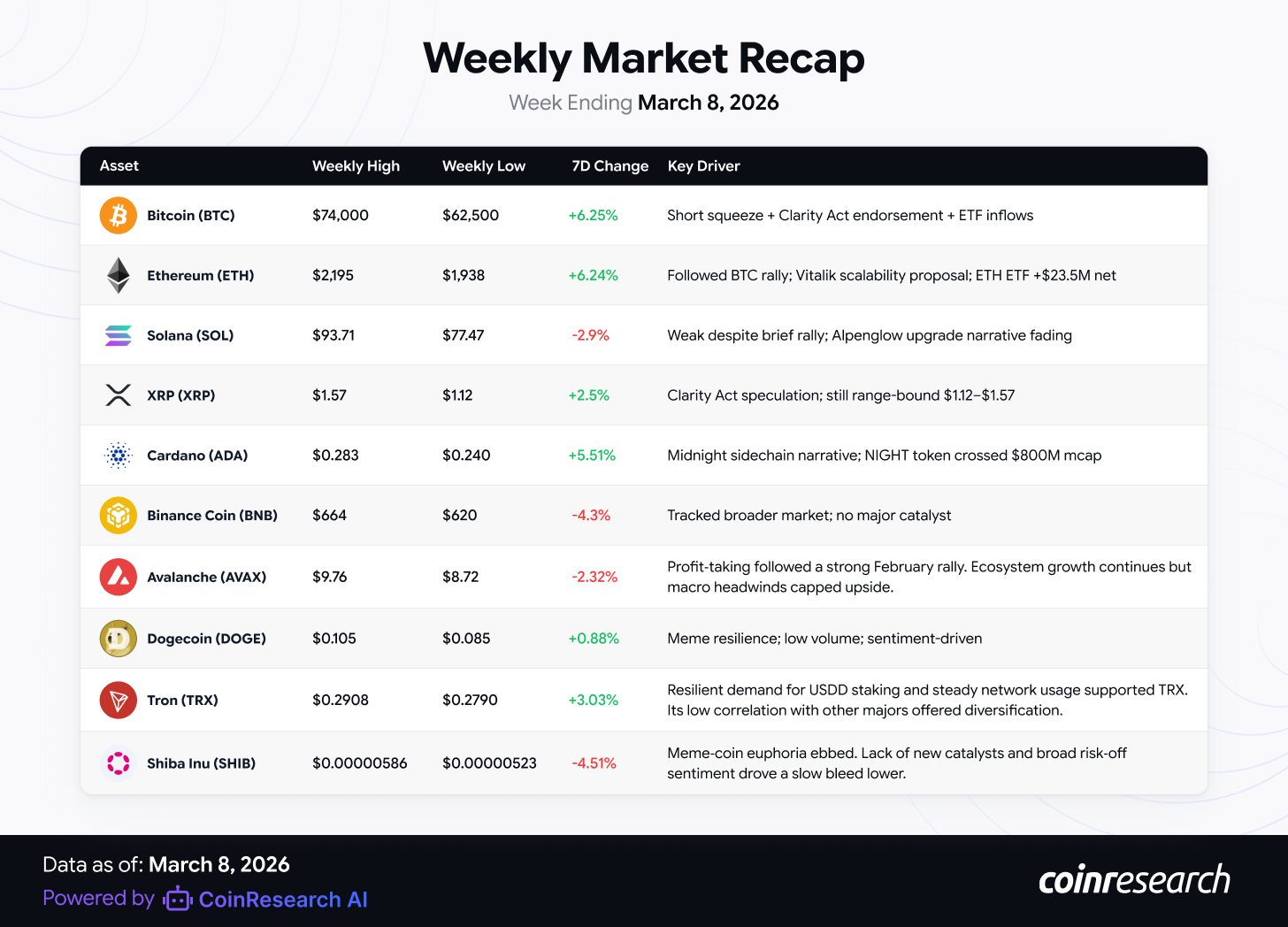
Overall Market Sentiment: Bearish with tactical bullish pockets. The Fear & Greed Index at 12 reflects capitulatory positioning. The $74K rejection and macro headwinds dominate, but the deleveraged state of the market and persistent ETF demand suggest downside may be limited near $60K–$62K support.
AI/ML Model Insight & Market Confluence
CoinResearch AI integrates the Price Prediction Machine-Learning with real-world technical indicators, sentiment data, and macro context.
Below are the latest model outputs for the 2nd week of March, 2026, cross-validated with market structure, momentum, and geopolitical risk assessment.
Disclaimer:
The insights and forecasts presented here are generated by CoinResearch AI’s predictive models and supporting analytics. They are provided for informational and educational purposes only and do not constitute financial advice or investment recommendations. Trading digital assets involves risk, and users should conduct their own research, exercise independent judgment, and use appropriate risk management before making any investment or trading decisions.
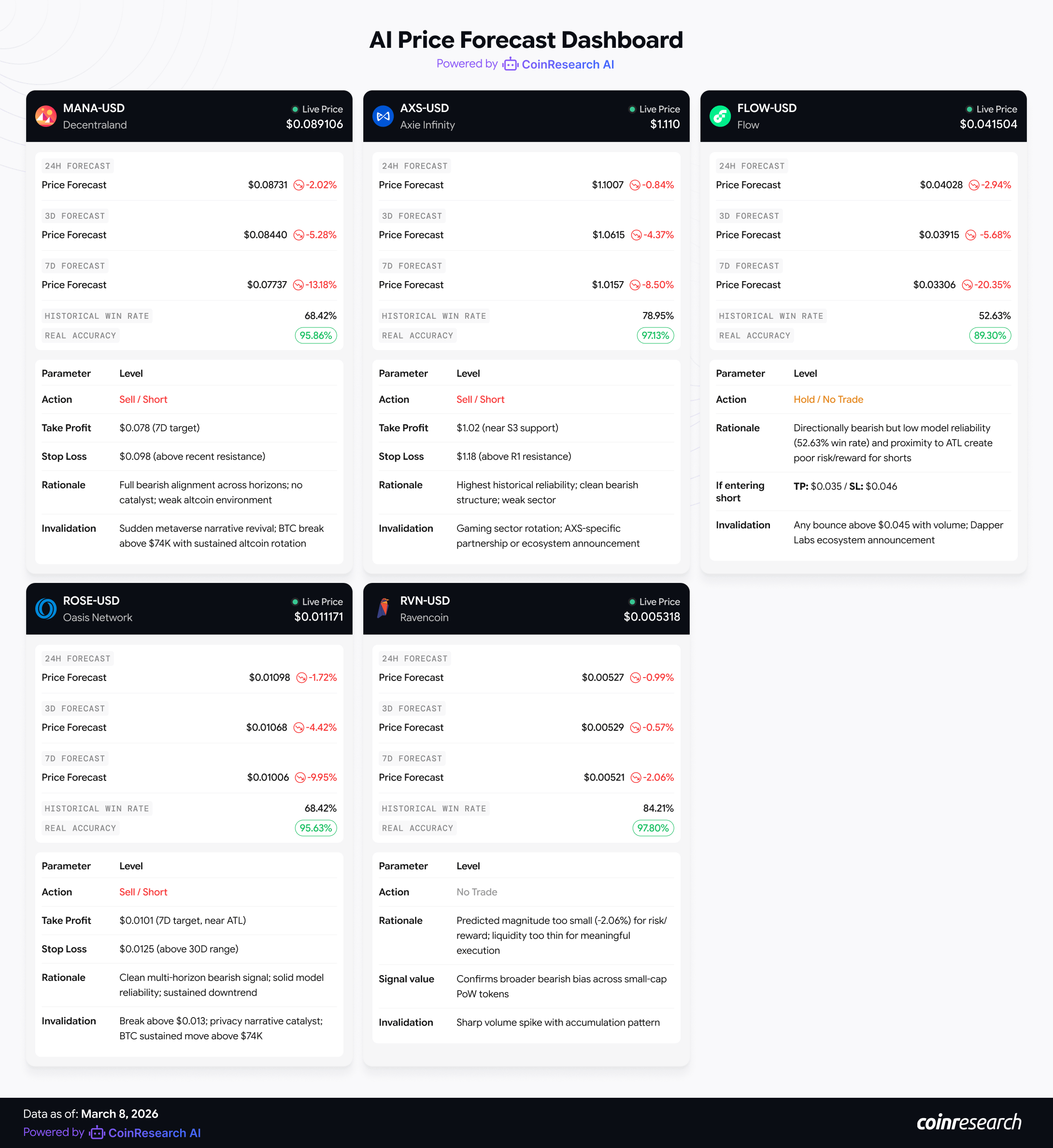
1. MANA (Decentraland)
Ranked #1 by Model Conviction
Model Output:
-
Reference Price: $0.0891
-
1D: -2.02% → $0.08731 | 3D: -5.28% → $0.08440 | 7D: -13.18% → $0.07737
-
Historical Win Rate: 68.42% | Real Accuracy: 95.86%
Market Assessment: MANA currently trades around $0.091, down roughly 2.7% in 24 hours. The metaverse narrative has been dormant for months, with no meaningful catalyst on the horizon. Volume remains thin at $9.8M/24h. The token is down over 96% from its all-time high. In an environment where altcoin breadth is absent and capital is concentrating in BTC, small-cap metaverse tokens face disproportionate downside risk.
Confluence: ✅ Agree with prediction model. The macro backdrop (rising BTC dominance, extreme fear, altcoin weakness) aligns with the bearish prediction. MANA has no near-term catalyst and faces selling pressure from token unlocks and risk-off positioning.
2. AXS (Axie Infinity)
Best Blend of History + Conviction
Model Output:
-
Reference Price: $1.110
-
1D: -0.84% → $1.1007 | 3D: -4.37% → $1.0615 | 7D: -8.50% → $1.0157
-
Historical Win Rate: 78.95% | Real Accuracy: 97.13%
Market Assessment: AXS trades at approximately $1.12 with a market cap of $406 million. The token has been in a grinding downtrend, losing 47.8% over the past year. Key pivot support sits at $1.03 with resistance at $1.15–$1.21. Daily trading volume ($39.7M) is healthy relative to market cap, suggesting active positioning. The gaming/metaverse sector continues to underperform, and AXS faces the same structural headwinds as MANA.
Confluence: ✅ Agree with model. The 78.95% win rate and 97.13% accuracy make this one of the most reliable signals in the set. AXS is technically weak, sitting near multi-year lows with no catalyst. The 7D target of $1.0157 aligns with the S3 support level at $1.03.
3. FLOW (Flow/Dapper Labs)
Most Aggressive Downside Call
Model Output:
-
Reference Price: $0.041504
-
1D: -2.94% → $0.04028 | 3D: -5.68% → $0.03915 | 7D: -20.35% → $0.03306
-
Historical Win Rate: 52.63% | Real Accuracy: 89.30%
Market Assessment: FLOW trades at approximately $0.043, up 3.15% in the past 24 hours with $13.7M in volume. The token is near its all-time low of $0.036 and has a market cap of just $45 million. The 7D prediction of -20.35% would push FLOW dangerously close to its ATL. While the model shows full bearish alignment across all horizons, the 52.63% win rate and 89.30% accuracy are the weakest in the set, well below AXS and RVN.
Confluence: ⚠️ Partial agreement, low conviction. The directional call (bearish) aligns with the macro environment and FLOW’s weak fundamentals. However, the -20.35% 7D target is extreme, and the model’s historical reliability on FLOW is notably lower. Trading near ATL often triggers technical bounces and accumulation. The risk/reward on a short at these levels is unfavorable.
4. ROSE (Oasis Network)
Strong Multi-Horizon Downside
Model Output:
-
Reference Price: $0.011171
-
1D: -1.72% → $0.01098 | 3D: -4.42% → $0.01068 | 7D: -9.95% → $0.01006
-
Historical Win Rate: 68.42% | Real Accuracy: 95.63%
Market Assessment: ROSE currently trades at approximately $0.01135, down 1.81% in 24 hours with a market cap of just $85.6 million. The token hit its all-time low of $0.00988 in December 2025, and the 7D model target of $0.01006 would bring it perilously close to that level. Over the past 30 days, ROSE has declined 16.31%. Privacy and confidential computing narratives have failed to gain traction in the current cycle.
Confluence: ✅ Agree with model. ROSE has been in a sustained downtrend with no catalyst for reversal. The privacy/confidential computing narrative has not captured market attention in 2026. The model’s 95.63% real accuracy provides confidence in the directional call. However, the proximity to ATL ($0.00988) means the absolute downside is limited.
5. RVN (Ravencoin)
Most Trustworthy Asset-Level Signal
Model Output:
-
Reference Price: $0.005318
-
1D: -0.99% → $0.00527 | 3D: -0.57% → $0.00529 | 7D: -2.06% → $0.00521
-
Historical Win Rate: 84.21% | Real Accuracy: 97.80%
Market Assessment: RVN trades at approximately $0.0054, with a market cap of $86.6 million. The token has declined 8.91% over the past 7 days and 57.36% over the past year. Daily volume is extremely thin at $14K, making execution on any meaningful size challenging. The model predicts only modest downside (-2.06% over 7 days), which is well within normal noise for a low-cap asset.
Confluence: ⚠️ Agree directionally, but no actionable trade. The model’s 84.21% win rate and 97.80% accuracy are the highest in the set, but the predicted move (-2.06%) is too small to justify entry after fees and slippage, especially given RVN’s thin liquidity. This is a “confirmation signal” that the broader market remains bearish, not a standalone trade.
Model Summary
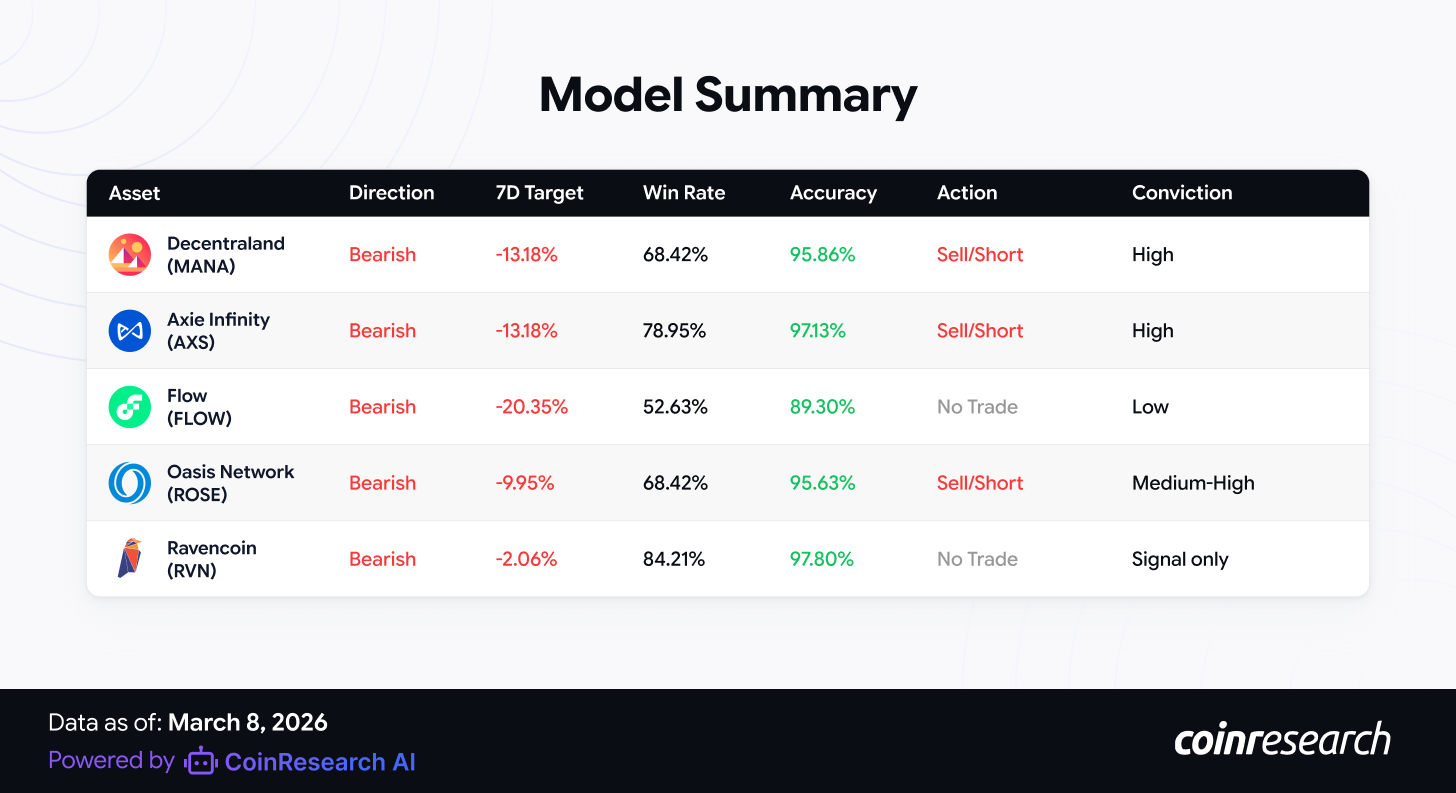
Key takeaway: AXS and MANA offer the cleanest short setups this week. FLOW’s extreme target and low win rate make it a pass despite the aggressive call. RVN confirms the directional bias without offering actionable edge. All five tokens pointing bearish is a strong cross-asset signal that the broader altcoin complex remains under pressure.
Token Launch & Ecosystem Radar
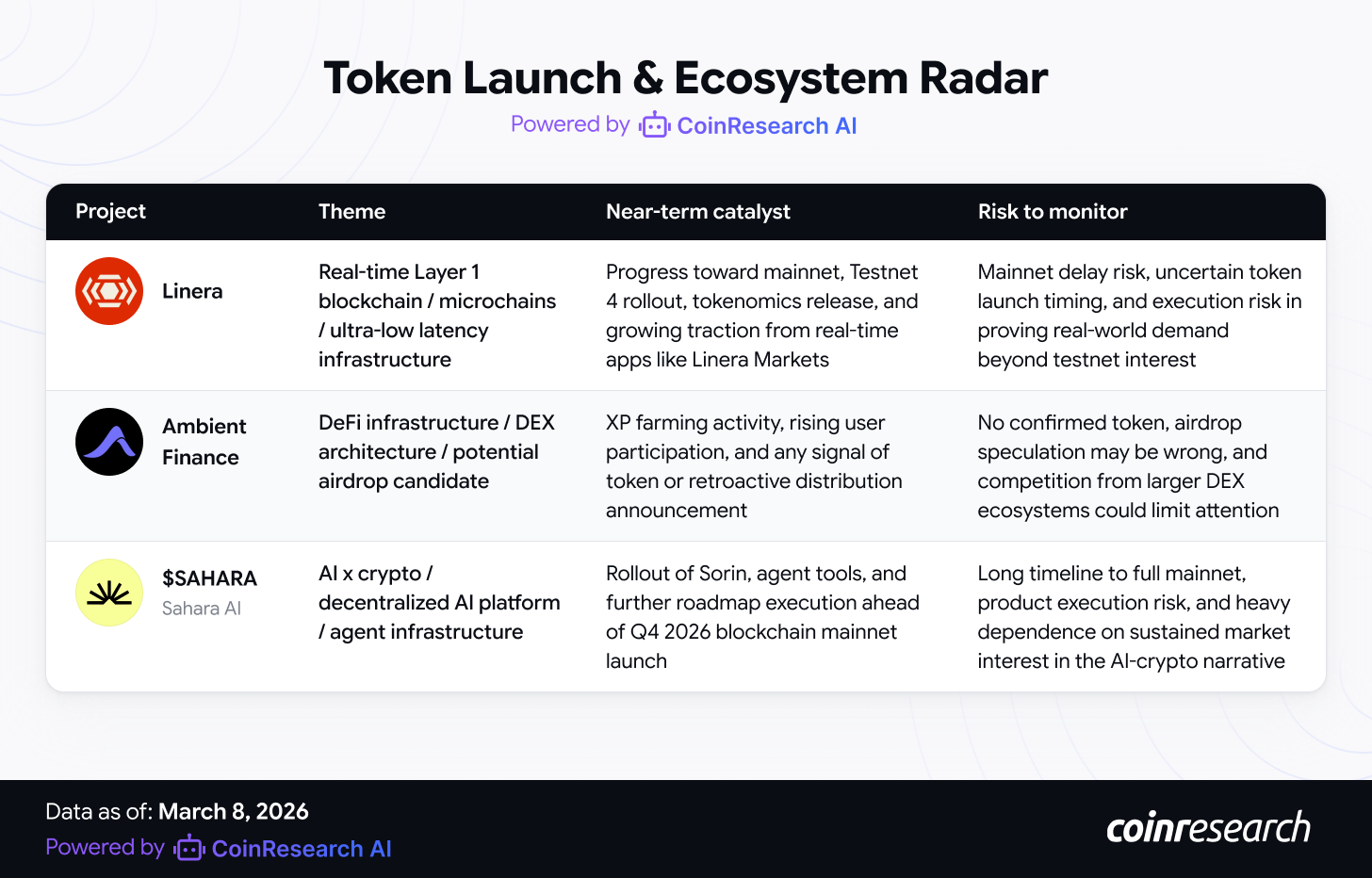
A curated look at three high-signal projects approaching major milestones that have not yet launched their tokens. Each combines strong backers, transparent development, and real execution momentum.
1. Linera, Real-Time L1 Blockchain via Microchains
Linera is a Layer 1 blockchain founded by Mathieu Baudet, former Meta/Libra researcher and co-author of the FastPay protocol. The project introduces “microchains”, lightweight, parallelized chains that enable sub-second latency and theoretically infinite scaling. Backed by $12 million from a16z crypto, Borderless Capital, and Tribe Capital, Linera is currently in its third testnet phase (Conway) with EVM compatibility, WalletConnect integration, and a points program already live.
Why watch: Linera recently launched Linera Markets, a prediction market application with 1-, 3-, and 5-minute rolling crypto markets that demonstrate the chain’s real-time capabilities. The mainnet and token are expected in 2026, and the Meta/Libra pedigree draws inevitable comparisons to Aptos and Sui, both of which command multi-billion dollar valuations. Testnet 4 (preparation for mainnet) is scheduled for late 2025 to early 2026 with finalized tokenomics.
2. Ambient Finance, Zero-Token DEX with Deep Liquidity Innovation
Ambient Finance is a decentralized exchange protocol that runs an entire DEX inside a single smart contract, combining concentrated and ambient constant-product liquidity on any arbitrary token pair. The project has raised $6.5 million and has been live with active trading, but has not confirmed a native token, making it a prime candidate for a retroactive airdrop.
Why watch: The project has implemented an XP farming system (capped at 250 XP per week) that strongly signals a future token distribution. In a market where DEX infrastructure continues to gain institutional attention, especially as Hyperliquid demonstrated explosive volume during geopolitical events this week, Ambient’s single-contract architecture offers gas efficiency and composability advantages. Users farming XP through swaps and liquidity provision are positioning for what could be one of the more significant DeFi airdrops of 2026.
3. Sahara AI, Decentralized AI Platform with Agentic Roadmap
Sahara AI is building a decentralized AI platform where users can create, monetize, and deploy AI models, datasets, and agents. While the $SAHARA token launched on Ethereum and BNB Chain in 2025, the Sahara blockchain mainnet has not yet launched, scheduled for Q4 2026. The project is backed by significant funding and has outlined an ambitious 2026 roadmap.
Why watch: Sahara AI’s Q1 2026 launches include “Sorin,” a personal investment AI agent covering equities, crypto, and commodities, plus a Crypto Agent Evaluation Framework and ClawApp for local AI agent deployment. The mainnet launch will transform $SAHARA into a native gas token with validator staking, governance, and on-chain AI asset registration. The AI-crypto intersection remains one of 2026’s strongest narratives, and Sahara’s focus on agent infrastructure positions it at the center of this convergence. The February 2026 partnership with Centrifuge deploying $100M in tokenized credit through Aave demonstrates the institutional credibility of adjacent projects in this space.
Strategic Recap & Forward Outlook
This week confirmed what many feared and some hoped: the market is structurally fragile but not broken. The $62,500-to-$74,000 round trip revealed two truths simultaneously, the market has deleveraged enough to produce explosive moves on catalyst, but there is not enough sustained demand to hold above resistance.
What the data tells us heading into the week of March 9–15:
-
The $74,000 level is the line in the sand. Bitcoin must reclaim and hold this level to invalidate the bearish midterm-year pattern. Until then, the base case remains a March relief high followed by renewed weakness into April-June, consistent with 2014, 2018, and 2022 analogs.
-
The FOMC meeting looms. The March FOMC decision is the next major macro catalyst. With February payrolls printing negative for the first time in years and unemployment rising, the market will be parsing every word for rate-cut timing. Current expectations have shifted toward potential easing in Q2-Q3 2026.
-
Oil and geopolitics remain the wild card. U.S. crude at $90.75 represents a meaningful inflation impulse that could constrain the Fed’s ability to cut, even if growth deteriorates. Any escalation or de-escalation in the Iran theater will move markets violently in either direction.
-
Altcoin positioning remains unfavorable. With BTC dominance near 59% and climbing, and our model producing uniform bearish signals across all five tracked altcoins, the message is clear: this is not yet the environment for altcoin risk. Capital should remain concentrated in majors or stablecoins until breadth improves.
-
The Fear & Greed Index at 12 is historically contrarian. Extreme Fear readings have historically preceded significant rallies, but only when paired with a catalyst. Without one, Extreme Fear can persist for weeks.
Base case for the coming week: Choppy, range-bound trading between $64,000 and $70,000 for BTC, with directional resolution likely delayed until FOMC. Altcoins continue to underperform. Risk management remains paramount.
Bull scenario: Ceasefire headlines or Fed dovish pivot → rapid re-test of $74K with potential breakout.
Bear scenario: Iran escalation deepens + hot CPI data → break below $62K support → cascade toward $55K–$58K.
No trade is also a trade. In environments like this, preservation of capital is the highest-conviction strategy.
Disclaimer: This publication is for informational and educational purposes only. It does not constitute financial advice, and past model performance does not guarantee future results. Always do your own research (DYOR) and manage risk accordingly.