
Eighty Reclaimed, Sentiment Slips: ETF Whipsaw, the Chair-Transition Window, and the Range That Wouldn’t Resolve | Week Ending May 3, 2026
1. A Range That Closed Higher Than It Opened — Just Barely
Bitcoin reclaimed $80,000 on Sunday for the first time in roughly three months, but the path there did almost nothing to settle the conviction question that has defined April. BTC closed the week at approximately $79,867, only fractionally above last edition’s reference. ETH printed near $2,326 — essentially flat W/W after a midweek dip to $2,244 that followed Powell’s third consecutive rate hold. The week ended with a bullish Sunday print, but the body of the week was a sideways grind in a $75K–$80K box that has now persisted three weeks running.
Three macro currents shaped the tape. The FOMC’s April 28–29 meeting held the federal funds rate at 3.50–3.75% with four dissenters voting for cuts, the most internal dissent at a single meeting since 1992 — a striking signal that Powell’s final policy decision will leave the committee genuinely divided. Iran sent a peace proposal on May 1, oil fell roughly 5% intraweek from a four-year Brent high above $126, and the geopolitical risk premium that had quietly anchored Q1 began to unwind. Spot BTC ETFs whipsawed harder than at any point this year: net outflows of approximately $475.87 million across the four sessions ending April 30 reversed a nine-day inflow streak, only to flip to a single-day inflow of roughly $629.8 million on May 1 as BTC reclaimed the $80K handle. Conviction did not so much return as oscillate.
The Fear & Greed Index registered 40 on Sunday, down from 47 (Neutral) last week — a counterintuitive slip given the Sunday rally, suggesting positioning is reading the breakout as a relief move rather than a regime shift. Counterweighting that caution: whale wallets accumulated approximately 270,000 BTC over the past 30 days, the largest 30-day institutional accumulation since 2013, and exchange BTC reserves now sit at a seven-year low — supply tightening into the rally even as sentiment lags it. The 200-day moving average at $82,228 remains the level the market has not closed above for seven months, and it is also the next test.
Key Themes
-
The range refused to resolve all week and then resolved on the last print. Five of seven sessions traded inside $75K–$80K; Sunday alone broke the upper bound.
-
ETF flows whipsawed from outflow to record inflow in 48 hours. Institutional positioning is being reset week-to-week, not held with conviction.
-
The chair transition window has opened. Powell’s term ends May 15; Kevin Warsh advanced 13–11 through the Senate Banking Committee on April 29.
-
Sentiment lagged price. F&G slipped despite the Sunday breakout — a clean tell that the move surprised positioning rather than confirmed it.

2. Strengths
-
Institutional accumulation is structural, not cyclical. Whale wallets added approximately 270,000 BTC over the past 30 days, the largest 30-day cluster of institutional accumulation since 2013. Exchange BTC reserves continue to make new seven-year lows, the kind of supply tightening that historically precedes — rather than confirms — directional moves. The caveat: large-wallet behavior is not a timing signal, and accumulation can persist for months alongside flat or weak price action.
-
The BTC ETF flow base remains intact even after a bad week. Net outflows of approximately $475.87 million across four sessions ending April 30 reversed a nine-day inflow streak, but the single-day flip to roughly $629.8 million of inflows on May 1 — paired with cumulative AUM still around $100–102 billion — signals that the institutional wrapper continues to absorb dips. April closed as the strongest monthly inflow print of 2026 at approximately $1.97 billion, even with the late-April reversal.
-
The Warsh handoff is being priced as a moderate easing path, not a hawkish reset. Kevin Warsh advanced through the Senate Banking Committee on April 29 with a 13–11 vote, with the full Senate vote expected the week of May 11. Markets are reading the transition as a continuity dovish-leaning replacement rather than a regime change, which keeps the rate-cut path on the table for H2 — supportive for the long-duration risk asset that is BTC. The honest caveat: confirmation timelines slip, and any stumble in the May 11 vote could reintroduce a chair vacuum risk.
-
Geopolitical risk de-escalated. Iran’s May 1 peace proposal sent Brent crude down approximately 5% from its $126.41 four-year high. Oil-driven inflation pressure had been the dominant Q1 risk transmission into rate expectations, and an unwinding of the risk premium frees the Fed to lean more dovish at the June meeting.
3. Weaknesses
-
Sentiment slipped during a rally — that’s the warning. F&G fell from 47 (Neutral) to 40 (Fear) over a week in which BTC closed higher than it opened. Sentiment dropping into a rising tape historically marks the kind of distribution that precedes deeper retests rather than continuation. The Sunday close above $80K may simply have surprised positioning rather than confirmed it.
-
ETF flows are no longer one-way. Spot BTC ETFs printed approximately $475.87 million of net outflows for the four sessions ending April 30 before the May 1 reversal. ETH ETFs ran four consecutive sessions of outflows ending April 30, and YTD ETH ETF flows remain negative at approximately -$413 million despite April being the first net-positive month since October 2025. The bull case requires inflows to be the modal weekly outcome; one-week-on, one-week-off does not yet meet that bar.
-
The 200-day moving average remains the line. BTC’s 200-day moving average sits at approximately $82,228 — a level the market has not closed above for seven months. Sunday’s reclaim of $80K is meaningful as a range break; it is not yet a trend reclaim. A failure at $82,228 would convert the Sunday print into another lower high.
-
DeFi tail risk reasserted itself. A $292 million DeFi exploit on May 2 became the largest single theft of 2026, and Brazil announced a ban on cross-border stablecoin and crypto operations by fintechs. Both items reinforce the narrative that the regulatory and security overhead in the broader ecosystem continues to compound — a structural drag on altcoin risk-taking even when BTC firms.
4. Market Recap: Top 10 Weekly Performance
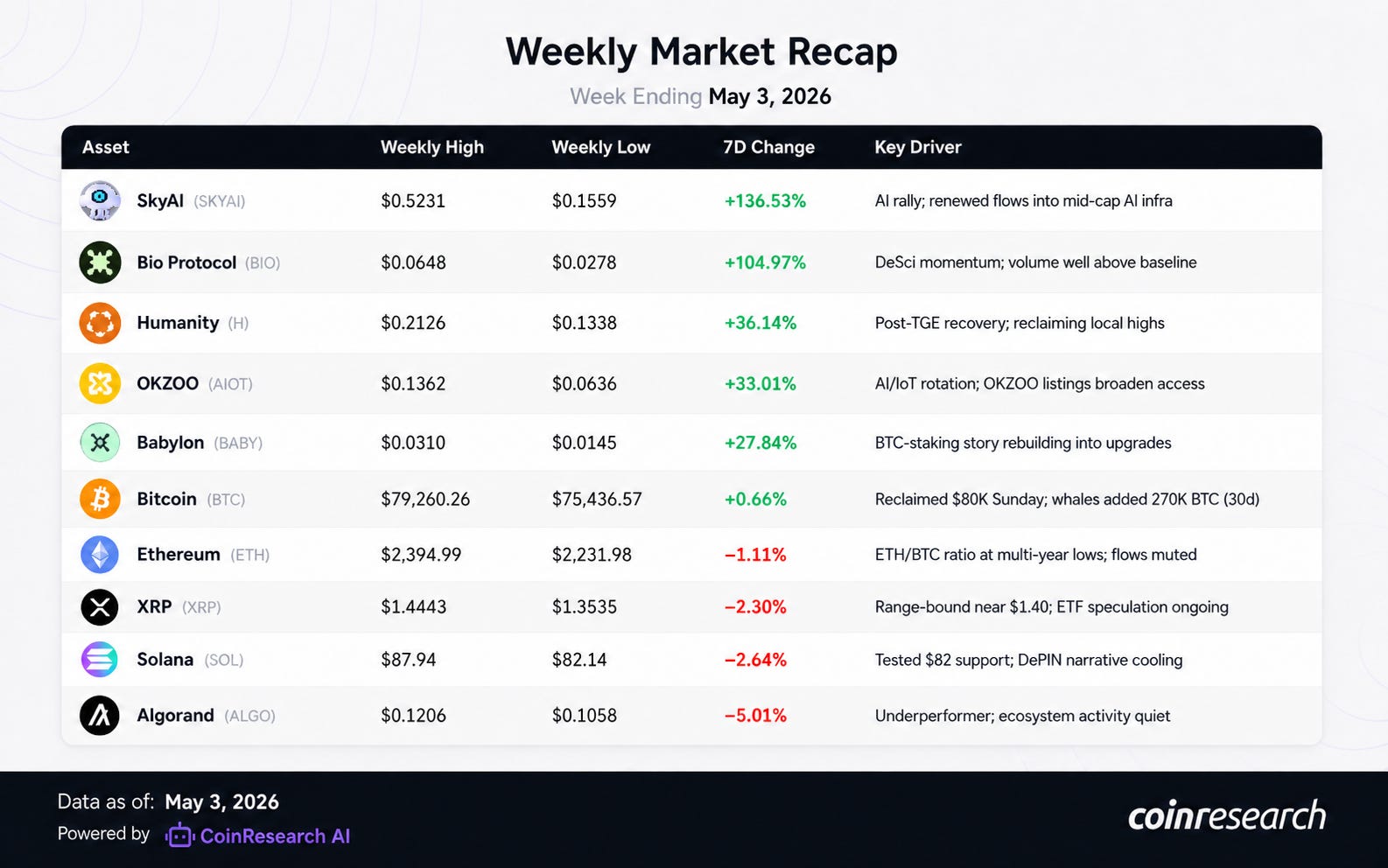
The week split cleanly: large-cap majors flat-to-slightly-up, a sharp dispersion in the long tail. BIO Protocol led the broad-market 7-day tape on a DeSci catalyst; AIOT (OKZOO) and SkyAI posted outsized single-day moves into the weekend. BTC closed near $79,867 (+0.93% W/W). ETH closed near $2,326 (essentially flat W/W). Total market cap printed at approximately $2.633 trillion; BTC dominance held at 58.0%; ETH dominance at 10.5%. Risk appetite favored small-cap dispersion over coordinated large-cap beta — a tape that rewards selectivity, not index exposure.
5. Predictive Analytics & Trade Confluence
Disclaimer: The insights and forecasts presented here are generated by CoinResearch AI’s predictive models and supporting analytics. They are provided for informational and educational purposes only and do not constitute financial advice or investment recommendations. Trading digital assets involves risk, and users should conduct their own research, exercise independent judgment, and use appropriate risk management before making any investment or trading decisions.
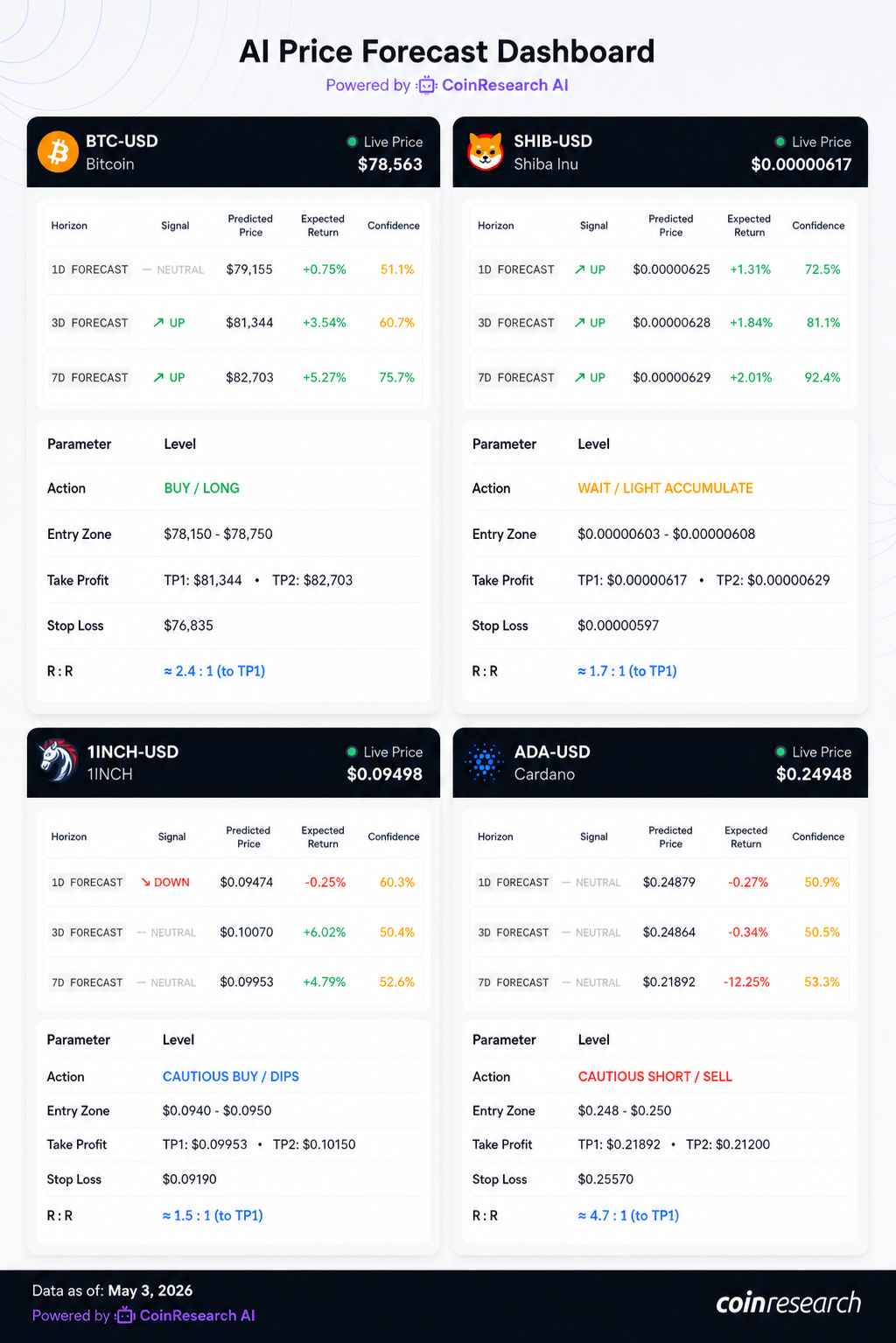
BTC-USD (Bitcoin)
Reference Price: $78,563
Summary: Grade A. The 3D and 7D model heads align directionally to the upside with rising confidence by horizon — the cleanest stack in this week’s spotlight. Tier 1 (high-conviction).
Market Confluence Analysis. The model’s 7D target at $82,703 is meaningful because it sits directly above the 200-day moving average at $82,228 — the level BTC has not closed above in seven months. A 7D UP signal at 75.7% confidence aligning with a recognized technical trigger is exactly the kind of confluence the analyst layer wants to see before sizing into a long. The bullish on-chain backdrop reinforces the setup: 270K BTC accumulated by whales over 30 days, exchange reserves at seven-year lows, and ETF flows already flipping back to inflows on May 1. The risk is the chair transition window — if Warsh’s confirmation slips past May 11, the resulting policy uncertainty could compress positioning before the move completes.
Trade Action.
-
Action: Buy / Long
-
Entry Zone: $78,150–$78,750
-
Take Profit: TP1 $81,344 / TP2 $82,703
-
Stop Loss: $76,835
-
R:R: ≈ 2.4:1 to TP1 from entry midpoint
-
Rationale: Strong 7D UP signal at 75.7% confidence with the 3D/7D model stack aligned to the upside. TP1 is anchored to the 3D model target, giving a favorable reward against an ATR-based stop below $76,835. Social sentiment is supportive at 79% bullish; the middling Galaxy 39 score keeps this as a model-led conviction trade rather than a sentiment-driven chase.
-
Invalidation: Exit if BTC closes below $76,835. If momentum stalls and the upper $79K area cannot be reclaimed after entry, reduce exposure rather than wait for the stop.
SHIB-USD (Shiba Inu)
Reference Price: $0.00000617
Summary: Grade C. Triple UP with rising confidence by horizon — but the 7D upside is only 2.01%, which is the entire problem. Tier 3 (low-magnitude).
Market Confluence Analysis. The directional signal is unambiguous and the confidence stack is unusually high (92.4% at 7D), but the projected magnitude is small. A 2% move over a week does not pay for slippage and execution friction unless the entry is disciplined. The trade is only viable at the lower end of the entry zone, where reward-to-risk improves to the 7D target. The 84% bullish social tilt aligns with the model, but the modest Galaxy 42 score keeps this as a measured accumulation rather than an aggressive entry.
Trade Action.
-
Action: Wait / Light Accumulate near $0.00000605
-
Entry Zone: $0.00000603–$0.00000608
-
Take Profit: TP1 $0.00000617 / TP2 $0.00000629
-
Stop Loss: $0.00000597
-
R:R: ≈ 1.7:1 to TP1 from entry midpoint
-
Rationale: A strong 7D UP signal with very high confidence, but modest upside means the setup only works with a disciplined dip entry and tight ATR-aware risk control. Sentiment is supportive at 84% bullish; the Galaxy 42 score frames this as measured accumulation, not an aggressive chase.
-
Invalidation: If SHIB loses $0.00000597, the tight low-volatility long thesis is invalidated and the trade should be cut quickly. Avoid entry if price runs materially above the stated zone, as the reward-to-risk deteriorates.
1INCH-USD (1INCH)
Reference Price: $0.09498
Summary: Grade C. A 7D tiebreaker long: the classifier reads NEUTRAL, but the regression head projects sufficient upside that the effective direction is UP. Tier 3 (model-led, low social signal).
Market Confluence Analysis. This is the spotlight asset where the analyst layer matters most. The classifier’s neutral read is an honest reflection of weak directional signal in the recent tape; the regression head pulled the effective direction to UP because the projected magnitude (≈4.79% over 7D) is large enough relative to ATR to satisfy the minimum reward-to-risk floor. Critically, social volume is only 40 — meaningfully thin — so the social bullishness is information-poor and the model carries virtually all the decision weight. Treat this as a model-led trade where invalidation is the discipline that protects the thesis.
Trade Action.
-
Action: Cautious Buy / Accumulate on Dips
-
Entry Zone: $0.0940–$0.0950
-
Take Profit: TP1 $0.09953 / TP2 $0.10150
-
Stop Loss: $0.09190
-
R:R: ≈ 1.5:1 to TP1 from entry midpoint
-
Rationale: A 7D tiebreaker long where the regression head projects a sufficiently strong upside to flip effective direction to UP. A wider stop near $0.0919 keeps risk around 3.2%; TP1 at the 7D predicted price offers about 4.8% upside, which clears the minimum R:R floor. Social sentiment reads bullish but volume is only 40 — treat as low-information context with the model carrying decision weight.
-
Invalidation: A clean break below $0.0919 invalidates the long setup and signals the expected 7D rebound is not materializing. If price loses the lower entry band on volume, step aside.
ADA-USD (Cardano)
Reference Price: $0.24948
Summary: Grade C. A 7D tiebreaker short: the classifier reads NEUTRAL, but the regression head projects a large downside move (-12.25% over 7D), so the effective direction is DOWN. Tier 3 (model-led, sentiment-conflicting).
Market Confluence Analysis. This is the second consecutive edition spotlighting ADA on the short side — Edition #26 ran a similar setup with TP1 at $0.22301 and SL at $0.26120. The thesis has not yet played out in price, but the model continues to project material downside on the 7D horizon. The structural read is that ADA sits in the late-cycle alt fade zone: large-cap altcoin without a near-term catalyst, social sentiment positive but increasingly disconnected from price action, and a technical structure that has failed to reclaim recent swing highs. The 84% bullish social tilt actively conflicts with the short thesis, which is precisely why position sizing should remain conservative.
Trade Action.
-
Action: Cautious Short / Sell
-
Entry Zone: $0.248–$0.250
-
Take Profit: TP1 $0.21892 / TP2 $0.21200
-
Stop Loss: $0.25570
-
R:R: ≈ 4.7:1 to TP1 from entry midpoint
-
Rationale: A 7D tiebreaker short where the regression head projects a large downside move, making the effective direction DOWN. A wider ATR-aware stop above $0.2557 keeps risk near 2.5%; TP1 at the model’s 7D target offers reward well above the 1.5:1 floor. Social sentiment is bullish (84% positive, Galaxy 36), which conflicts with the short and lowers conviction — sizing should stay conservative.
-
Invalidation: Exit if ADA closes decisively above $0.2557, which would negate the near-term downside structure. If momentum stalls and price reclaims the upper ATR band, the regression-led short thesis weakens.
6. Token Launch & Ecosystem Radar
A curated look at three high-signal projects approaching major milestones that have not yet launched their tokens.
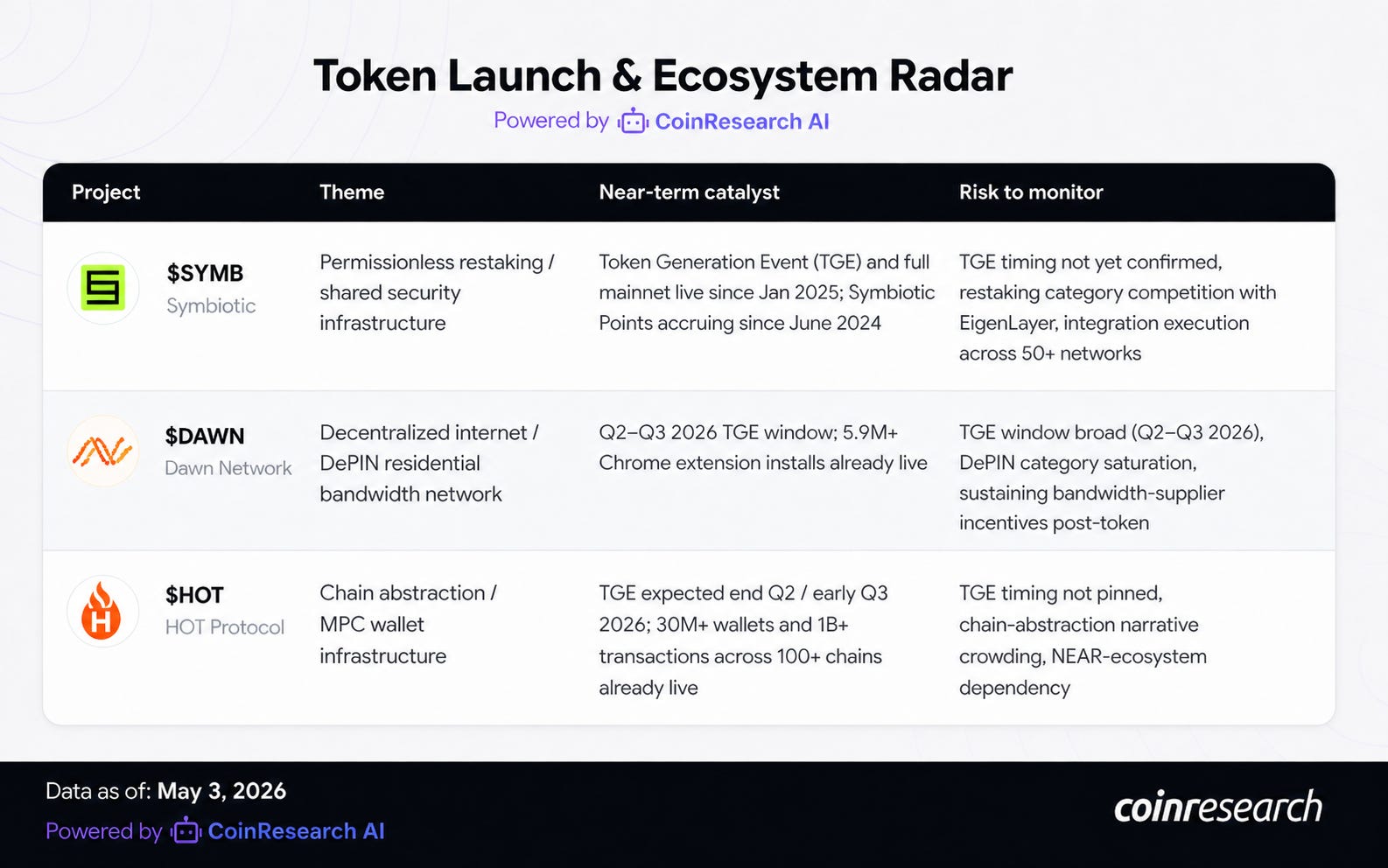
Symbiotic ($SYMB) — Permissionless, asset-agnostic shared security and restaking protocol.
-
Why watch it: Symbiotic has raised approximately $34.8 million across two rounds — a $5.8 million seed co-led by Paradigm and cyber Fund, and a $29 million Series A led by Pantera Capital with Coinbase Ventures participating. By late 2025, over 50 networks had integrated or were onboarding, including Hyperlane, Avail, Ethena, Frax, Manta Pacific, and EtherFi. Mainnet went live in January 2025 and the Symbiotic Points program has been accruing for users since June 2024 — strongly hinting at conversion to a future token.
-
Current Status: Pre-TGE. No native token yet; if you see a “SYM” or similar ticker on exchanges today it is a different project. Tokenomics, supply, and exact TGE timing remain unannounced.
-
Monitoring Rationale: Symbiotic is the asset-agnostic counterweight to EigenLayer in the restaking design space — supporting any ERC-20 (LSTs, stablecoins, governance tokens) as collateral, with non-upgradeable core contracts that minimize governance risk. The “External Rewards” mechanism launched in August 2025 is already proving that networks will pay in their own tokens for shared security, which strengthens the eventual TGE thesis.
Dawn Network ($DAWN) — Solana-based decentralized internet infrastructure built on shared residential bandwidth.
-
Why watch it: Dawn has raised approximately $48.5 million from Polychain, Dragonfly, ParaFi, Robot Ventures, CMT Digital, and Wintermute — a tier-one DePIN backer roster. The Chrome extension has crossed 5.9 million downloads, providing a real, observable user base ahead of TGE rather than a paper roadmap. The January 2026 AMA confirmed mainnet within six months, framing the Q2–Q3 2026 token launch window.
-
Current Status: Pre-TGE. Tokenomics disclosure is expected in Q2 2026 with 25% of the 1 billion supply earmarked for community node operators. No exchange listings yet announced.
-
Monitoring Rationale: DePIN is one of the few narratives still attracting tier-one capital in 2026 even after the late-2025 retracement. Dawn fits the narrative profile that has worked in this cycle — usable product before token, large institutional backing, and a tokenomic structure that materially rewards the contributing user base.
-
Why watch it: HOT Wallet has processed over 1 billion transactions across 30 million-plus wallets, making it one of the most active pre-TGE ecosystems in Web3. Built on NEAR’s Chain Abstraction with MPC-based decentralized signing, the wallet operates as both a Telegram Mini-App and a standalone mobile app, supporting EVM chains, TON, Solana, and TRON natively. The full product suite — HOT Wallet, HOT Exchange (HEX), HOT Pay, HOT Bridge — gives the eventual token meaningful day-one utility.
-
Current Status: Pre-TGE. The TGE is officially targeted for end of Q2 or early Q3 2026, with token conversion ratios from mining points still pending. Pre-TGE mining via timed cycles is currently active.
-
Monitoring Rationale: Chain abstraction is one of the strongest UX narratives heading into the next cycle, and HOT is the deepest production case study so far — distribution is already in place, transaction volume is real, and the launch itself is the catalyst rather than the start of the product. The launch will test whether wallet-as-coordination-layer commands a different valuation regime than wallet-as-feature.
7. Strategic Recap & Forward Outlook
The Sunday reclaim of $80,000 is meaningful as a range break and not yet meaningful as a trend reclaim. The 200-day moving average at $82,228 is the line that converts this week’s print from a relief rally into a regime change, and the chair-transition window plus the Strategy earnings calendar will determine whether positioning has the conviction to take it. The most honest read: institutional accumulation is structural, ETF flows have flipped back, and macro risk is de-escalating — but sentiment slipped during the rally, which is the kind of divergence that historically precedes retests rather than continuation. Position for the BTC long with the discipline of a structural setup, not the urgency of a breakout. Risk posture: constructive with tight invalidation. Watch for: a daily close above $82,228 to upgrade the thesis, or a loss of $78,000 with conviction selling to revert to range.
Forward Outlook — Week of May 4–10
Macro Watch. Strategy reports Q1 earnings on May 5 — a critical signal on whether Saylor continues BTC accumulation or pauses, given the firm’s recent announcement of a temporary halt before the print. The Senate full-floor vote on Kevin Warsh is expected the week of May 11; any procedural delay reintroduces chair-vacuum risk into rate expectations. Powell’s term ends May 15, making this his final policy-shaping week. The CLARITY Act continues to advance through the Senate. CPI prints later in May, but this week is dominated by the Fed transition and corporate earnings.
BTC Key Levels. Resistance: 200-day moving average at approximately $82,228 (untouched seven months); above that, $85,000 round number. Support: $78,000 (lower entry zone of this week’s spotlight); below that, $75,000 range floor that held three consecutive weeks; structural break level at $73,500.
Altcoin Outlook. DeSci continues to attract rotational capital following BIO Protocol’s run. DePIN narratives remain bid into the Dawn Network mainnet runway. AI tokens divergent — large-caps fading, small-caps with single-day moves on individual catalysts. Memecoins ex-DOGE remain weak; DOGE whale accumulation now at a record 108.52 billion held by top wallets, but price action has not yet confirmed the on-chain bid.
Disclaimer: This analysis is for informational purposes only and should not be construed as investment advice. Cryptocurrency markets carry substantial risk, including the potential loss of principal. Past performance does not guarantee future results. Always conduct your own due diligence and consult a qualified financial advisor before making investment decisions